
Toothache is pain in or around a tooth, most often caused by tooth decay, a dental abscess, a cracked tooth, a damaged filling or gum disease. Over-the-counter painkillers such as ibuprofen or paracetamol (acetaminophen) can ease it for a short time, but a toothache that lasts more than 2 days, keeps coming back or comes with fever or swelling needs a dentist, because most causes do not heal on their own.
Source: NHS, Cleveland Clinic
Contents
- What is a toothache?
- Toothache symptoms and what the pain can mean
- 7 common causes of toothache
- When the pain is not from the tooth
- Toothache relief at home
- Painkillers: what the evidence says
- When a toothache is an emergency
- How a dentist diagnoses and treats the cause
- How to prevent tooth pain
- Frequently asked questions
What is a toothache?
A toothache is any pain felt in or around a tooth. Mild cases sometimes come from temporary gum irritation, for example after food gets stuck between teeth, and settle within a day or two. More severe or lasting pain usually means a problem inside the tooth or in the tissues that hold it, such as a cavity, an infection or a crack, and these problems do not resolve without treatment.
Source: Cleveland Clinic
The dental problems behind toothache are extremely common. The World Health Organization estimates that oral diseases affect about 3.7 billion people, and untreated decay in permanent teeth is the single most common health condition worldwide. In the United States, the CDC reports that about 1 in 5 adults aged 20 to 64 (21%) has at least one untreated cavity.
Inside every tooth is the pulp, a soft core of nerves and blood vessels surrounded by hard dentin and, on the crown, by enamel. When decay, cracks or repeated dental work let bacteria or irritation reach the pulp, it becomes inflamed, a condition dentists call pulpitis. Because the pulp sits inside rigid walls, swelling has nowhere to go, which helps explain why an inflamed tooth can hurt so much.
Source: MSD Manual Professional
Toothache symptoms and what the pain can mean
Toothache can feel different depending on its cause, and the pattern of pain is one of the first things a dentist asks about. Cleveland Clinic describes several common patterns:
- Sharp, jabbing pain, often when biting, which can point to a cavity, a cracked tooth or a problem with a filling or crown.
- A dull, constant ache, which may come from an infected tooth or from grinding your teeth at night.
- Throbbing pain, which can mean infection has reached the pulp.
- Sensitivity to hot and cold, which has several possible causes; if it fades quickly, worn enamel is one possibility.
- Other signs such as swollen gums, headache, fever, chills, bad breath or a bad taste in the mouth.
Source: Cleveland Clinic
Pain that stops quickly vs pain that lingers
How long the pain lasts after a trigger matters. In reversible pulpitis, pain caused by something cold or sweet stops within about 1 to 2 seconds once the trigger is removed, and the nerve can usually be saved by removing the decay and placing a filling. In irreversible pulpitis, pain starts on its own or lingers for minutes after a stimulus (usually heat, less often cold), and people may struggle to tell which tooth hurts. The pain can then ease for several days as the nerve dies, which is not a sign of healing: a dead pulp no longer reacts to hot or cold but often hurts when the tooth is tapped or bitten on.
Source: MSD Manual Professional
Pain on biting and release
A toothache with erratic pain when chewing, especially at the moment you release your bite, is a classic sign of a cracked tooth. Pain when biting down, with a tooth that feels “high,” is also typical once infection has spread beyond the root tip.
Source: American Association of Endodontists, MSD Manual Professional
The table below summarizes these patterns, but you cannot know the exact cause of a toothache without a dental examination.
Source: Cleveland Clinic
| Type of pain | Possible cause | Usual dental treatment |
|---|---|---|
| Brief twinge with cold or sweet, gone in seconds | Early decay, worn enamel, exposed root, reversible pulpitis | Filling, fluoride, desensitizing toothpaste |
| Sharp pain on biting or on release | Cavity, cracked tooth, broken filling or crown | Filling, crown, root canal if the pulp is involved |
| Lingering or spontaneous pain, worse at night | Irreversible pulpitis | Root canal treatment or extraction |
| Constant throbbing, swelling, bad taste, fever | Dental abscess (infection) | Drainage, root canal or extraction; antibiotics only if infection spreads |
| Dull ache in several teeth and jaw, often on waking | Teeth grinding (bruxism) | Protective night guard |
| Toothache with a blocked nose and pressure in the cheeks | Sinusitis | Treat the sinus problem; dental check to rule out a tooth cause |
Source: Cleveland Clinic, MSD Manual Professional, ADA MouthHealthy: Sensitive teeth, MedlinePlus (NIH), NHS: Sinusitis
7 common causes of toothache
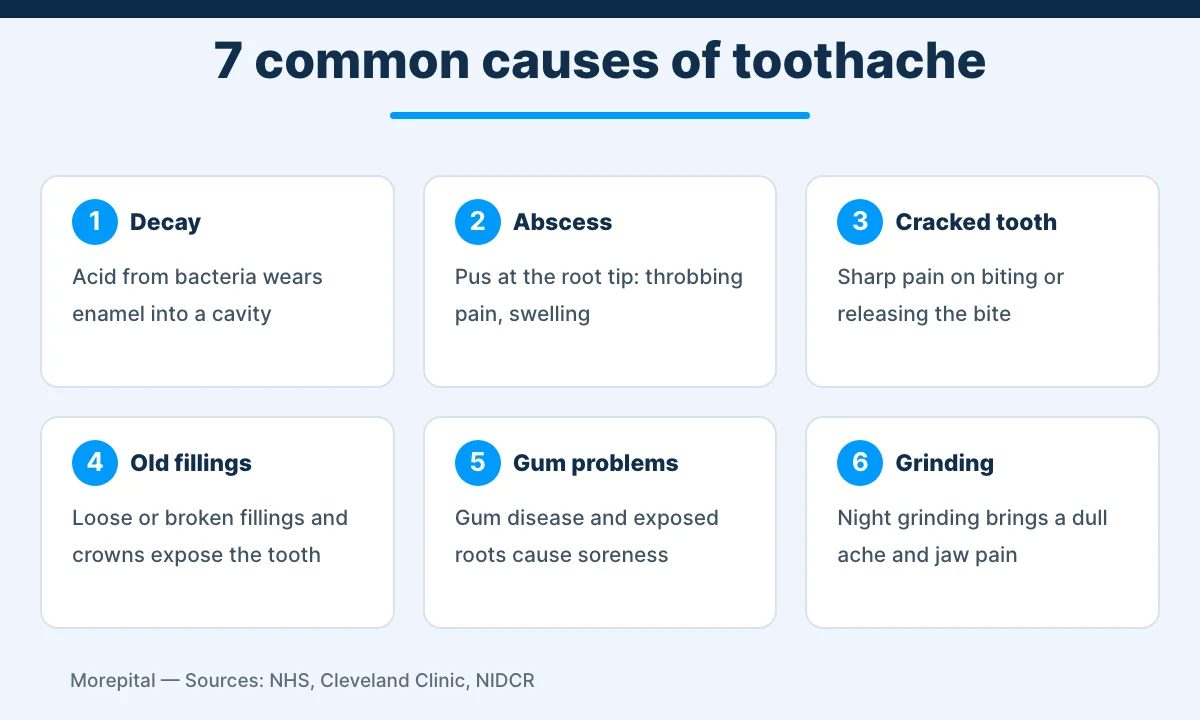
1. Tooth decay (cavities)
Decay starts when mouth bacteria turn sugars and starches into acid, which strips minerals from the enamel. An early white spot can still be reversed with saliva and fluoride, but if mineral loss continues, the enamel breaks down into a cavity. Early decay usually causes no symptoms; as it deepens, it brings sensitivity to sweets, heat or cold and eventually toothache.
Source: NIDCR (NIH)
2. Dental abscess
If decay or a crack lets bacteria reach the pulp, infection can spread to the tip of the root and form a pocket of pus, called an abscess. This typically causes severe pain, facial swelling and sometimes fever. Read our guide to tooth abscess symptoms and treatment for more detail. Left untreated, infection from upper teeth can spread toward the sinuses, and from lower teeth into the floor of the mouth and neck.
Source: NIDCR (NIH), MSD Manual Professional
3. A cracked or broken tooth
Cracks range from harmless craze lines in the enamel to a crack running toward the root or a tooth split into pieces. Unlike broken bone, cracks in teeth do not heal and may grow, so early diagnosis gives the best chance of saving the tooth. A crack that extends below the gum line generally means the tooth cannot be saved.
Source: American Association of Endodontists
4. A loose or damaged filling or crown
Old fillings wear, and fillings or crowns can loosen or break, exposing the tooth underneath. This often produces sharp pain on biting or sensitivity to temperature, and worn fillings are a recognized cause of sensitive teeth.
Source: NHS, Cleveland Clinic, ADA MouthHealthy: Sensitive teeth
5. Gum disease and exposed roots
Gum disease can make the area around a tooth sore, and receding gums expose the root surface, which has no enamel and reacts to hot, cold and sweet. Gum problems are among the causes the NHS and Cleveland Clinic list for toothache.
Source: NHS, Cleveland Clinic, ADA MouthHealthy: Sensitive teeth
6. Teeth grinding (bruxism)
Clenching or grinding, often during sleep, can cause a dull, constant ache, jaw pain and worn teeth. Our page on bruxism explains the causes and how a night guard protects the teeth.
Source: Cleveland Clinic, MedlinePlus (NIH)
7. Wisdom teeth
A wisdom tooth that has broken through the gum but lacks room to come through fully can become infected and painful at the back of the mouth. If a wisdom tooth keeps flaring up, see our guide to wisdom teeth removal.
Source: NHS
When the pain is not from the tooth
Not every toothache starts in a tooth. MedlinePlus notes that pain can be referred from elsewhere, such as an earache, a sinus infection, an injury to the jaw or mouth, or even a heart attack. In these cases a dentist may find nothing wrong with the teeth, and you may need your primary care doctor instead.
Source: MedlinePlus (NIH)
Sinusitis is a common example: the NHS lists toothache among its symptoms, alongside a blocked or runny nose, pain, swelling and tenderness around the cheeks, eyes or forehead, headache and bad breath. Because the roots of the upper teeth lie close to the sinuses, it can be hard to tell the two apart yourself, so a dental check is still sensible to rule out decay or infection.
Source: NHS: Sinusitis
Jaw pain that comes with chest discomfort, shortness of breath, cold sweats, nausea or pain in the arms, back or neck may be a heart attack, not a dental problem. Call emergency services straight away, even if you are not sure.
Source: MedlinePlus (NIH), MedlinePlus: Heart attack
Toothache relief at home
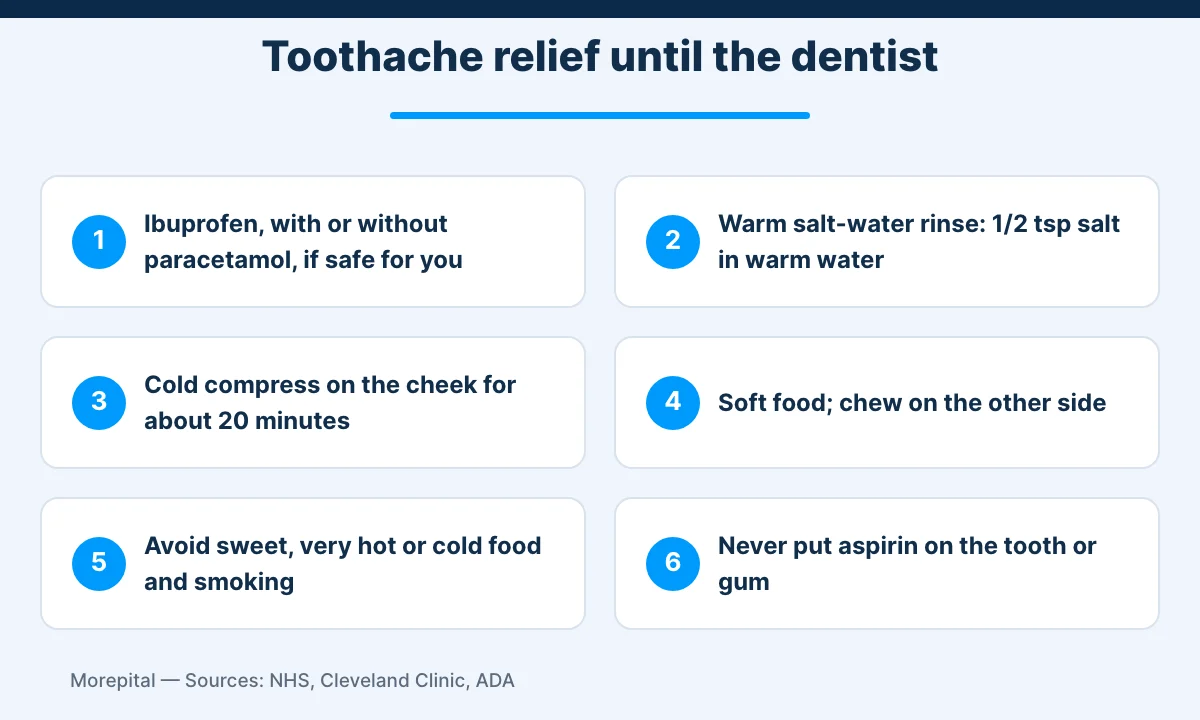
Home measures cannot fix the cause of a toothache, but they can make the wait for a dental appointment easier. The NHS and Cleveland Clinic recommend:
- Warm salt-water rinses: dissolve half a teaspoon of salt in a glass of warm water (about 8 oz or 240 ml), swish for around 30 seconds and spit it out. Children should not try this.
- A cold compress: hold an ice pack wrapped in a cloth against the outside of the cheek or jaw for about 20 minutes, several times a day.
- Soft food: choose foods like yogurt or scrambled eggs and chew on the other side.
- Gentle cleaning: use a soft toothbrush. Rinse with warm water, and if food is trapped, try gentle flossing to dislodge it; the NHS suggests not flossing around a tooth that is already sore.
- Avoid triggers: sweet, very hot and very cold food and drinks, and smoking, which can make dental problems worse.
Source: NHS, Cleveland Clinic, ADA MouthHealthy
The American Dental Association warns against one popular myth: do not put aspirin on the aching tooth or gum tissues. The American Association of Endodontists gives similar advice for cracked teeth and suggests biting on clean, moist gauze for comfort until you can see a dentist.
Source: ADA MouthHealthy, American Association of Endodontists
Painkillers: what the evidence says
In February 2024 the American Dental Association published a clinical practice guideline, developed with the University of Pittsburgh and the University of Pennsylvania and funded by the FDA, on managing acute dental pain. It recommends nonsteroidal anti-inflammatory drugs (NSAIDs) such as ibuprofen or naproxen, alone or combined with acetaminophen (paracetamol), as the first-line treatment for adults and adolescents aged 12 and over, including for a toothache when same-day dental care is not available.
Source: ADA News (2024 guideline), American Dental Association
The ADA summary cites an overview of systematic reviews that found 400 mg of ibuprofen combined with 1,000 mg of acetaminophen relieved dental pain better than any opioid-containing combination, with fewer side effects. Opioids are reserved for cases where first-line medicines are not enough or NSAIDs cannot be used, and the guideline advises against “just in case” opioid prescriptions.
Source: American Dental Association, ADA News (2024 guideline)
Using ibuprofen safely
For adults, the NHS advises 200 mg ibuprofen tablets at 1 or 2 tablets up to 3 times a day, at least 4 hours apart and no more than 6 tablets in 24 hours, ideally with or after food. Check with a pharmacist or doctor first if you have had a stomach ulcer, asthma, heart, liver or kidney disease, a bleeding disorder or a stroke, if you are pregnant, or if you take blood thinners, steroids or blood pressure medicines. Do not combine ibuprofen with other NSAIDs such as naproxen or aspirin, and children under 16 should not take aspirin at all.
Source: NHS: Ibuprofen for adults, NHS
Why antibiotics are usually not the answer
Many people expect antibiotics for toothache. The ADA’s 2019 guideline recommends against antibiotics for most nerve and root-tip conditions, including irreversible pulpitis and a localized abscess, in adults with a normal immune system. What relieves the pain is treating the source, for example cleaning out the infected pulp, plus over-the-counter pain relievers if needed. Antibiotics are advised when infection spreads and causes fever or feeling generally unwell. Cleveland Clinic adds that medicines alone only ease symptoms temporarily, and infections return unless the cause is treated.
Source: ADA: Antibiotic stewardship, Cleveland Clinic
When a toothache is an emergency
See a dentist about your toothache as soon as you can if any of the following apply:
- the toothache lasts more than 2 days;
- the pain does not improve with painkillers;
- you have a high temperature, pain when biting, red gums or a bad taste in your mouth;
- your cheek or jaw is swollen;
- it hurts to open your mouth wide, or you also have an earache.
Source: NHS, Cleveland Clinic, MedlinePlus (NIH)
Go to an emergency department, or call an ambulance, if you have swelling around your eye or neck, or swelling in your mouth or neck that makes it hard to breathe, swallow or speak. Cleveland Clinic also lists swelling below the eye or a knot on the jaw, severe pain that medicine does not relieve, bleeding that will not stop with pressure, and a fever above 101°F (38.3°C). A toothache with fever and chills is a dental emergency. Do not drive yourself; ask someone to take you.
Source: NHS, Cleveland Clinic
In the UK, the NHS advises calling your own dentist first, even out of hours, and using NHS 111 if you have no dentist or cannot get an emergency appointment. GPs cannot provide dental treatment.
Source: NHS
How a dentist diagnoses and treats the cause
Diagnosis
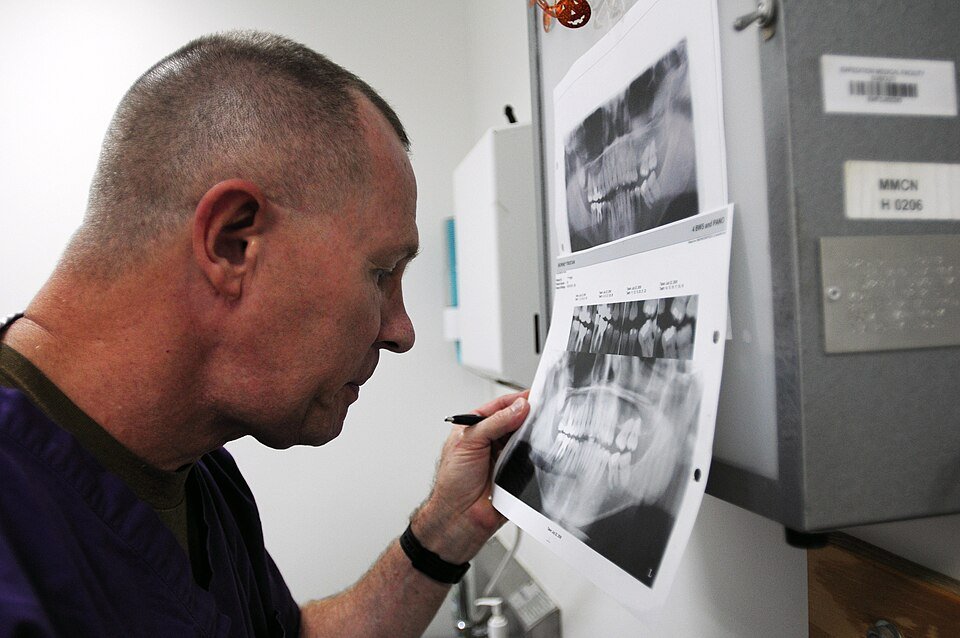
The dentist will examine your teeth, gums, tongue and throat and may check your ears, nose and neck. Expect questions about when the pain started, where it is, how severe it is, whether it wakes you at night, what makes it better or worse, any injury, your medicines and your last checkup. Dental X-rays show what is happening beneath the gums and around the roots.
Source: MedlinePlus (NIH), Cleveland Clinic
Simple tests help pinpoint the tooth: applying cold or heat, tapping on the tooth and, sometimes, an electric pulp test that shows whether the nerve is still alive.
Source: MSD Manual Professional
Treatment options
Treatment for toothache depends on the cause:
- Filling: for a small cavity or chip.
- Crown: a cap covering the whole tooth for large cavities, fractures or a weakened tooth.
- Root canal treatment: when bacteria reach the pulp, the inflamed nerve and tissue are removed, the canals cleaned and filled, and a crown is usually placed. Our page on root canal treatment explains each step.
- Extraction: for a tooth too damaged to save.
- Desensitizing treatment or a night guard: for sensitivity from exposed roots or for grinding.
Source: Cleveland Clinic, MedlinePlus (NIH), ADA MouthHealthy: Sensitive teeth
Small chips or worn edges that trigger sensitivity can sometimes be repaired with tooth-colored resin, a technique covered in our article on dental bonding. If a tooth has to be removed, it can be replaced with a bridge, a denture or an implant. Patients who choose to travel for replacement teeth can read our guide to dental implants in Turkey, but any active infection and pain should be treated promptly by a local dentist first.
Source: Cleveland Clinic, American Association of Endodontists
How to prevent tooth pain
Not every toothache can be prevented, but most are caused by decay and gum disease, which daily habits can reduce. The NHS, Cleveland Clinic and NIDCR agree on the basics:
- brush twice a day for about 2 minutes with a fluoride toothpaste and a soft-bristled brush;
- clean between your teeth every day with floss or interdental brushes;
- keep sugary foods and drinks to occasional treats at mealtimes and limit frequent snacking;
- avoid tobacco, including smokeless tobacco;
- have regular dental checkups and professional cleanings, so problems are found before they hurt;
- ask your dentist about fissure sealants and fluoride treatments, especially for children;
- tell your dentist if you grind your teeth, so they can protect them.
Source: NHS, NIDCR (NIH), Cleveland Clinic, MedlinePlus (NIH)
Toothache: frequently asked questions
Can a toothache go away on its own?
Pain from temporary gum irritation often settles within a day or two. Pain from a cavity or abscess may come and go but does not disappear fully, and a nerve that stops hurting may simply have died. See a dentist if the pain lasts more than 2 days.
Source: Cleveland Clinic, MSD Manual Professional, NHS
What is the best painkiller for toothache?
For adults and teenagers over 12, ADA guidance recommends an NSAID such as ibuprofen, alone or combined with acetaminophen (paracetamol), as the first choice. Check it is safe for you and follow the pack dose.
Source: ADA News (2024 guideline), NHS: Ibuprofen for adults
Why is toothache worse at night?
Pain that wakes you at night is something dentists ask about specifically, and spontaneous pain that lingers is typical of an inflamed nerve (irreversible pulpitis), which usually needs root canal treatment or extraction.
Source: MedlinePlus (NIH), MSD Manual Professional
Will antibiotics cure a toothache?
Usually not. ADA guidance recommends against antibiotics for most tooth-nerve and root-tip problems; the cause has to be treated by a dentist. Antibiotics are used if infection spreads and causes fever or malaise.
Source: ADA: Antibiotic stewardship
Should I go to my doctor or a dentist for toothache?
A dentist, in almost all cases. In the UK, the NHS notes that GPs cannot give dental treatment. See a doctor if the pain may be coming from elsewhere, such as the sinuses or ears.
Source: NHS, MedlinePlus (NIH)
Can I put aspirin on the gum for toothache?
No. Do not put aspirin directly on the tooth or gum; the ADA warns against it. Safer home measures include warm salt-water rinses, a cold compress and soft food until you see a dentist.
Source: ADA MouthHealthy, NHS
When is a toothache an emergency?
Go to an emergency department if swelling reaches your eye or neck, or if you struggle to breathe, swallow or speak. A toothache with fever and chills also needs urgent care.
Source: NHS, Cleveland Clinic
Disclaimer: this article is for general health education and does not replace advice from a qualified doctor who can assess your individual case. Last updated: October 2026.