
Wisdom teeth removal is a common minor operation to take out one or more third molars, the last teeth at the back of the mouth, when they are impacted, partly erupted or causing pain, infection, decay or cysts. It is usually done under local anesthetic in a dental chair, often takes from a few minutes up to about 40 minutes, and most people are back to normal activities within a few days, with full healing over roughly two weeks or longer.
Source: NHS, Cleveland Clinic
Contents
- What wisdom teeth are and why they cause problems
- When is wisdom teeth removal needed?
- Removing healthy wisdom teeth: what the evidence says
- Before surgery: assessment, X-rays and anesthesia
- The wisdom teeth removal procedure step by step
- Wisdom teeth removal recovery day by day
- What to eat after wisdom teeth removal
- Dry socket and other risks of wisdom teeth removal
- When to call your dentist
- Wisdom teeth removal: frequently asked questions
What wisdom teeth are and why they cause problems

Wisdom teeth, or third molars, are the four teeth at the very back of the mouth, one in each corner of the upper and lower jaw. They are the last teeth to come through. The American Dental Association and MedlinePlus place their usual arrival between ages 17 and 21, while Cleveland Clinic gives a wider range of 17 to 25. Some people have all four, others have fewer or none at all, and both are considered normal variation.
Source: American Dental Association (MouthHealthy), MedlinePlus (NIH), Cleveland Clinic
Because they arrive last, there is often not enough room left in the jaw, which is the main reason wisdom teeth removal is so common. A wisdom tooth that is blocked by the tooth in front of it, trapped in bone or only partly covered by gum is called impacted. Impacted teeth can grow tilted, sideways or twisted. A fully buried tooth often causes no symptoms at all, whereas a partly erupted one leaves a flap of gum where food and bacteria collect, which is hard to keep clean.
Source: NHS, MedlinePlus (NIH)
That trapped debris explains most of the trouble. According to the NHS, problem wisdom teeth can lead to pain and swelling, an infection of the gum around the tooth called pericoronitis, food packing, tooth decay, gum disease, a fluid-filled cyst and a dental abscess. If an infection spreads to the root tip you may develop a tooth abscess, which needs prompt dental care.
Source: NHS, American Dental Association (MouthHealthy)
When is wisdom teeth removal needed?
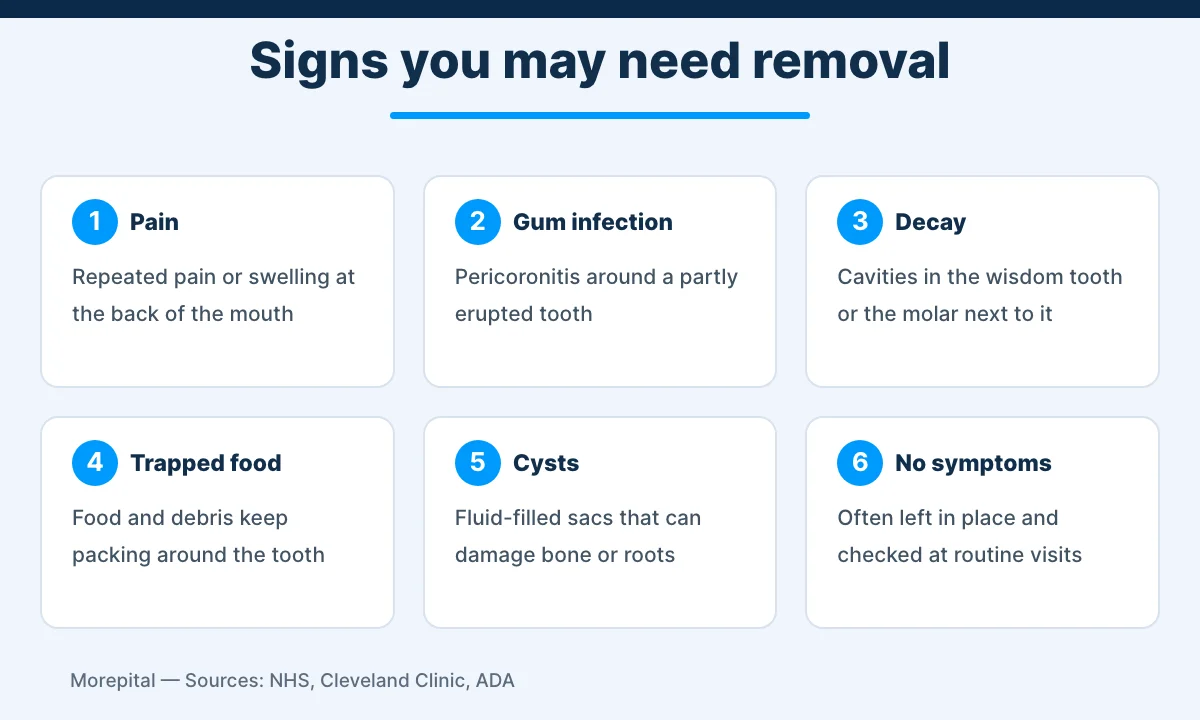
Whether you need wisdom teeth removal is decided by a dentist, who combines your symptoms with an examination and X-rays that show the position of the tooth and its roots. Wisdom teeth removal is generally recommended when the tooth is already causing problems, or when its position means it is likely to. Reasons listed by the NHS, Cleveland Clinic and the American Dental Association include:
- repeated pain or swelling at the back of the mouth
- pericoronitis, the gum infection around a partly erupted tooth
- decay in the wisdom tooth, or decay that cannot be restored
- gum disease around the back molars
- damage to the neighboring second molar or the surrounding bone
- a cyst or, rarely, a tumor around the tooth
- food and debris that keep getting trapped
- removal planned as part of orthodontic or other dental treatment
Source: NHS, Cleveland Clinic, American Dental Association (MouthHealthy)
Typical warning signs of a problem tooth are bad breath, an unpleasant taste, red or swollen gum behind the last molar, jaw pain, headaches and, at times, difficulty opening the mouth fully. Mild soreness while a wisdom tooth erupts is normal and does not by itself mean you need wisdom teeth removal, but the American Dental Association advises seeing a dentist straight away if it becomes painful.
Source: MedlinePlus (NIH), American Dental Association (MouthHealthy)
Removing healthy wisdom teeth: what the evidence says
A frequent question is whether impacted teeth that cause no symptoms should come out “just in case”. Practice differs between countries. The NHS states that a wisdom tooth that is not causing problems is usually left in place and monitored at check-ups. Cleveland Clinic notes that some dentists in the United States recommend preventive removal to reduce the risk of later infection and decay.
Source: NHS, Cleveland Clinic
A 2020 Cochrane systematic review looked for high-quality studies on this exact question and found only two, with 493 participants in total. The authors concluded that the evidence is insufficient to say whether symptom-free, disease-free impacted wisdom teeth should be removed or kept. Keeping them may be linked to a higher long-term risk of gum disease around the adjacent second molar, but that finding was very low certainty, and the one randomized trial found that removal may not significantly affect crowding of the front teeth.
Source: Cochrane Review (2020)
The practical takeaway is that preventive wisdom teeth removal is a shared decision: weigh your symptoms, the tooth’s position, your age and your preferences with your dentist or oral surgeon. If you keep your wisdom teeth, clean carefully around them and have them reviewed regularly so that decay or infection is caught early.
Source: Cochrane Review (2020), American Dental Association (MouthHealthy)
Age is part of the conversation about wisdom teeth removal. MedlinePlus notes that removing wisdom teeth before about age 20 tends to give better results, because the roots are less developed and the bone heals more easily. A literature review on nerve injury also lists age over 24 among the risk factors for nerve problems after lower wisdom teeth removal.
Source: MedlinePlus (NIH), Sarikov & Juodzbalys, J Oral Maxillofac Res (PMC)
Before surgery: assessment, X-rays and anesthesia
Before wisdom teeth removal, your dentist or oral surgeon will examine your mouth and take dental X-rays. A panoramic X-ray shows all the teeth and both jaws in one image. When it suggests that the roots of a lower wisdom tooth sit very close to the canal carrying the inferior alveolar nerve, which supplies feeling to the lower lip and chin, a 3D cone beam CT (CBCT) scan may be used for a clearer view.
Source: Cleveland Clinic, Sarikov & Juodzbalys, J Oral Maxillofac Res (PMC)
Tell the surgeon about every medicine and supplement you take, but do not stop any medicine without asking the prescriber first. If you are having sedation, you will normally be asked to fast for six to eight hours beforehand, and you cannot drive for at least 24 hours afterward.
Source: Cleveland Clinic
Types of anesthesia
The NHS describes three anesthesia options for wisdom teeth removal:
- Local anesthetic: an injection that numbs the tooth and gum. You stay awake, but the procedure should be painless. It is the usual choice.
- Sedation: medicine that helps you relax, given alongside the local anesthetic.
- General anesthetic: you are asleep. It is usually reserved for teeth that are harder to remove or for very anxious patients, and you may need an overnight hospital stay.
Source: NHS
Driving rules matter here. The NHS advises not driving for 48 hours after a general anesthetic or for 24 hours after a sedative injection.
Source: NHS
The wisdom teeth removal procedure step by step
Wisdom teeth removal may be carried out by a general dentist or by an oral surgery specialist at a dental practice, clinic or hospital. The main steps described by the NHS and Cleveland Clinic are:
- Numbing: anesthetic is given to the teeth and gums, with sedation if chosen.
- Access: if gum covers the tooth, a small cut is made to reach it.
- Widening the socket: the socket the tooth sits in is gently widened.
- Removal: the tooth is lifted out whole or divided into two or three pieces, which makes it easier to remove through a smaller opening.
- Cleaning: the area is cleaned of debris.
- Stitches: the gum is closed with dissolvable stitches if needed.
- Gauze: a gauze pad is placed over the socket to help a blood clot form and slow bleeding.
Source: NHS, Cleveland Clinic
How long does it take? The NHS says the procedure often lasts just a few minutes and should take no more than 40 minutes, while Cleveland Clinic says it is usually an hour or less, with complex cases taking longer. Most people go home the same day after wisdom teeth removal.
Source: NHS, Cleveland Clinic
The anesthetic should make wisdom teeth removal itself painless. Afterward, as the numbness wears off, soreness and swelling are expected. The blood clot that forms in the empty socket is essential for healing, so most aftercare advice is about protecting it.
Source: NHS, Cleveland Clinic Health Essentials
Wisdom teeth removal recovery day by day
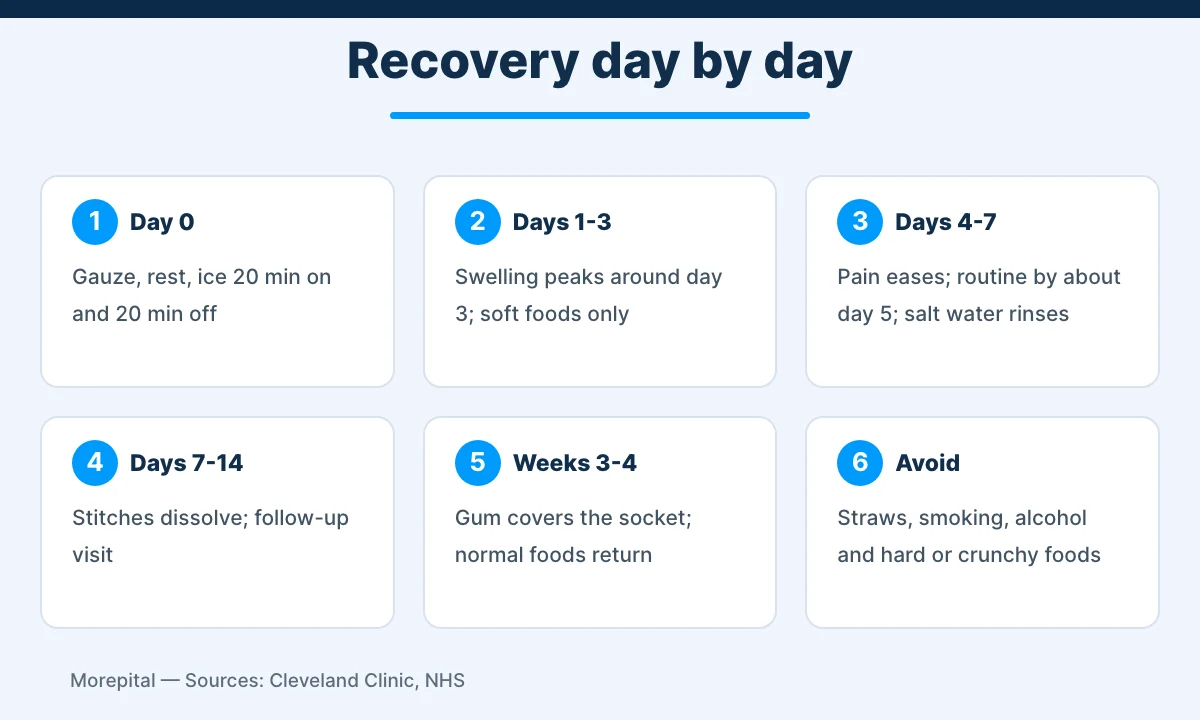
Recovery after wisdom teeth removal varies with the number of teeth removed, how deeply they were impacted and your general health. Use the timeline below as a guide and always follow the written instructions from your own surgeon.
Source: Cleveland Clinic, Cleveland Clinic Health Essentials
Day 0: the day of surgery
You may wake up or leave the chair with gauze in your mouth. Bite on it gently as instructed. A blood clot begins to form in the socket within the first 24 hours. Rest, keep your head raised and apply a cold pack to the cheek for 20 minutes on and 20 minutes off. Avoid alcohol, driving and operating machinery if you had sedation or general anesthesia.
Source: Cleveland Clinic Health Essentials, NHS
Days 1 to 3: peak swelling
Light bleeding, swelling and pain are expected. Swelling is typically at its worst around day 3. After the first 24 hours you can switch from ice to a warm compress, using the same on-off pattern. Keep your head elevated above your heart when lying down. Take pain relief as advised; Cleveland Clinic recommends avoiding aspirin early on because it can increase bleeding. The NHS notes that most people can return to normal activities the day after surgery, although a difficult removal or a general anesthetic may mean 1 to 3 days off work.
Source: Cleveland Clinic, Cleveland Clinic Health Essentials, NHS
Days 4 to 7: things start to settle
Pain and swelling ease, and Cleveland Clinic says most people return to their routine by about day 5. Warm salt water rinses can begin, and gentle spitting is allowed again. Light activity is fine, but Cleveland Clinic advises waiting 48 to 72 hours before exercise and avoiding heavy lifting during early healing.
Source: Cleveland Clinic
Days 7 to 14: stitches and follow-up
Dissolvable stitches usually disappear on their own within about 7 to 10 days, and a follow-up appointment is often booked around this time. Keep rinsing with salt water, and gently brush and floss the rest of your mouth while avoiding the socket. According to the NHS, some pain, swelling, jaw stiffness, cheek bruising and discomfort when chewing can last up to two weeks.
Source: Cleveland Clinic Health Essentials, Cleveland Clinic, NHS
Weeks 3 to 4 and beyond
Gum tissue gradually closes over the socket, and you can begin gently brushing the new tissue and return to normal foods. Cleveland Clinic notes that full healing of the socket itself can take more than a month, and impacted teeth may take longer.
Source: Cleveland Clinic, Cleveland Clinic Health Essentials
| Stage | What to expect | What to do |
|---|---|---|
| Day 0 | Gauze, bleeding slows, clot forms | Rest, head raised, ice 20 min on/off, no driving after sedation |
| Days 1–3 | Swelling and pain peak (around day 3) | Soft foods, painkillers as advised, warm compress after 24 h, no straws |
| Days 4–7 | Symptoms ease; routine by about day 5 | Gentle warm salt water rinses, light activity |
| Days 7–14 | Stitches dissolve; follow-up visit | Keep rinsing, brush gently around the socket |
| Weeks 3–4+ | Gum covers the socket | Normal foods and activity; full socket healing can take over a month |
Source: Cleveland Clinic, Cleveland Clinic Health Essentials, NHS
Pain relief and aftercare
For most people, over-the-counter pain relief is enough after wisdom teeth removal. The NHS suggests paracetamol (acetaminophen) or ibuprofen, and Cleveland Clinic describes ibuprofen as the main pain reliever, with any prescribed opioid reserved for breakthrough pain.
Source: NHS, Cleveland Clinic Health Essentials
Simple habits protect the clot and keep the wound clean:
- If bleeding restarts, press a clean, folded gauze or cloth firmly on the area for at least 10 minutes.
- Rinse gently with warm salt water or mouthwash, especially after eating, once your surgeon says you can.
- Brush your other teeth carefully and avoid scrubbing the surgical site.
- Do not smoke, because smoking increases the risk of infection.
- Avoid alcohol and very hot drinks, which can increase bleeding or scald a numb mouth.
- Do not drink through a straw or rinse vigorously in the first days.
Source: NHS, Cleveland Clinic Health Essentials, Cleveland Clinic
What to eat after wisdom teeth removal
After wisdom teeth removal, stick to soft or liquid food until chewing feels comfortable, usually for the first few days and up to about a week. Cleveland Clinic suggests following your provider’s soft-food list for the first three days and eating soft foods for five to seven days overall. Drink plenty of water, but sip it rather than swishing it around your mouth.
Source: NHS, Cleveland Clinic, Cleveland Clinic Health Essentials
Good choices in the first week include:
- yogurt and pudding
- eggs, for example scrambled
- soft, well-cooked pasta
- liquid foods such as soups, allowed to cool so they are not hot
Source: Cleveland Clinic Health Essentials, NHS
Foods to avoid until the socket has healed:
- hard or crunchy foods
- nuts, seeds and fine grains, which can lodge in the wound
- very chewy foods
- spicy foods
- carbonated and alcoholic drinks, which Cleveland Clinic advises skipping for at least five days
Source: NHS, Cleveland Clinic, Cleveland Clinic Health Essentials
Return to a normal diet gradually as comfort allows. Cleveland Clinic says normal foods can usually be resumed around weeks 3 to 4, once gum tissue has begun to cover the socket.
Source: Cleveland Clinic
Dry socket and other risks of wisdom teeth removal
Dry socket, known medically as alveolar osteitis, happens when the blood clot in the socket fails to form properly or is lost before the gum heals, leaving the bone exposed. It is one of the most common complications of tooth extraction, including wisdom teeth removal. A comprehensive review in the International Journal of Dentistry reported rates of about 0.5% to 5% after routine extractions and about 1% to 37.5% after lower wisdom teeth removal, with the wide range reflecting the lack of agreed diagnostic criteria.
Source: NHS, Kolokythas et al., International Journal of Dentistry (PMC)
Dry socket symptoms and timing
Dry socket usually begins 1 to 3 days after wisdom teeth removal or another extraction, and almost all cases appear within the first week. The typical picture is pain in and around the socket that gets worse instead of better, sometimes spreading to the ear or temple, along with bad breath, an unpleasant taste and a socket that looks empty because the clot has broken down.
Source: Kolokythas et al., International Journal of Dentistry (PMC)
Dry socket risk factors
The same review found the strongest links with difficult, traumatic surgery and with bacteria. Smoking showed a dose-dependent effect: one study it cited reported dry socket in 12% of people smoking half a pack a day and over 20% of those smoking a pack a day, compared with 2.6% of non-smokers. Oral contraceptive use, older age and a less experienced operator were also associated with higher rates. Cleveland Clinic adds that swishing, straws and fizzy or alcoholic drinks can dislodge the clot.
Source: Kolokythas et al., International Journal of Dentistry (PMC), Cleveland Clinic
Preventing and treating dry socket
Chlorhexidine mouth rinse used before and after surgery had the best support for prevention in the review, although no single method is universally accepted. Management focuses on controlling pain until normal healing begins. Local measures are usually enough, often including a medicated dressing placed in the socket, and painkillers or antibiotics are sometimes needed. Dressings help with pain but some studies suggest they may slow healing. If you suspect dry socket, contact your dentist rather than waiting for it to settle.
Source: Kolokythas et al., International Journal of Dentistry (PMC), NHS
Infection and nerve injury
Complications of wisdom teeth removal are uncommon, and your surgeon should explain the risks that apply to you before treatment. Besides dry socket, the main ones are infection, which may need antibiotics, and damage to nearby structures such as the jawbone, sinuses, neighboring teeth or nerves.
Source: NHS, Cleveland Clinic
Nerve injury is the risk people worry about most. It can cause numbness or tingling in the tongue, lower lip or chin. The NHS says it usually improves but can last weeks or months. A literature review of 14 studies put inferior alveolar nerve injury after lower wisdom teeth removal at about 0.35% to 8.4%. In one large study cited, 0.7% of patients had permanent sensory loss, and the review concluded that recovery is the usual outcome and permanent injury is very rare. Risk was higher with age over 24, horizontal impaction and roots lying close to the nerve canal on X-ray.
Source: NHS, Sarikov & Juodzbalys, J Oral Maxillofac Res (PMC)
For other dental topics, read our guide to dental implants, browse the diseases A to Z or explore the full treatments guide.
When to call your dentist
Some discomfort is normal after wisdom teeth removal, but contact your dentist, oral surgeon or an urgent dental service if you have:
- bleeding that will not stop despite firm pressure
- severe or worsening pain and swelling that painkillers do not help
- swelling that keeps increasing after day 3
- pain with a bad taste in the mouth, a high temperature or feeling unwell
- a fever above 102°F (38.8°C) or pus from the socket or incision
Source: NHS, Cleveland Clinic
Seek emergency help immediately for any difficulty breathing or swallowing, which Cleveland Clinic lists among the warning signs after surgery. In the UK you can also call NHS 111 for advice out of hours.
Source: Cleveland Clinic, NHS
Wisdom teeth removal: frequently asked questions
Does wisdom teeth removal hurt?
The procedure itself should not be painful because the area is numbed with local anesthetic. Afterward, soreness and swelling are normal for a few days and are usually controlled with paracetamol or ibuprofen.
Source: NHS
How long does wisdom teeth removal recovery take?
After wisdom teeth removal, most people resume their routine within a few days, and many feel much better by day 5. Symptoms can last up to about two weeks, and the socket itself may take more than a month to fill in fully.
Source: Cleveland Clinic, NHS
Can I go to work or school the day after wisdom teeth removal?
Many people can return the day after, according to the NHS, but you may need 1 to 3 days off after a difficult removal or a general anesthetic.
Source: NHS
Should all four wisdom teeth be removed at once?
Not necessarily. The decision depends on which teeth are causing or likely to cause problems. Teeth that are healthy and symptom-free are often monitored instead, because evidence for preventive removal is limited.
Source: NHS, Cochrane Review (2020)
When can I eat normally after wisdom teeth removal?
Eat soft foods for roughly the first week, then reintroduce firmer foods as comfort allows. Most people return to normal foods around weeks 3 to 4, avoiding nuts and seeds until the socket closes.
Source: Cleveland Clinic, Cleveland Clinic Health Essentials
How do I know if I have dry socket?
Suspect it if pain gets worse rather than better 1 to 3 days after the extraction, especially with bad breath, a bad taste or an empty-looking socket. Your dentist can treat it.
Source: Kolokythas et al., International Journal of Dentistry (PMC)
Can I smoke after wisdom teeth removal?
It is best not to smoke after wisdom teeth removal. Smoking raises the risk of infection and is strongly linked to dry socket, with risk rising the more you smoke.
Source: NHS, Kolokythas et al., International Journal of Dentistry (PMC)
Source: NHS, Cleveland Clinic, Kolokythas et al., International Journal of Dentistry (PMC)
Disclaimer: this article is for general health education and does not replace advice from a qualified doctor who can assess your individual case. Last updated: October 2026.