
Rhinoplasty in Turkey is the same operation as anywhere else: surgery that reshapes the bone, cartilage and skin of the nose to change how it looks, how it works, or both. It usually takes about 1.5 to 3 hours under general anesthesia, the external splint stays on for roughly a week, and the final shape can take up to a year to settle. Before booking rhinoplasty in Turkey, check the surgeon’s specialty and society membership, the hospital’s authorization and how aftercare will work once you are home.
Source: NHS, Cleveland Clinic, BAAPS and TSPRAS
Contents
- What rhinoplasty in Turkey involves
- Cosmetic vs functional nose surgery
- Who is a good candidate?
- Open vs closed rhinoplasty
- Planning the trip: steps and length of stay
- Recovery timeline after rhinoplasty in Turkey
- Risks, revision and realistic results
- Choosing a surgeon and hospital in Turkey
- Aftercare at home after rhinoplasty in Turkey
- Frequently asked questions
What rhinoplasty in Turkey involves

Rhinoplasty is surgery to repair or reshape the nose. A surgeon can make the nose smaller by removing cartilage and bone, make parts of it larger with cartilage grafts (often taken from the septum or ear, and sometimes bone from elsewhere), or change the shape of the bridge and nostrils by breaking the nasal bones and rearranging cartilage. Typical goals include reducing a hump, refining the tip, narrowing the nostrils or correcting asymmetry.
Source: NHS, MedlinePlus, ASPS
Clinically, rhinoplasty in Turkey follows the same principles as in the UK, Europe or the US. What changes is the logistics: consultation, surgery and splint removal are often packed into a short stay, and any later problem may be handled by a different doctor in your home country. For a fuller overview of the operation itself, see our rhinoplasty treatment guide.
Source: NHS, UK Foreign Office
Purely cosmetic nose reshaping is not usually funded by the NHS and must be paid for privately; the NHS puts the UK private cost at about £4,000 to £7,000, plus consultations and follow-up. Cost is one reason people look at rhinoplasty in Turkey, but the NHS advises that decisions about treatment abroad should be based on the quality of care, not on how attractive a destination seems for a holiday. Prices for rhinoplasty in Turkey vary widely by surgeon, hospital and package, so we do not quote them.
Cosmetic vs functional rhinoplasty in Turkey
Nose surgery can be cosmetic, functional or both. Cosmetic rhinoplasty changes appearance. Functional surgery aims to improve breathing, for example when structural problems inside the nose block airflow. Septoplasty straightens the internal wall between the nostrils and can be combined with rhinoplasty in one operation (often called septorhinoplasty) to address appearance and breathing together.
Arabic-speaking readers: a detailed, source-referenced Arabic overview of this topic is available in the Alphateb medical encyclopedia — تجميل الأنف.
Source: Cleveland Clinic, ASPS
A bent or off-center septum is very common, and only larger deviations cause symptoms such as a blocked nose, nosebleeds or repeated sinus infections; our page on deviated septum explains the symptoms and non-surgical options. If you have breathing problems, mention them before planning rhinoplasty in Turkey. The US clinical practice guideline on rhinoplasty (American Academy of Otolaryngology–Head and Neck Surgery Foundation) recommends that surgeons assess every patient for nasal airway obstruction before surgery and explain how the operation may affect breathing.
Source: AAO-HNSF rhinoplasty guideline (Ishii et al. 2017), Cleveland Clinic
Funding differs for the two goals. In the UK, nose surgery may be available on the NHS if it is needed to help you breathe or to repair an injury, so it is worth seeing your GP or an ENT specialist first if breathing is your main complaint. According to Cleveland Clinic, people who have functional surgery for a deviated septum usually notice better breathing within about six weeks.
Source: NHS, BAPRAS, Cleveland Clinic
Who is a good candidate for rhinoplasty in Turkey?
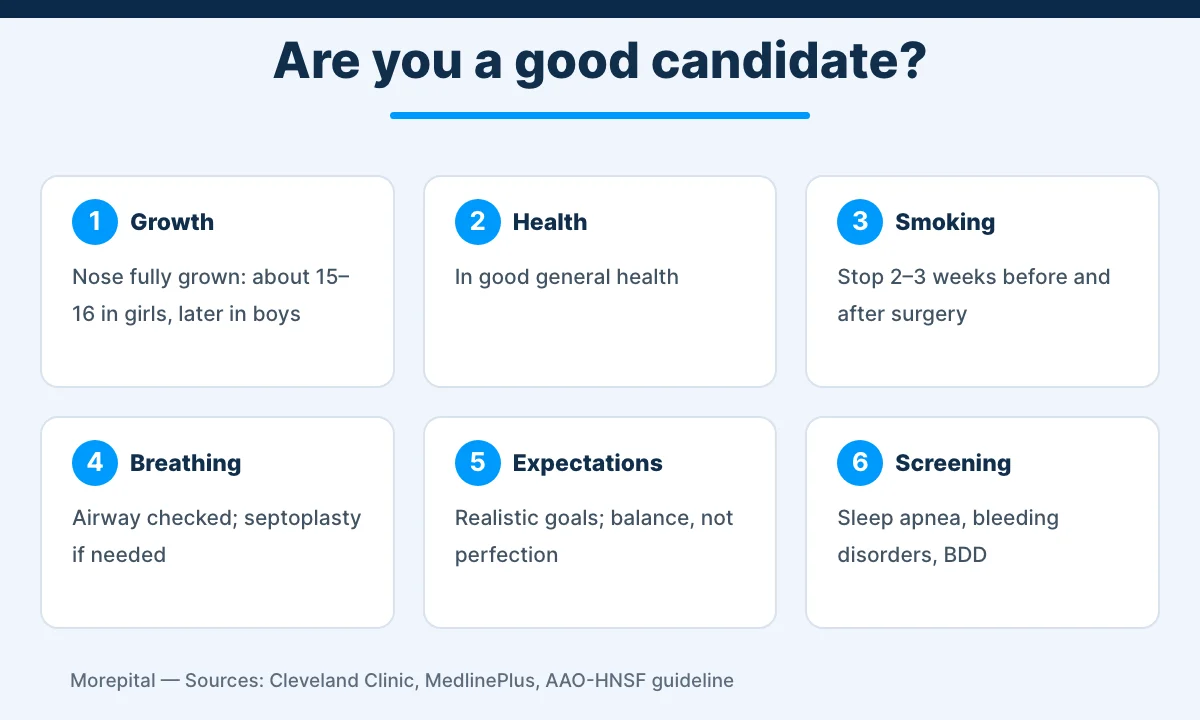
Cleveland Clinic describes good candidates as people who have finished growing, are in good physical health, do not smoke, understand the limits of nose surgery and want it for their own reasons. Many surgeons wait for cosmetic surgery until the nasal bone has stopped growing, which MedlinePlus puts at around age 15 to 16 in girls and somewhat later in boys. Most clinics offering rhinoplasty in Turkey to international patients treat adults.
Source: Cleveland Clinic, MedlinePlus
Health factors that need discussion
Smoking slows healing; MedlinePlus advises stopping for 2 to 3 weeks before and after surgery. Blood-thinning medicines may need to be stopped as your surgeon directs. The rhinoplasty guideline also recommends screening for conditions that may change or rule out surgery, including obstructive sleep apnea, bleeding disorders, body dysmorphic disorder and long-term use of decongestant nasal sprays.
Source: MedlinePlus, AAO-HNSF guideline
Expectations and body image
Every face is somewhat asymmetric, so the aim is balance rather than perfect symmetry. Results also depend on nose size, skin and age, and BAPRAS notes that surgery alone will not solve emotional or social concerns. Body dysmorphic disorder (BDD), a mental health condition in which a person is preoccupied with a perceived flaw, is more common in this group: a systematic review estimated a weighted prevalence of 20.1% among rhinoplasty patients, compared with 1.9% of adults in the community. If you have spent years worrying about one small feature, discuss it honestly with your doctor before planning rhinoplasty in Turkey.
Source: ASPS, BAPRAS, Veale et al., Body Image 2016
Open vs closed rhinoplasty in Turkey
There are two main approaches. In closed rhinoplasty, all cuts are made inside the nostrils, so there is no visible external scar; it suits smaller changes but is not always possible. In open rhinoplasty, a small cut is made across the columella (the strip of skin between the nostrils) and the skin is lifted to expose the cartilage. This gives the surgeon a clearer view, which helps with tip work and major reshaping, but swelling is greater and recovery is longer.
Source: BAPRAS, NHS, Cleveland Clinic
Neither approach is “better” in general. A systematic review of 49 studies found reoperation rates of 2.73% after primary open and 1.56% after primary closed rhinoplasty, a difference that was not statistically significant; the authors concluded that the choice should be guided by the surgeon’s judgment and experience, and noted that most of the evidence came from low-level case series. If a clinic offering rhinoplasty in Turkey promises one technique before anyone has examined your nose, ask why.
Source: Crosara et al. 2016
Anesthesia and time in hospital
Rhinoplasty is done under general anesthesia, or under local anesthesia with sedation. The operation usually lasts 1.5 to 3 hours. US sources describe it as typically outpatient, while UK patients usually stay one or two nights; ask which applies to your rhinoplasty in Turkey.
Source: Cleveland Clinic, MedlinePlus, NHS, BAPRAS
Planning rhinoplasty in Turkey: steps and length of stay
A safe plan for rhinoplasty in Turkey usually follows the same steps a UK or US surgeon would use, with extra attention to timing:
- Talk to your own doctor first. The UK Foreign Office (FCDO) and the NHS both advise discussing plans with your GP or clinician before going ahead, and asking how your medical notes will reach the overseas team.
- Get a real consultation with the operating surgeon. The NHS suggests two consultations before surgery and a cooling-off period of about two weeks, which is the norm in the UK, and warns against paying for a surgeon you have never met.
- Complete written consent before you travel. The joint British and Turkish plastic surgery guidance says a comprehensive consent form should be completed before travel, and its absence should raise concern.
- Plan the recovery stay. The splint and any stitches usually come off after about a week, and the NHS advises not flying for 7 to 10 days after facial cosmetic surgery because of the risk of blood clots.
- Arrange follow-up at home before you leave, including who you will contact if something goes wrong.
Source: FCDO, NHS, NHS, BAAPS and TSPRAS
Do not treat rhinoplasty in Turkey as a holiday: the NHS advises resting and avoiding alcohol, sun, sightseeing and swimming, and notes that travel insurance normally does not cover problems arising from surgery. If you have read our guides to a hair transplant in Turkey or veneers in Turkey, the same planning logic applies.
Source: NHS
Recovery timeline after rhinoplasty in Turkey

Early recovery after rhinoplasty in Turkey happens before you fly home, so know what is normal. Right after surgery you will have a dressing and a splint taped over the nose, and you will breathe mainly through your mouth for about a week. A stiff, numb nose, soreness, swelling and bruising around the eyes, and light nosebleeds in the first few days are all common.
Not everyone has internal packing. Cleveland Clinic says it is usually removed within 24 to 48 hours, MedlinePlus says after 3 to 5 days, and the US rhinoplasty guideline advises surgeons not to place packing routinely. Ask your surgeon in advance whether you will have packing or soft internal splints, and when they will come out.
Source: Cleveland Clinic, MedlinePlus, AAO-HNSF guideline
| Time after surgery | What usually happens |
|---|---|
| First few days | Head propped up; mouth breathing; light bleeding; pain and swelling peak in the first week |
| About 1 week | Splint and non-dissolving stitches removed (Cleveland Clinic: splint 1 to 2 weeks) |
| 7 to 10 days | Earliest flight advised by the NHS after facial cosmetic surgery |
| 1 to 3 weeks | Back to work or study for most; bruising, swelling and redness usually fade by 3 weeks |
| 3 weeks | Swimming may be allowed |
| 4 to 6 weeks | Strenuous exercise, heavy lifting and contact sports can usually resume |
| 2 to 6 months | Most swelling gone; the tip may stay swollen and numb longer |
| Up to 1 year or more | Final shape emerges |
Source: NHS, NHS, Cleveland Clinic, MedlinePlus, ASPS
Daily care in the first weeks
The NHS advises keeping your head propped up for a couple of days, avoiding hot baths, keeping the splint dry, not blowing your nose or picking crusts until the splint is off and sneezing through your mouth. Cleveland Clinic adds cool (not ice-cold) compresses on the cheeks, avoiding knocks to the face, limiting sun exposure and not resting glasses or sunglasses on the bridge of the nose.
Source: NHS, Cleveland Clinic
Why the final result takes a year
Swelling settles slowly. Cleveland Clinic estimates about 90% of swelling is gone by three months, with mild swelling, especially in the morning, lasting up to a year. BAPRAS says that after tip surgery about 60% of the change is visible at three weeks and the remaining 40% develops over months, up to a year. Judge your rhinoplasty in Turkey on the result at 12 months, not on photos taken when the splint comes off.
Source: Cleveland Clinic, BAPRAS
Rhinoplasty in Turkey: risks, revision and realistic results
Like any operation, rhinoplasty carries general risks such as heavy bleeding, blood clots, infection and reactions to anesthesia. Nose-specific risks include breathing that is worse rather than better, a hole in the septum (septal perforation), loss of nasal support or contour irregularities, an altered sense of smell, poor wound healing or scarring, tiny permanent red spots from burst blood vessels, pain lasting several weeks and an appearance you are not happy with. The NHS describes permanent breathing difficulty, septal damage and heavy nosebleeds as rare.
Source: NHS, Cleveland Clinic, MedlinePlus, BAPRAS
How often is a second operation needed?
Sources disagree on revision rates. Cleveland Clinic states that about 15% of people need revision surgery for small changes, while the systematic review cited above found reoperation rates of under 3% across mostly case-series studies. Because definitions and follow-up differ, ask your surgeon for their own revision policy. BAPRAS warns that repeated surgery can weaken the nose’s supporting structure and advises agreeing the conditions and costs of any re-operation in advance, which matters even more when rhinoplasty in Turkey means a second trip.
Source: Cleveland Clinic, Crosara et al. 2016, BAPRAS
Extra risks of surgery abroad
The FCDO says cosmetic surgery is among the most common reasons for medical tourism, that standards vary within countries as well as between them, and that it is aware of 7 British nationals who died in Turkey in 2025 after medical procedures, with others needing further treatment for complications. In November 2023 the British Association of Aesthetic Plastic Surgeons (BAAPS) reported that 78% of the corrective operations its members had performed since November 2022 were on people who had had aesthetic procedures in Turkey. These figures cover all procedures, not rhinoplasty in Turkey alone, but they show why selection matters.
Choosing a surgeon and hospital for rhinoplasty in Turkey
In 2023 BAAPS and the Turkish Society of Plastic Reconstructive and Aesthetic Surgeons (TSPRAS) issued joint advice for UK patients considering surgery in Türkiye. It recommends that you:
- confirm the surgeon is a TSPRAS member using the society’s online listing, and ask to see their Turkish board certificate (membership of the European board, EBOPRAS, is desirable but not essential);
- check the surgeon has practised plastic, reconstructive and aesthetic surgery for at least five years, and that they are genuinely a specialist, since some people claiming to be plastic surgeons are not;
- choose a fully recognized hospital, suggested as one with at least 30 beds;
- ask how long the surgeon has worked with the clinic or agency (at least three years is suggested);
- know your surgeon’s name and how to contact them, and make sure an aftercare plan is offered.
Source: BAAPS and TSPRAS
Rhinoplasty is performed by plastic surgeons and by facial plastic surgeons trained in ENT (otolaryngology); what matters is that the surgeon is board-certified in a relevant specialty and does nose surgery regularly. The NHS suggests asking how many nose reshaping operations they have done, how many complications they have had, what follow-up they provide and what their patient satisfaction rates are, and seeing before-and-after photos of their own work.
Checking official authorization
Under Turkish health tourism rules (Regulation no. 30123 of July 2017), healthcare facilities and intermediary agencies serving international patients must hold an International Health Tourism Authorization Certificate. The Health Tourism Department of the Turkish Ministry of Health publishes lists of authorized hospitals, medical centers, private practices and facilitators, and the government-backed Health Türkiye platform lists certified providers. Checking these lists is a sensible first filter when comparing options for rhinoplasty in Turkey, but authorization of a facility does not replace checking the individual surgeon.
Source: Health Türkiye (USHAŞ), Turkish Ministry of Health
Warning signs
NHS red flags include a hard sell, pressure to decide quickly and no discussion of complications or aftercare. The FCDO adds that agencies have a financial interest in booking you, so their marketing should not be your only information when comparing rhinoplasty in Turkey.
Questions to ask before booking rhinoplasty in Turkey
Bring your medicines list, photos of the look you hope for and these questions:
- Who exactly will operate, what is their specialty and board certification, and are they a TSPRAS member?
- How many rhinoplasties do you do, and can I see your own before-and-after photos?
- Will you use an open or closed approach for my nose, and why? Will you also work on my septum or breathing?
- When will the splint and stitches come off, and when can I safely fly home?
- What happens if I have a complication after I return home, and who pays for it?
- What is your revision policy, and what would a second operation cost?
- Is the hospital authorized by the Ministry of Health for international patients, and does the clinic or surgeon carry insurance that covers me?
Source: Cleveland Clinic, NHS, BAAPS and TSPRAS, BAPRAS
A good surgeon will also ask you questions. The US guideline recommends that surgeons ask every patient about their motives and expected outcomes, tell them whether those expectations are realistic, and explain what to expect after surgery, including possible complications, effects on breathing and the chance of future nasal surgery. If your consultation for rhinoplasty in Turkey skips this conversation, consider it a warning sign.
Source: AAO-HNSF guideline
Aftercare at home after rhinoplasty in Turkey
After rhinoplasty in Turkey, ask your surgeon for written notes on the operation and your medicines, and share them with your GP. The NHS advises being clear about how aftercare will be coordinated, where follow-up appointments will take place and how easily you could return to the clinic. The rhinoplasty guideline recommends that satisfaction with both appearance and breathing be assessed at least 12 months after surgery, so agree with your surgeon in advance how that review will happen, whether in person or remotely.
Source: NHS, NHS, AAO-HNSF guideline
When to get medical help
Contact your surgeon or a local doctor promptly if you have difficulty breathing, nausea or vomiting, fever or yellow discharge, severe or worsening pain, or a nosebleed that will not stop. In the UK, the NHS advises calling NHS 111 if you cannot reach the clinic; in an emergency, call your local emergency number.
Source: Cleveland Clinic, NHS, NHS
Considering rhinoplasty in Turkey? Contact us for a free consultation and a treatment plan tailored to you.
Rhinoplasty in Turkey: frequently asked questions
How long should I stay in Turkey after rhinoplasty?
Plan to stay until the splint and any stitches are removed, which is usually about a week. The NHS advises not flying for 7 to 10 days after facial cosmetic surgery, so many patients plan around 10 days; your surgeon should confirm the date for you.
Is rhinoplasty in Turkey safe?
It can be when done by a qualified specialist in a properly equipped hospital, but complications can happen with any surgeon in any country, and treatment abroad adds risks around follow-up and travel. Check the surgeon’s society membership and the hospital’s authorization, and plan aftercare before you go.
Source: BAAPS and TSPRAS, FCDO
When can I go back to work after rhinoplasty in Turkey?
Most people return to work or school within one to two weeks; the NHS suggests allowing up to two weeks off, and people with physically demanding jobs may need longer.
Source: NHS, Cleveland Clinic
Will I have a visible scar?
Closed rhinoplasty leaves no visible external scar. Open rhinoplasty leaves a small scar across the columella, and narrowing the nostrils may leave small scars at their base, which MedlinePlus describes as rarely visible.
Source: NHS, MedlinePlus
Can rhinoplasty in Turkey also fix my breathing?
Yes, septoplasty can be combined with rhinoplasty to improve both appearance and breathing if a structural problem such as a deviated septum is found. Ask for a breathing assessment at your consultation.
Source: Cleveland Clinic, AAO-HNSF guideline
Are the results of rhinoplasty in Turkey permanent?
The structural changes are considered permanent, but the nose keeps settling for up to a year as swelling fades, and normal aging still affects the face over time.
Source: Cleveland Clinic, MedlinePlus
Disclaimer: this article is for general health education and does not replace advice from a qualified doctor who can assess your individual case. Last updated: October 2026.