Thyroid symptoms depend on whether the gland is making too little or too much hormone. An underactive thyroid (hypothyroidism) typically causes tiredness, feeling cold, weight gain, constipation, dry skin and low mood, while an overactive thyroid (hyperthyroidism) causes weight loss, a fast or irregular heartbeat, anxiety, shaking, sweating and heat intolerance. Because these signs overlap with many other conditions, a simple blood test for TSH and thyroxine (T4) is the only reliable way to confirm a thyroid problem.
Source: NHS, NHS, NIDDK (NIH)
Source: MedlinePlus, NIDDK (NIH), NIDDK (NIH)
Contents
- What the thyroid does and why thyroid symptoms vary
- Underactive thyroid symptoms (hypothyroidism)
- Overactive thyroid symptoms (hyperthyroidism)
- What causes thyroid symptoms
- Who is most at risk, including pregnancy and after birth
- Neck swelling, goiter and thyroid nodules
- Tests for thyroid symptoms: TSH, T4, T3, antibodies and scans
- Treatment options once thyroid symptoms are diagnosed
- When thyroid symptoms need a doctor or emergency care
- FAQ
What the thyroid does and why thyroid symptoms vary

The thyroid is a small, butterfly-shaped gland that sits in the front of the neck, just below the voice box. It makes two main hormones, thyroxine (T4) and triiodothyronine (T3), which control how the body uses energy. These hormones influence almost every organ, including breathing, heart rate, weight, digestion and mood. The thyroid itself is directed by thyroid-stimulating hormone (TSH), which comes from the pituitary gland at the base of the brain: when thyroid hormone levels fall, the pituitary releases more TSH to push the thyroid to work harder, and when levels rise, TSH falls.
Source: MedlinePlus, American Thyroid Association
This explains why thyroid symptoms fall into two almost opposite groups. Too little hormone slows the body down, so people feel sluggish, cold and heavy. Too much hormone speeds everything up, so people feel wired, hot and shaky, and they may lose weight without trying. The thyroid can also enlarge (a goiter), develop lumps called nodules, become inflamed (thyroiditis) or, less often, develop cancer, and these problems may or may not change hormone levels.
Source: MedlinePlus, NIDDK (NIH)
Thyroid symptoms usually develop gradually. An underactive thyroid often comes on slowly, sometimes over years, so people tend to blame aging, stress or a busy life. An overactive thyroid can start suddenly or build up slowly. Many people with mild thyroid disease have few or no symptoms at all, which is why blood tests matter so much.
Source: Cleveland Clinic, Cleveland Clinic, NIDDK (NIH)
Underactive thyroid symptoms (hypothyroidism)

Hypothyroidism means the thyroid does not make enough hormone for the body’s needs. The NHS lists these as the main underactive thyroid symptoms:
- extreme tiredness (fatigue)
- feeling cold more than usual
- weight gain
- constipation
- difficulty concentrating or thinking clearly (“brain fog”)
- low mood or depression
- dry skin, dry hair or hair loss
- a hoarse voice
- irregular or heavy periods
Source: NHS
Cleveland Clinic adds several other features that doctors look for: dry, coarse skin and hair, raised blood cholesterol, numbness or tingling in the hands, muscle soreness or weakness, anxiety, and facial changes such as drooping eyelids and puffiness around the eyes. Not everyone has all of these thyroid symptoms, and in mild cases the changes can be subtle enough to go unnoticed for a long time.
Source: Cleveland Clinic
Tiredness and low energy are also common in other conditions, so it helps to rule out look-alikes. Iron deficiency, for example, causes fatigue, breathlessness and pale skin (see our guide to anemia symptoms), and low vitamin D can cause tiredness and aches (see vitamin D deficiency). Constipation or bowel changes can also come from the gut itself, as in irritable bowel syndrome. Symptoms alone cannot tell these conditions apart, which is why doctors confirm hypothyroidism with blood tests.
Source: NIDDK (NIH), NHS
Complications if hypothyroidism is not treated
Left untreated or under-treated, an underactive thyroid can lead to heart problems such as coronary heart disease and heart failure, bone problems including osteoporosis, and pregnancy complications such as pre-eclampsia, premature birth and miscarriage. Very rarely, severe hypothyroidism causes myxedema coma, a life-threatening emergency that is more common in older people and needs hospital treatment.
Source: NHS, Cleveland Clinic
Overactive thyroid symptoms (hyperthyroidism)
Hyperthyroidism means the thyroid produces more hormone than the body needs, which speeds up many body functions. Typical overactive thyroid symptoms include:
- nervousness, anxiety, irritability or mood swings
- restlessness, trouble sleeping and, paradoxically, constant tiredness
- sensitivity to heat, heavy sweating and warm, moist skin
- a fast, pounding or irregular heartbeat (palpitations)
- trembling or shaky hands and muscle weakness
- weight loss, often despite a bigger appetite
- diarrhea or more frequent bowel movements
- needing to urinate more often and persistent thirst
- itchy skin, hives, red palms, loose nails and patchy hair thinning
- missed or irregular periods and reduced interest in sex
- swelling at the front of the neck (goiter)
Source: NHS, Cleveland Clinic, NIDDK (NIH)
Thirst, frequent urination and unexplained weight loss are also classic signs of high blood sugar, so a doctor may check for diabetes at the same time (see diabetes symptoms). Again, the overlap is the reason that blood tests, not symptom checklists, make the diagnosis.
Source: NHS
Eye changes and Graves’ disease
Some people with an overactive thyroid develop eye problems such as redness, dryness, swelling, bulging eyes or changes in vision. This is linked to Graves’ disease and is called Graves’ ophthalmopathy or thyroid eye disease. Eye-related thyroid symptoms are easy to miss early on. Any new eye bulging, double vision or loss of vision should be checked promptly.
Source: NHS, Cleveland Clinic, NIDDK (NIH)
Thyroid symptoms in older adults
In people over 60, thyroid symptoms of hyperthyroidism may not look like the textbook picture. Instead of restlessness and a big appetite, older adults may have loss of appetite or withdraw from people around them, and the condition can be mistaken for depression or dementia. Overactive nodules are also a more common cause at older ages.
Source: NIDDK (NIH)
Complications if hyperthyroidism is not treated
Untreated hyperthyroidism can cause an irregular heartbeat that may lead to blood clots, stroke or heart failure, as well as thinning bones and osteoporosis, muscle problems, and menstrual and fertility problems. Rarely, it triggers thyroid storm, a life-threatening surge in hormone levels described in the emergency section below.
Source: NIDDK (NIH), Cleveland Clinic
Thyroid symptoms compared: underactive vs overactive
The table below puts the two groups of thyroid symptoms side by side. Some features, such as tiredness, hair loss, a goiter and period changes, can occur in both.
| Feature | Underactive thyroid (hypothyroidism) | Overactive thyroid (hyperthyroidism) |
|---|---|---|
| Energy and mood | Fatigue, brain fog, low mood | Anxiety, irritability, restlessness, poor sleep, tiredness |
| Temperature | Feeling cold | Heat intolerance, sweating |
| Weight | Weight gain | Weight loss despite appetite |
| Heart | Slow heartbeat in severe cases | Fast or irregular heartbeat |
| Bowels | Constipation | Diarrhea, frequent bowel movements |
| Skin and hair | Dry, coarse skin and hair; hair loss | Warm, moist skin; thinning or brittle hair |
| Periods | Heavy or irregular | Missed or irregular |
| Typical blood test | High TSH, low free T4 | Low TSH, high free T4 and/or T3 |
| Most common cause | Hashimoto’s disease | Graves’ disease |
Source: NHS, NHS, Cleveland Clinic, Cleveland Clinic, American Thyroid Association
What causes thyroid symptoms
Causes of an underactive thyroid
The most common cause of hypothyroidism is Hashimoto’s disease, an autoimmune condition in which the immune system attacks the thyroid. Other causes include thyroiditis (inflammation of the gland), surgery or radiotherapy to the neck or thyroid, treatment for an overactive thyroid, certain medicines (including some heart, bipolar and cancer drugs), and congenital hypothyroidism, which is present from birth and is picked up by newborn screening in many countries. Iodine deficiency is a cause of thyroid symptoms in some parts of the world but is rare in the UK and US, and problems with the pituitary gland or hypothalamus are uncommon causes.
Source: NIDDK (NIH), NHS
Causes of an overactive thyroid
Graves’ disease, another autoimmune disorder, is the most common cause of hyperthyroidism. Other causes are overactive thyroid nodules (lumps that make excess hormone, most often in older adults), thyroiditis that leaks stored hormone into the blood, too much iodine from foods such as seaweed or from some medicines and cough syrups, taking too much thyroid hormone medicine, and, rarely, a noncancerous pituitary tumor.
Source: NIDDK (NIH)
Thyroiditis deserves a special mention because it can produce both sets of thyroid symptoms in turn. Inflammation first releases stored hormone, causing a temporary overactive phase, which may then be followed by an underactive phase that is sometimes permanent.
Source: NIDDK (NIH), NIDDK (NIH)
Iodine, seaweed and supplements
The thyroid needs iodine to make its hormones, but more is not better. People with Hashimoto’s disease or other autoimmune thyroid conditions can be sensitive to excess iodine, and large amounts from kelp, dulse or other seaweed, or from iodine supplements, may cause or worsen hypothyroidism. Excess iodine can also trigger hyperthyroidism. Check with a doctor or pharmacist before taking iodine-containing supplements or cough medicines if you have thyroid disease.
Source: NIDDK (NIH), NIDDK (NIH)
Who is most at risk, including pregnancy and after birth
Both main thyroid disorders are more common in women and in people over 60. Hypothyroidism is more likely if you have had a previous thyroid problem such as a goiter, thyroid surgery or radioactive iodine treatment, radiation to the neck or chest, a family history of thyroid disease, a pregnancy in the past 6 months, or Turner syndrome. Other autoimmune or related conditions also raise the risk, including celiac disease, Sjögren’s syndrome, pernicious anemia, type 1 or type 2 diabetes, rheumatoid arthritis and lupus.
Source: NIDDK (NIH)
The risk of hyperthyroidism is higher with a family history of thyroid disease, pernicious anemia, type 1 or type 2 diabetes, or primary adrenal insufficiency, as well as with high iodine intake, nicotine use and a pregnancy in the past 6 months.
Source: NIDDK (NIH)
Pregnancy
Untreated hypothyroidism in pregnancy can affect both mother and baby. Thyroid medicines are safe during pregnancy, and many women need a higher dose, so anyone on thyroid treatment should contact their doctor as soon as they find out they are pregnant, or tell their doctor if they are planning a pregnancy. Pregnant women also need more iodine and should ask their doctor how much is right.
Source: NIDDK (NIH), NHS
Postpartum thyroiditis
According to the American Thyroid Association, postpartum thyroiditis affects about 5–10% of women in the United States. It may start with an overactive phase about 1–4 months after delivery, causing anxiety, insomnia, palpitations, fatigue, weight loss and irritability, symptoms that are easily dismissed as normal new-parent stress. An underactive phase, which is the more common presentation, usually begins 4–8 months after birth and causes fatigue, weight gain, constipation, dry skin and depression. Most women regain normal thyroid function within 12–18 months, but around 20% of those who go through an underactive phase stay hypothyroid. If you feel unusually low, exhausted or anxious in the first year after giving birth, ask for a thyroid test.
Source: American Thyroid Association
Neck swelling, goiter and thyroid nodules
A goiter is an enlargement of the thyroid gland, which may show as swelling at the front of the neck. It can occur with an underactive thyroid, an overactive thyroid or normal hormone levels. A doctor checking for thyroid symptoms will usually feel the neck for swelling as part of the examination.
Source: MedlinePlus, NHS, NIDDK (NIH)
Thyroid nodules are lumps within the gland. They are very common: the American Thyroid Association says about half of people have one by age 60, and more than 90% are benign. Most nodules cause no thyroid symptoms at all. Large ones can press on the windpipe or food pipe and cause trouble breathing or swallowing or a tickle in the throat, while hoarseness is uncommon and is more often linked to cancer.
Source: American Thyroid Association
Thyroid blood tests are usually normal even when a nodule is cancerous, so they cannot rule cancer in or out. Nodules are assessed with an ultrasound scan, which shows their size and any suspicious features, and, when needed, a fine needle aspiration (FNA) biopsy, a quick office procedure that samples cells from the nodule. See a doctor about any new lump in the neck, especially one that is growing or causing hoarseness or swallowing problems.
Source: American Thyroid Association
Tests for thyroid symptoms: TSH, T4, T3, antibodies and scans
Thyroid symptoms alone are not enough to make a diagnosis because they overlap with so many other conditions. A doctor will ask about your symptoms, family history and any recent pregnancy, examine your neck, and order blood tests.
Source: NIDDK (NIH), NHS
TSH: the first test
TSH is the best first test and acts as an early warning system, because it often changes before thyroid hormone levels go out of range. When thyroid symptoms raise suspicion of hypothyroidism, guidelines summarized in American Family Physician recommend starting with a TSH level. A high TSH usually means the thyroid is not making enough hormone, and a low TSH usually means it is making too much. Less often, a low TSH reflects a pituitary problem.
Source: American Thyroid Association, American Family Physician (AAFP)
Free T4 and T3
Free T4 measures the unbound, active hormone and is read alongside TSH: a high TSH with a low free T4 points to primary hypothyroidism, a low TSH with a high free T4 points to hyperthyroidism, and a low TSH with a low free T4 suggests a pituitary problem. Total T4 can shift with pregnancy or birth control pills, which is why free T4 is more reliable. T3 is useful for diagnosing hyperthyroidism and judging its severity, but it rarely helps in hypothyroidism because it is the last test to become abnormal.
Source: American Thyroid Association
Subclinical hypothyroidism
Sometimes TSH is raised but free T4 is still normal. This is called subclinical hypothyroidism, and many people with it have mild or no symptoms. In non-pregnant adults, American Family Physician notes that levothyroxine is generally considered when TSH is above 10 mIU/L or thyroid peroxidase (TPO) antibodies are raised, and most others do not benefit from treatment. Your doctor may simply repeat the test later, particularly if thyroid symptoms are absent or mild.
Source: American Family Physician (AAFP)
Antibody tests and imaging
Thyroid peroxidase antibodies in someone with hypothyroidism point to Hashimoto’s disease, while TSH receptor antibodies (including thyroid-stimulating immunoglobulin, TSI) point to Graves’ disease. Imaging may include a thyroid ultrasound or a radioactive iodine uptake (RAIU) test and scan: very high uptake is seen in an overactive gland, and the scan shows which parts of the thyroid are taking up iodine.
Source: American Thyroid Association, Cleveland Clinic
Treatment options once thyroid symptoms are diagnosed
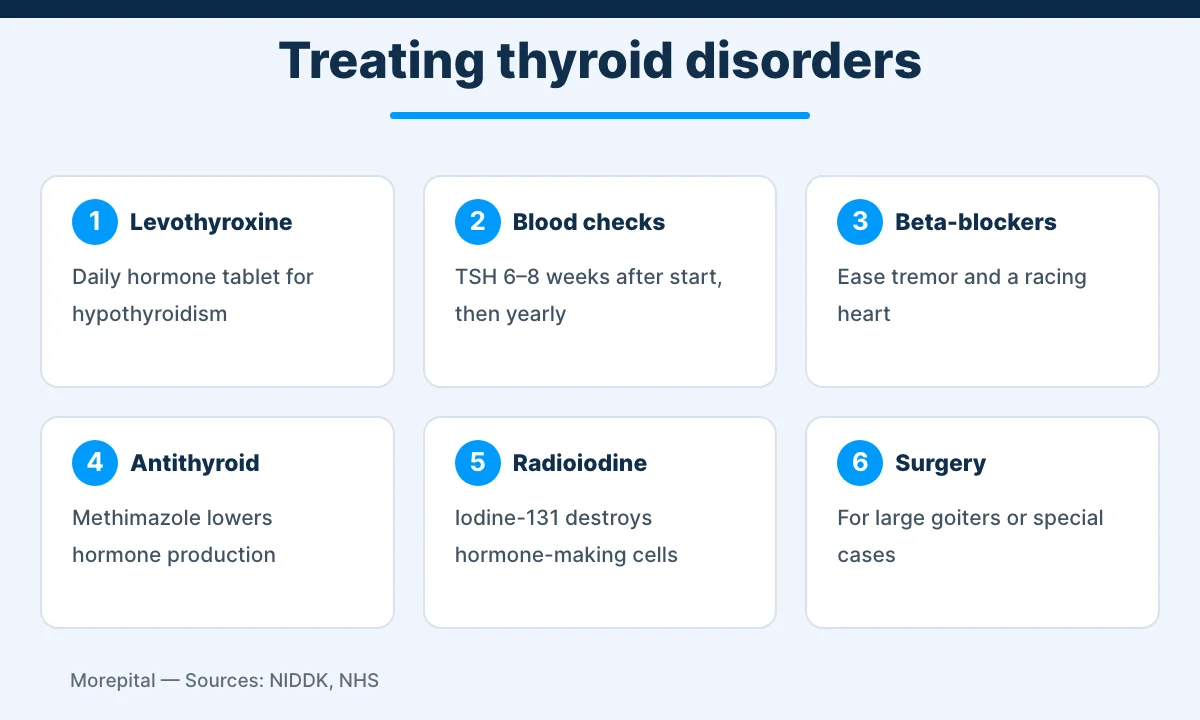
Treating an underactive thyroid
Hypothyroidism is usually treated with levothyroxine, a daily tablet that replaces the missing hormone. Treatment is usually lifelong. It is often taken in the morning before eating, and a blood test is done about 6–8 weeks after starting, with dose changes and retesting after each adjustment. Once the dose is stable, testing is repeated after 6 months and then yearly. Too high a dose can cause side effects such as nausea, diarrhea, headaches and sleep problems, and over the long term problems such as atrial fibrillation or osteoporosis, so never change or stop the medicine without talking to your doctor.
Source: NIDDK (NIH), NHS, American Family Physician (AAFP)
American Family Physician notes that starting doses are based on body weight for younger adults without heart disease, while people over 60 or with heart disease usually start on a lower dose that is increased gradually. Most people find their thyroid symptoms improve as hormone levels return to normal.
Source: American Family Physician (AAFP)
Treating an overactive thyroid
- Beta-blockers ease tremor and a rapid heartbeat quickly but do not lower hormone production.
- Antithyroid medicines reduce hormone production. Methimazole is used most often; propylthiouracil is used in the first 3 months of pregnancy. Side effects can include rashes, a low white blood cell count and, rarely, liver failure.
- Radioactive iodine (iodine-131) destroys the hormone-making thyroid cells. It is not used during pregnancy or breastfeeding, and nearly everyone develops hypothyroidism afterwards, which is easier to manage.
- Thyroid surgery is used less often, for example for large goiters or in pregnant women who cannot take antithyroid medicines.
- Radiofrequency ablation is an emerging option for overactive nodules, mainly when other treatments fail.
Source: NIDDK (NIH)
Because antithyroid medicines can rarely lower white blood cells, report a fever or sore throat to your doctor promptly while taking them. Thyroiditis-related overactivity is usually managed differently, because antithyroid medicines are not used for thyroiditis.
Source: NIDDK (NIH)
When thyroid symptoms need a doctor or emergency care
See a doctor if you have thyroid symptoms, especially if several of them appear together or persist for weeks. It helps to write down your symptoms, when they started and any medicines or supplements you take. Also see a doctor if you notice swelling or a lump in your neck, if you are pregnant or planning a pregnancy and have thyroid disease, or if you feel persistently low, anxious or exhausted in the year after giving birth. Unexplained weight changes are worth checking too; if weight gain is the main concern, our reference page on obesity covers other causes and treatments.
Source: NHS, NHS, American Thyroid Association
Emergency signs
Seek emergency care straight away for:
- Possible thyroid storm in someone with hyperthyroidism: agitation or restlessness, confusion or reduced alertness, fever, a rapid pounding heartbeat, shaking, sweating and diarrhea. It can be triggered by infection, trauma or a heart attack and is treated in intensive care.
- Possible myxedema coma in someone with severe hypothyroidism: difficulty breathing, extreme drowsiness or lethargy, low body temperature, low blood pressure and a slow heartbeat.
- Sudden vision changes, double vision or painful bulging eyes.
Source: MedlinePlus, Cleveland Clinic, Cleveland Clinic, NHS
Thyroid symptoms: frequently asked questions
What are the first thyroid symptoms people usually notice?
With an underactive thyroid, tiredness, feeling cold, weight gain and constipation are often the first changes, and they develop slowly. With an overactive thyroid, people often first notice anxiety, a racing heart, weight loss, sweating or shaky hands.
Can thyroid symptoms come and go?
They can change over time. Thyroiditis, including postpartum thyroiditis, can cause an overactive phase followed by an underactive phase, and most women recover normal function within 12–18 months.
Source: American Thyroid Association, NIDDK (NIH)
Are thyroid symptoms different in women?
The core symptoms are the same, but thyroid disease is more common in women, can cause heavy, irregular or missed periods and fertility problems, and needs special care in pregnancy and after birth.
Source: NIDDK (NIH), NIDDK (NIH), NHS
Which blood test checks for thyroid symptoms?
A TSH test is the usual first step, often with free T4. T3, antibody tests and scans are added when needed to find the cause or check for hyperthyroidism.
Source: American Thyroid Association, American Family Physician (AAFP)
Can a thyroid problem cause anxiety or depression?
Yes. Low mood and depression are common with an underactive thyroid, while anxiety, irritability and mood swings are common with an overactive thyroid. A thyroid test is reasonable when these symptoms appear alongside physical changes.
Is hypothyroidism treatment lifelong?
Usually, yes. Levothyroxine is normally taken for life, with regular blood tests to keep the dose right, although temporary hypothyroidism from thyroiditis may resolve.
Source: NHS, NIDDK (NIH)
Can I treat thyroid symptoms with iodine or seaweed supplements?
Not without medical advice. Large amounts of iodine from seaweed or supplements can cause or worsen hypothyroidism in people with autoimmune thyroid disease and can also trigger hyperthyroidism.
Source: NIDDK (NIH), NIDDK (NIH)
Disclaimer: this article is for general health education and does not replace advice from a qualified doctor who can assess your individual case. Last updated: October 2026.