
Hair transplant
Hair restoration surgery (FUE / FUT)
A hair transplant is an outpatient surgery that moves healthy hair follicles, usually from the back of the scalp, to thinning or bald areas. It is done under local anesthetic using the FUE or FUT technique, and the new hair grows in gradually, with full results after about 12 to 18 months.
Source: NHS, Cleveland Clinic, American Academy of Dermatology
- What is a hair transplant?
- Who is a good candidate (and who is not)
- How to prepare
- How a hair transplant is done, step by step
- Recovery timeline
- Results and how long they last
- Risks and complications
- Alternatives to a hair transplant
- Choosing a surgeon or clinic, at home or abroad
- When to call your doctor
- FAQ
- Sources
What is a hair transplant?
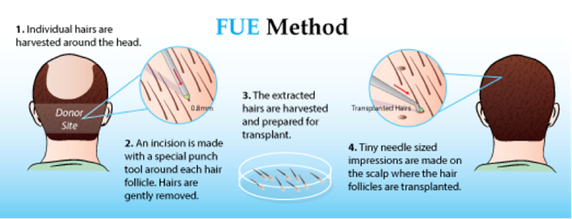
A hair transplant is a surgical procedure that moves healthy hair from one part of the body, usually the back of the scalp, to an area that has become thin or bald. It is also known as hair restoration or hair replacement surgery, and it is performed by dermatologists or plastic surgeons. The hair at the back and sides of the head tends to resist the type of loss seen in pattern baldness, so when it is relocated it generally keeps growing in its new place.
Source: Cleveland Clinic, NHS
Hair grows naturally in tiny clusters called follicular units, each holding one to three hairs and occasionally four or more. Modern surgery harvests and replants these units one by one, which is why today’s results can look far more natural than the older “plug” grafts. The surgeon makes very small cuts in the thinning area and places the grafts into them.
Source: Sharma & Ranjan, J Maxillofac Oral Surg 2019 (PMC), NHS
The two main techniques: FUT and FUE
- FUT (follicular unit transplantation, the “strip” method): a strip of hair-bearing scalp is removed from the back of the head and divided into grafts of 1 to 4 hairs. The wound is stitched, leaving a fine linear scar that is usually hidden unless the hair is cut very short.
- FUE (follicular unit extraction or excision): the donor area is shaved and individual follicular units are removed one at a time with a tiny punch, typically 0.7 to 1 mm wide. This leaves many small dot-like scars that are less noticeable, which suits people who like to wear their hair very short.
Source: NHS, Sharma & Ranjan, J Maxillofac Oral Surg 2019 (PMC), American Academy of Dermatology
Neither method is right for everyone. FUE takes longer and needs a larger donor area, while FUT can be preferred when follicles are hard to extract individually. Older approaches such as scalp reduction, flap surgery and tissue expansion are still used in selected cases, for example after burns or injuries.
Source: Sharma & Ranjan, J Maxillofac Oral Surg 2019 (PMC), Cleveland Clinic
Who is a good candidate (and who is not)
According to the American Academy of Dermatology, men and women of all races can be good candidates for a hair transplant. Two conditions matter most: you need enough healthy hair on the scalp to move to the thinning area, and the thinning area must still be able to grow hair. A dermatologist checks this with a scalp examination and sometimes a blood test or a scalp biopsy.
Source: American Academy of Dermatology
Cleveland Clinic describes the ideal candidate as someone in good general health, with realistic expectations and areas of thick hair growth left on the scalp. Surgery is usually considered for people who have already tried other hair loss treatments.
Source: Cleveland Clinic
Conditions it can help
The procedure is best suited to permanent, inherited hair loss, known as male or female pattern baldness (androgenetic alopecia). It can also restore hair lost to scars from injuries or burns.
Source: NHS, Cleveland Clinic
When it may not be suitable
- Patchy hair loss (alopecia areata): the NHS says a hair transplant is usually not suitable for this condition, while Cleveland Clinic lists alopecia areata among the conditions that may be treated. The difference reflects that alopecia areata is an autoimmune problem in which hair often regrows or the disease stays active, so a specialist assessment is essential.
- Diffuse thinning across the whole scalp: some women have thinning everywhere, which can leave too little healthy donor hair to transplant.
- Young men with early loss: men in their 20s may be asked to wait and start hair loss medicine first, because the pattern of loss is still changing.
- Unrealistic expectations: a fuller head of hair is a realistic goal, but a complete head of hair may not be.
Source: NHS, Cleveland Clinic, American Academy of Dermatology
How to prepare
Preparation starts with a consultation. The surgeon should take a full medical history, including any medicines, allergies, smoking and diabetes, and examine both the donor area and the area to be treated. Hidden medical issues can matter: a published case series describes a dangerous rise in blood pressure during surgery in a patient who had not mentioned he was taking propranolol.
Source: Garg & Garg, Indian J Plast Surg 2021 (PMC)
Smoking and poorly controlled diabetes are linked to wound problems after surgery, so it makes sense to discuss stopping smoking and optimizing blood sugar with your doctor beforehand. You should also ask the surgeon which technique they recommend and why, how many grafts or sessions you are likely to need, and what follow-up is offered if problems arise.
Source: Garg & Garg, Indian J Plast Surg 2021 (PMC), NHS
Because hair loss usually continues after surgery, your dermatologist may suggest starting a hair loss medicine before or alongside the transplant to protect the hair you still have.
Source: American Academy of Dermatology
How a hair transplant is done, step by step
- Planning: the surgeon designs the new hairline and decides how many grafts are needed, keeping future hair loss in mind so the result still looks natural years later.
- Anesthesia: the scalp is numbed with local anesthetic. Most people stay awake, and some receive a mild sedative.
- Harvesting: grafts are taken either as a strip of scalp (FUT) or as individual follicular units (FUE).
- Graft preparation: the grafts are sorted and kept in a cold storage solution until they are implanted. Research summarized in a 2019 review shows that grafts stay highly viable for about two hours outside the body, with survival falling the longer they wait.
- Implantation: the surgeon makes tiny cuts in the thinning area and places each graft at the correct angle and direction.
- Dressing: the scalp is bandaged and you receive home-care instructions.
Source: NHS, American Academy of Dermatology, Sharma & Ranjan, J Maxillofac Oral Surg 2019 (PMC)
A session usually takes 4 to 8 hours. Very large transplants may require you to come back the next day for a few more hours, and extensive bald areas may need two or more sessions on different days, often several months apart. A team of two or three people usually assists the doctor.
Source: American Academy of Dermatology, NHS, Cleveland Clinic
Most hair transplants are outpatient procedures, so you can go home the same day without an overnight stay.
Source: NHS, Cleveland Clinic
Recovery timeline
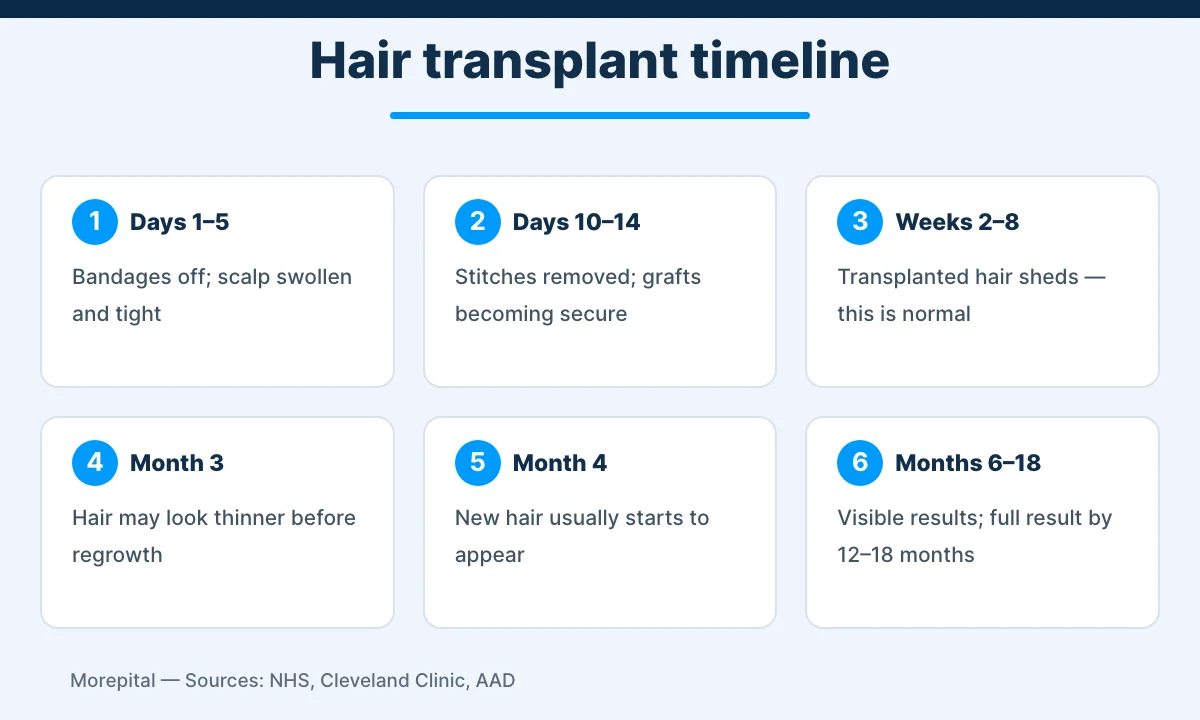
Expect a tight, achy and swollen scalp for a few days, along with scabbing, itching and some numbness. Swelling can spread to the forehead or around the eyes. The grafts are fragile at first, so for the first two weeks you must treat the area very gently.
Source: NHS, Cleveland Clinic, Garg & Garg, Indian J Plast Surg 2021 (PMC)
| Time after surgery | What usually happens |
|---|---|
| Day 1–5 | Bandages come off (Cleveland Clinic says day 1; the NHS says days 2 to 5). Do not touch the grafts. |
| Day 2–6 | Gentle hair washing begins: day 2 according to Cleveland Clinic, day 6 according to the NHS. Follow your own surgeon’s instructions. |
| Day 3 to 2 weeks | Return to work: Cleveland Clinic says days 3 to 5 for light activities; the NHS says people typically need 1 to 2 weeks off. |
| Day 10–14 | Non-dissolving stitches are removed (mainly after FUT). |
| 2–8 weeks | Transplanted hair sheds. This is normal and expected. |
| 3–4 weeks onward | Exercise and sports can usually resume; the NHS advises reducing exercise for the first month to limit scarring. |
| Around 3 months | Hair may look thinner than before surgery; this is a normal phase. |
| About 4 months | New hair usually starts to appear. |
| 6–18 months | Most people see results at 6 to 9 months; full results take up to 12 to 18 months. |
Source: NHS, Cleveland Clinic, American Academy of Dermatology
Results and how long they last
When done well, a hair transplant can give permanent, natural-looking results, although the final outcome depends heavily on the surgeon. The transplanted hair comes from areas that usually resist pattern baldness, which is why it tends to last.
Source: American Academy of Dermatology, Cleveland Clinic
The new hair does not stop the hair around it from thinning. Pattern hair loss can keep progressing in the untransplanted hair, so a dermatologist may recommend medicine to protect your result. In a large single-surgeon series of 2,896 patients, most of the people who were unhappy with their outcome were disappointed because of loss of their original, non-transplanted hair rather than failure of the grafts.
Source: American Academy of Dermatology, NHS, Garg & Garg, Indian J Plast Surg 2021 (PMC)
Patience is part of the process. Some people need one or more touch-up sessions to achieve a natural, even look, and the full result can take a year or more to judge.
Source: Cleveland Clinic, NHS
Risks and complications
Hair transplant surgery is generally considered safe, and serious complications are uncommon. In the 2,896-patient series mentioned above, no significant or life-threatening complications were recorded, and the authors concluded that most complications are avoidable with careful planning and technique.
Source: Garg & Garg, Indian J Plast Surg 2021 (PMC)
Common, usually temporary side effects
- Swelling, tightness, pain or throbbing
- Crusts, scabs and itching
- Numbness or reduced feeling in the scalp, usually settling within weeks
- Small pimple-like bumps (folliculitis), the most frequent minor problem in published series
- “Shock loss”: temporary shedding of existing hair near the treated area, usually 3 to 4 weeks after surgery, with regrowth within a few months
Source: Cleveland Clinic, NHS, Garg & Garg, Indian J Plast Surg 2021 (PMC)
Less common complications
- Bleeding, infection or an allergic reaction to the anesthetic
- Grafts that fail to take, leading to poor growth
- Noticeable scarring, including a wide strip scar or pale dot scars after FUE
- Areas of skin damage (necrosis), more likely in smokers and people with diabetes
- An over-harvested, patchy donor area if too many grafts are taken
- An unnatural hairline when grafts are placed at the wrong angle or design
Source: NHS, Cleveland Clinic, Garg & Garg, Indian J Plast Surg 2021 (PMC), Sharma & Ranjan, J Maxillofac Oral Surg 2019 (PMC)
The International Society of Hair Restoration Surgery (ISHRS) warns that many of the worst outcomes it sees, such as visible scarring, poor growth and depleted donor areas, come from clinics where unlicensed technicians perform the surgery.
Source: ISHRS
Alternatives to a hair transplant
Surgery is not the only option, and for many people medicine comes first. Starting treatment soon after noticing hair loss tends to give better results.
Source: American Academy of Dermatology
- Minoxidil: a non-prescription solution or foam applied to the scalp. Results can take months (2 to 4 months according to Cleveland Clinic, 6 to 12 months according to the AAD), and the benefit is lost when you stop.
- Finasteride: a prescription tablet for men that slowed further hair loss in about 80% to 90% of men taking it, according to the AAD. Results appear in about 6 months and fade after stopping.
- Platelet-rich plasma (PRP): injections of a concentrate from your own blood, given monthly at first and then every few months. It can be used alone or before a transplant but needs ongoing maintenance.
- Laser devices: home-use devices exist; some are FDA cleared, which involves less scrutiny than FDA approval.
Source: American Academy of Dermatology, Cleveland Clinic
Choosing a surgeon or clinic, at home or abroad
The skill and experience of the surgeon have the biggest influence on how your result looks. Choose a doctor who understands hair loss and performs hair transplants regularly. In the UK, the NHS advises checking that the clinic is registered with the Care Quality Commission, that the surgeon is registered with the General Medical Council, and whether the surgeon belongs to the British Association of Hair Restoration Surgery.
Source: American Academy of Dermatology, NHS
Questions to ask
- What are your qualifications, and how many hair transplants have you performed?
- How many of your patients have had complications?
- Which technique do you recommend for me, and why?
- Who will make the incisions and harvest the grafts: you or a technician?
- What follow-up do you offer if something goes wrong?
Hair transplant abroad
Many people travel to countries such as Turkey for hair restoration. The ISHRS reports that some clinics attracting patients from abroad have procedures performed mostly by technicians without medical licenses. Its advice is to confirm that a licensed physician will perform the surgery, ask about everyone’s training and role, check malpractice insurance, and be wary of advertising that promises very low prices or guaranteed results. Our guide to hair transplant in Turkey covers planning a trip in more detail, and specialised centres such as Hair Cultivate focus solely on hair restoration.
Source: ISHRS
Cost
Because it is cosmetic surgery, a hair transplant is not available on the NHS, and insurance rarely covers elective cosmetic procedures. In the UK, the NHS gives a range of about £1,000 to £30,000, depending on how much hair is lost, the technique used and the clinic.
Source: NHS, Cleveland Clinic
When to call your doctor
Some soreness, swelling and scabbing are normal after a hair transplant. Contact your clinic as soon as possible if you have severe pain or symptoms you did not expect.
Source: NHS
- You have a fever that does not go away
- Your scalp bleeds heavily or will not stop bleeding
- The scalp becomes very red or severely painful
- You notice green or yellow pus or other signs of infection at the incisions
- Areas of the scalp turn dark or dusky, or form thick black crusts
Source: Cleveland Clinic, Garg & Garg, Indian J Plast Surg 2021 (PMC)
If you are unhappy with the result or think the procedure was poorly performed, talk to your surgeon first. In the UK you can raise concerns with the Care Quality Commission or the General Medical Council.
Source: NHS
Related conditions
Further reading
Hair transplant: frequently asked questions
Is a hair transplant permanent?
The transplanted hair is usually permanent because it comes from areas that resist pattern baldness. However, your original hair can keep thinning, so medicine may be recommended to maintain the overall result.
How long does a hair transplant take?
A session usually lasts 4 to 8 hours. Very large transplants may need a few more hours the next day, and extensive baldness may need more than one session.
Source: American Academy of Dermatology, NHS
Does a hair transplant hurt?
The scalp is numbed with local anesthetic, sometimes with sedation, so you stay awake but should not feel pain during surgery. Afterwards the scalp is usually tight, achy and swollen for a few days.
Source: NHS
When will I see results after a hair transplant?
Transplanted hair sheds within 2 to 8 weeks, new growth usually starts around 4 months, and most people see results at 6 to 9 months. Full results can take 12 to 18 months.
Source: American Academy of Dermatology, NHS
What is the difference between FUE and FUT?
FUT removes a strip of scalp and leaves a fine linear scar; FUE removes follicles one by one and leaves tiny dot scars. FUE suits short hairstyles but takes longer.
Source: NHS, American Academy of Dermatology, Sharma & Ranjan, J Maxillofac Oral Surg 2019 (PMC)
How much time off work do I need?
Sources differ: Cleveland Clinic says many people return to light work in 3 to 5 days, while the NHS says 1 to 2 weeks off is typical.
Source: Cleveland Clinic, NHS
Can women have a hair transplant?
Yes. Women can be good candidates if they have enough healthy donor hair, but thinning across the whole scalp may rule it out.
Source: American Academy of Dermatology
Can a hair transplant treat alopecia areata?
Usually not. The NHS says it is generally unsuitable for patchy alopecia areata, though Cleveland Clinic lists it among conditions that may be treated, so a specialist must assess each case.
Source: NHS, Cleveland Clinic
What are the risks of a hair transplant?
Common effects are swelling, scabbing, numbness and temporary shedding. Less often, infection, bleeding, poor graft growth, scarring or skin damage can occur.
Source: NHS, Cleveland Clinic, Garg & Garg, Indian J Plast Surg 2021 (PMC)
Considering a hair transplant? Contact us for a free consultation about your case.
Sources
- NHS — Hair transplant
- Cleveland Clinic — Hair Transplant: How Does It Work, Success Rates
- American Academy of Dermatology — A hair transplant can give you permanent, natural-looking results
- American Academy of Dermatology — What is male pattern hair loss, and can it be treated?
- Cleveland Clinic — Male Pattern Baldness (Androgenic Alopecia): Stages, Treatment
- Cleveland Clinic — Hair Replacement Surgery
- Indian Journal of Plastic Surgery (PMC) — Complications of Hair Transplant Procedures—Causes and Management (Garg & Garg, 2021)
- Journal of Maxillofacial & Oral Surgery (PMC) — Follicular Unit Extraction (FUE) Hair Transplant: Curves Ahead (Sharma & Ranjan, 2019)
- ISHRS — Fight the FIGHT campaign against fraudulent hair restoration practices
This page is part of the Morepital medical reference. It is for general health education and does not replace a consultation with a qualified doctor. Last reviewed: October 2026.