
Male pattern baldness
Androgenetic alopecia
Male pattern baldness (androgenetic alopecia) is a common, inherited form of hair loss in which DHT gradually shrinks scalp hair follicles, causing a receding hairline and thinning crown. It is permanent without treatment, but minoxidil, finasteride and hair transplant surgery can slow or partly reverse it.
Source: Cleveland Clinic, MedlinePlus Genetics, NHS
- What is male pattern baldness?
- Symptoms and signs
- Causes and risk factors
- Stages: the Norwood (Hamilton-Norwood) scale
- Diagnosis
- Treatment options
- Complications and associated conditions
- Prevention and living with male pattern baldness
- When to see a doctor
- FAQ
- Sources
What is male pattern baldness?
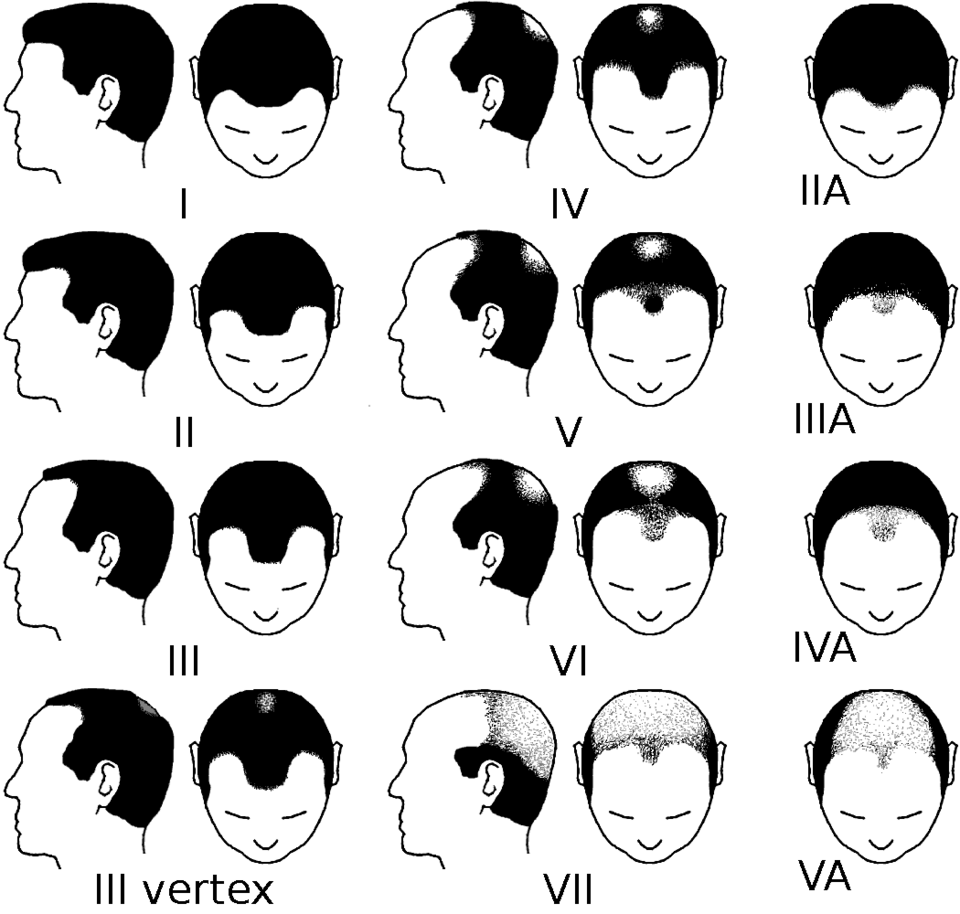
Male pattern baldness is the most common cause of thinning hair and balding in adult men. Doctors call it androgenetic alopecia because it results from the combined effect of androgens (male sex hormones) and an inherited sensitivity of certain scalp hair follicles to those hormones. Hair is lost in a predictable pattern: the hairline recedes at the temples and the hair thins on the crown, and the lost hair does not grow back on its own.
Source: DermNet, Cleveland Clinic
Male pattern baldness is extremely common, but published figures vary between sources. MedlinePlus Genetics estimates that it affects about 50 million men in the United States and that more than half of men over 50 have some degree of hair loss. Cleveland Clinic states that it affects about two-thirds of men, that about 25% notice the first signs before age 21 and that about half have hair loss by age 50. DermNet reports that up to half of white men are affected by 50 and possibly up to 80% by 70, while a 2023 review on PMC cites about 30% of white men by age 30 and about 80% of men aged 70 or older.
Source: MedlinePlus Genetics, Cleveland Clinic, DermNet, Kaiser et al., PMC 2023
Male pattern baldness is not contagious and does not harm physical health in itself. It can, however, affect self-esteem and emotional well-being, and studies have linked hair loss with low self-confidence and depression. The NHS describes it as a permanent type of hair loss that usually runs in families, and notes that most hair loss does not need treatment unless it causes distress.
Source: Cleveland Clinic, DermNet, NHS
Symptoms and signs
Male pattern baldness develops gradually over years rather than suddenly. The typical signs are:
- A receding hairline that starts above both temples and often forms an “M” shape.
- Thinning or loss of hair on the crown (vertex), often in a roughly circular area.
- Hairs that become progressively finer and shorter before they stop growing.
- In later stages, the bald areas at the front and crown join, leaving a horseshoe (“U”) of hair around the sides and back of the head.
Source: MedlinePlus Genetics, Cleveland Clinic, DermNet
In male pattern baldness the scalp itself usually looks healthy, without redness, scaling, pain or scarring. The hair at the back and sides of the head is typically preserved, which is why it can be used as donor hair in a hair transplant. Normal daily shedding of about 50 to 100 hairs is not a sign of balding on its own.
Male pattern baldness is different from telogen effluvium, which is sudden, usually temporary shedding triggered by stress, illness or hormonal changes. Sudden patchy loss, itching, flaking or a painful scalp suggest another cause and are a reason to see a doctor.
Source: Cleveland Clinic
Causes and risk factors
Hormones: the role of DHT
The key hormone behind male pattern baldness is dihydrotestosterone (DHT), an androgen produced from testosterone by the enzyme 5-alpha reductase. In genetically susceptible follicles, DHT shortens the anagen (growth) phase of the hair cycle from several years to weeks or months. With each cycle the follicle miniaturizes, so thick terminal hairs are gradually replaced by short, fine, almost invisible vellus hairs until the follicle stops producing visible hair.
Source: DermNet, MedlinePlus Genetics, Kaiser et al., PMC 2023
Genetics
Male pattern baldness tends to run in families, and having a close relative with patterned hair loss is a risk factor. The only gene confirmed so far is the AR gene on the X chromosome, which carries the instructions for the androgen receptor; certain variants may make hair-follicle receptors more easily activated. Several other genes, inherited from either parent, are suspected, so the inheritance pattern is not simple. DermNet notes that genetic tests are currently unreliable for predicting who will go bald.
Source: MedlinePlus Genetics, Cleveland Clinic, DermNet
Other risk factors
- Age: the risk rises steadily with age, although the process can begin in the teens.
- Family history: Cleveland Clinic notes a higher risk if a father, brother or grandfather is affected, and states that a bald father roughly doubles the likelihood.
- Ethnic background: male pattern baldness is most common in white men, followed by men of African-Caribbean descent, and less common in Chinese and Japanese men.
Source: MedlinePlus Genetics, Cleveland Clinic, DermNet
Cleveland Clinic also notes that stress may increase androgen activity, which is one reason stress management is part of its general hair-care advice.
Source: Cleveland Clinic
Stages: the Norwood (Hamilton-Norwood) scale
Doctors grade the severity of male pattern baldness with the Hamilton-Norwood scale, which has seven main stages. DermNet also mentions the Sinclair scale as another grading system.
| Stage | What it looks like |
|---|---|
| 1 | Little or no hair loss or hairline recession |
| 2 | Slight recession near the temples |
| 3 | Deep recession at the temples; the hairline may look M- or U-shaped |
| 4 | Very deep frontal recession plus hair loss on the crown |
| 5 | The receding front comes close to the bald area on the crown |
| 6 | Hair between the temples and the crown is very thin or gone |
| 7 | Only a narrow band of hair remains around the sides and back of the head |
Source: Cleveland Clinic, DermNet
The stage of male pattern baldness helps a doctor decide which treatments are realistic. Medicines tend to work best when there are still many miniaturized hairs to rescue; MedlinePlus notes that topical minoxidil works best in men under 40 with recent hair loss and does not restore a receding hairline. A 2023 review adds that finasteride gives its strongest response at the crown and a smaller response at the front.
Source: MedlinePlus, Kaiser et al., PMC 2023
Diagnosis
Male pattern baldness is usually recognized from its typical pattern. A doctor or dermatologist confirms the diagnosis by examining the scalp and asking when the hair loss started, how fast it is progressing and whether relatives are affected. A GP may be able to identify the cause just by looking at the hair.
Source: Cleveland Clinic, NHS
Some clinics measure hair follicle thickness with a densitometer. If another cause is suspected, the doctor may look for a scalp infection, analyze a sample of hair, take a small scalp biopsy or order blood tests, for example to look for iron deficiency, which can also cause hair loss.
Source: Cleveland Clinic, DermNet, NHS
Before starting treatment, it is reasonable to ask your doctor how they can tell the hair loss is male pattern baldness, what else could be causing it, and whether you should see a dermatologist or a plastic surgeon.
Source: Cleveland Clinic
Treatment options
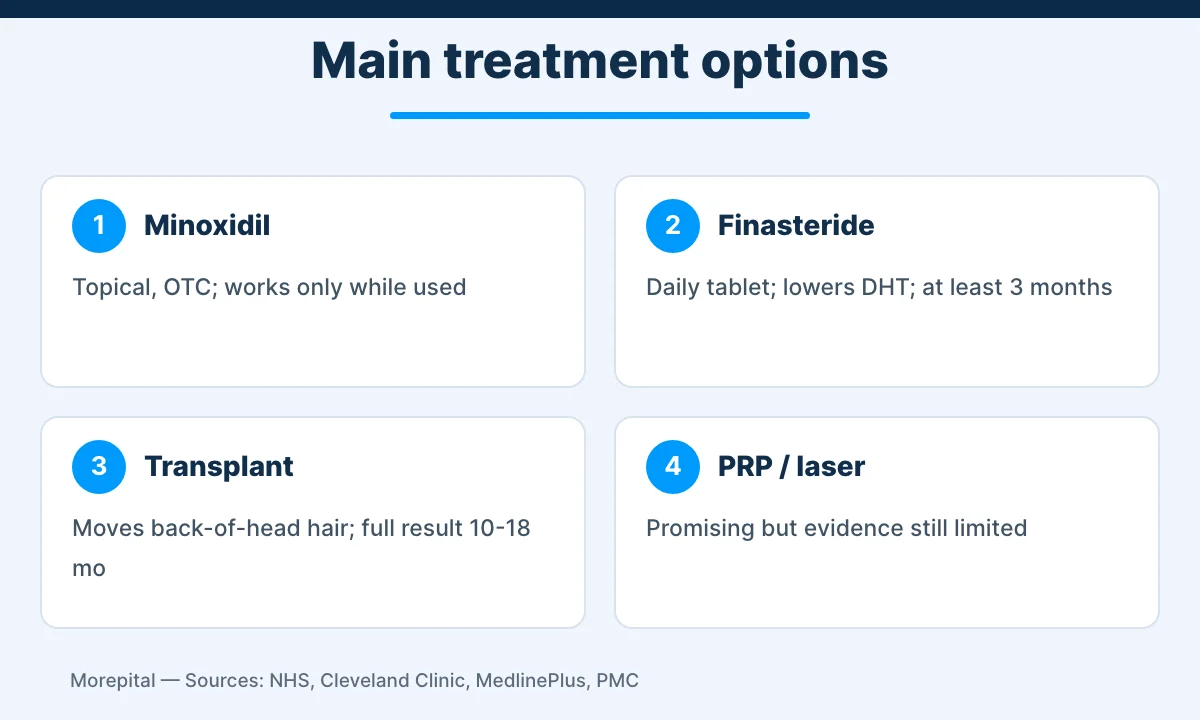
There is no cure for male pattern baldness, and no treatment is 100% effective. Treatment can slow the loss, regrow some hair or replace hair in bald areas, but medicines only work for as long as they are used. Many men choose not to treat it at all. Several treatments are not available on the NHS and must be paid for privately.
Source: NHS, Cleveland Clinic
Minoxidil (topical)
Minoxidil solution or foam is applied to the dry scalp, usually twice a day, and is available without a prescription. It is usually the first treatment tried. Sources give different timelines: Cleveland Clinic says improvement may take 2 to 4 months of daily use, MedlinePlus advises using it for at least 4 months and possibly up to a year before judging the effect, and a 2023 review reports that effects begin at 6 to 8 weeks and level off at 12 to 16 weeks. In men, the 5% strength is more effective than 2%. Most new hair is lost within a few months of stopping. Common side effects are scalp itching, dryness, flaking and irritation; temporary extra shedding and unwanted hair growth can also occur.
Source: Cleveland Clinic, MedlinePlus, Kaiser et al., PMC 2023
Finasteride (oral)
Finasteride is a prescription tablet that blocks type II 5-alpha reductase and so lowers DHT. It was approved by the US FDA for male pattern hair loss at 1 mg a day in 1997. Visible improvement may take at least 3 months; if there is no improvement after 12 months, further treatment is unlikely to help. Regrown hair is usually lost within about 12 months of stopping. Possible side effects include erection problems, lower sex drive, ejaculation problems and testicular pain; rarer serious effects include breast changes, allergic reactions and new or worsening depression. Women who are or may become pregnant must not handle broken or crushed tablets.
Source: MedlinePlus, Kaiser et al., PMC 2023, NHS
Other medicines
Dutasteride, which blocks both types of 5-alpha reductase, has outperformed finasteride in a trial reported in a 2023 review, but it was first approved for an enlarged prostate. Low-dose oral minoxidil is used off-label and can increase hair growth, with excess body hair as a common side effect. Topical finasteride, ketoconazole shampoo and clascoterone are other options or are still under study. These should only be used under a doctor’s supervision.
Source: Kaiser et al., PMC 2023, DermNet
Hair transplant
For advanced male pattern baldness, a hair transplant moves hair-bearing follicles from the back of the head to thinning or bald areas, using either the strip method (FUT) or follicular unit extraction (FUE). It is cosmetic surgery, so the NHS does not offer it. Full results take 10 to 18 months, and medicines are often continued afterwards because a transplant does not stop the underlying hair loss. Specialized hair-transplant centers such as Hair Cultivate focus on this procedure; whichever clinic you choose, check the surgeon’s registration and experience first.
Source: NHS, Kaiser et al., PMC 2023, Cleveland Clinic
PRP, laser and microneedling
Platelet-rich plasma (PRP) therapy uses a concentrate of your own blood injected into the scalp, and repeat sessions are usually needed. Low-level laser therapy uses devices with red or near-infrared light, and microneedling is often combined with minoxidil. A 2023 review found encouraging results for PRP and laser but noted small studies and a lack of standardized protocols; DermNet describes the benefit of PRP as still uncertain and that of laser as unproven.
Source: Cleveland Clinic, Kaiser et al., PMC 2023, DermNet
Cosmetic options
Hairstyles, wigs, hair pieces and scalp micropigmentation (a tattoo that mimics short hair) can conceal male pattern baldness without medical treatment. Some wigs are available on the NHS.
Source: NHS, Cleveland Clinic, DermNet
Complications and associated conditions
Male pattern baldness does not damage general health, but it is permanent without treatment and can cause stress, anxiety and depression. Your GP may be able to arrange counseling, and support groups can help.
Source: Cleveland Clinic, NHS
MedlinePlus Genetics reports that male pattern baldness has been associated with a higher risk of coronary heart disease, an enlarged prostate, prostate cancer, insulin-resistance disorders such as diabetes and obesity, and high blood pressure. Researchers think some of these links may relate to androgen levels. An association does not mean that baldness causes these diseases, but it can be a reason to keep up with routine health checks.
Source: MedlinePlus Genetics
Treatments for male pattern baldness also carry their own risks. A hair transplant can cause bleeding, infection, scarring, graft failure and ongoing thinning around the transplanted area, and PRP can cause scalp pain and irritation. Finasteride may raise the risk of high-grade prostate cancer and breast cancer according to MedlinePlus, and it may reduce fertility.
Source: NHS, Cleveland Clinic, MedlinePlus
Prevention and living with male pattern baldness
There is no known way to prevent male pattern baldness. Starting treatment early, while there are still many hairs to rescue, gives medicines the best chance to slow the process. General habits that support healthy hair include eating enough protein (about 40 to 60 grams a day), a Mediterranean-style diet, adequate vitamins and minerals such as iron and zinc, and managing stress.
Source: Cleveland Clinic, MedlinePlus
Many men accept male pattern baldness as a normal part of aging, and are comfortable without any treatment. If you consider a commercial hair clinic, the NHS advises speaking to a GP first. For any surgery, check that the surgeon is properly registered, ask how many procedures they have performed and how complications are handled, and be wary of clinics that rely on paid advertising.
Source: Cleveland Clinic, NHS, NHS
When to see a doctor
See a GP or dermatologist if your hair loss worries you or affects your well-being, if you want to keep your hair (treatment works best early), or if the loss is sudden, patchy or accompanied by itching, pain or a rash, which points to a different cause.
Source: NHS, Cleveland Clinic
- You have chest pain, a rapid heartbeat or trouble breathing while using minoxidil.
- Your face, lips or throat swell, or you have trouble breathing, after taking finasteride or minoxidil.
- You have thoughts of harming yourself while taking finasteride.
Source: MedlinePlus, MedlinePlus
After a hair transplant, contact the clinic promptly if you have severe pain or unexpected symptoms, such as signs of infection.
Source: NHS
Related treatments
Further reading
Male pattern baldness: frequently asked questions
Can male pattern baldness be reversed?
It cannot be cured, but minoxidil and finasteride can slow the loss and regrow some hair while they are used. A hair transplant can restore hair to bald areas.
Source: NHS, Cleveland Clinic
At what age does male pattern baldness start?
It can start in the late teens. Cleveland Clinic says about 25% of men notice signs before 21, and the risk rises with age.
Source: Cleveland Clinic, MedlinePlus Genetics
Is male pattern baldness inherited from the mother's side?
Partly. The AR gene is on the X chromosome, which men inherit from their mother, but other genes from either parent are also involved, so both sides of the family matter.
Source: MedlinePlus Genetics, DermNet
How long does minoxidil take to work?
Sources vary: from 2 to 4 months (Cleveland Clinic) to at least 4 months and up to a year (MedlinePlus). Hair gained is lost within months of stopping.
Source: Cleveland Clinic, MedlinePlus
What are the side effects of finasteride?
Possible effects include erection problems, lower libido, ejaculation problems and testicular pain; rarely breast changes, allergy or depression. Discuss them with your doctor.
Source: MedlinePlus
Does a hair transplant stop further hair loss?
No. Transplanted hair usually persists, but surrounding native hair can keep thinning, so many men continue medicines after surgery.
Source: NHS, Kaiser et al., PMC
Does PRP work for male pattern baldness?
Small studies show encouraging results, but evidence quality is low and protocols are not standardized; DermNet calls its benefit uncertain.
Source: Kaiser et al., PMC, DermNet
Can stress cause male pattern baldness?
It is caused mainly by genes and DHT. Stress may increase androgen activity, while sudden stress-related shedding is usually a different, temporary condition (telogen effluvium).
Source: Cleveland Clinic
Is male pattern baldness linked to other health problems?
It has been associated with heart disease, enlarged prostate, prostate cancer, diabetes, obesity and high blood pressure, though it does not cause them.
Source: MedlinePlus Genetics
Get a free hair-loss assessment
Sources
- NHS — Hair loss
- NHS — Hair transplant
- Cleveland Clinic — Male Pattern Baldness (Androgenic Alopecia): Stages, Treatment
- MedlinePlus Genetics — Androgenetic alopecia
- DermNet — Male pattern hair loss (androgenetic alopecia, balding)
- MedlinePlus — Finasteride: MedlinePlus Drug Information
- MedlinePlus — Minoxidil Topical: MedlinePlus Drug Information
- PMC — Treatment of Androgenetic Alopecia: Current Guidance and Unmet Needs (Kaiser et al., 2023)
This page is part of the Morepital medical reference. It is for general health education and does not replace a consultation with a qualified doctor. Last reviewed: October 2026.