
Liposuction
Lipoplasty (suction-assisted fat removal)
Liposuction is a cosmetic surgery that removes stubborn pockets of fat through a thin suction tube to reshape areas such as the abdomen, hips and thighs. It works best for healthy adults near their ideal weight with firm skin, and it is not a weight-loss or cellulite treatment. Final results show at 3 to 6 months and last if weight stays stable.
Source: Cleveland Clinic, ASPS, MedlinePlus
- What is liposuction?
- Who is a good candidate (and who is not)
- Preparing for liposuction
- How liposuction is done: step by step
- Recovery timeline after liposuction
- Liposuction results and how long they last
- Risks and complications
- Alternatives to liposuction
- Choosing a surgeon and having liposuction abroad
- When to call your doctor
- FAQ
- Sources
What is liposuction?
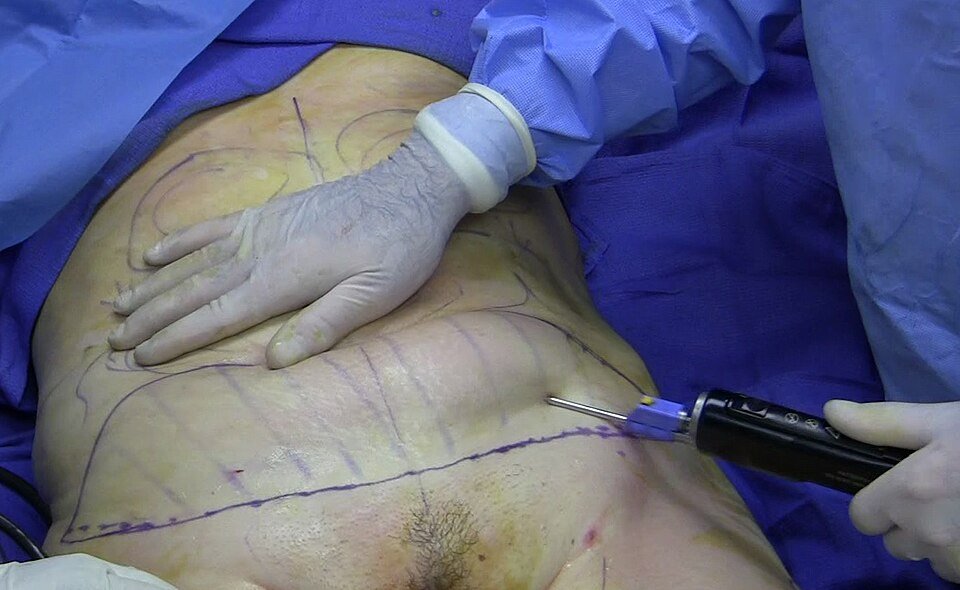
Liposuction (also called lipoplasty or simply “lipo”) is a cosmetic operation that uses suction to remove localized deposits of fat from beneath the skin. The surgeon passes a thin, hollow tube called a cannula through small incisions into the fat layer between the skin and the muscle, loosens the fat, and draws it out with a vacuum or a large syringe. The aim is to reshape and smooth a body contour, not to lower body weight.
Source: Cleveland Clinic, MedlinePlus
Liposuction permanently removes fat cells from the treated area, which is why it is used for stubborn pockets that have not responded to diet and exercise. Cleveland Clinic notes that it is one of the most common plastic surgery procedures, with more than 200,000 performed each year in the United States and an estimated 15% to 20% of plastic surgeries worldwide.
Source: Cleveland Clinic
Areas commonly treated
- Abdomen and waist
- Hips and flanks (“love handles”)
- Back and chest, including some types of male breast enlargement (gynecomastia)
- Face, cheeks, chin and neck
- Buttocks and thighs
- Inner knees, calves and ankles
- Upper arms
Source: ASPS, Cleveland Clinic
What liposuction cannot do
Liposuction is not a treatment for obesity and is not a substitute for healthy eating and exercise. It does not remove cellulite or stretch marks, and it cannot tighten loose, sagging skin. MedlinePlus adds that surgeons avoid certain sites, such as the fat on the sides of the breasts. When a patient has both excess fat and loose skin, liposuction is often combined with a skin-removing operation such as a tummy tuck (abdominoplasty).
Source: ASPS, NHS 111 Wales, MedlinePlus, Cleveland Clinic
Outside cosmetic surgery, the NHS notes that liposuction can be used for certain medical conditions, such as lymphedema and lipedema. The removed fat can also be harvested and reinjected elsewhere in the body (fat grafting), which is the basis of procedures such as the Brazilian butt lift.
Source: NHS 111 Wales, MedlinePlus
Who is a good candidate (and who is not)
Liposuction gives the best results in people who are close to a healthy weight and have a specific area of fat that resists lifestyle changes. Firm, elastic skin matters, because skin that has been stretched by pregnancy, major weight loss or aging may not shrink back smoothly over the new contour.
Typical candidates
- Adults of average or slightly above-average weight; the American Society of Plastic Surgeons (ASPS) describes this as being within about 30% of ideal weight
- Firm, elastic skin and good muscle tone
- Good general health, with no serious illness or condition that impairs healing
- Non-smokers and non-vapers
- Realistic, specific goals for body contouring
Source: ASPS, Cleveland Clinic
Who may not be suitable
- People who are underweight
- People with obesity looking for weight loss; Cleveland Clinic lists a body mass index (BMI) over 25 as a reason someone may not be a candidate
- People with serious or life-threatening conditions, or conditions that make wound healing difficult
- People with poor skin quality or significant loose skin (a skin-removal operation may be advised instead or in addition)
- People with unrealistic expectations
Source: Cleveland Clinic, ASPS
Age alone is not usually a barrier, although people over 65 may have less elastic skin. MedlinePlus advises that heart disease, high blood pressure, diabetes, lung problems and tobacco, alcohol or drug use should be identified and controlled before surgery.
Source: Cleveland Clinic, MedlinePlus
Preparing for liposuction
The process starts with a consultation. The surgeon reviews your medical history, medicines, allergies and goals, examines your skin and fat distribution, and explains which technique suits you. MedlinePlus notes that the assessment may include a psychological evaluation, and blood and urine tests may be requested. A surgeon should also check for hernias in the abdominal wall and whether abdominal fat lies under the skin or inside the abdomen, because liposuction only removes fat under the skin.
Source: Cleveland Clinic, MedlinePlus, Eplasty (PMC)
Typical instructions before surgery
- Complete lab tests or a medical evaluation
- Adjust or stop some medicines as directed
- Stop smoking and vaping, which reduce blood flow, slow wound healing and raise infection risk
- Avoid aspirin, anti-inflammatory drugs and herbal supplements that can increase bleeding
- Follow any diet or alcohol restrictions
- Arrange for someone to drive you to and from surgery and stay with you at least the first night
Source: ASPS, Cleveland Clinic, NHS 111 Wales
Most US health insurance plans do not cover cosmetic liposuction or its complications. ASPS reports an average surgeon’s fee of $4,711, a figure that excludes anesthesia, facility charges, tests, compression garments and medicines. NHS 111 Wales gives a typical private UK price range of about £3,000 to £8,500, depending on the provider and the areas treated.
Source: ASPS, NHS 111 Wales
How liposuction is done: step by step
- Marking: the surgeon marks the areas to be treated while you are standing.
- Anesthesia: local anesthesia, intravenous sedation or general anesthesia, depending on the extent of surgery. NHS 111 Wales says general anesthesia is usual in the UK, and an epidural may be used for the lower body.
- Infiltration: a solution of salt water, a local anesthetic (lidocaine) and epinephrine is injected into the fat to numb it, shrink blood vessels and reduce bleeding.
- Small incisions: tiny cuts are made in discreet places.
- Loosening and suction: the cannula is moved back and forth to break up the fat, which is suctioned out by vacuum or syringe, often working from several directions.
- Closing: excess fluid is drained, small drains may be left, and the incisions are stitched and covered.
- Compression: a compression garment or elastic bandage is applied.
Source: NHS 111 Wales, ASPS, Cleveland Clinic, MedlinePlus
NHS 111 Wales states that the operation usually takes 1 to 3 hours; Cleveland Clinic notes that the duration depends on how much fat is removed and how many areas are treated.
Source: NHS 111 Wales, Cleveland Clinic
Liposuction techniques
| Technique | How it works |
|---|---|
| Tumescent | Most common type; a large volume of dilute lidocaine and epinephrine solution is injected first, sometimes enough to be the only anesthetic |
| Super-wet | Similar, but the volume injected roughly equals the fat removed; faster, usually needs sedation or general anesthesia |
| Suction-assisted (traditional) | The cannula breaks up fat and a vacuum removes it |
| Power-assisted (PAL) | A vibrating cannula breaks up stubborn fat for easier, more precise removal |
| Ultrasound-assisted (UAL, VASER) | Ultrasonic energy liquefies fat; useful in dense, fibrous areas such as the upper back or male chest |
| Laser-assisted (LAL) | Laser energy liquefies fat through a thin fiber; suited to small areas such as the chin and jowls |
| Water-assisted | A pressurized saline jet loosens fat cells |
Source: MedlinePlus, Cleveland Clinic, ASPS
A review in Eplasty explains why fluid infiltration matters: in the old “dry” technique, 20% to 45% of the removed material was blood, whereas super-wet and tumescent techniques cut blood loss to under 1% of the aspirate. Removal of more than 5 liters (5,000 mL) of total aspirate is classed as large-volume liposuction, which ASPS recommends be done in an acute-care hospital with overnight monitoring.
Source: Eplasty (PMC), ASPS
Where it is done and hospital stay
Sources differ by health system. ASPS and Cleveland Clinic state that many procedures are outpatient, in an accredited office facility, surgery center or hospital, while large-volume cases need a hospital and possibly an overnight stay. NHS 111 Wales says most people in the UK stay in hospital overnight.
Source: ASPS, Cleveland Clinic, NHS 111 Wales
Recovery timeline after liposuction
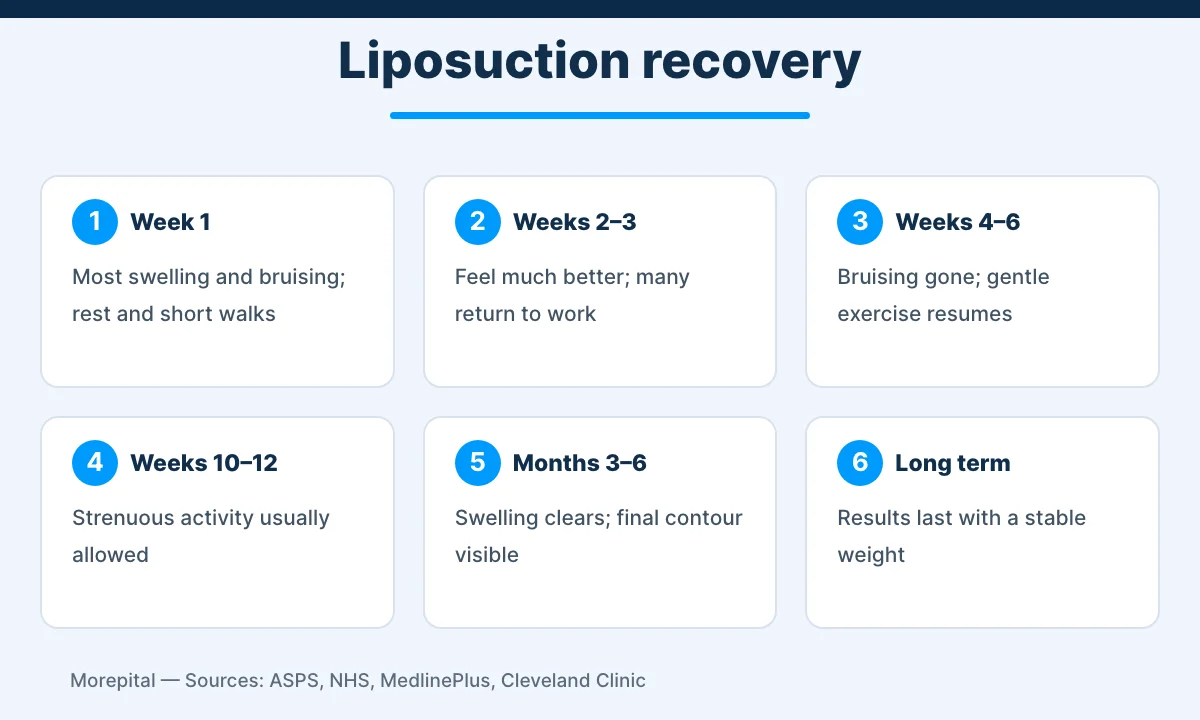
Bruising, swelling, numbness and soreness are expected. Pain is usually mild to moderate and often described as a burning sensation for a couple of days. Bandages stay on for some time, and a snug compression garment is worn constantly for several weeks; the Eplasty review advises up to 6 weeks. Walking soon after surgery helps prevent blood clots. Stitches are removed after about 5 to 10 days unless they dissolve.
Source: Cleveland Clinic, MedlinePlus, NHS 111 Wales, Eplasty (PMC)
| Time after surgery | What to expect |
|---|---|
| First 24 hours | Someone should take you home and stay with you |
| Week 1 | Most pain, swelling and bruising; activity strongly limited; stitches out at about a week |
| Weeks 1–3 | Most people feel much better; return to work possible depending on the job |
| Weeks 3–5 | Bruising fades; swelling begins to settle; gentle exercise often allowed from 3–4 weeks |
| Week 6 onward | Gradual return to normal activity and exercise |
| 10–12 weeks | Strenuous activity usually resumed (NHS advice) |
| 3–6 months | Remaining swelling resolves and final contour becomes clear |
Source: ASPS, NHS 111 Wales, MedlinePlus, Cleveland Clinic
Advice on returning to work varies. Cleveland Clinic and MedlinePlus say outpatient patients can often return within a few days, ASPS gives weeks 2–3 depending on the job, and the NHS says it depends on your work and how much of the body was treated. Check the plan with your own surgeon.
Source: Cleveland Clinic, MedlinePlus, ASPS, NHS 111 Wales
Liposuction results and how long they last
A change in shape starts to show within the first couple of weeks, with more visible improvement at 4 to 6 weeks. Because swelling takes time to clear, final results are usually judged at 3 to 6 months; NHS 111 Wales says this can take up to 6 months, and ASPS notes contours can keep developing for months. Scars are typically very small.
Source: MedlinePlus, Cleveland Clinic, NHS 111 Wales, ASPS
The fat cells removed do not come back, and results are long-lasting as long as you keep a stable weight and stay generally fit. However, liposuction does not prevent weight gain: the remaining fat cells can still enlarge, and fat can build up in treated and untreated areas. Natural aging also reduces skin firmness over time, although most of the improvement should remain.
Source: ASPS, Cleveland Clinic
Results are not guaranteed. Sometimes one operation does not achieve the desired effect, and a second procedure, or a separate operation to remove loose skin, may be recommended. MedlinePlus reports that most people are satisfied with their results.
Source: ASPS, NHS 111 Wales, MedlinePlus
Risks and complications
Liposuction is real surgery. MedlinePlus notes that it can involve a painful recovery and can, rarely, cause serious or even fatal complications. A 2024 meta-analysis of 60 studies covering 21,776 people who had aesthetic liposuction alone found an overall complication rate of about 12%, with major complications in about 1%. Contour irregularities and seroma (a fluid collection) were each around 1–2%, and hematoma and infection about 1% each. The authors noted the studies varied widely in how they reported complications.
Source: MedlinePlus, Plastic Surgery (PMC)
Common and expected
- Bruising and swelling, including swollen ankles after leg treatment
- Numbness, which usually settles within 6 to 8 weeks
- Small scars
Source: NHS 111 Wales
Less common
- Lumpy, uneven or asymmetrical results, rippling or loose skin; contour deformity is the most common unwanted outcome
- Fluid build-up (seroma) or bleeding under the skin
- Persistent numbness or skin color changes
- Infection and poor wound healing
- Burns from heat in ultrasound- or laser-assisted techniques
- Need for revision surgery
Source: ASPS, NHS 111 Wales, Eplasty (PMC)
Rare but serious
- Blood clots in the legs (deep vein thrombosis) or lungs (pulmonary embolism)
- Fat embolism
- Fluid overload or shock from fluid imbalance
- Lidocaine reaction or overdose
- Damage to nerves, blood vessels, muscles, lungs or abdominal organs
- Anesthesia complications
Source: MedlinePlus, ASPS, NHS 111 Wales
Risk rises with larger volumes and with several areas treated in one session. Cleveland Clinic notes that smaller, shorter procedures carry the fewest risks, and that combining liposuction with other operations can increase risk.
Source: Cleveland Clinic, ASPS
Alternatives to liposuction
- Diet, exercise and medical weight management: the first step for general weight loss; for obesity, weight-loss treatment rather than liposuction is appropriate.
- Tummy tuck (abdominoplasty): removes excess skin and tightens the abdominal muscles, and may also remove some fat; often considered after pregnancy or major weight loss, including for separated abdominal muscles (diastasis recti).
- Fat freezing (cryolipolysis, e.g. CoolSculpting): a non-surgical option for small, localized bulges.
- Other procedures: breast reduction or removal of a lipoma, depending on the problem.
Source: Cleveland Clinic, ASPS, MedlinePlus, ASPS
Fat freezing uses controlled cold to damage fat cells. Cleveland Clinic reports an average fat reduction of 15% to 28% about 4 months after treatment, with best results at 3 to 6 months, and often more than one session. It is not meant for people with obesity, and in rare cases treated fat can enlarge instead (paradoxical adipose hyperplasia). ASPS notes that liposuction removes more fat in a single session and suits larger areas or more marked contour change, while cryolipolysis gives a mild to moderate improvement with little or no downtime.
Source: Cleveland Clinic, ASPS
Choosing a surgeon and having liposuction abroad
ASPS advises choosing a plastic surgeon certified by a recognized board, such as the American Board of Plastic Surgery, and warns against official-sounding certifications that are not recognized. The operation should take place in an accredited or licensed surgical facility. At consultation, ask about the surgeon’s training, years in practice, how many liposuction procedures they perform, hospital privileges, which technique they recommend and why, the risks, the recovery, and what happens if you are unhappy with the result.
Source: ASPS, Cleveland Clinic
Liposuction is one of the procedures people most often travel abroad for. The CDC reports that infections are the most common complications in medical tourists, and lists blood clots, fat embolism, contour problems, wound breakdown and death among the non-infectious risks. Before booking surgery in another country:
- Find out how surgeons and clinics are regulated there, and verify the facility’s accreditation (for example by Joint Commission International) and the surgeon’s certification
- Meet the surgeon yourself, ideally across two consultations with a cooling-off period, rather than dealing only with sales staff
- Agree in advance how complications and follow-up will be handled, what aftercare costs, and whether insurance covers problems
- Ask for complete medical records in a language your home doctor can read
- Avoid flying for 5 to 7 days after liposuction (NHS advice); the CDC advises 10 days after abdominal surgery, as surgery and flying both raise clot risk
- Rest after surgery and avoid alcohol, sunbathing, swimming and long sightseeing tours
Source: CDC Yellow Book, NHS
When to call your doctor
Contact your surgeon promptly if you have pain that is severe or getting worse, increasing swelling, fluid or blood leaking from an incision, redness or a fever.
Source: Cleveland Clinic
- You become short of breath or have chest pain
- You have breathing difficulty together with confusion or a rash of tiny red-purple spots (possible fat embolism)
Source: Cleveland Clinic, Eplasty (PMC)
Related treatments
Related conditions
Liposuction: frequently asked questions
Is liposuction a weight-loss surgery?
No. Liposuction reshapes specific areas of stubborn fat in people near a healthy weight. It is not a treatment for obesity and does not substantially reduce total body weight.
Source: Cleveland Clinic, ASPS
How long does liposuction take?
Usually 1 to 3 hours, depending on how much fat is removed and how many areas are treated.
Source: NHS 111 Wales, Cleveland Clinic
Is liposuction permanent?
The fat cells removed are gone for good, and results last if your weight stays stable. Remaining fat cells can still grow if you gain weight.
Source: Cleveland Clinic, ASPS
How long does it take to recover from liposuction?
Most people feel much better within 1 to 2 weeks, and many return to desk work within days to about 3 weeks. Strenuous exercise usually waits 4 to 12 weeks, and final results appear at 3 to 6 months.
Source: MedlinePlus, ASPS, NHS 111 Wales
How long do I wear a compression garment after liposuction?
Usually constantly for several weeks; one clinical review recommends up to 6 weeks. Your surgeon will give you a specific schedule.
Source: NHS 111 Wales, Eplasty (PMC)
Does liposuction remove cellulite or loose skin?
No. Cellulite is caused by fibrous bands under the skin, and liposuction cannot tighten skin. Loose skin may need a tummy tuck or other skin-removal surgery.
Source: Cleveland Clinic, ASPS
What is the difference between liposuction and a tummy tuck?
Liposuction removes fat. A tummy tuck removes excess skin and tightens the abdominal muscles, and may remove some fat too. The two are often combined.
Source: Cleveland Clinic
How safe is liposuction?
In a large meta-analysis, about 12% of patients had a complication, mostly minor, and about 1% had a major complication. Serious problems such as blood clots or fat embolism are rare.
Source: Plastic Surgery (PMC), MedlinePlus
When can I fly after liposuction?
The NHS advises avoiding flying for 5 to 7 days after liposuction because both surgery and flying raise the risk of blood clots.
Source: NHS, CDC Yellow Book
Ask about liposuction
Sources
- ASPS — Liposuction
- ASPS — Liposuction candidates
- ASPS — Liposuction procedure steps
- ASPS — Liposuction recovery
- ASPS — Liposuction risks and safety
- ASPS — Liposuction results
- ASPS — Preparing for liposuction
- ASPS — Choosing a plastic surgeon for liposuction
- ASPS — How much does liposuction cost?
- ASPS — Liposuction or CoolSculpting: which is better for your goals?
- Cleveland Clinic — Liposuction: What It Is, Surgery, Recovery & Results
- Cleveland Clinic — Fat Freezing (Cryolipolysis)
- MedlinePlus — Liposuction: MedlinePlus Medical Encyclopedia
- NHS 111 Wales — Health A-Z: Liposuction
- NHS — Cosmetic surgery abroad
- CDC Yellow Book — Medical Tourism
- Eplasty (PMC) — Shridharani SM et al. Liposuction. 2013
- Plastic Surgery (PMC) — Aljerian A et al. Complications of Aesthetic Liposuction Performed in Isolation: A Systematic Review and Meta-Analysis
This page is part of the Morepital medical reference. It is for general health education and does not replace a consultation with a qualified doctor. Last reviewed: October 2026.