
Colon cancer symptoms most often include a change in bowel habits that lasts, blood in or on the stool, ongoing belly pain or bloating, unexplained weight loss and tiredness caused by anemia. Early colon cancer and the polyps it grows from often cause no symptoms at all, which is why screening matters. Many of these signs have harmless causes, but the only way to know is to see a doctor, who may arrange a stool test (FIT), blood tests or a colonoscopy.
Source: NHS, CDC, American Cancer Society
Source: WHO, NHS, American Cancer Society
Contents
- What colon cancer is and why symptoms appear late
- The 10 most common colon cancer symptoms
- Blood in the stool: what the color can tell you
- Colon cancer symptoms by tumor location
- Colon cancer symptoms in younger adults
- Signs of advanced disease and bowel obstruction
- Who is most at risk of colon cancer
- How doctors investigate colon cancer symptoms
- Screening: finding colon cancer before symptoms start
- When colon cancer symptoms need a doctor
- FAQ
What colon cancer is and why symptoms appear late
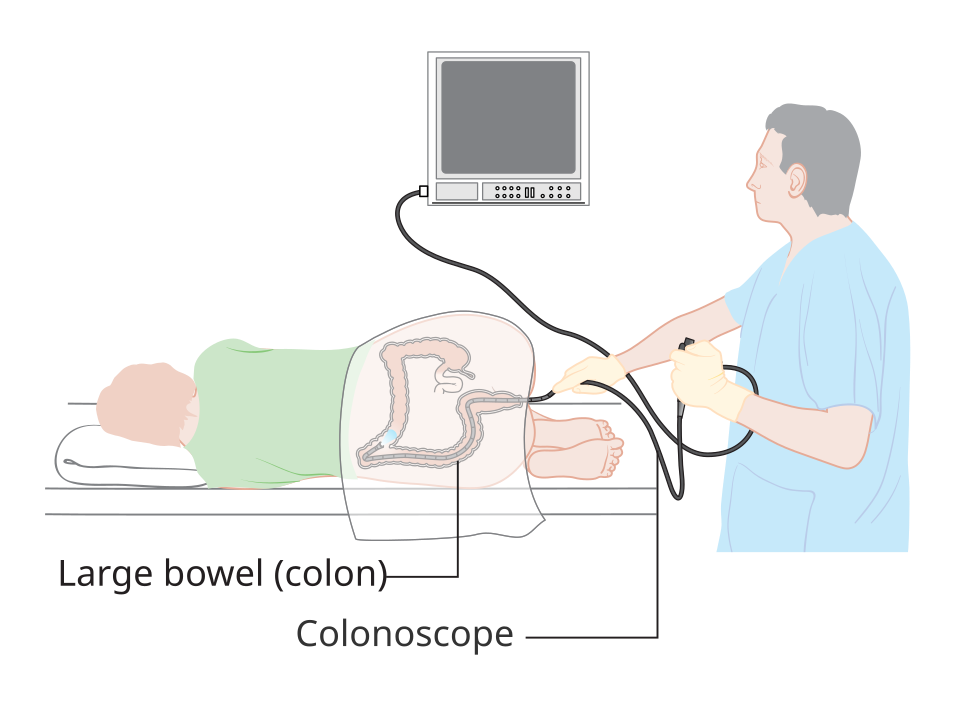
Colon and rectal cancer are often grouped together as colorectal or bowel cancer. In the United States, the American Cancer Society estimates about 108,860 new colon cancers and about 49,990 new rectal cancers in 2026, with roughly 55,230 deaths from colorectal cancer.
Source: American Cancer Society, MedlinePlus
Most colon cancers start as a polyp, a small growth on the inner lining of the bowel. Cleveland Clinic notes that a precancerous polyp takes about 10 years to become a cancer large enough to cause symptoms. The CDC stresses that polyps and early colorectal cancer may not cause symptoms, so you can have them without knowing. That is why colon cancer symptoms are a late signal and screening of healthy people is recommended.
Source: Cleveland Clinic, CDC
Worldwide, the World Health Organization reports about 1.9 million new colorectal cancer cases and more than 900,000 deaths in 2022, with the highest incidence in Europe, Australia and New Zealand.
Source: WHO
The 10 most common colon cancer symptoms
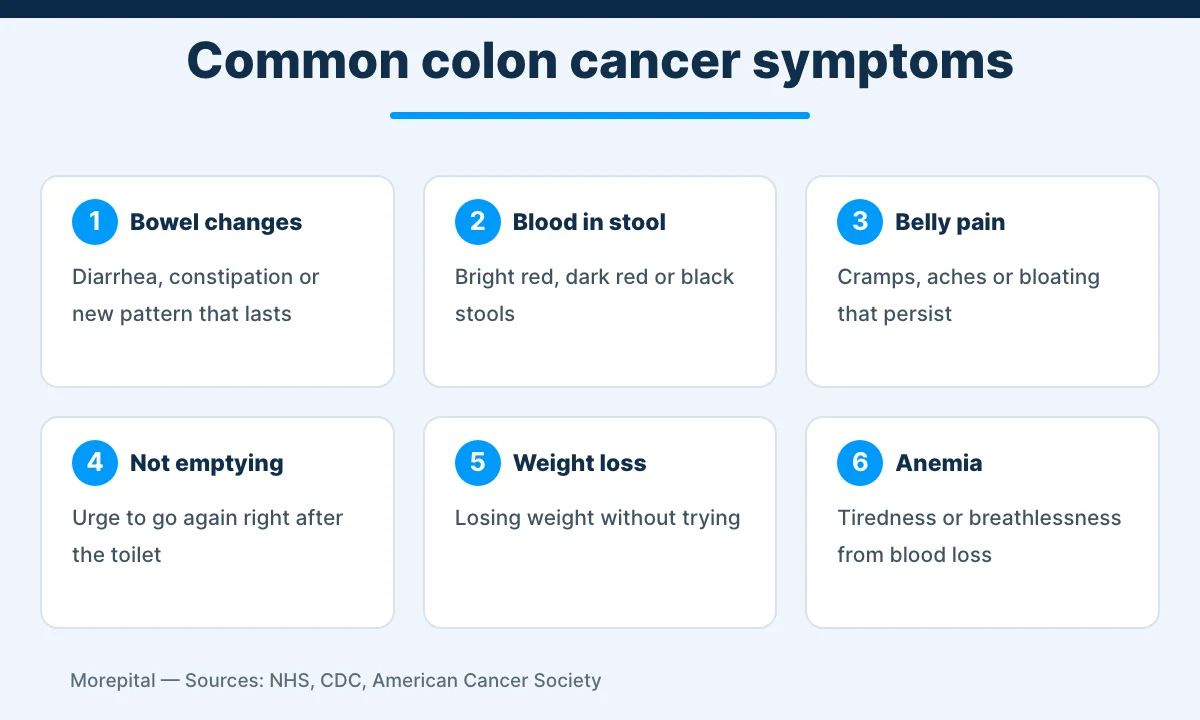
The NHS, the CDC, the American Cancer Society and the WHO list a very similar set of colon cancer symptoms:
- A change in bowel habits that is unusual for you: looser stools, diarrhea, constipation or going more or less often than normal.
- Blood in or on the stool, which may look bright red, dark red or black.
- Bleeding from the bottom (rectal bleeding).
- Feeling that the bowel has not emptied, or needing to go again right after using the toilet.
- Abdominal (tummy) pain, aches or cramps that keep coming back.
- Bloating that persists.
- Narrower stools than usual.
- A lump in the abdomen that you or a doctor can feel.
- Losing weight without trying.
- Tiredness, weakness or breathlessness, which can be signs of anemia caused by slow bleeding from the tumor.
Source: NHS, CDC, American Cancer Society, WHO
None of these colon cancer symptoms is specific. The American Cancer Society points out that bowel changes count as a warning sign when they last more than a few days, and that a persistent urge to empty the bowel that is not relieved by going is another typical complaint. What matters most is a change from your own normal pattern.
Source: American Cancer Society
Why anemia can be the first clue
Colorectal cancers can bleed slowly into the digestive tract. The stool often looks normal, but the blood loss adds up over months and leads to iron-deficiency anemia. The American Cancer Society notes that sometimes the first sign of colorectal cancer is a blood test showing a low red blood cell count. If you have unexplained low iron, read our guide to anemia symptoms and iron deficiency.
Source: American Cancer Society, CDC
Blood in the stool: what the color can tell you
Rectal bleeding is one of the colon cancer symptoms people notice most, and its color gives a rough idea of where the blood comes from. Cancer Research UK explains that bleeding from higher up the bowel tends to look dark red or black, while bright red blood usually comes from lower down, near the rectum or anus.
Source: Cancer Research UK, American Cancer Society
The NHS advises asking for an urgent GP appointment if your stool is black or dark red, or if you have bloody diarrhea. Call emergency services or go to the emergency department if you are bleeding non-stop from the bottom, or if there is a lot of blood or large clots.
Source: NHS
Is it hemorrhoids or something more serious?
Bright red blood after passing stool is a very common symptom of hemorrhoids (piles). However, the NHS lists painless bleeding from the bottom as a reason for an urgent appointment even in people who know they have piles,. Cancer Research UK also lists piles among the conditions that can cause the same symptoms as bowel cancer, so only an examination can tell piles from colon cancer symptoms.
Source: NHS, Cancer Research UK
Colon cancer symptoms by tumor location
Where the tumor sits in the colon shapes which colon cancer symptoms appear first. The Colorectal Cancer Alliance describes the general pattern: right-sided cancers more often cause anemia, fatigue or hidden bleeding rather than noticeable bowel changes, while left-sided cancers more often cause changes in bowel habits such as constipation, narrow stools or blockage.
Source: Colorectal Cancer Alliance
A 2023 study of 94 patients with colon cancer at a hospital in Mexico supports part of this picture. Visible blood with the stool (hematochezia) was the main symptom in left-sided tumors, reported by about 60% of those patients, and narrowed stools were also more common on the left. Diarrhea was the most frequent complaint in right-sided tumors, though that difference was not statistically significant. The study was small, so this is a tendency, not a rule.
Source: Rev Med Inst Mex Seguro Soc (PMC)
In practice, a right-sided tumor may show up only as tiredness and a low blood count, so unexplained iron-deficiency anemia should be investigated even when colon cancer symptoms in the bowel itself are absent.
Source: Colorectal Cancer Alliance, American Cancer Society
Colon cancer symptoms in younger adults
Colorectal cancer is no longer only a disease of older people. The American Cancer Society reports that incidence in people under 50 rose by about 2.9% a year between 2013 and 2022 and that death rates in people under 55 have been rising by about 1% a year since the mid-2000s. The WHO also reports rising rates in adults aged 30 to 50 in some countries.
Source: American Cancer Society, WHO
A large US study published in the Journal of the National Cancer Institute in 2023 compared 5,075 adults diagnosed with early-onset colorectal cancer with matched controls. Four red-flag signs were linked to a higher risk: rectal bleeding, iron-deficiency anemia, abdominal pain and diarrhea. Rectal bleeding had the strongest association. About two-thirds of patients had at least one red flag up to two years before diagnosis, and the median time from first symptom to diagnosis was about 8.7 months.
Source: Journal of the National Cancer Institute (PMC)
The accompanying editorial notes that these signs are also common in healthy people, so not everyone needs a colonoscopy straight away. Still, colon cancer symptoms in a 30- or 40-year-old deserve the same attention as in a 65-year-old.
Source: Journal of the National Cancer Institute (PMC)
Signs of advanced disease and bowel obstruction
When colon cancer grows large enough to narrow the bowel, it can cause a bowel obstruction. Cancer Research UK lists the typical signs: cramping abdominal pain, bloating, constipation with inability to pass wind, and vomiting. A bowel obstruction is an emergency.
Source: Cancer Research UK
If the cancer spreads beyond the bowel, other symptoms can appear depending on the organ involved. The American Cancer Society explains that spread to the liver may cause an enlarged liver or yellowing of the skin and eyes (jaundice), and spread to the lungs may cause trouble breathing. These late colon cancer symptoms usually mean the disease is more advanced.
Source: American Cancer Society
Who is most at risk of colon cancer
Knowing your risk helps you judge colon cancer symptoms and plan screening, much as it does for breast cancer symptoms or prostate cancer symptoms. The American Cancer Society says more than half of colorectal cancers are linked to factors that can be changed.
Source: American Cancer Society
Risk factors you can change
- Excess body weight: overweight and obesity raise the risk of developing and dying from colorectal cancer.
- Diet: frequent red and processed meat, and diets low in fruit and vegetables.
- Physical inactivity.
- Smoking: long-term tobacco use raises the risk of polyps and cancer.
- Alcohol: moderate to heavy drinking is linked to higher risk.
- Type 2 diabetes is associated with higher risk and a less favorable outlook.
Source: American Cancer Society, WHO
Risk factors you cannot change
- Age: risk rises with age and is much higher after 50.
- Family history: up to 1 in 3 people with colorectal cancer have a relative who had it; risk is higher if a first-degree relative was diagnosed before 50 or more than one is affected.
- Inherited syndromes: about 5% of cases are linked to inherited gene changes. The best known are Lynch syndrome and familial adenomatous polyposis (FAP).
- Personal history of adenomatous polyps, earlier colorectal cancer, or inflammatory bowel disease (ulcerative colitis or Crohn’s disease).
- Previous radiation to the abdomen or pelvis.
Source: American Cancer Society
How doctors investigate colon cancer symptoms
When you report colon cancer symptoms, your doctor will usually ask about your bowel habits, general health, medical history and family history of bowel cancer. The NHS says you may be offered a rectal examination, a stool sample, a FIT home test kit or a blood test. An urgent referral does not confirm cancer.
Source: NHS
Further tests include:
- Blood tests: a complete blood count for anemia, liver tests and sometimes the tumor marker CEA.
- Colonoscopy: a thin camera examines the whole colon, and samples (biopsies) are taken from anything abnormal. A biopsy is needed to confirm cancer.
- Imaging: CT, MRI or PET scans show whether the cancer has spread (staging).
Source: MedlinePlus, Cleveland Clinic
Conditions that can mimic colon cancer symptoms
Many bowel symptoms have other explanations, including infections, hemorrhoids, irritable bowel syndrome and inflammatory bowel disease. The American Cancer Society notes that irritable bowel syndrome does not raise colorectal cancer risk, while ulcerative colitis and Crohn’s disease do. Because these conditions overlap with colon cancer symptoms, a harmless diagnosis should be made by a doctor, not assumed.
Source: American Cancer Society, American Cancer Society, Cancer Research UK
Stages and outlook
Colon cancer is staged from 0 (abnormal cells limited to the inner lining or a polyp) to IV (spread to distant organs). Surgery is the main treatment when it has not spread, sometimes with chemotherapy or other drugs. MedlinePlus explains that stages 0 to III are often curable, while stage IV is usually not, although cure is sometimes possible when spread is limited to the liver. Cleveland Clinic gives five-year survival estimates from the US National Cancer Institute by stage at diagnosis:
Source: MedlinePlus, Cleveland Clinic
| Stage at diagnosis | What it means | Approx. 5-year survival |
|---|---|---|
| Localized | Cancer limited to the colon wall | About 91% |
| Regional | Spread to nearby tissue or lymph nodes | About 73% |
| Distant | Spread to organs such as the liver or lungs | About 13% |
Source: Cleveland Clinic
These are averages, not individual predictions, but they show why acting early on colon cancer symptoms matters.
Source: Cleveland Clinic, NHS
Screening: finding colon cancer before symptoms start
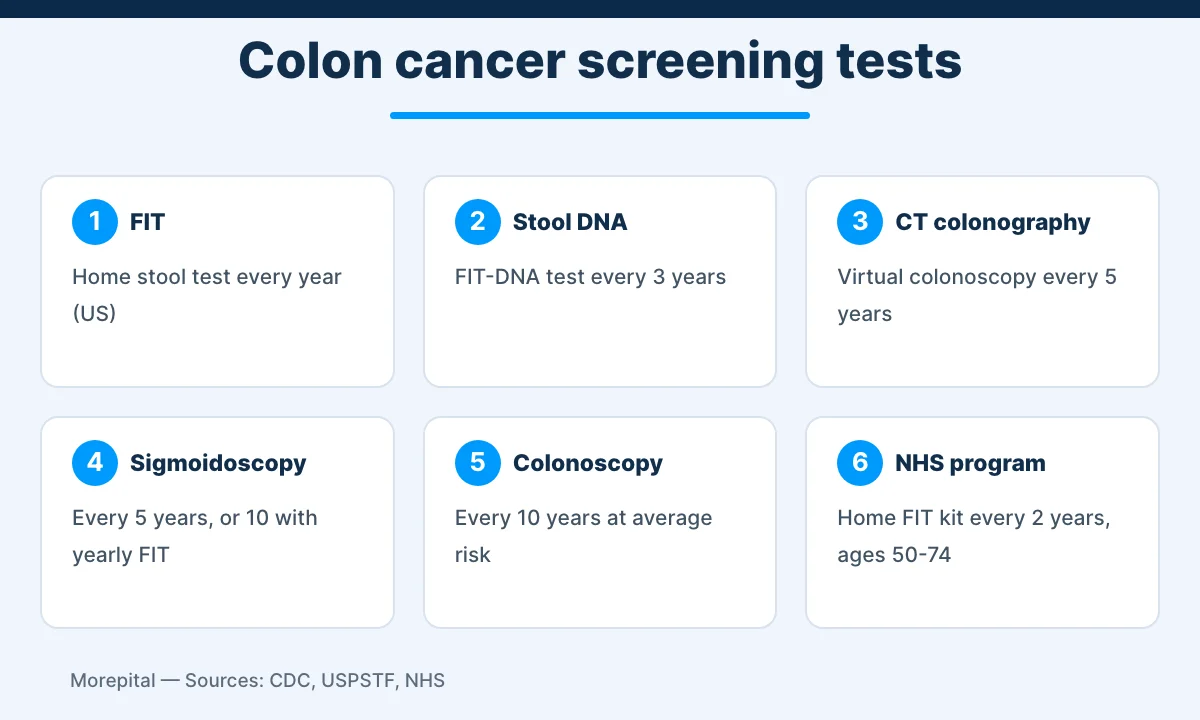
Screening is meant for people with no colon cancer symptoms. The WHO describes regular screening, where organized programs exist, as the most effective way to detect colorectal cancer early; it also finds and removes precancerous polyps and has been shown to reduce both cases and deaths. If you already have symptoms, do not wait for a screening invitation: see a doctor instead.
United States
The US Preventive Services Task Force (2021) recommends screening for adults aged 45 to 75, with an individual decision between 76 and 85. The CDC lists the accepted test options and intervals for people at average risk:
- Fecal immunochemical test (FIT) or guaiac-based stool test (gFOBT): every year.
- Stool DNA test (FIT-DNA): every 3 years.
- CT colonography (virtual colonoscopy): every 5 years.
- Flexible sigmoidoscopy: every 5 years, or every 10 years with a yearly FIT.
- Colonoscopy: every 10 years.
Any abnormal stool test, sigmoidoscopy or CT colonography needs a follow-up colonoscopy. People with inflammatory bowel disease, a personal or family history of colorectal cancer or polyps, or a genetic syndrome may need to start earlier or be screened more often.
United Kingdom
The NHS bowel screening program in England sends a home FIT kit every 2 years to registered patients aged 50 to 74, and people aged 75 or over can ask for a kit. Other UK nations run their own programs, so check your local health service.
Source: NHS
When colon cancer symptoms need a doctor
Having one or more colon cancer symptoms does not mean you have bowel cancer; the NHS stresses that many are common and have other causes. But finding bowel cancer early makes it easier to treat, so the advice is to see a doctor about any of them, and sooner in the situations below. Doctors are used to discussing bowel symptoms, so embarrassment should not delay you.
| Situation | What to do |
|---|---|
| Lasting change in bowel habits, bloating, tummy pain, weight loss or tiredness | Book a routine doctor’s appointment |
| Unexplained iron-deficiency anemia | Ask your doctor to look for a bleeding source |
| Black or dark red stools, or bloody diarrhea | Urgent same-day appointment (NHS 111 in the UK) |
| Non-stop bleeding, lots of blood or large clots | Emergency department or ambulance |
| Cramping pain, swollen belly, vomiting, unable to pass stool or wind | Emergency: possible bowel obstruction |
Source: NHS, Cancer Research UK, American Cancer Society
Before your appointment, note your symptoms, when they started and any family history of bowel cancer or polyps. If your symptoms continue after tests that were normal, go back; persistent colon cancer symptoms deserve a second look.
Source: NHS
Colon cancer symptoms: frequently asked questions
What are the first colon cancer symptoms?
Often there are none. When early colon cancer symptoms appear, the most common are a change in bowel habits, blood in the stool, abdominal pain and tiredness from anemia. In some people a blood test showing a low red blood cell count is the first clue.
Source: CDC, American Cancer Society
Can you have colon cancer and feel completely fine?
Yes. Polyps and early colorectal cancer may cause no symptoms, which is why screening is recommended for healthy adults from age 45 in the US and from 50 in the NHS program.
What does colon cancer stool look like?
It may contain red blood, look black, be looser or narrower than usual, or look normal. Black or dark red stools need an urgent appointment.
Source: American Cancer Society, NHS, MedlinePlus
Are colon cancer symptoms different in women?
The symptoms are the same in both sexes. The American Cancer Society notes that women after menopause are more likely to develop right-sided colon cancer, which tends to cause anemia and tiredness rather than obvious bowel changes.
Source: American Cancer Society, Colorectal Cancer Alliance
Do colon cancer symptoms mean I have cancer?
Not necessarily. Many colon cancer symptoms are common and have other causes, such as infections, piles or IBS. A doctor’s assessment is the only way to know.
Can young people get colon cancer?
Yes. Rates in adults under 50 have been rising by about 2.9% a year in the US. Rectal bleeding and iron-deficiency anemia in a young adult should be investigated promptly.
Source: American Cancer Society, Journal of the National Cancer Institute (PMC)
Disclaimer: this article is for general health education and does not replace advice from a qualified doctor who can assess your individual case. Last updated: October 2026.