
Minoxidil for hair loss is a non-prescription scalp treatment, sold as a liquid or foam, that helps slow hereditary (pattern) hair loss and regrow some hair in both men and women. It works best when thinning is recent, takes about 6 to 12 months to show its full effect, and only keeps working while you use it. A low-dose tablet form is also prescribed off-label by some dermatologists.
Source: AAD, MedlinePlus, Gupta 2023
Source: AAD, AAFP, Gupta 2023
Contents
- What is minoxidil for hair loss?
- Who minoxidil works best for
- Topical vs oral minoxidil for hair loss
- How to apply topical minoxidil correctly
- Minoxidil for hair loss: results timeline
- Minoxidil shedding: why hair can fall out at first
- Side effects of minoxidil for hair loss
- Minoxidil for hair loss in women
- Combination treatment and when a hair transplant makes sense
- Minoxidil for hair loss: frequently asked questions
What is minoxidil for hair loss?
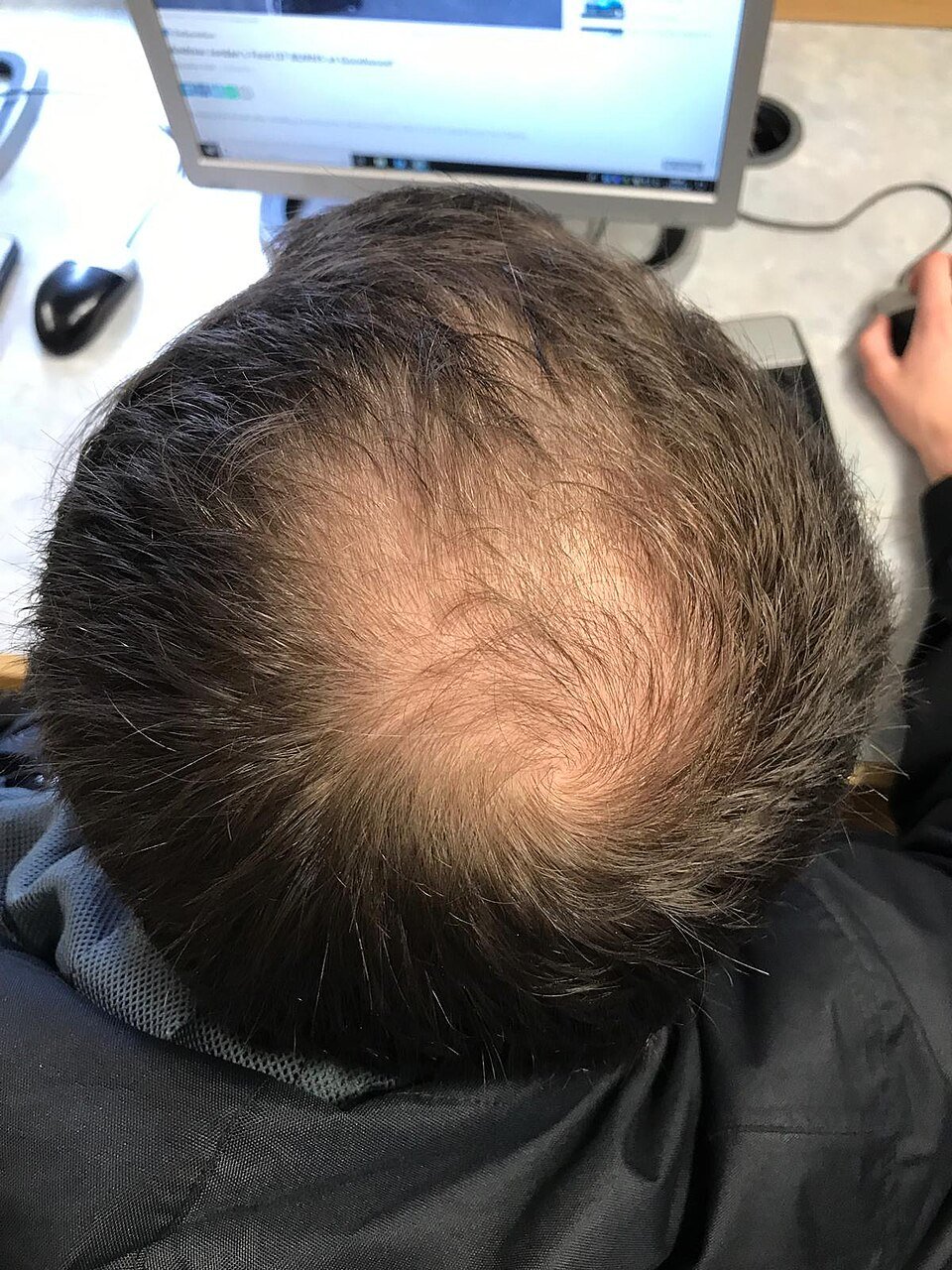
Minoxidil was first developed in the 1970s as a blood pressure tablet. Doctors noticed that patients taking it grew extra hair, including on balding scalps, and this led to a topical version. A 2% solution was launched in 1986 and a 5% solution in 1993, and topical minoxidil is now approved by the US Food and Drug Administration (FDA) for male androgenetic alopecia and female pattern hair loss.
Source: Suchonwanit 2019
How minoxidil for hair loss works is still not fully understood. It lengthens the anagen (growth) phase of the hair cycle, which reduces shedding and helps hairs grow thicker. It also widens blood vessels and may stimulate growth factors around the follicle. To work, minoxidil has to be converted into its active form, minoxidil sulfate, by an enzyme called sulfotransferase. Levels of this enzyme vary from person to person and across different parts of the scalp, which helps explain why results with the topical form differ so much between users.
Source: ISHRS, Suchonwanit 2019
Minoxidil is not a steroid and does not block the hormones behind pattern baldness. Instead, minoxidil for hair loss supports the follicles you still have, which is why early treatment matters.
Source: ISHRS, MedlinePlus
Who minoxidil works best for
Minoxidil for hair loss is meant for hereditary thinning: male pattern baldness (androgenetic alopecia) and female pattern hair loss. MedlinePlus notes it works best for people under 40 whose hair loss is recent, and the ISHRS says it is less effective when hair loss is long-standing or covers a large area. If you are unsure what type of hair loss you have, our reference guide to male pattern baldness explains the typical pattern and how it is diagnosed.
Arabic-speaking readers: a detailed, source-referenced Arabic overview of this topic is available in the Alphateb medical encyclopedia — الصلع الوراثي.
Source: MedlinePlus, ISHRS
Where you apply it also matters. US men’s 5% labels say the product is for the top of the scalp (the vertex), and MedlinePlus states it has no effect on a receding hairline, while the ISHRS says 5% minoxidil can be applied to the temples and front hairline too. Expect the clearest benefit of minoxidil for hair loss on the crown.
Source: DailyMed, MedlinePlus, ISHRS
When to see a doctor before you start
Over-the-counter labels say not to use minoxidil if you have no family history of hair loss, if the loss is sudden or patchy, if your scalp is red, inflamed or painful, or if you are under 18. Ask a doctor first if you have heart disease. Sudden or patchy loss can point to other conditions, such as alopecia areata, so see a dermatologist rather than self-treating.
Source: DailyMed, Cleveland Clinic
No hair loss treatment works for everyone, and the NHS notes that many are not available on the NHS, so you may pay privately for minoxidil for hair loss. Our diseases and conditions library covers other causes of thinning.
Source: NHS
Topical vs oral minoxidil for hair loss
Topical minoxidil: liquid or foam
Topical minoxidil comes as a liquid solution or a foam, usually at 2% or 5%. In the US, 5% is sold without a prescription. The liquid contains propylene glycol, which helps the drug penetrate but can feel greasy and irritate the skin. The foam is propylene glycol-free, tends to be less irritating, dries faster and is sold at 5% for both men and women.
Source: ISHRS, Suchonwanit 2019
Strength makes a difference. In a meta-analysis of men with androgenetic alopecia summarized in a 2019 review, the 2% solution increased hair counts by about 8.11 hairs per cm² compared with placebo, while the 5% solution increased them by about 14.90 hairs per cm². In an earlier trial, the 5% solution produced about 45% more regrowth than 2% at week 48.
Source: Suchonwanit 2019
Low-dose oral minoxidil
Low-dose oral minoxidil (LDOM) is a once-daily tablet. It is not FDA-approved for hair loss, so it is prescribed off-label. A 2023 review lists typical starting doses of 1 to 5 mg a day for men and 0.5 to 1 mg a day for women, with a usual maximum of about 5 mg; doctors may raise the dose slowly because the benefit appears dose-dependent. The ISHRS explains that the liver activates minoxidil more consistently than the scalp, so tablets are usually more effective, but their side effects are more pronounced.
Source: Gupta 2023, ISHRS
The best head-to-head data come from a 2024 double-blind randomized trial in 90 men aged 18 to 55. After 24 weeks, oral minoxidil 5 mg once daily and topical 5% twice daily improved hair density by similar amounts, with a significant advantage for tablets only on the crown. Body-hair growth (hypertrichosis) affected 49% of the oral group versus 25% of the topical group, and headache 14% versus 2%, while scalp eczema was more common with the solution (16% versus 2%). Only 68 men completed follow-up.
Source: AAFP
| Feature | Topical minoxidil | Oral minoxidil (low dose) |
|---|---|---|
| Status | FDA-approved, sold over the counter (2% and 5%) | Off-label, prescription only |
| Typical use | Men: 5% twice daily; women: 2% twice daily or 5% foam once daily | Men: 1–5 mg/day; women: 0.5–1 mg/day |
| Main side effects | Scalp itching, scaling, eczema; facial hair | Body and facial hair; headache; dizziness, swelling, fast heartbeat |
| Who may prefer it | First-line option for most people | People who cannot tolerate or keep using the topical form |
| Medical check | Ask a doctor if you have heart disease | Doctor review, blood pressure monitoring often advised |
Source: Suchonwanit 2019, Gupta 2023, AAFP, DailyMed
The trial authors describe tablets as an option for men who prefer oral treatment or cannot tolerate the topical form, and the 2023 review positions them for people who did not respond well to topical minoxidil for hair loss. Never start tablets without a prescription: at higher doses the same drug is a powerful blood pressure medicine.
Source: AAFP, Gupta 2023
How to apply topical minoxidil correctly
For the 5% solution, the usual dose is 1 mL applied with the dropper onto the thinning area twice a day; using more or applying it more often will not speed up results. For women, a 2019 review suggests 1 mL of 2% solution twice daily or half a capful of 5% foam once daily. Always follow your own product’s instructions.
Source: DailyMed, MedlinePlus, Suchonwanit 2019
- Apply to a dry scalp and dry hair. You do not need to shampoo before each use.
- Part your hair and put the product on the skin, not the hair shaft. Combing afterwards is fine.
- Applying it at night is acceptable, according to the ISHRS.
- Wash your hands after each use and keep it away from the eyes, nose and mouth.
- Do not apply to a cut, scraped, sunburned or irritated scalp, or to other parts of the body.
- If you miss a dose, skip it or apply it when you remember; never double up.
Source: Cleveland Clinic, ISHRS, MedlinePlus
The liquid is flammable, so keep it away from heat and flames, and store it at room temperature, 20–25 °C (68–77 °F), out of reach of children. MedlinePlus adds that minoxidil may increase sun sensitivity, so protect a thinning scalp outdoors.
Source: Cleveland Clinic, DailyMed, MedlinePlus
Minoxidil for hair loss: results timeline
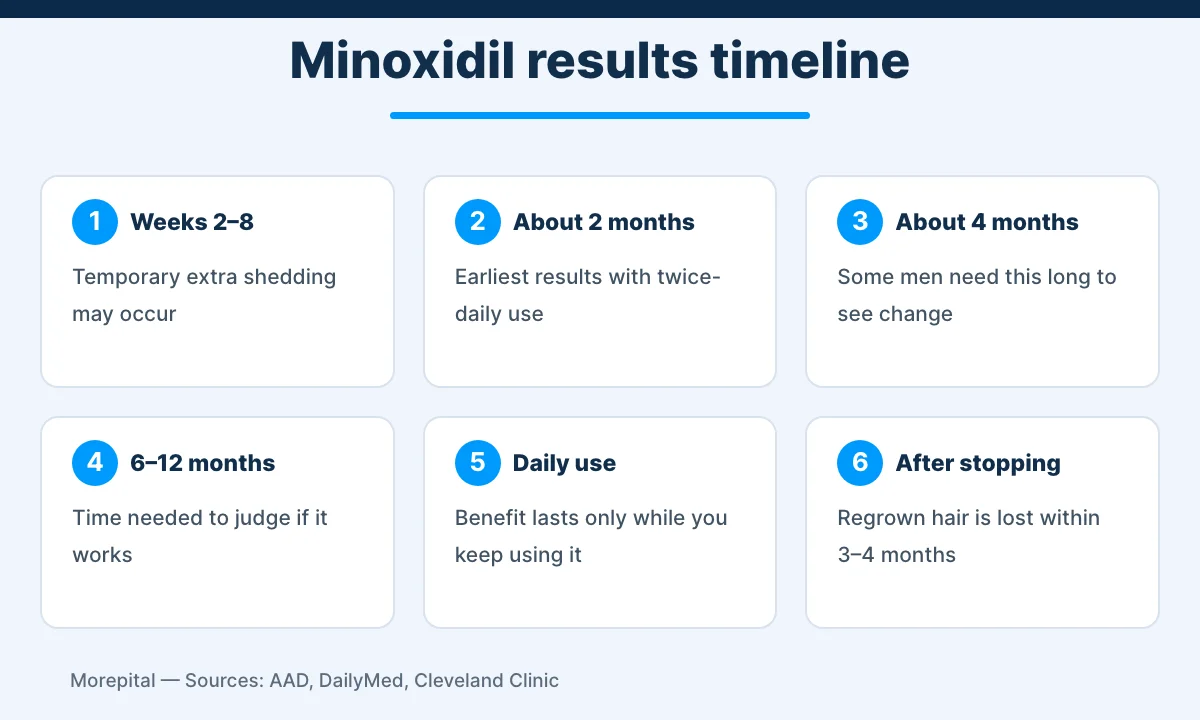
Patience is the main requirement with minoxidil for hair loss. US labels say results may appear at about 2 months with twice-daily use, though some men need at least 4 months, and Cleveland Clinic gives 2 to 4 months for first improvement. The American Academy of Dermatology (AAD) says it usually takes 6 to 12 months of daily use to judge whether minoxidil is working.
Source: DailyMed, Cleveland Clinic, AAD
Sources disagree on when to give up. Labels and Cleveland Clinic advise contacting your care team if there is no regrowth after 4 months, while dermatology sources suggest 6 to 12 months before deciding. Take monthly photos of your crown and parting in the same light and review them with your doctor.
Source: DailyMed, Cleveland Clinic, AAD
Expect stabilization more than transformation. In trials, minoxidil for hair loss reduced shedding, stimulated growth and strengthened existing hairs, but full regrowth is unlikely and some men see no difference. US labels add that regrowth has not been shown to last beyond 48 weeks in large trials with continuous use.
What happens when you stop
Minoxidil for hair loss only works while you use it. After stopping, regrown hair usually falls out within about 3 to 4 months, and hair you kept may look and feel thinner. According to the ISHRS, stopping does not make hair loss worse than it would have been without treatment: the natural pattern simply resumes.
Source: Cleveland Clinic, Suchonwanit 2019, AAD, ISHRS
Minoxidil shedding: why hair can fall out at first
Some people notice more hair in the shower or on their pillow soon after starting. The AAD says hair loss may temporarily increase during the first 2 to 8 weeks of using minoxidil for hair loss and then stop as regrowth begins. This early shedding is the reason many people quit too soon, just before the treatment starts to help.
Source: AAD
Keep using the product as directed during this period. Shedding that lasts well beyond 2 months, comes out in patches, or comes with a red, painful scalp is not typical of minoxidil for hair loss and should be checked by a doctor.
Side effects of minoxidil for hair loss
Topical side effects
The most common side effect of topical minoxidil for hair loss is scalp irritation: itching, dryness, scaling, flaking or burning. Contact dermatitis from the liquid is mostly caused by propylene glycol, so switching to the propylene glycol-free foam is recommended if an allergy is suspected. People with psoriasis or seborrheic dermatitis are more prone to irritation. Headaches and changes in hair color or texture are also reported.
Source: MedlinePlus, Suchonwanit 2019, ISHRS, AAD, DailyMed
Unwanted hair on the forehead or cheeks is more common in women and with the 5% solution. It is usually caused by absorption into the bloodstream rather than spillage, and it typically resolves within months of stopping minoxidil for hair loss.
Source: Suchonwanit 2019, ISHRS
Oral side effects
With tablets, side effects rise with the dose. In a 2023 review, hypertrichosis affected about 29% of people at 0.25–0.75 mg a day, 30% at 1–1.25 mg and 87% at 2.5–5 mg, while cardiovascular symptoms such as low blood pressure, swelling or a fast heartbeat affected about 4%, 11% and 34%. The review lists heart rhythm disorders, kidney disease, pheochromocytoma and pregnancy as contraindications and advises against tablets in people with low blood pressure.
Source: Gupta 2023
Warning signs: stop and call a doctor
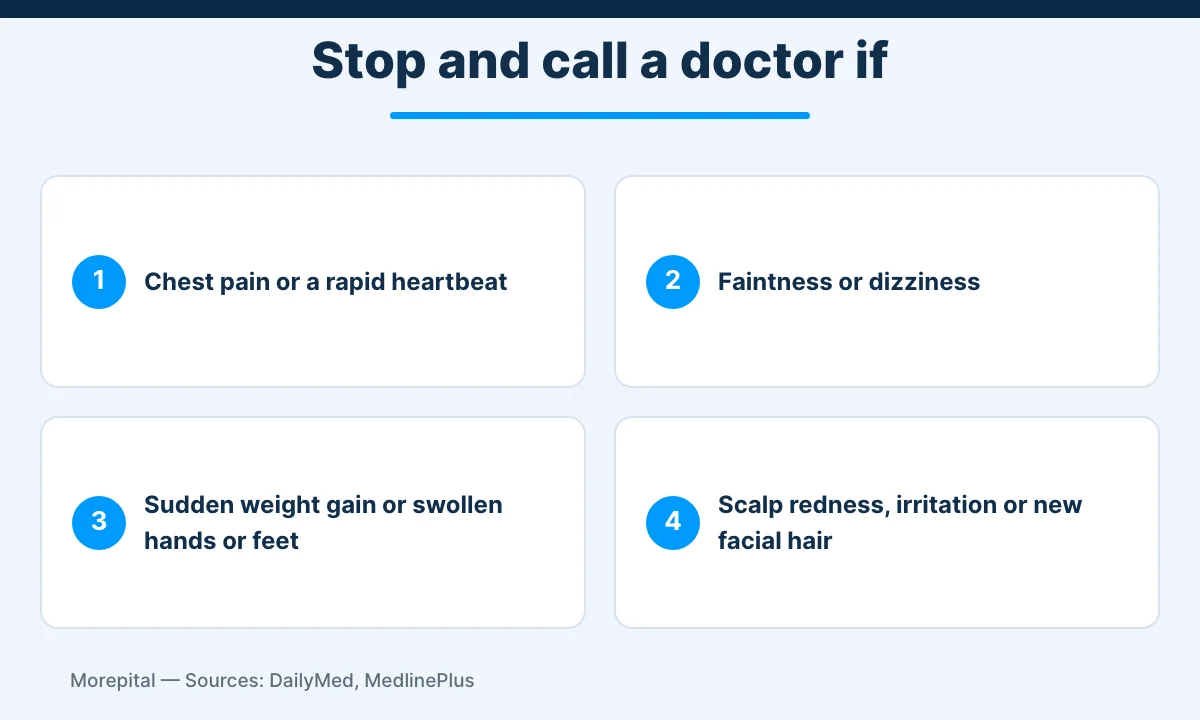
Stop minoxidil for hair loss and seek medical advice if you develop chest pain, a rapid heartbeat, faintness or dizziness, sudden unexplained weight gain, swelling of the hands, feet or face, trouble breathing, or signs of an allergic reaction such as hives. These warnings apply to the topical form too.
Source: DailyMed, MedlinePlus, Cleveland Clinic
Minoxidil for hair loss in women
Minoxidil for hair loss is a mainstay for female pattern hair loss, and both 2% and 5% products are approved for women. The NHS notes that women should not use finasteride, which makes minoxidil the usual first choice. Allow about 6 to 12 months of continuous use before judging it.
The 2% solution was traditionally recommended for women to lower the risk of facial hair. More recent evidence shows that once-daily 5% foam is as effective as twice-daily 2% solution, with fewer side effects. To limit unwanted hair, apply the product only to the scalp and wash your face and hands afterwards.
Source: Suchonwanit 2019, ISHRS, AAD
Women who are pregnant, planning a pregnancy or breastfeeding should not use minoxidil. Animal studies have shown possible harm to a developing baby, and traces may pass into breast milk. Oral minoxidil is also not recommended during pregnancy or breastfeeding, or for women who have had laser hair removal, because of the risk of new body hair.
Source: AAD, Cleveland Clinic, Gupta 2023
Thinning in women can also come from thyroid problems, anemia or low iron, which simple blood tests can check. Cleveland Clinic advises seeing a dermatologist as soon as you notice thinning, because earlier treatment tends to work better.
Source: Cleveland Clinic
Combination treatment and when a hair transplant makes sense
Dermatologists say minoxidil tends to work better alongside another hair loss treatment. For men, prescription finasteride can be combined with it, and the ISHRS notes that combining treatments that target the follicle in different ways, including laser therapy, is usually more effective than one alone. Ask your doctor before adding any other scalp product.
Source: AAD, AAD, ISHRS, DailyMed
Minoxidil for hair loss cannot replace follicles that are already gone. When the crown or hairline is smooth and bald, a hair transplant moves permanent follicles from the back of the scalp to the thinning area. You can compare surgical and non-surgical options in our treatments library.
Source: AAD
If you are considering surgery abroad, Hair Cultivate, a specialized hair-transplant center in Istanbul, publishes information on hair transplant in Turkey, female hair transplant and PRP hair treatment. Whichever clinic you choose, share your current medicines, including minoxidil for hair loss, with the doctor planning your procedure.
Considering hair loss treatment? Contact us for a free consultation and a treatment plan tailored to you.
Minoxidil for hair loss: frequently asked questions
How long does minoxidil for hair loss take to work?
First changes can appear at around 2 to 4 months, but dermatologists recommend about 6 to 12 months of daily use before judging the result.
Source: Cleveland Clinic, AAD
Is minoxidil shedding normal?
Yes. Hair loss can increase for the first 2 to 8 weeks and then stop as regrowth begins. Patchy loss or a painful scalp is not typical and needs a doctor’s review.
Source: AAD
Is oral minoxidil better than the topical form?
In a 24-week trial in men, oral 5 mg and topical 5% gave similar overall results, with a small advantage for tablets on the crown and more body-hair growth and headache. Tablets are off-label and need a prescription.
Source: AAFP
Can women use minoxidil for hair loss?
Yes. Both 2% and 5% products are approved for female pattern hair loss, but women should avoid it during pregnancy, when planning a pregnancy and while breastfeeding.
Source: AAD
Will my hair fall out if I stop minoxidil?
Regrown hair usually falls out within about 3 to 4 months of stopping, and natural thinning continues as it would have without treatment.
Source: Cleveland Clinic, Suchonwanit 2019, ISHRS
Can minoxidil regrow a completely bald area?
No. It helps early hair loss but cannot regrow an entire head of hair; smooth bald areas usually need a hair transplant.
Source: AAD
Disclaimer: this article is for general health education and does not replace advice from a qualified doctor who can assess your individual case. Last updated: October 2026.