
Glaucoma
Open-angle and angle-closure glaucoma (optic nerve disease)
Glaucoma is a group of eye diseases that damage the optic nerve, usually linked to raised pressure inside the eye, and it can lead to permanent vision loss and blindness. The most common type has no early symptoms, so it is usually found at a routine eye exam. There is no cure, but eye drops, laser treatment and surgery can slow or stop further damage.
Source: NEI, NHS, MedlinePlus
- What is glaucoma?
- Symptoms of glaucoma
- Causes and risk factors
- Types of glaucoma
- How glaucoma is diagnosed
- Glaucoma treatment options
- Complications and outlook
- Prevention and living with glaucoma
- When to see a doctor
- FAQ
- Sources
What is glaucoma?

Glaucoma is the name for a group of eye diseases that damage the optic nerve. This nerve carries visual signals from the eye to the brain. The damage builds up over time, and once nerve fibers are lost the vision they served does not come back. Left untreated, it can end in blindness.
In most cases the damage is linked to pressure inside the eye, called intraocular pressure (IOP). The front of the eye is filled with a clear, nourishing fluid, the aqueous humor. A structure behind the iris, the ciliary body, makes this fluid, and it normally drains through a mesh-like tissue, the trabecular meshwork, found in the angle where the iris meets the cornea. When resistance to drainage rises, fluid builds up, the pressure climbs, and the optic nerve is slowly injured. As its nerve fibers deteriorate, blind spots form in the field of vision.
Source: Cleveland Clinic, JAMA review (PMC), Glaucoma Research Foundation
Pressure is not the whole story, though. The NEI notes that some people with high eye pressure never develop the disease, that one type happens with normal pressure, and that what counts as normal varies from person to person. The Glaucoma Research Foundation gives the average range as usually 10 to 21 mmHg. A 2014 JAMA review reports that in population studies 25% to 50% of people with glaucoma had pressure below 22 mmHg.
Source: NEI, Glaucoma Research Foundation, JAMA review (PMC)
How common is glaucoma?
The CDC estimates that about 3 million Americans are affected and calls the disease the second leading cause of blindness worldwide. Half of the people who have it are not aware of it. It becomes more common with age. Cleveland Clinic says about 10% of people aged 75 and older have it.
Source: CDC, Cleveland Clinic
Around the world, a widely cited 2014 meta-analysis by Tham and colleagues estimated that 64.3 million people aged 40 to 80 were affected in 2013. It projected 76 million cases in 2020 and 111.8 million in 2040, with most of the growth in Asia and Africa. These figures are projections, not counts.
Source: Cureus (PMC)
Symptoms of glaucoma
The most common forms usually cause no symptoms at first. There is no pain and no early change in sight. This is why it is often called a silent disease and why it is usually found at a routine eye test rather than because someone notices a problem.
Source: NEI, NHS, Glaucoma Research Foundation
Open-angle type
Vision loss usually begins in the side (peripheral) vision, often in the part closest to the nose. The loss is gradual and can go unnoticed for years. As the disease progresses, the field of view narrows into what is often called tunnel vision. Without treatment, central vision can eventually be lost too.
Source: NEI, MedlinePlus, CDC, Glaucoma Research Foundation
Acute angle closure
The angle-closure type can come on suddenly when the drainage angle is blocked. Typical symptoms include:
- Sudden, intense pain in the eye or forehead
- A red eye and tenderness around the eye
- Blurred, hazy or cloudy vision, or sudden loss of vision
- Rainbow-colored rings or halos around lights
- Headache
- Nausea and vomiting
Source: NHS, MedlinePlus, Cleveland Clinic, Glaucoma Research Foundation
This is a medical emergency. A 2014 JAMA review notes that some people have intermittent episodes of blurred vision with halos around lights, and that such episodes can point to earlier attacks. In that case doctors may consider preventive laser treatment.
Source: JAMA review (PMC)
Normal-tension type
According to the Glaucoma Research Foundation, vision loss in normal-tension glaucoma tends to sit closer to the center of vision, and small bleeds on the optic nerve are seen more often than in the usual open-angle form.
Source: Glaucoma Research Foundation
Babies and children
Congenital glaucoma is usually noticed when a baby is a few months old. Signs include a cloudy front of the eye, one or both eyes looking larger than normal, redness, sensitivity to light, and a lot of tearing.
Source: MedlinePlus, Glaucoma Research Foundation
Causes and risk factors
Scientists still do not know exactly what causes the most common types. Raised eye pressure is the most important known risk factor, and treatments that lower it slow the disease. Secondary glaucoma has a known cause, such as an eye injury, inflammation inside the eye (uveitis), diabetes, steroid medicines, or a previous eye procedure.
Source: NEI, Cleveland Clinic, MedlinePlus
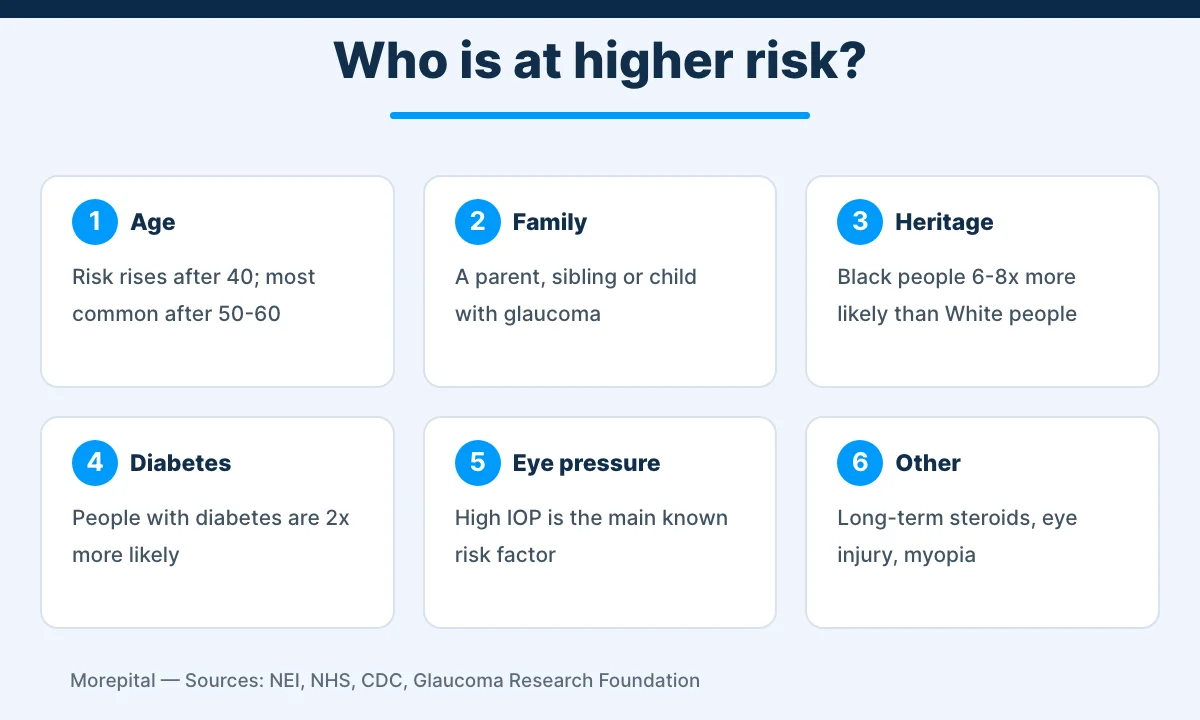
Who is at higher risk?
- Age: risk rises after 40. The NHS says it is most common in adults aged 50 and over, and the NEI flags everyone over 60.
- Family history: having a parent, brother, sister or child with the disease raises your risk.
- Ethnic background: the NEI lists African Americans over 40 and people over 60, especially Hispanic/Latino people. The CDC says Black people are 6 to 8 times more likely than White people to develop it. People of Asian and Inuit descent have a higher risk of the angle-closure type.
- Diabetes and blood pressure: the CDC says people with diabetes are twice as likely to develop it. High blood pressure is also linked to a higher risk.
- Refractive error: nearsightedness is linked to the open-angle type and farsightedness to angle closure.
- Eye features: high eye pressure, a thin cornea, a large or thinning optic nerve, and a narrow or closed drainage angle.
- Other factors: a past eye injury and long-term use of steroid medicines. Migraine and low blood pressure have been linked to the normal-tension type.
Source: NEI, NHS, CDC, Cleveland Clinic, Glaucoma Research Foundation, Glaucoma Research Foundation
Sex also plays a part. Women have a higher risk of angle closure, probably because of differences in eye anatomy. A 2014 JAMA review adds a shallow front chamber of the eye and a short eye as anatomical risks for angle closure. A 2020 epidemiology review reports a higher open-angle risk in men. The more risk factors you have, the higher your overall risk.
Source: Cleveland Clinic, JAMA review (PMC), Cureus (PMC)
Types of glaucoma
Doctors sort the disease by the state of the drainage angle and by whether another condition is behind it.
| Type | What happens | Typical course |
|---|---|---|
| Primary open-angle glaucoma | The drainage angle is open, but fluid drains too slowly | The most common type (at least 90% of cases, per the Glaucoma Research Foundation); slow and painless |
| Angle-closure glaucoma | The iris blocks the drainage angle | Can be a sudden attack (an emergency) or a slower form |
| Normal-tension glaucoma | The optic nerve is damaged even though eye pressure is normal | Usually no symptoms; needs regular monitoring |
| Secondary glaucoma | Caused by another problem such as injury, uveitis, steroids or pigment dispersion | Depends on the cause |
| Congenital (childhood) glaucoma | Abnormal development of the eye’s drainage system before birth | Rare; usually found in babies and treated with surgery |
Source: Cleveland Clinic, MedlinePlus, NHS, Glaucoma Research Foundation, Glaucoma Research Foundation
Other named forms include pigmentary glaucoma, where pigment granules from the back of the iris clog the drainage system; exfoliative glaucoma, where flaky material from the lens collects in the angle; and neovascular glaucoma, where abnormal new blood vessels block drainage, most often in people with diabetes. Sources group some of these differently: the Glaucoma Research Foundation’s types page calls pigmentary glaucoma a form of open-angle glaucoma, while its glossary lists it under secondary glaucoma. Experts also debate whether normal-tension glaucoma is a separate disease or a form of open-angle glaucoma.
Source: Glaucoma Research Foundation, Glaucoma Research Foundation, Glaucoma Research Foundation
Ocular hypertension and suspects
Some people have higher than normal eye pressure while the optic nerve looks normal and there is no vision loss. This is called ocular hypertension. It does not mean you have the disease, but it raises your risk, and Cleveland Clinic notes it can be treated to help prevent glaucoma. The Glaucoma Research Foundation explains that people with certain findings, such as pressure above 21 mmHg, may be called glaucoma suspects.
Source: Glaucoma Research Foundation, JAMA review (PMC), Cleveland Clinic
It usually affects both eyes, although one eye can be worse than the other.
Source: NHS
How glaucoma is diagnosed
The only reliable way to find it is a complete eye exam. A pressure check on its own is not enough, because pressure goes up and down during the day and can be normal in people who have the disease. Your eye doctor will usually put in drops to widen (dilate) the pupils so they can see the optic nerve. The tests are painless.
Source: NEI, MedlinePlus, Glaucoma Research Foundation
Tests may include:
- Tonometry: measures the pressure inside the eye.
- Dilated eye exam and slit-lamp exam: the doctor looks at the optic nerve and the structures of the eye.
- Gonioscopy: a special lens shows whether the drainage angle is open or closed.
- Visual field test: maps your side vision to find blind spots.
- Pachymetry: measures how thick the cornea is.
- Optic nerve imaging: optical coherence tomography (OCT) and photographs measure the nerve and track changes over time.
- Visual acuity: the standard letter chart test.
Source: Cleveland Clinic, MedlinePlus, Glaucoma Research Foundation
For suspected normal-tension glaucoma, doctors may take several pressure readings at different times of day, and brain or optic nerve imaging may be advised if the nerve does not look typical.
Source: Glaucoma Research Foundation
How often should you be checked?
Advice differs between sources and countries. MedlinePlus suggests a complete eye exam once in your 20s and twice in your 30s, with earlier or more frequent checks for people at higher risk. The NEI advises people at higher risk to have a dilated eye exam every 1 to 2 years. The NHS recommends an eye test at least every 2 years for everyone, and more often for people at higher risk. In the US, Medicare covers a glaucoma test once a year for people in high-risk groups.
Source: MedlinePlus, NEI, NHS, CDC
Glaucoma treatment options
There is no cure for glaucoma, and treatment cannot restore vision that has already been lost. What treatment can do is lower eye pressure and slow or stop further damage. Starting early gives the best chance of keeping useful sight. The right plan depends on the type and how much damage there is. A 2014 JAMA review says an initial goal is often to lower pressure by 20% to 50%, with the target lowered further if damage keeps progressing.
Source: NEI, NHS, CDC, JAMA review (PMC)
Glaucoma eye drops
Prescription eye drops are the most common treatment. They are used every day, and many people use them long term. Some drops lower the amount of fluid the eye makes; others help it drain. You may need more than one type. Prostaglandin analogs are usually the first choice and are taken once at night. The main groups are:
- Prostaglandin analogs (for example latanoprost, bimatoprost, travoprost): increase drainage. They can darken the iris and eyelid skin and make eyelashes grow.
- Beta blockers (for example timolol): reduce fluid production. They can slow the pulse, lower blood pressure, cause tiredness and affect breathing.
- Alpha agonists (for example brimonidine): reduce fluid and improve drainage. Side effects include stinging, tiredness and a dry mouth.
- Carbonic anhydrase inhibitors (dorzolamide and brinzolamide drops; acetazolamide tablets): reduce fluid production. Tablets can cause tingling in the hands and feet and stomach upset.
- Rho kinase inhibitors (netarsudil): increase drainage and can cause eye redness.
- Combination drops: two medicines in one bottle, which can make a routine easier.
Source: Glaucoma Research Foundation, JAMA review (PMC), MedlinePlus
Drops only work if they are taken as prescribed. Tell your eye doctor about side effects, cost problems or trouble remembering doses, since there are usually other options, such as preservative-free drops or laser treatment.
Source: Glaucoma Research Foundation, NEI, CDC
Laser treatment
Laser treatment is done as an outpatient, often in the doctor’s office, with numbing drops, and most people return to normal activities the next day. Selective laser trabeculoplasty (SLT) improves drainage in open-angle disease. It is often a first-line option, can be used with drops and can be repeated. Its effect fades over time: the JAMA review cites a failure rate of about 10% a year. Laser peripheral iridotomy makes a tiny opening in the iris so it moves away from the drainage angle. It is the first-line treatment for angle closure and is done after pressure is brought down in an acute attack; the other eye is often treated to prevent an attack. Laser cyclophotocoagulation reduces fluid production and is usually used later in treatment.
Source: Glaucoma Research Foundation, JAMA review (PMC), MedlinePlus, NEI
Glaucoma surgery
If drops and laser do not control the pressure, surgery creates a new route for fluid to leave the eye:
- Trabeculectomy: the most common operation. It routes fluid to a space under the conjunctiva, the thin outer layer of the eye, where a small bubble (bleb) forms over the new opening.
- Drainage implants (tube shunts): a small tube carries fluid to a reservoir placed on the eye. The JAMA review describes them as similarly effective at lowering pressure.
- Minimally invasive glaucoma surgery (MIGS): uses tiny incisions and devices such as iStent, Hydrus or Xen. The Glaucoma Research Foundation notes that MIGS is safer than standard surgery but gives up some effectiveness. Many of these procedures are done together with cataract surgery.
- Cataract (lens) surgery: in angle closure with a significant cataract, removing the lens can lower pressure and widen the drainage angle.
Source: Glaucoma Research Foundation, Glaucoma Research Foundation, JAMA review (PMC), Cleveland Clinic, MedlinePlus
Babies born with the condition are almost always treated with surgery under general anesthesia, and they usually do well when it is done early. Treatment of secondary forms includes managing the underlying cause.
Source: MedlinePlus
Complications and outlook
The main complication is permanent vision loss. It starts with blind spots and tunnel vision, and if untreated it can lead to total blindness.
Source: MedlinePlus, Cleveland Clinic
An acute angle-closure attack is especially dangerous and needs treatment right away to save vision. The JAMA review notes that many people recover without lasting nerve damage if the pressure is controlled quickly. A 2020 review also notes that the angle-closure type leads to blindness more often than the open-angle type, although it is less common.
Source: MedlinePlus, JAMA review (PMC), Cureus (PMC)
The outlook with treatment is much better. The Glaucoma Research Foundation says the vast majority of people who work closely with their eye doctor keep their sight. The NHS notes that early diagnosis and treatment may mean vision changes very little, although sight can still be affected in some people and, rarely, lost.
Source: Glaucoma Research Foundation, NHS
Prevention and living with glaucoma
There is no known way to prevent most cases. You can prevent much of the vision loss, though, by finding it early through regular eye exams and sticking to treatment. People at risk of angle closure may be offered preventive treatment before an attack happens.
Source: NEI, Cleveland Clinic, MedlinePlus
Healthy habits help too. The CDC suggests keeping a healthy weight, controlling blood pressure, staying active and not smoking. These habits also lower the risk of type 2 diabetes, which is itself a risk factor. Wearing safety glasses or goggles can prevent the eye injuries that cause secondary forms.
Source: CDC, Cleveland Clinic
Day-to-day tips
- Use your drops every day, exactly as prescribed. Linking them to a daily habit, such as brushing your teeth, or setting an alarm can help.
- Keep every follow-up appointment; your eye doctor will tell you how often to come back.
- Report side effects and any new change in your vision.
- If you have normal-tension glaucoma and take blood pressure medicine, your eye doctor may suggest reviewing it with your primary care doctor.
- Tell your parents, siblings and children so they can get their own eyes checked, because the disease runs in families.
- If vision loss makes daily tasks harder, ask about vision rehabilitation services and devices.
Source: NEI, CDC, Glaucoma Research Foundation, Glaucoma Research Foundation, NHS
Diabetes affects the eyes in more than one way. If you have it, you may also want to read about diabetes symptoms and the regular eye checks that people with diabetes need.
When to see a doctor
Have regular eye tests, and ask about checks sooner if you have a family history of the disease, diabetes, high blood pressure, very short or long sight, or you have used steroids for a long time. See an eye doctor or optician if you have any concerns about your vision, such as blurred vision or a narrowing of your side vision. If your baby has cloudy, enlarged or watery eyes, or is very sensitive to light, contact your doctor.
Source: NHS, NEI, MedlinePlus, Cleveland Clinic
- You have sudden, severe eye pain or pain in your forehead
- Your vision suddenly becomes blurred or you lose vision
- Your eye turns red and you see rainbow-colored halos around lights
- Eye pain comes with headache, nausea or vomiting
- You suddenly notice new floaters or flashing lights
Source: NHS, MedlinePlus, Cleveland Clinic
The NHS advises that you should not drive yourself to the emergency department in this situation. Ask someone to take you or call an ambulance, and bring any medicines you take.
Source: NHS
Related conditions
Further reading
Glaucoma: frequently asked questions
Can glaucoma be cured?
What are the first signs of glaucoma?
Usually there are none. The first change is often a slow loss of side vision that people do not notice. Only a full eye exam can find it early.
Source: NEI, MedlinePlus
Can you go blind from glaucoma?
Yes, if it is not treated. The Glaucoma Research Foundation says the vast majority of people who work closely with their eye doctor keep their sight.
Source: Glaucoma Research Foundation, MedlinePlus
Is glaucoma hereditary?
It often runs in families. Having a parent, sibling or child with it raises your risk, so relatives should have their eyes checked.
Source: NEI, Cleveland Clinic
What eye pressure is normal?
The Glaucoma Research Foundation gives the average range as usually 10 to 21 mmHg. Glaucoma can still happen at normal pressure, so doctors also check the optic nerve and side vision.
Source: Glaucoma Research Foundation, NEI
Is glaucoma painful?
The common open-angle type is usually painless. Acute angle closure causes sudden, severe eye pain and needs emergency care.
Source: NHS, MedlinePlus
Can glaucoma be prevented?
Do I need eye drops for life?
Many people use daily drops long term and need regular clinic visits. Laser or surgery may reduce the need for drops for some people. Talk to your doctor before changing treatment.
Source: NHS, Glaucoma Research Foundation
Is glaucoma the same as cataracts?
No. Glaucoma damages the optic nerve, while a cataract is a cloudy area in the lens. In angle closure, removing a cataract can lower eye pressure and widen the drainage angle.
Source: NEI, NEI, JAMA review (PMC)
Worried about glaucoma or eye pressure? Contact us to arrange an eye specialist consultation.
Sources
- NEI — Glaucoma
- NHS — Glaucoma
- Cleveland Clinic — Glaucoma: What It Is, Symptoms, Causes, Types & Treatment
- CDC — About Glaucoma
- MedlinePlus — Glaucoma (Medical Encyclopedia)
- Glaucoma Research Foundation — Glaucoma Medications and Their Side Effects
- Cureus (PMC) — Epidemiology of Glaucoma: The Past, Present, and Predictions for the Future (Allison et al., 2020)
- Glaucoma Research Foundation — What Is Glaucoma? Symptoms, Causes & Treatment
- Glaucoma Research Foundation — Types of Glaucoma
- Glaucoma Research Foundation — Normal Tension Glaucoma
- Glaucoma Research Foundation — Laser Surgery
- Glaucoma Research Foundation — What Is MIGS?
- Glaucoma Research Foundation — Glossary
- JAMA review (PMC) — The Pathophysiology and Treatment of Glaucoma: A Review (Weinreb, Aung, Medeiros, 2014)
- NEI — Cataracts
This page is part of the Morepital medical reference. It is for general health education and does not replace a consultation with a qualified doctor. Last reviewed: October 2026.