
Cataracts
Cataract (lens opacity)
Cataracts are cloudy areas in the eye's natural lens that make vision blurry, hazy or less colorful, most often as a normal part of aging. They develop slowly, usually after age 60, and the only way to remove them is cataract surgery, in which the cloudy lens is replaced with a clear artificial one.
Source: NEI, MedlinePlus, NHS
- What are cataracts?
- Cataract symptoms
- Causes and risk factors
- Types of cataracts
- How cataracts are diagnosed
- Cataract treatment options
- Complications
- Prevention and living with cataracts
- When to see a doctor
- FAQ
- Sources
What are cataracts?
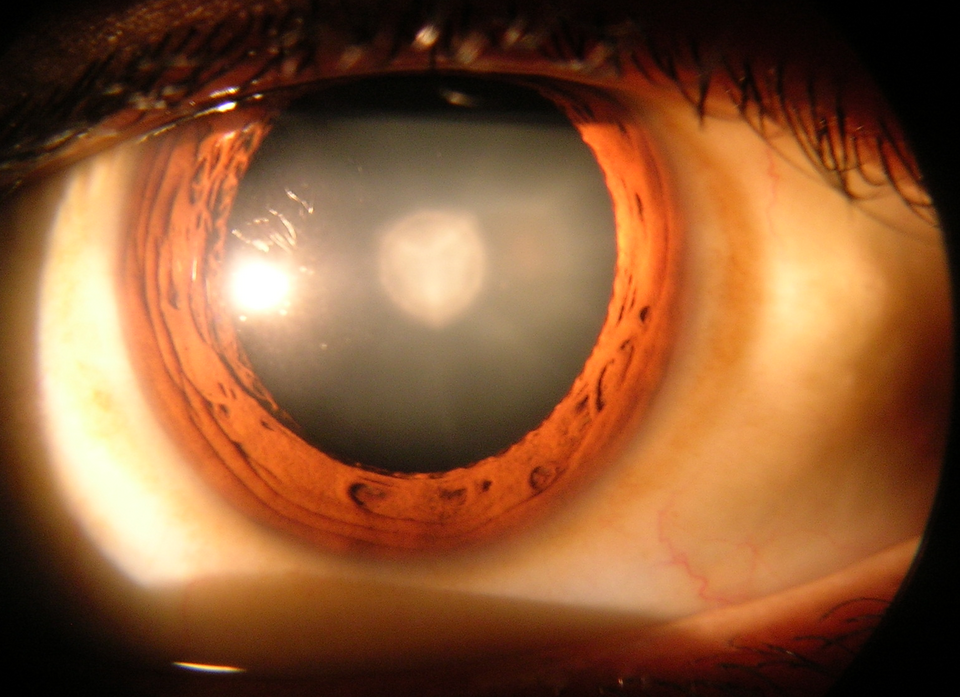
The lens is the clear part of the eye that focuses incoming light so that what you see looks sharp. In a healthy eye it is completely transparent. A cataract is a cloudy area that forms in this lens, so light is scattered instead of being focused cleanly. Over time the result is vision that looks blurry, hazy, foggy or less colorful, a little like looking through a dirty window.
Source: NEI, MedlinePlus, Cleveland Clinic
Clouding of the lens is one of the most common eye problems of later life. In the United States, more than half of people aged 80 or older either have this condition or have already had surgery for it, and cataract surgery is one of the most common operations in the country. The problem can affect one eye or both, but it cannot spread from one eye to the other; each eye develops its own.
Source: NEI
Worldwide, lens clouding is a major public-health issue. The World Health Organization lists cataract and uncorrected refractive error as the leading causes of vision impairment and blindness, with an estimated 94 million people living with distance vision impairment or blindness due to cataract. WHO also reports that about 1 in 2 people who need cataract surgery do not have access to it, even though the operation is among the most cost-effective treatments in all of health care.
Source: WHO
Cataract symptoms
The condition usually develops slowly and painlessly. In the early stages many people notice nothing at all. As the cloudy area grows, symptoms gradually appear and become harder to ignore. Both eyes are often affected, though usually to different degrees.
Source: NEI, NHS, MedlinePlus
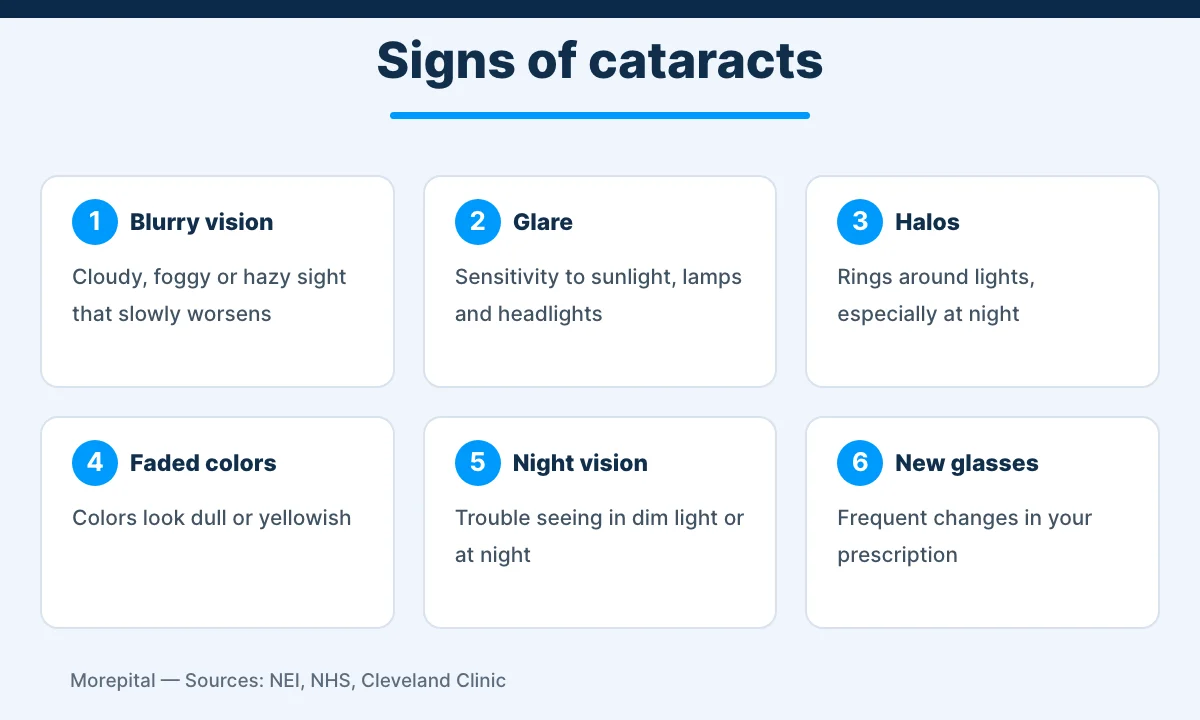
The most common symptoms are:
- Blurry, cloudy or foggy vision that does not clear with blinking.
- Faded colors; the NHS notes that blues in particular can look washed out.
- Glare and light sensitivity, so that sunlight, lamps or oncoming headlights seem too bright.
- Halos around lights, especially at night.
- Poor night vision and difficulty reading or watching TV.
- Double vision, which NEI notes may fade as the cataract grows.
- Trouble telling shapes or shades apart (MedlinePlus).
- Frequent changes in glasses or contact lens prescription; Cleveland Clinic notes nearsightedness in particular can worsen.
Source: NEI, NHS, MedlinePlus, Cleveland Clinic
Because a typical cataract forms slowly, a sudden change in vision, or eye pain, points to something else that needs prompt attention. Cleveland Clinic advises having any new eye or vision symptom checked to rule out more serious causes.
Source: MedlinePlus, Cleveland Clinic
Causes and risk factors
Why cataracts form
Most cases are a normal part of aging. From around age 40, proteins in the lens begin to break down and clump together, making the lens less flexible and creating cloudy areas that slowly enlarge. Symptoms often do not appear until after age 60. According to MedlinePlus, most people have some mild clouding after 60, and by age 75 most people have cataracts that affect their vision.
Source: NEI, Cleveland Clinic, MedlinePlus
Risk factors
Age is the biggest risk factor, but several other factors can make lens clouding appear earlier or progress faster:
- Diabetes – a well-recognized risk factor, so good blood sugar control matters (see our guide to diabetes symptoms).
- Smoking and heavy alcohol use.
- Long-term steroid (corticosteroid) use and certain other medicines.
- Too much sun – regular exposure to strong ultraviolet (UV) light without protection.
- Eye injury, previous eye surgery or radiation treatment to the upper body.
- Family history – having a parent, brother or sister with cataracts – and certain genetic changes.
- Other eye conditions, such as uveitis (eye inflammation) or being very short-sighted.
- Other long-term conditions, such as high blood pressure and severe dermatitis (NHS).
Source: NEI, NHS, MedlinePlus, Cleveland Clinic
The NHS also lists being a woman as a factor that raises the risk. Research summarized in the journal Ophthalmic Research links different risk factors to different cataract types: smoking is consistently associated with nuclear cataracts, high sunlight exposure with cortical cataracts, and steroid treatment, diabetes, high myopia and ionizing radiation with posterior subcapsular cataracts.
Source: NHS, Ophthalmic Research (PMC)
Types of cataracts
Doctors usually name age-related cataracts by where the cloudiness sits in the lens. Each type tends to affect vision in a slightly different way, and it is common for one eye to have more than one type at the same time.
Source: Cleveland Clinic
| Type | Where it forms | Typical effect on vision |
|---|---|---|
| Nuclear | Center (nucleus) of the lens, which gradually hardens and may turn yellow-brown | Blurred vision, particularly for clear distance sight; colors can look duller |
| Cortical | Outer part of the lens around the nucleus, often starting at the edges as spoke-like streaks | Glare and halos, trouble in bright light and with headlights at night |
| Posterior subcapsular | Back of the lens, just under the thin lens capsule | Blur both near and far and glare in bright light; can reduce sharpness early because it sits on the line of sight |
Source: Cleveland Clinic, Ophthalmic Research (PMC)
Posterior subcapsular cataracts are the least common of the three types in population studies. Beyond age-related forms, cataracts can also follow an eye injury (traumatic cataract) or surgery for another eye problem such as glaucoma, and some are linked to health conditions or medicines such as steroids.
Source: Ophthalmic Research (PMC), NEI, Cleveland Clinic
Cataracts in babies and children
Some babies are born with cataracts (congenital cataracts), and some children develop them later. The NHS describes childhood cataracts as rare. Signs can include a white or cloudy-looking pupil, difficulty following moving objects or faces, wobbling eye movements and a squint. Risk is higher with a family history, certain genetic conditions such as Down’s syndrome, infections such as rubella during pregnancy, or an eye injury. Babies are checked for congenital cataracts during the newborn physical examination, and treatment is usually surgery to protect the child’s sight. WHO notes that congenital cataract is a leading cause of childhood vision impairment in low-income countries.
Source: NHS (children), WHO
How cataracts are diagnosed
The diagnosis is made during an eye examination by an optometrist (optician) or an ophthalmologist. The tests are painless and usually include:
- Questions about your symptoms, medical history and the medicines you take.
- Vision testing – reading letters on a chart to measure how sharply each eye sees.
- Slit-lamp examination – a microscope with a bright light lets the doctor look closely at the front of the eye and the lens to see the cataract.
- Dilated eye exam – drops widen the pupils so the doctor can look inside the eye and check for cataracts.
Source: Cleveland Clinic, MedlinePlus, NEI
Additional tests are rarely needed except to look for other causes of poor vision. In the UK, an optician who suspects cataracts will refer you to an eye specialist for further assessment. The National Eye Institute (NEI) recommends that adults aged 60 and older have a dilated eye exam every 1 to 2 years, because early cataracts often cause no symptoms.
Source: MedlinePlus, NHS, NEI
Cataract treatment options
Surgery is the only way to remove a cataract; NEI, MedlinePlus and Cleveland Clinic all describe it as the only treatment that does so. It is not always needed straight away, and mild cases can often be managed for some time with simple measures:
- An updated glasses or contact lens prescription.
- Brighter lighting at home or work, especially for reading.
- Anti-glare sunglasses.
- Magnifying lenses for reading and close tasks.
Source: NEI, MedlinePlus, NHS, Cleveland Clinic
Cataract surgery
When cataracts start to interfere with daily activities such as reading, driving, using screens or watching television, even with the best glasses, doctors usually recommend cataract surgery. The surgeon removes the cloudy natural lens and replaces it with a clear artificial lens called an intraocular lens (IOL), which stays in the eye permanently. NEI notes that the eye is measured about a week beforehand to choose the right IOL, and Cleveland Clinic adds that some IOLs can also correct refractive errors, which may reduce the need for glasses afterward.
Source: NEI (surgery), Cleveland Clinic, MedlinePlus, NHS
The operation is typically done under local anesthesia, given as numbing drops, an injection or both, so the patient is awake but should not feel pain; medicine can be given to help you relax. Sources give different time frames: NEI says the procedure lasts about an hour, while the NHS says the operation itself usually takes 20 to 45 minutes. Most people go home the same day. If both eyes need surgery, they are treated on separate days, usually about a month apart according to NEI.
Source: NEI (surgery), NHS (surgery), NHS
Cataract surgery is considered safe and effective: according to NEI, about 9 out of 10 people see better afterward. Itching, discomfort and light sensitivity usually settle in 1 to 2 days. Estimates of full recovery differ: NEI says most people are completely healed by about 8 weeks, while Cleveland Clinic describes recovery as usually taking about a month. During recovery you use eye drops (the NHS says for about 4 weeks), may wear a protective shield at night, and should avoid touching the eye, bending over or heavy lifting for a few weeks. You must not drive yourself home after the operation.
Source: NEI (surgery), Cleveland Clinic, NHS (surgery)
Does waiting cause harm?
For typical age-related cataracts, waiting usually does not damage the eye or make surgery harder later, so the timing is mostly decided by how much the cataract affects your life. There are exceptions: your eye doctor may advise earlier surgery if a cataract blocks the view needed to treat another eye disease such as diabetic retinopathy. The NHS notes that cataracts tend to get worse over time and, without treatment, eventually cause sight loss.
Source: NEI, MedlinePlus, NHS
Complications
When diagnosed and treated, the condition rarely causes lasting harm, and the vision loss it causes is usually reversible with surgery. Left untreated for a long time, however, the clouding can keep worsening until they severely limit sight. In rare cases a very advanced (hypermature) cataract can leak material into other parts of the eye, causing painful inflammation and a type of glaucoma.
Source: Cleveland Clinic, MedlinePlus
Poor vision also raises the risk of falls and injuries at home, so safety changes may be needed as sight worsens. Vision after surgery may not reach 20/20 if other eye diseases, such as macular degeneration, are present; an eye doctor can often predict this before the operation.
Source: MedlinePlus
Risks of surgery and secondary cataract
Like any operation, cataract surgery carries some risks, including swelling, bleeding, infection, inflammation, unusual changes in eye pressure, vision loss, double vision, the new lens shifting position and retinal detachment. Serious complications are rare, and most problems appear soon after surgery.
Source: NEI (surgery), NHS (surgery)
A more common later issue is posterior capsular opacification (PCO), often called a secondary cataract: the thin capsule that holds the new lens becomes cloudy weeks, months or years after surgery, and vision turns hazy again. Cleveland Clinic calls it the most common complication of cataract surgery, affecting up to half of people within five years. It is treated with YAG laser capsulotomy, an in-office procedure of about five minutes that opens a small window in the cloudy capsule; vision typically clears in about a day.
Source: Cleveland Clinic (PCO), NEI (surgery)
Prevention and living with cataracts
Because aging is the main cause, lens clouding cannot be completely prevented. Still, several habits may lower your risk or slow their development:
- Protect your eyes from the sun with sunglasses and a brimmed hat; CDC advises choosing sunglasses that block 99 to 100% of UV-A and UV-B radiation.
- Do not smoke, or get help to quit.
- Manage diabetes and other health conditions that raise cataract risk.
- Talk to your doctor about long-term steroid use and other medicines linked to cataracts.
- Wear protective eyewear during sports or tasks that could injure the eyes, such as using power tools.
- Eat a healthy diet rich in fruits, vegetables, leafy greens, nuts and whole grains.
Source: NEI, CDC, MedlinePlus
Research reviewed in Ophthalmic Research found that vitamin supplement trials showed little benefit for preventing cataracts, so supplements are not a substitute for these measures.
Source: Ophthalmic Research (PMC)
Day-to-day tips
If you have been diagnosed with cataracts but do not need surgery yet, use brighter lights for reading and close work, try magnifying lenses, and make safety changes at home to lower the risk of falls as your sight changes. Keep up regular eye exams so your doctor can track the cataract. You may still be allowed to drive if your vision meets legal standards; in the UK you must tell the DVLA if your eyesight falls below the minimum driving standard.
Source: NEI, MedlinePlus, NHS
When to see a doctor
See an optometrist or eye doctor if you notice blurry or cloudy vision, increasing glare, faded colors, poor night vision or frequent prescription changes. Cataracts are usually not an emergency, but any new vision change should be checked promptly to rule out more serious problems. Parents should contact a doctor if a child’s pupil looks white or cloudy or the child seems not to follow faces or objects.
Source: Cleveland Clinic, MedlinePlus, NHS (children)
- You have sudden vision loss or sudden blurring in one or both eyes.
- After cataract surgery you develop severe eye pain that does not respond to medication.
- After surgery your eye becomes very red or your vision gets worse.
- You see a sudden shower of floaters, flashes of light, or a dark curtain or shadow moving across your vision.
Source: NEI (surgery), NHS (surgery), Cleveland Clinic
Related conditions
Further reading
Cataracts: frequently asked questions
Can cataracts go away on their own?
Can eye drops dissolve cataracts?
No. NEI, MedlinePlus and Cleveland Clinic all state that surgery is the only way to remove a cataract. Glasses, brighter lighting and magnifiers can only help you cope with early symptoms.
Source: NEI, MedlinePlus, Cleveland Clinic
At what age do cataracts usually start?
Lens proteins start to break down from around age 40, but symptoms often do not appear until after 60. Most people have some mild clouding after 60, and by 75 most have cataracts that affect vision.
Source: NEI, Cleveland Clinic, MedlinePlus
Is cataract surgery painful?
How long does it take to recover from cataract surgery?
Discomfort usually eases within 1 to 2 days. Sources differ on full recovery: NEI says most people are completely healed by about 8 weeks, while Cleveland Clinic says recovery usually takes about a month.
Source: NEI, Cleveland Clinic
Can a cataract come back after surgery?
The cataract itself cannot return, because cataracts do not form on artificial lenses. However, the capsule behind the new lens can become cloudy later (a secondary cataract, or PCO), which is treated with a quick YAG laser procedure.
Source: Cleveland Clinic, NEI
Do I need surgery as soon as I am diagnosed?
Not usually. Surgery is recommended when cataracts interfere with daily activities such as driving or reading. Waiting typically does not harm the eye or make surgery harder.
Source: NEI, MedlinePlus
Can I drive with cataracts?
Are cataracts linked to diabetes?
Yes. Diabetes is a recognized risk factor for cataracts, and controlling diseases that raise cataract risk is part of protecting your eyes.
Source: NEI, NHS, MedlinePlus
Thinking about cataract surgery? Contact us for a free consultation about your options.
Sources
- National Eye Institute (NEI) — Cataracts
- National Eye Institute (NEI) — Cataract Surgery
- NHS — Cataracts in adults
- NHS — Childhood cataracts
- Cleveland Clinic — Cataracts: What They Are, Symptoms, Types & Treatment
- MedlinePlus — Cataract – adult
- World Health Organization — Blindness and vision impairment (fact sheet)
- Ophthalmic Research (PMC) — Oxidative Damage and the Prevention of Age-Related Cataracts (Beebe et al., 2010)
- NHS — Cataract surgery
- Cleveland Clinic — Posterior Capsular Opacification (Secondary Cataract)
- CDC — Keep Your Eyes Healthy (Vision Health)
This page is part of the Morepital medical reference. It is for general health education and does not replace a consultation with a qualified doctor. Last reviewed: October 2026.