Prostate cancer symptoms are usually absent in the early stages, because the cancer tends to start in the outer part of the gland, away from the urethra. When prostate cancer symptoms do appear, the most common are urinary changes such as a weak or interrupted flow, difficulty starting, needing to pee more often (especially at night), and blood in the urine or semen, while bone pain, weight loss and fatigue suggest the cancer may have spread. A harmless enlarged prostate is a far more common cause, so only a doctor’s check can tell.
Source: NHS, CDC, American Cancer Society
Contents
- What are prostate cancer symptoms?
- Early prostate cancer symptoms: why there are often none
- Urinary and sexual prostate cancer symptoms
- Signs that the cancer may have spread
- Prostate cancer symptoms or an enlarged prostate?
- Who is most at risk?
- The PSA test: what it shows and what it misses
- The screening debate: benefits and harms
- When to see a doctor about prostate cancer symptoms
- Prostate cancer symptoms: frequently asked questions
What are prostate cancer symptoms?
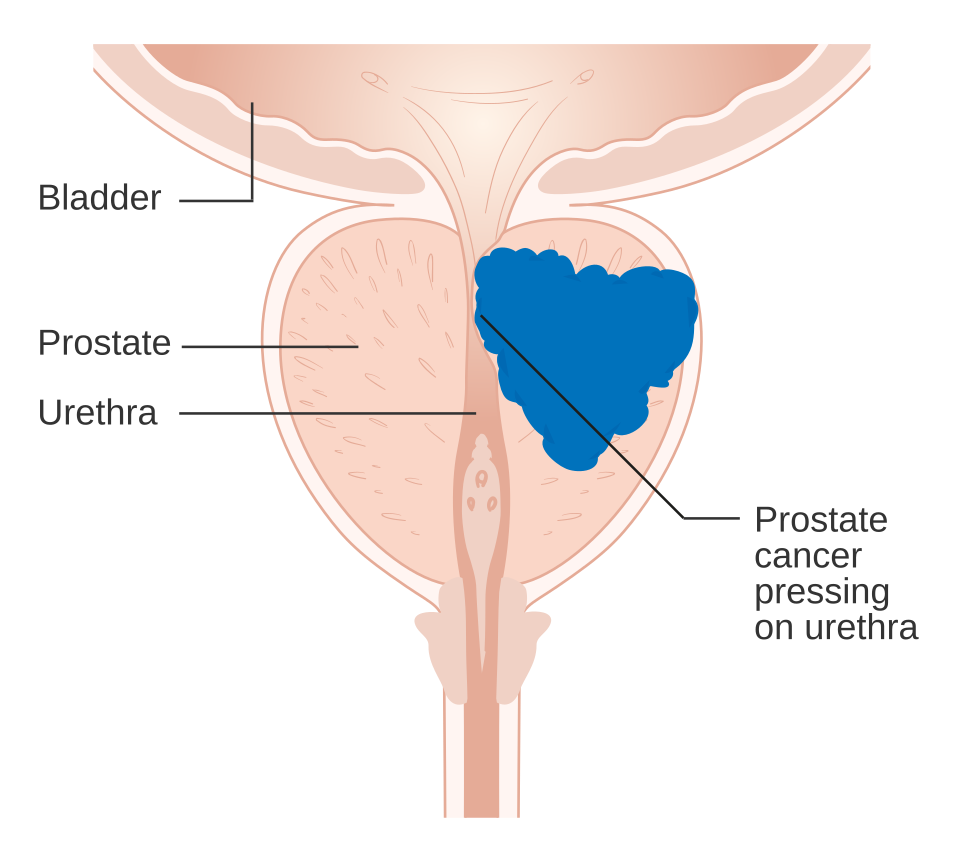
The prostate is a small gland that sits below the bladder and in front of the rectum. It wraps around the urethra, the tube that carries urine and semen, and makes fluid that keeps sperm healthy. Anything that enlarges the gland or presses on the urethra can change the way you pee.
Source: Cleveland Clinic, NHS
Prostate cancer is very common. The World Cancer Research Fund reports about 1.47 million new cases worldwide in 2022, making it the second most common cancer in men. In the United States, the National Cancer Institute’s SEER program estimates 333,830 new cases and 36,320 deaths in 2026, with a median age at diagnosis of 68. In the UK, Prostate Cancer UK puts the lifetime risk at about 1 in 8 men.
Source: WCRF, NCI SEER, Prostate Cancer UK
Prostate cancer symptoms are the changes a growing tumor causes by pressing on the urethra or spreading to bones and other organs. Knowing them is useful, but it is just as important to understand their limits: most men diagnosed today have no prostate cancer symptoms at all, and most men who have these urinary problems do not have cancer.
Source: CDC, American Cancer Society
Early prostate cancer symptoms: why there are often none
The NHS explains that prostate cancer usually starts to grow in the outer part of the gland. A small tumor there often does not press on the urethra, so prostate cancer symptoms may not appear until it has grown larger or spread. The American Cancer Society (ACS) and CDC agree that early prostate cancer usually causes no symptoms.
Source: NHS, American Cancer Society, CDC
MedlinePlus adds that the PSA level in the blood may rise before any prostate cancer symptoms appear. That is the main reason PSA testing exists: it is a way to look for cancer in men who feel completely well. Cancer found while still confined to the prostate has an excellent outlook: SEER data show that about 69% of US cases are diagnosed at the localized stage, and 5-year relative survival for localized and regional disease is close to 100%, compared with about 40% when the cancer has spread to distant parts of the body.
Source: MedlinePlus, NCI SEER
The practical lesson: do not wait for early prostate cancer symptoms. If you are in a higher-risk group or approaching screening age, ask your doctor whether a PSA test makes sense for you.
Source: NHS, ACS – Screening
Urinary and sexual prostate cancer symptoms

When a tumor grows large enough to narrow the urethra or irritate the bladder, the first prostate cancer symptoms are usually urinary. The NHS, CDC and Cleveland Clinic list:
- Difficulty starting to pee, or having to strain.
- A weak, slow or stop-start (interrupted) flow.
- Needing to pee more often, or more urgently.
- Waking up at night to pee (nocturia).
- Feeling that your bladder has not emptied fully.
- Pain or burning when you pee.
- Dribbling at the end, or leaking urine.
Source: NHS, CDC, Cleveland Clinic, MedlinePlus
Blood in urine or semen
Blood in the urine (hematuria) or in the semen (hematospermia) appears on the lists of the NHS, CDC, ACS and Cleveland Clinic. It can have many other causes, including infections, but it should never be ignored. The US National Institute of Diabetes and Digestive and Kidney Diseases (NIDDK) advises getting care right away if you see blood in your urine.
Source: NHS, American Cancer Society, NIDDK
Sexual symptoms
Some men notice sexual changes. The CDC and Cleveland Clinic list painful ejaculation, and the NHS and ACS include erectile dysfunction (ED). On its own, ED is common and usually has other causes; our guide to erectile dysfunction explains the usual causes and tests. A new erection problem combined with urinary prostate cancer symptoms is a good reason to book an appointment.
Source: CDC, Cleveland Clinic, American Cancer Society
Signs that the cancer may have spread
Advanced prostate cancer has grown larger and may have spread beyond the gland, for example to the bones. According to the ACS, Cleveland Clinic and the NHS, it can cause:
- Pain in the lower back, hips, pelvis, ribs, spine or chest that does not go away, caused by cancer in the bones.
- Weight loss without trying.
- Fatigue.
- Erectile dysfunction.
- Weakness or numbness in the legs or feet, or loss of bladder or bowel control, if the cancer presses on the spinal cord.
Source: American Cancer Society, Cleveland Clinic, NHS
MedlinePlus notes that such bone pain is most often felt in the lower back and pelvis. Back pain is extremely common for other reasons, so the warning sign is persistent, unexplained pain. Sudden leg weakness, numbness or loss of bladder or bowel control can mean spinal cord pressure and needs emergency care.
Source: MedlinePlus, American Cancer Society
Prostate cancer symptoms or an enlarged prostate?
The ACS states that trouble urinating is much more often caused by benign prostatic hyperplasia (BPH), a non-cancerous growth of the prostate, than by cancer. NIDDK estimates that BPH affects about 5% to 6% of men aged 40 to 64 and about 29% to 33% of men aged 65 and older, and its symptoms overlap almost completely with urinary prostate cancer symptoms. MedlinePlus adds that BPH does not raise the risk of prostate cancer, although it can raise PSA results.
Source: American Cancer Society, NIDDK, MedlinePlus
Prostatitis, an infection or inflammation of the gland, can also push PSA up for a while. Because these conditions look so similar from the outside, prostate cancer symptoms alone cannot tell them apart.
| Feature | Prostate cancer | Enlarged prostate (BPH) | Prostatitis |
|---|---|---|---|
| What it is | Malignant tumor of the gland | Non-cancerous growth | Infection or inflammation |
| Early symptoms | Usually none | Weak flow, frequency, night-time peeing | Painful or frequent urination |
| Effect on PSA | May be raised | May be raised | May be raised temporarily |
| Red-flag signs | Bone pain, weight loss, leg weakness | Unable to pee at all | Fever and chills with urinary pain |
Source: American Cancer Society, NIDDK, NCI, Cleveland Clinic
Who is most at risk?
Some men need to pay closer attention to prostate cancer symptoms and testing than others, because their chance of developing the disease is higher. The NHS, MedlinePlus and Prostate Cancer UK describe these main risk factors:
- Age: prostate cancer mainly affects men over 50, and the risk rises with age. In the UK the most common age at diagnosis is 70 to 74.
- Black ethnicity: men of Black African or Black Caribbean background have a higher risk. Prostate Cancer UK estimates that about 1 in 4 Black men will be diagnosed in their lifetime.
- Family history: a father or brother with prostate cancer makes a man about two and a half times more likely to get it. Risk may be higher with more than one affected relative, or when relatives were diagnosed under 60.
- Inherited genes: a faulty BRCA2 gene raises the risk, and a close relative with breast, ovarian or pancreatic cancer may point to shared inherited genes.
- Other factors: MedlinePlus lists obesity, a diet high in animal fat and exposure to Agent Orange.
Source: NHS, Prostate Cancer UK, MedlinePlus
The US Preventive Services Task Force (USPSTF) reports a prostate cancer death rate of 44.1 per 100,000 for Black men compared with 19.1 for white men. For men in these higher-risk groups, Prostate Cancer UK and the ACS suggest starting the conversation about testing earlier, from about age 45.
Source: USPSTF, Prostate Cancer UK, ACS – Screening
The PSA test: what it shows and what it misses
Prostate-specific antigen (PSA) is a protein made by both normal and cancerous prostate cells. A blood test measures it in nanograms per milliliter (ng/mL). The National Cancer Institute (NCI) explains that PSA is used to investigate urinary symptoms, monitor men already diagnosed and screen men who have no prostate cancer symptoms. It cannot diagnose cancer on its own.
Source: NCI
What counts as a high PSA?
There is no single PSA level that separates normal from abnormal. The NCI says a level above 4.0 ng/mL has generally been treated as abnormal, but some doctors use a lower threshold, such as 2.5 ng/mL, for younger men and a higher one, such as 5 ng/mL, for older men. Finasteride and dutasteride, used for an enlarged prostate, lower PSA, so lower cutoffs apply to men taking them.
Source: NCI
Things that raise PSA without cancer
BPH, prostatitis, a urine infection and a recent prostate biopsy can all raise PSA. Ejaculation, vigorous exercise and cycling can push it up for a short time. To get a reliable result, the NHS advises avoiding ejaculation, anal sex, exercise that leaves you out of breath and cycling for 48 hours before the test, and waiting 4 to 6 weeks after a urine infection has cleared. You can eat and drink as usual.
Source: NCI, NHS – PSA test
How accurate is it?
The NCI estimates that about 6% to 7% of men have a false-positive PSA result in any screening round, and only about 25% of men who have a biopsy because of a raised PSA turn out to have prostate cancer. The NHS stresses that a high PSA does not mean you have cancer, and that a result may not be accurate.
Source: NCI, NHS – PSA test
What happens after a raised result
A raised result is usually repeated, for example after 6 to 8 weeks. If PSA stays high or keeps rising, or a lump is felt during a digital rectal exam (DRE), the next step is often an MRI scan of the prostate. The NHS says men referred to a specialist will have an MRI, which shows whether further tests are needed, and a biopsy is suggested only if more information is required. A biopsy, taken through the rectum or the skin behind the scrotum (transperineal), is the only way to confirm the diagnosis. The cells are graded with the Gleason system, where a higher score means a more aggressive cancer.
Source: NCI, NHS, Cleveland Clinic, MedlinePlus
The screening debate: benefits and harms
The question is whether testing men without prostate cancer symptoms saves enough lives to justify false alarms, biopsies and treatment side effects. Major organizations answer differently.
What the guidelines say
- USPSTF (United States, 2018): for men aged 55 to 69, PSA screening should be an individual decision made after discussing benefits and harms with a clinician (grade C). It recommends against PSA screening for men aged 70 and older (grade D).
- American Cancer Society: men should discuss screening with their provider from age 50 at average risk, age 45 at high risk (including African American men and men with a father or brother diagnosed before 65), and age 40 at even higher risk. If PSA is below 2.5 ng/mL, retesting every 2 years may be enough; at 2.5 ng/mL or higher, yearly testing is advised. Men with a life expectancy under 10 years generally should not be screened.
- NHS (UK): there is no routine PSA screening program, except for people found to carry a faulty BRCA2 gene, but any man can ask a GP for a PSA test.
Source: USPSTF, ACS – Screening, NHS – PSA test
The numbers behind the decision
The USPSTF estimates that if 1,000 men aged 55 to 69 are offered screening for about 13 years, about 1.3 will avoid dying from prostate cancer and about 3 will avoid metastatic cancer. Over the same period, about 240 will have a positive PSA test, 220 a biopsy and 100 a diagnosis; 2 will be hospitalized for a biopsy complication. An estimated 20% to 50% of screen-detected cancers are overdiagnosed, meaning they would never have caused harm. Among those treated, about 50 men develop sexual dysfunction and 15 urinary incontinence.
Many men with slow-growing, low-risk cancer are now offered active surveillance: regular PSA tests, scans and biopsies, with treatment only if the cancer changes. Hormone therapy is mainly used for cancer that has spread. Surgery and radiation can affect erections and bladder control; Cleveland Clinic notes that incontinence often improves within 6 to 12 months and ED medicines can help. Browse more guides in our treatments and procedures section.
Source: Cleveland Clinic, MedlinePlus
When to see a doctor about prostate cancer symptoms
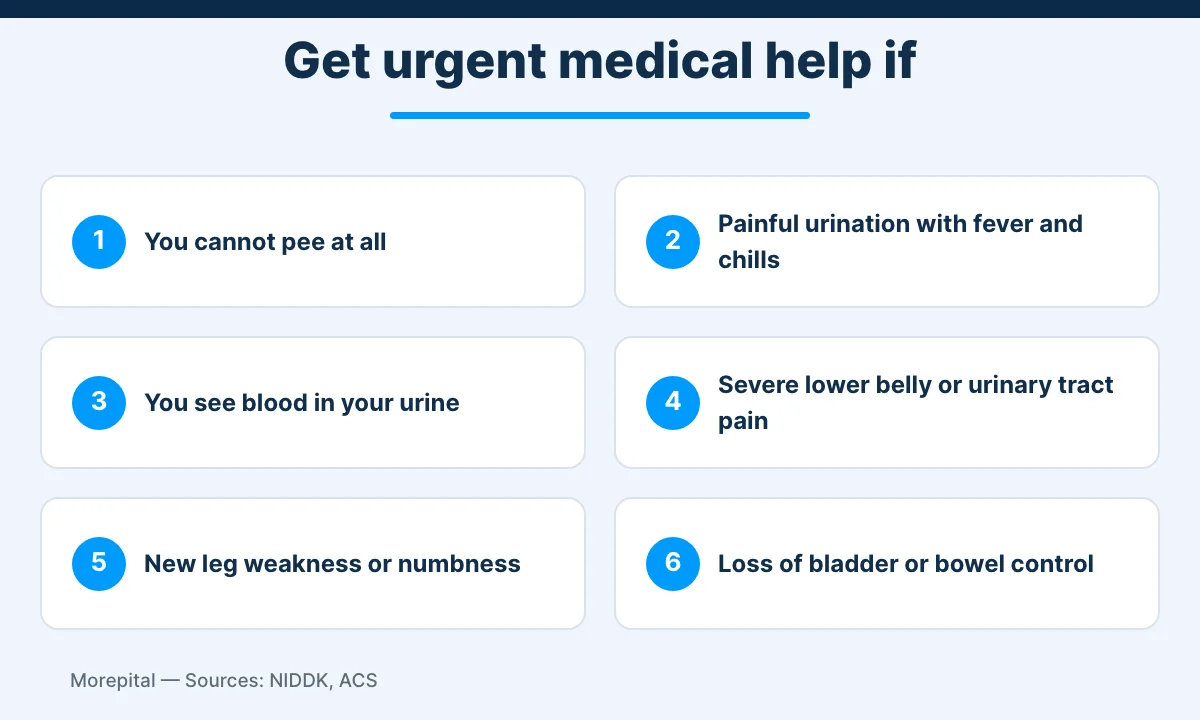
Book a routine appointment with your doctor or GP if you have any urinary or sexual prostate cancer symptoms, even mild ones, and especially if they are new, changing or getting worse. The NHS also suggests seeing a GP if you are over 40 and know you carry a faulty BRCA2 gene, or if you are simply worried about your risk. The CDC advises seeing your doctor right away if you notice any of the prostate cancer symptoms on its list.
Some prostate cancer symptoms, and some symptoms of other prostate problems, need urgent or same-day care. Get help quickly if you:
- Cannot pee at all.
- Have painful, frequent or urgent urination together with fever and chills.
- See blood in your urine.
- Have severe pain in your lower abdomen or urinary tract.
- Develop new weakness or numbness in your legs, or lose control of your bladder or bowels.
Source: NIDDK, American Cancer Society
Reporting prostate cancer symptoms early is worthwhile, and a referral is not a diagnosis: the NHS stresses that being referred for tests does not mean you have cancer. For background on other common conditions, see our diseases and conditions library.
Source: NHS
Prostate cancer symptoms: frequently asked questions
What are the first prostate cancer symptoms?
Most men have no prostate cancer symptoms at first. When they appear, they are usually urinary: a weak or interrupted flow, difficulty starting, needing to pee more often, especially at night, and sometimes blood in the urine or semen.
Source: NHS, American Cancer Society
Can you have prostate cancer with no prostate cancer symptoms?
Yes. Early prostate cancer usually causes no symptoms, and the CDC notes that most men have none at all. A raised PSA level may be the only early clue.
Source: CDC, MedlinePlus
Are prostate cancer symptoms different from BPH symptoms?
The urinary symptoms are almost identical, and BPH is a far more common cause. Bone pain, weight loss and leg weakness point more toward advanced cancer, but only tests can tell the conditions apart.
Source: American Cancer Society, NIDDK
At what age should men think about PSA screening?
The ACS suggests discussing it from age 50 at average risk, 45 at high risk and 40 at very high risk. The USPSTF advises an individual decision at 55 to 69 and recommends against screening from 70.
Source: ACS – Screening, USPSTF
Is back pain one of the prostate cancer symptoms?
It can be, but rarely. Persistent pain in the back, hips or ribs can be a sign of advanced prostate cancer that has spread to the bones, but most back pain has other causes. See a doctor if it is new, persistent or comes with urinary symptoms.
Source: American Cancer Society, MedlinePlus
Disclaimer: this article is for general health education and does not replace advice from a qualified doctor who can assess your individual case. Last updated: October 2026.