
Gastric sleeve in Turkey is the same operation offered worldwide: a keyhole procedure that permanently removes about 80% of the stomach, leaving a narrow, banana-shaped tube that holds less food and reduces hunger. It usually takes 1 to 3 hours under general anesthesia, most people leave hospital within 1 to 3 days, and the average loss is about 25% to 30% of body weight over the first one to two years. Before booking a gastric sleeve in Turkey, check that you meet the medical criteria, that the hospital is approved by the Turkish Ministry of Health, and that at least two years of specialist follow-up is arranged for when you are home.
Source: NHS, Cleveland Clinic, UK Foreign Office
Source: NHS, ASMBS/IFSO 2022 statement, NHS, CDC, BOMSS
Contents
- What a gastric sleeve in Turkey involves
- Who is a candidate?
- Sleeve vs bypass, band and endoscopic options
- Planning a gastric sleeve in Turkey step by step
- Recovery and diet timeline
- Results: how much weight you can expect to lose
- Risks of a gastric sleeve in Turkey
- Choosing a surgeon and hospital in Turkey
- Long-term follow-up at home
- Frequently asked questions
What a gastric sleeve in Turkey involves

A gastric sleeve, or vertical sleeve gastrectomy, is a weight-loss operation in which the surgeon removes most of the stomach and staples the remaining part into a narrow tube. The surgery is usually laparoscopic: it is done through about 2 to 5 small cuts in the abdomen while you are asleep under general anesthesia, and the stomach is inflated with air so the surgeon can see and work. The intestines are not cut or rerouted, and the valves at the top and bottom of the stomach are left as they are.
Source: NHS, MedlinePlus, NIDDK
The smaller stomach fills quickly, so small portions satisfy you. The part that is removed also produces most of the so-called hunger hormone, which is why many people notice less appetite after the operation. Because the removed stomach cannot be put back, a gastric sleeve in Turkey, like anywhere else, is a permanent change that only works well alongside lasting changes in eating and activity. For a broader overview of the operation itself, see our gastric sleeve treatment guide.
Source: ASMBS, MedlinePlus, NIDDK
Operating times differ by source: 1 to 3 hours (NHS) or about 60 to 90 minutes (Cleveland Clinic, MedlinePlus). What differs abroad is the logistics: assessment, surgery and early recovery are compressed into a short stay, and later problems may be handled by a different team at home.
Source: NHS, Cleveland Clinic, MedlinePlus, NHS
Who is a good candidate for a sleeve?

Obesity is a chronic disease, and a gastric sleeve in Turkey or elsewhere is meant for people with significant obesity who have not been able to lose enough weight in other ways. Under the criteria used by the NHS, NIDDK and Cleveland Clinic, sleeve gastrectomy is usually considered for adults with a body mass index (BMI) of 40 or more, or a BMI of 35 to 40 with a condition that might improve with weight loss, such as type 2 diabetes, high blood pressure, sleep apnea, arthritis or breathing problems. Our obesity guide explains BMI and its health risks.
Source: NHS, NIDDK, Cleveland Clinic, MedlinePlus
International guidance has moved lower. The 2022 joint statement from the American Society for Metabolic and Bariatric Surgery (ASMBS) and the International Federation for the Surgery of Obesity and Metabolic Disorders (IFSO) recommends surgery for a BMI above 35 regardless of other conditions, says it should be considered at a BMI of 30 to 34.9 with metabolic disease, and suggests a threshold of 27.5 for people of Asian descent. The NHS similarly says surgery may be considered at a lower BMI for people from South Asian, Chinese, other Asian, Middle Eastern, Black African or African-Caribbean backgrounds. It sets no upper age limit, though older patients need careful assessment.
Source: ASMBS/IFSO 2022 statement, NHS
Beyond BMI: readiness matters
Cleveland Clinic lists prior attempts at weight loss and physical and mental readiness as part of eligibility, assessed by dietitians, psychologists and other specialists. The NHS adds that you must agree to make healthy lifestyle changes and attend regular check-ups after surgery. If you have type 2 diabetes or suspect it, read about diabetes symptoms and get tested before your consultation, because blood sugar control affects how the operation is planned.
Source: Cleveland Clinic, NHS
Being a candidate on paper is not the same as being suitable. A Northern Ireland audit of patients who had bariatric surgery outside the NHS, almost all of them sleeve gastrectomy, found that only 21 of 47 patients (44.7%) met UK NICE criteria for surgery. If you are considering a gastric sleeve in Turkey, ask the team to explain in writing why a sleeve is the right operation for you.
Source: Ulster Medical Journal (2024), BOMSS
Gastric sleeve vs bypass, band and endoscopic options
Sleeve gastrectomy and Roux-en-Y gastric bypass together account for about 90% of weight-loss operations worldwide. Compared with a gastric band, a sleeve generally produces more weight loss but carries a higher chance of surgery-related problems. Compared with a bypass, it leaves the intestines untouched and has a lower risk of vitamin and iron shortage, but it has less metabolic impact and may worsen reflux.
Source: ASMBS/IFSO 2022 statement, NIDDK, ASMBS, NHS
| Procedure | What is done | Reversible? | Main trade-off |
|---|---|---|---|
| Gastric sleeve | About 80% of the stomach removed, intestines unchanged | No | May cause or worsen reflux; less metabolic effect than bypass |
| Gastric bypass (Roux-en-Y) | Small stomach pouch joined to the lower small intestine | Difficult | Higher risk of vitamin and iron shortage than a sleeve |
| Gastric band | Adjustable silicone band around the top of the stomach | Yes | Less weight loss; band can slip or erode |
| Duodenal switch | Sleeve plus a major intestinal bypass | No | Most weight loss but the most surgery-related problems |
| Endoscopic sleeve gastroplasty | Stomach folded and stitched through the mouth, nothing removed | No cuts, no stomach removed | Often same-day discharge; not the same operation as a sleeve |
When a clinic offers you a gastric sleeve in Turkey, confirm which of these procedures you are actually booking. BOMSS, the UK bariatric surgery society, lists receiving a different procedure from the one the patient expected among its concerns about surgery abroad.
Source: BOMSS
Planning a gastric sleeve in Turkey step by step
A safe plan for a gastric sleeve in Turkey starts at home, weeks before the flight. The US Centers for Disease Control and Prevention (CDC) advises a pretravel consultation with a doctor or travel medicine clinic at least 4 to 6 weeks before any medical trip, and the UK Foreign Office recommends discussing your plans with your UK doctor before going ahead.
Source: CDC, UK Foreign Office
- Get a baseline check at home of your BMI, blood pressure, blood sugar, medicines and reflux symptoms, with copies of results.
- Shortlist providers. Check the hospital and surgeon against the Turkish Ministry of Health’s approved provider list and look for international accreditation such as Joint Commission International (JCI).
- Have a full assessment by a surgeon, dietitian and, ideally, a psychologist.
- Follow the pre-operative diet. Many programs use about two weeks of a liquid diet to shrink the liver, then no food or drink for about 12 hours before surgery.
- Pack records and insurance: medical records, allergy details, enough medicine, and cover for complications.
- Plan your stay and flight. Book accommodation near the hospital after discharge and allow 10 to 14 days before a long flight home.
- Book follow-up at home for at least two years.
Source: CDC, Cleveland Clinic, HealthTürkiye (Turkish Ministry of Health), BOMSS
Conditions such as high blood pressure affect anesthetic risk, so get them checked and treated before a gastric sleeve in Turkey. Our guide to high blood pressure explains how it is diagnosed and treated.
Source: NHS, Cleveland Clinic
Recovery and diet timeline after a gastric sleeve in Turkey
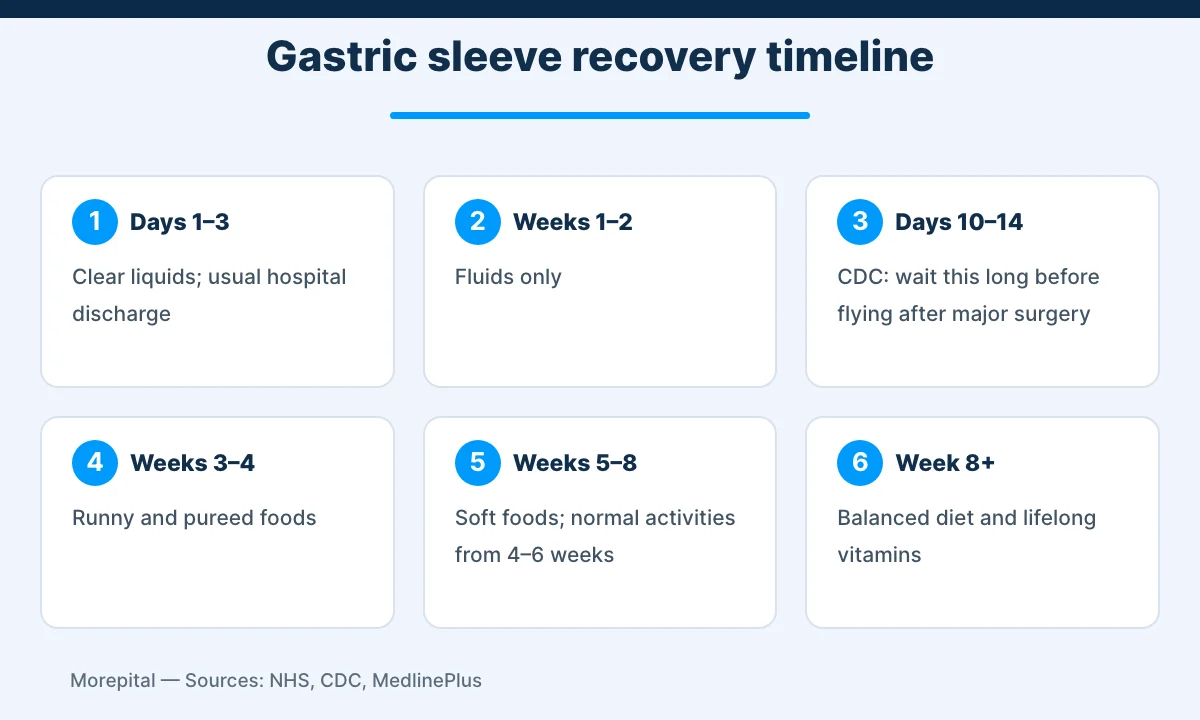
After a gastric sleeve in Turkey you will usually start on clear liquids in hospital and leave 1 to 3 days after surgery. The NHS describes a typical staged diet: fluids only for the first 2 weeks, runny or pureed foods in weeks 3 and 4, soft foods in weeks 5 to 8, and a gradual return to a healthy balanced diet from about week 8. Your own plan may differ, so follow the written instructions from your team.
Source: NHS, MedlinePlus, Cleveland Clinic
Walking several times a day from the first day after a gastric sleeve in Turkey lowers the risk of blood clots and helps recovery. According to the NHS, most people can start returning to normal activities after 4 to 6 weeks, and Cleveland Clinic suggests allowing about a month before you feel like yourself or work at full capacity, as tiredness is common.
Source: MedlinePlus, NHS, Cleveland Clinic
When is it safe to fly home?
The CDC advises waiting 10 to 14 days after major surgery before flying, because long flights soon after an operation raise the risk of blood clots. BAAPS and BOMSS describe clots after early long-distance travel as potentially life-threatening. If your package includes a flight home only a few days after a gastric sleeve in Turkey, ask the team how they will lower your clot risk, for example with anticoagulant (blood-thinning) medicines, and consider staying longer.
Source: CDC, BAAPS and BOMSS, NHS
Lifelong vitamins
After a gastric sleeve in Turkey you will need vitamin and mineral supplements for life and regular blood tests to check your levels.
Source: NHS, Cleveland Clinic
Results: how much weight you can expect to lose
The expected results of a gastric sleeve in Turkey are the same as elsewhere. Cleveland Clinic reports an average loss of about 25% to 30% of total body weight in the first one to two years, with results that stay fairly consistent at five years, although some people regain part of the weight. For a person weighing 120 kg (265 lb), that would mean roughly 30 to 36 kg (66 to 79 lb). Weight usually comes off more slowly than after a gastric bypass, and loss can continue for 2 to 3 years. Results depend heavily on diet, activity and follow-up, so no clinic offering a gastric sleeve in Turkey can promise a specific figure.
Source: Cleveland Clinic, MedlinePlus
Conditions such as type 2 diabetes, high blood pressure and sleep apnea may improve after surgery. In long-term studies summarized by ASMBS and IFSO, bariatric surgery was associated with lower overall mortality than non-surgical care, including a 30.7% adjusted reduction in the Swedish Obese Subjects study.
Source: MedlinePlus, ASMBS/IFSO 2022 statement, NIDDK
Risks and complications of a gastric sleeve in Turkey
Serious surgical complications occur in fewer than 1% of sleeve operations, according to Cleveland Clinic, and the ASMBS/IFSO statement puts perioperative mortality for bariatric surgery between 0.03% and 0.2%. These figures come from experienced centers and are not guaranteed everywhere, so check the experience of any surgeon offering a gastric sleeve in Turkey.
Source: Cleveland Clinic, ASMBS/IFSO 2022 statement
Early complications
- Staple-line leak: food or fluid leaking from the stomach can cause serious infection and needs urgent treatment.
- Bleeding and infection.
- Blood clots in the legs (deep vein thrombosis) that can travel to the lungs (pulmonary embolism).
- Nausea and vomiting, including vomiting from eating more than the new stomach can hold.
Source: NHS, NIDDK, MedlinePlus
Later complications
- Acid reflux: a sleeve can worsen existing reflux or cause new heartburn. Medicines often help. If you already have acid reflux, tell your surgeon, as it may favor a different operation.
- Narrowing (stricture) from scar tissue, which can make solid food hard to swallow and may need widening.
- Gallstones after rapid weight loss; some doctors prescribe medicine for about 6 months to help prevent them.
- Nutritional deficiencies such as anemia or weak bones if supplements are not taken.
- Loose skin, especially around the abdomen, breasts, hips and limbs; removing it is usually treated as cosmetic surgery, such as a tummy tuck.
Source: ASMBS, Cleveland Clinic, NIDDK, NHS
NIDDK notes that about one-third of patients need some form of follow-up procedure, surgery or hospital stay within 5 years of bariatric surgery, though this is needed less often after a sleeve than after a bypass.
Source: NIDDK
Risks specific to surgery abroad
Some risks of a gastric sleeve in Turkey arise when complications appear after you return home. The Northern Ireland audit found that 19% of patients who had surgery abroad developed wound infections, 9% attended an emergency department and 6% were admitted to hospital, while blood monitoring dropped sharply over two years. The UK Foreign Office was aware of 7 British nationals who died in Turkey in 2025 following medical procedures, and BOMSS warns that legal redress is harder abroad.
Source: Ulster Medical Journal (2024), UK Foreign Office, BOMSS, CDC
Seek urgent medical care if, after a gastric sleeve in Turkey, you develop severe abdominal pain, vomiting blood or material that looks like coffee grounds, difficulty breathing or chest pain with a painful swollen leg, a high temperature, a fast heartbeat or fast breathing. Regular vomiting, tummy pain or difficulty swallowing also need an urgent medical review, as they can signal a leak, clot, infection or blockage.
Source: NHS, MedlinePlus
Choosing a surgeon and hospital for a gastric sleeve in Turkey
When choosing a gastric sleeve in Turkey, start with the Turkish Ministry of Health, which provides a list of approved providers through the HealthTürkiye portal, and the UK Foreign Office points travelers to it while stressing that it does not endorse any individual practitioner. The CDC recommends checking the surgeon’s qualifications and the facility’s credentials and looking for accreditation from bodies such as Joint Commission International or DNV, while noting that accreditation does not guarantee a good outcome.
Source: UK Foreign Office, HealthTürkiye (Turkish Ministry of Health), CDC
Questions to ask before booking
- Is the surgeon certified in bariatric surgery, and how many sleeve operations do they perform each year?
- Will I have a full pre-operative assessment, including dietitian and psychological review?
- Exactly which procedure will I have, and why is it right for me?
- How will you lower my risk of blood clots, and when can I fly?
- Who manages complications after I go home, and how do I reach them?
- Will I receive my operation notes, discharge summary and diet plan in English?
Be wary of any gastric sleeve in Turkey package sold mainly on speed or price. UK surgical societies urge patients to weigh the quality of assessment and aftercare, not just the cost. A credible provider will answer these questions in writing and give you time to think before you consent.
Source: BAAPS and BOMSS, BOMSS
Long-term follow-up at home
BOMSS says weight-loss surgery needs at least 2 years of support from a specialist team with dietetic, nursing, psychological and surgical expertise, followed by lifelong annual reviews. The NHS describes the same pattern: clinic follow-up for at least the first 2 years, then yearly checks with your GP. Most family doctors are not trained in bariatric aftercare, so after a gastric sleeve in Turkey ask the surgical team for a written follow-up plan and share it with your doctor.
Source: BOMSS, NHS, BAAPS and BOMSS
In the Northern Ireland audit, vitamin D testing among people who had surgery abroad fell from 22% at 3 months to 9% at 24 months, and ferritin (iron store) testing fell from 78% to 27%. Schedule your blood tests in advance and keep taking your supplements, even when you feel well. Tell your doctor too if your mood changes after surgery.
Source: Ulster Medical Journal (2024), NHS
Considering a gastric sleeve in Turkey? Contact us for a free consultation and a treatment plan tailored to you.
Gastric sleeve in Turkey: frequently asked questions
How long should I stay after a gastric sleeve in Turkey?
Hospital stay is usually 1 to 3 days, but the CDC advises waiting 10 to 14 days after major surgery before flying, so plan to stay nearby for about that long unless your surgeon advises otherwise.
Is a gastric sleeve in Turkey reversible?
No. About 80% of the stomach is permanently removed. A sleeve can, however, be revised or converted to a gastric bypass or duodenal switch later if needed.
Source: NIDDK, Cleveland Clinic
Can I have a gastric sleeve in Turkey with a BMI under 35?
Possibly. The 2022 ASMBS/IFSO guidance says surgery should be considered at a BMI of 30 to 34.9 with metabolic disease such as type 2 diabetes, and at 27.5 or above in people of Asian descent. Local criteria vary, so ask your doctor.
Source: ASMBS/IFSO 2022 statement, NHS
When can I return to work after a gastric sleeve in Turkey?
Many people need about a month before working at full capacity, and the NHS suggests most normal activities can resume after 4 to 6 weeks. Physically demanding jobs may need longer.
Source: Cleveland Clinic, NHS
Will I get acid reflux after a gastric sleeve in Turkey?
Some people do. A sleeve can worsen existing reflux or cause new heartburn, which is often controlled with medicine. Tell your surgeon about any reflux before the operation.
Source: ASMBS, Cleveland Clinic
Do I need vitamins forever after a gastric sleeve in Turkey?
Yes. Lifelong vitamin and mineral supplements and regular blood tests are recommended after a sleeve to prevent problems such as anemia and bone thinning.
Is it safe to get pregnant after a gastric sleeve in Turkey?
The NHS advises avoiding pregnancy for 12 to 18 months after surgery, until your weight has stabilized.
Source: NHS
Disclaimer: this article is for general health education and does not replace advice from a qualified doctor who can assess your individual case. Last updated: October 2026.