Acid reflux happens when stomach acid flows back up into the esophagus (food pipe), causing a burning feeling in the middle of the chest called heartburn, often with a sour taste in the mouth. Occasional acid reflux is common and usually settles with simple diet and lifestyle changes or pharmacy medicines, but reflux that happens twice a week or more, or that damages the esophagus, is called gastroesophageal reflux disease (GERD) and should be checked by a doctor.
Source: NHS, MedlinePlus, NIDDK
Contents
- What is acid reflux?
- Heartburn vs acid reflux vs GERD
- Acid reflux symptoms
- Causes and triggers of acid reflux
- Red flags: when to see a doctor
- Lifestyle changes that ease acid reflux
- Medicines for acid reflux
- How GERD is diagnosed
- Complications of untreated reflux
- Surgery and procedures for acid reflux
- Frequently asked questions
What is acid reflux?

At the bottom of the esophagus sits a ring of muscle called the lower esophageal sphincter (LES). Together with the diaphragm, it normally works like a one-way valve: it opens to let food into the stomach and then closes to keep stomach contents where they belong. Acid reflux happens when this valve weakens or relaxes at the wrong time, so acid and digestive enzymes wash back up into the esophagus.
Source: NIDDK, Cleveland Clinic
The stomach has a thick protective lining that resists its own acid, but the esophagus does not. That is why even small amounts of refluxed acid can sting, and why repeated exposure over months or years can inflame and eventually change the esophageal lining. Many people get occasional heartburn with no clear cause, and an episode after a large, rich meal is not a sign of disease on its own.
Source: Cleveland Clinic, NHS
Reflux is very common worldwide, although rates differ by region. A systematic review in the journal Gut found that weekly heartburn or regurgitation affected about 18% to 28% of people in North America, 9% to 26% in Europe and 9% to 33% in the Middle East, but under 8% in East Asia. In the United States, researchers estimate that about 20% of people have GERD.
Source: El-Serag et al., Gut, NIDDK
Heartburn vs acid reflux vs GERD
These three terms are often used as if they mean the same thing, but they describe different levels of the same problem. Knowing the difference helps you judge when self-care is enough and when it is time to see a doctor.
- Heartburn is a symptom: a painful, burning feeling in the middle of the chest, behind the breastbone. Despite the name, it has nothing to do with the heart.
- Acid reflux (gastroesophageal reflux, or GER) is the event itself: stomach contents moving back up into the esophagus. It does not always cause symptoms.
- GERD (called GORD in the UK) is a long-lasting, more serious form of reflux. MedlinePlus describes it as reflux that happens two or more times a week, or reflux that has damaged the lining of the esophagus.
Source: Cleveland Clinic, NIDDK, MedlinePlus
In practice, someone who gets heartburn once a month after a big curry has occasional acid reflux. Someone who needs antacids most days, wakes at night with a sour taste, or has a persistent cough from reflux probably has GERD. Not everyone with GERD has heartburn, however, so the condition can be missed when it shows up mainly as a cough, hoarseness or trouble swallowing.
Source: NIDDK, MedlinePlus
Acid reflux symptoms
The two classic acid reflux symptoms are heartburn and regurgitation, the feeling of stomach contents or sour liquid coming up into the throat or mouth. Symptoms are typically worse after eating, when lying down and when bending over.
Other common symptoms
- A sour or bitter taste in the mouth
- A recurring cough or hiccups
- A hoarse voice
- Bad breath
- Bloating and nausea
- Chest pain, or pain and difficulty when swallowing
Symptoms outside the esophagus
Refluxed acid can irritate the throat, voice box and airways. That is why GERD is linked with a chronic dry cough, hoarseness, laryngitis, asthma-like symptoms and even wearing away of tooth enamel. If you have a long-standing cough or hoarse voice with no obvious cause, reflux is one of the possibilities a doctor will consider.
Source: NIDDK, MedlinePlus
Bloating and belly discomfort can also come from other gut problems. If your main symptoms are cramping pain that eases after a bowel movement, with diarrhea or constipation, read our guide to irritable bowel syndrome, which often overlaps with upper digestive symptoms.
Causes and triggers of acid reflux
Most acid reflux comes down to two things: a lower esophageal sphincter that does not stay closed, and extra pressure pushing stomach contents upward. Anything that relaxes the valve or squeezes the stomach can tip the balance.
Source: NIDDK, Cleveland Clinic
Body and health factors
- Excess weight: overweight (BMI over 25) and obesity (BMI over 30) are among the strongest risk factors, because abdominal fat raises pressure on the stomach.
- Hiatal hernia: the upper part of the stomach pushes up into the chest through the opening in the diaphragm, weakening the anti-reflux barrier.
- Smoking and regular exposure to secondhand smoke.
- Pregnancy and rising levels of hormones such as progesterone and estrogen.
- Stress and anxiety, which the NHS lists as possible triggers.
- A stomach ulcer or a bacterial infection of the stomach, which can cause similar burning symptoms.
Source: Cleveland Clinic, NIDDK, NHS
Food, drink and eating habits
Common trigger foods include coffee, chocolate, alcohol, tomatoes and tomato sauce, citrus fruits, mint, and fatty or spicy meals. Large meals and late dinners also make reflux more likely, as does lying down soon after eating or wearing clothes that are tight around the waist. Triggers are personal: a food that bothers one person may not affect another, so a short symptom diary is often more useful than a long list of banned foods.
Source: NHS, Cleveland Clinic, ACG guideline
Medicines that can worsen reflux
Some medicines relax the sphincter or irritate the esophagus. These include anti-inflammatory painkillers (NSAIDs) such as ibuprofen, benzodiazepine sedatives, calcium channel blockers used for high blood pressure, certain asthma medicines, tricyclic antidepressants and, according to Cleveland Clinic, birth control pills. Never stop a prescribed medicine on your own; ask your doctor or pharmacist whether an alternative is suitable.
Source: NIDDK, NHS, Cleveland Clinic
Acid reflux in pregnancy
Heartburn is very common in pregnancy because hormones relax the muscle between the stomach and esophagus and the growing baby presses on the stomach. It is more likely later in pregnancy and in women who had indigestion before or have been pregnant before. The NHS suggests smaller, more frequent meals, sitting upright while eating, avoiding food within 3 hours of bedtime, raising the head and shoulders in bed and sleeping on the left side. Tell the pharmacist you are pregnant before buying any remedy, and do not take antacids within 2 hours of iron or folic acid supplements, because they can reduce absorption.
Source: NHS (pregnancy)
Red flags: when to see a doctor
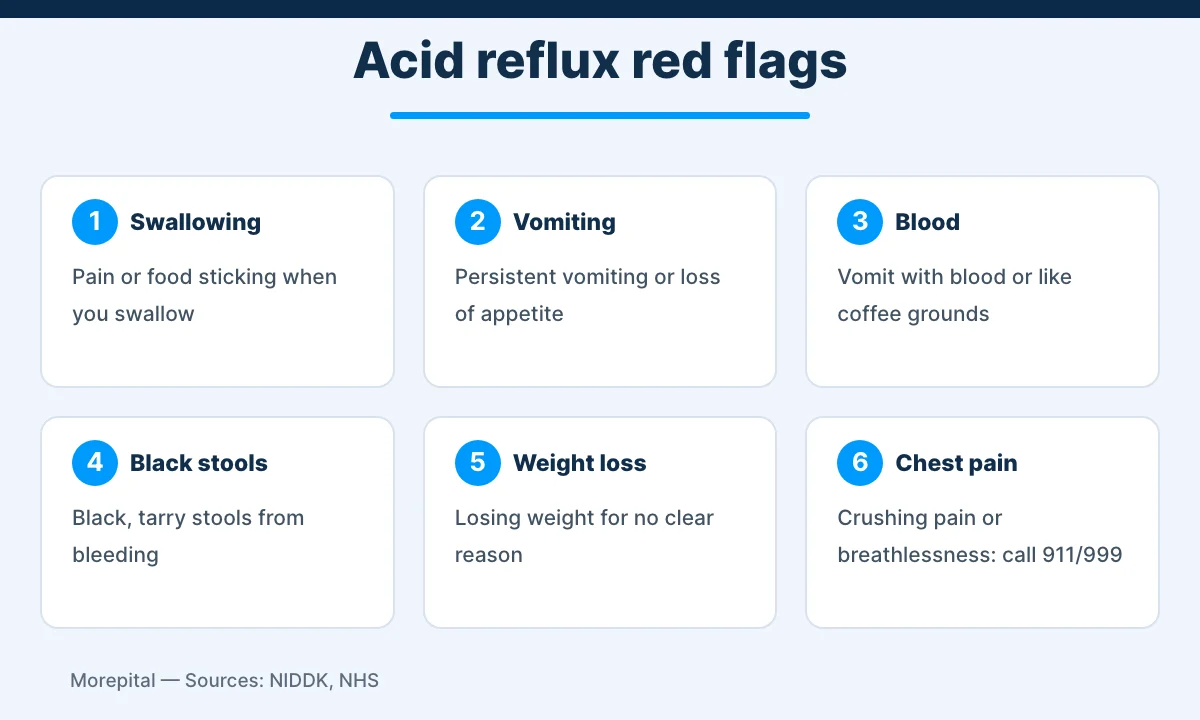
Most acid reflux is a nuisance rather than a danger, but certain symptoms suggest a complication or a different illness. See a doctor promptly if you have any of the following:
- Trouble or pain when swallowing, or food that feels stuck in your throat
- Persistent vomiting or loss of appetite
- Vomit that contains blood or looks like coffee grounds
- Black, tarry stools, which can be a sign of bleeding in the digestive tract
- Weight loss you cannot explain
- Chest pain
The American College of Gastroenterology (ACG) also counts anemia among the alarm features, because slow bleeding from an inflamed esophagus can lower your red blood cell count without obvious bleeding. Tiredness, breathlessness and pale skin alongside reflux are worth mentioning to your doctor; our article on anemia symptoms explains what to look for.
Source: ACG guideline, NIDDK
Book a non-urgent appointment if heartburn happens most days or at least weekly, if pharmacy medicines and lifestyle changes are not helping, if you have a chronic cough or hoarse voice, or if you are over 60. Cleveland Clinic advises contacting a provider when reflux symptoms last two weeks or more.
Source: NHS, Cleveland Clinic
Heartburn or heart attack?
A heart attack can feel like indigestion, with burning in the chest and a sense of fullness, so do not assume chest pain is just reflux. Call emergency services (999 in the UK, 911 in the US) if chest pain is tight, crushing or squeezing, spreads to the arm, neck, jaw or back, or comes with shortness of breath, sweating, nausea or pale, gray skin. If you are not sure, treat it as an emergency.
Source: NHS (heart attack), MedlinePlus
Lifestyle changes that ease acid reflux

Lifestyle changes are the first step for everyone with acid reflux, and the ACG guideline supports several of them for GERD.
Source: ACG guideline
Change how and when you eat
- Eat smaller, more frequent meals instead of two or three large ones.
- Stop eating 2 to 3 hours before lying down. The ACG suggests avoiding meals within 2 to 3 hours of bedtime, and the NHS advises 3 to 4 hours.
- Avoid your personal trigger foods, for example coffee, alcohol, chocolate, or fatty, spicy or tomato-based dishes.
- Loosen tight belts and waistbands, which squeeze the stomach.
Source: ACG guideline, NHS, MedlinePlus
Raise the head of your bed
For night-time symptoms, raising the head end of the bed lets gravity keep acid in the stomach. The NHS recommends lifting it by 10 to 20 cm (about 4 to 8 inches) with blocks or sturdy books under the bed legs, and says extra pillows are not a good idea because bending at the waist can increase pressure on the stomach. The NIDDK suggests raising the head 6 to 8 inches (15 to 20 cm) and mentions a foam wedge or extra pillows as options. Because advice on pillows differs, a wedge or raised bed legs that keep the whole upper body on a slope is the safer bet.
Source: NHS, NIDDK, ACG guideline
Lose weight and stop smoking
The ACG makes a firm recommendation for weight loss in people who are overweight or have obesity, because it improves GERD symptoms. Quitting smoking is also advised, since smoking weakens the valve at the bottom of the esophagus. Finding ways to relax and cutting back on heavy drinking round out the self-care plan.
Source: ACG guideline, NIDDK, NHS
Medicines for acid reflux
If lifestyle changes are not enough, several types of medicine can help. They differ in how fast they work, how strong they are and how long you should take them.
Antacids and alginates
Antacids neutralize acid that is already in the stomach and give quick relief for mild heartburn. Alginates form a protective layer on top of the stomach contents that helps stop acid rising into the esophagus. Both work best taken with food or soon after eating, when symptoms are most likely. They ease symptoms in the short term but do not cure the problem, and the NHS and NIDDK advise against using them every day for long periods without talking to a doctor.
Source: NHS, NHS (pregnancy), NIDDK
H2 blockers
H2 receptor antagonists such as famotidine reduce the amount of acid the stomach makes. They help the esophagus heal, but less well than PPIs, so doctors often use them when a PPI does not suit someone or as an add-on.
Proton pump inhibitors (PPIs)
PPIs block the “proton pumps” in the stomach lining that produce acid. They are the strongest acid-reducing medicines and the main treatment for GERD. Examples include omeprazole, esomeprazole, lansoprazole, pantoprazole, rabeprazole and dexlansoprazole; some are sold over the counter and others need a prescription. A typical first course lasts 4 or 8 weeks. The ACG recommends taking a PPI 30 to 60 minutes before a meal rather than at bedtime, because the drug works best when it is already active as food switches on acid production.
Source: Cleveland Clinic, NHS, ACG guideline
Over-the-counter omeprazole is meant for adults only and should not be taken for more than 2 weeks without seeing a doctor. Common side effects include headache, stomach pain, nausea, diarrhea or constipation and wind. Rare but more serious problems, such as low vitamin B12 or magnesium, weaker bones and fractures, C. difficile gut infection and kidney disease, have been linked to long-term use, and the risk may be higher after a year or more. For this reason the ACG advises using the lowest dose that controls symptoms and trying to stop, or switching to on-demand use, in people whose symptoms have settled and who do not have severe esophagitis or Barrett’s esophagus. Make that change with your doctor rather than alone.
Source: NHS (omeprazole), Cleveland Clinic, ACG guideline
| Treatment | How it works | Best for | Key point |
|---|---|---|---|
| Lifestyle changes | Less pressure on the stomach, fewer triggers | Everyone with reflux | Weight loss and no late meals have guideline support |
| Antacids | Neutralize existing acid | Mild, occasional heartburn | Fast relief; not for daily long-term use |
| Alginates | Form a barrier over stomach contents | After-meal reflux, pregnancy (ask a pharmacist) | Take with or soon after food |
| H2 blockers | Reduce acid production | When PPIs do not suit | Heal the esophagus less well than PPIs |
| PPIs | Block the stomach’s acid pumps | GERD and esophagitis | Take 30–60 min before a meal; lowest effective dose |
| Surgery or procedures | Rebuild or reinforce the valve | Proven GERD not controlled by medicines | More complication risk than medicines |
Source: NIDDK, NHS, ACG guideline
How GERD is diagnosed
Doctors usually diagnose acid reflux and GERD from your symptoms and medical history alone. When heartburn and regurgitation are the main symptoms and there are no warning signs, the ACG recommends an 8-week trial of a once-daily PPI taken before a meal. If symptoms clear up, that supports the diagnosis. Tests are recommended when symptoms suggest a complication or a different problem, or when they do not improve with treatment.
Source: NIDDK, ACG guideline
Upper endoscopy (gastroscopy)
A thin, flexible tube with a camera is passed through the mouth into the esophagus, stomach and first part of the small intestine. The doctor can look for inflammation, narrowing or Barrett’s esophagus and take small tissue samples (biopsies). Endoscopy is the first test for people with alarm symptoms such as difficulty swallowing, weight loss or bleeding. Samples can also be checked for a stomach infection, which is treated with antibiotics plus a PPI.
Source: NIDDK, ACG guideline, NHS
Esophageal pH monitoring
This is the most accurate way to measure acid in the esophagus. A thin tube passed through the nose, or a small wireless capsule attached to the esophageal lining during endoscopy, records acid levels while you keep a log of meals, sleep and symptoms. It is used to confirm GERD before surgery, or when symptoms continue despite treatment.
Source: NIDDK
Complications of untreated reflux
Left untreated for a long time, GERD can damage the esophagus. Esophagitis, inflammation of the lining, can cause ulcers and bleeding. Chronic inflammation can lead to scar tissue that narrows the esophagus (a stricture) and makes swallowing difficult. Reflux can also worsen asthma and cause a chronic cough or hoarseness.
Source: NIDDK, MedlinePlus
Barrett’s esophagus
In Barrett’s esophagus, the normal lining of the lower esophagus is replaced by tissue that resembles the lining of the intestine. It causes no symptoms of its own and usually develops after years of untreated reflux; Cleveland Clinic estimates that about 10% to 15% of people with GERD develop it, most after at least 10 years of symptoms. It is more common in men and in people over 55. A small number of people with Barrett’s develop a type of esophageal cancer called adenocarcinoma, but the risk is low, at roughly 0.5% per year. People with Barrett’s have regular endoscopies so that any precancerous change (dysplasia) can be found and treated early.
Source: Cleveland Clinic, NIDDK
Surgery and procedures for acid reflux
Surgery is rarely needed for acid reflux, but it is an option when GERD has been confirmed by tests and symptoms persist despite lifestyle changes and medicines, or when someone wants to avoid lifelong medication. The ACG specifically recommends that anti-reflux surgery be done by an experienced surgeon. Operations carry a higher risk of complications than medicines, so the decision is made with a specialist.
Source: MedlinePlus, NIDDK, ACG guideline
Fundoplication and other options
- Fundoplication is the most common GERD operation. The top of the stomach is wrapped around the lower esophagus to strengthen the valve, usually by keyhole (laparoscopic) surgery.
- Magnetic sphincter augmentation (MSA), a ring of magnetic beads placed around the lower esophagus, is suggested by the ACG as an alternative to fundoplication for regurgitation that does not respond to medicines.
- Transoral incisionless fundoplication (TIF) is done through the mouth with an endoscope and may be considered for people who prefer to avoid surgery and do not have severe esophagitis or a hiatal hernia larger than 2 cm.
Source: NIDDK, ACG guideline
Acid reflux and weight-loss surgery
For people who have both GERD and obesity, weight-loss surgery can treat both problems, and the ACG suggests considering Roux-en-Y gastric bypass as an option. The choice of operation matters. A review in Annals of Translational Medicine found that the gastric sleeve was associated with a higher risk of reflux than gastric bypass, although some trials found no clear difference. If you already have significant acid reflux and are considering bariatric surgery, discuss it openly with your surgeon, who may recommend tests before choosing the procedure.
Source: ACG guideline, Annals of Translational Medicine, NIDDK
Acid reflux: frequently asked questions
Is acid reflux the same as heartburn?
Not quite. Acid reflux is acid moving up into the esophagus; heartburn is the burning chest pain it often causes. Reflux can happen without heartburn, and frequent reflux is called GERD.
Source: Cleveland Clinic, NIDDK
How often is acid reflux considered GERD?
Reflux symptoms two or more times a week, or reflux that has damaged the esophagus, generally point to GERD.
Source: MedlinePlus
What foods trigger acid reflux?
Common triggers are coffee, alcohol, chocolate, tomatoes, citrus, mint, and fatty or spicy food, plus large or late meals. Triggers vary from person to person.
Source: NHS, Cleveland Clinic
Can acid reflux cause a cough or sore throat?
Yes. Refluxed acid can irritate the throat and airways, causing a chronic cough, hoarseness or laryngitis, sometimes without any heartburn.
Source: NIDDK
How long can I take omeprazole?
Over-the-counter omeprazole should not be used for more than 2 weeks without medical advice. Prescribed courses usually last 4 to 8 weeks, and some people need longer treatment under a doctor’s supervision at the lowest effective dose.
Source: NHS (omeprazole), NHS
Can acid reflux go away on its own?
Occasional acid reflux often settles with lifestyle changes such as smaller meals, no late eating, weight loss and stopping smoking. Frequent symptoms that keep coming back should be assessed by a doctor.
Source: NHS, MedlinePlus
Is acid reflux dangerous?
Usually not, but long-term untreated GERD can cause esophagitis, strictures and Barrett’s esophagus. Trouble swallowing, bleeding or weight loss need prompt medical review.
Source: NIDDK
Disclaimer: this article is for general health education and does not replace advice from a qualified doctor who can assess your individual case. Last updated: October 2026.