
Invisalign is a brand of clear aligners: a series of custom-made, removable plastic trays that gradually straighten crowded or crooked teeth and correct some mild to moderate bite problems. Invisalign works well for many people with mild to moderate cases, but only when the trays are worn about 22 hours a day, and severe or complex problems are often better treated with fixed braces.
Source: Cleveland Clinic, U.S. FDA
Contents
- What Invisalign is and how it works
- Invisalign vs braces: what the evidence says
- Who is a good candidate for Invisalign?
- Treatment steps, from scan to final tray
- Invisalign timeline: how long treatment takes
- Living with aligners: wear time, eating and cleaning
- Risks, side effects and limitations
- Invisalign results and keeping them with retainers
- Choosing a provider at home or abroad
- Frequently asked questions
What Invisalign is and how it works

Clear aligners, sometimes called invisible braces, are clear, custom-made plastic devices that fix crowded or crooked teeth and some mild to moderate malocclusion, the medical term for upper and lower teeth that do not line up properly when the mouth closes. Invisalign is one well-known brand of this treatment; ClearCorrect is another. Most research covers clear aligners as a group, so what follows applies to Invisalign and similar systems alike.
Source: Cleveland Clinic
Like braces, Invisalign moves teeth with gentle, continuous pressure. Instead of a wire that is tightened at each visit, you receive a series of trays, each shaped slightly differently from the last. Each new tray keeps the teeth moving a little further in the planned direction. The U.S. Food and Drug Administration (FDA) describes each aligner as being worn for about one to two weeks before you switch to the next one in the series.
Source: Cleveland Clinic, U.S. FDA
To help Invisalign trays grip and push the teeth, the dentist often bonds small tooth-colored bumps called attachments to some teeth. Research reviews show that attachments improve the accuracy of certain movements, such as rotating a tooth or moving it bodily rather than simply tipping it. In some cases the clinician also polishes away a very thin sliver of enamel between teeth (interproximal reduction) to create space; one review found this helped correct rotations.
Source: Cleveland Clinic, AlMogbel et al., Journal of Orthodontic Science 2024
Clear aligners are prescription medical devices. In the United States, the FDA reviews and authorizes them before they can be marketed, and they are intended for use under the supervision of a licensed dentist or orthodontist. The agency states that it has not authorized aligners sold directly to consumers without a prescription and professional supervision. If you are looking at cosmetic dental options more broadly, our treatments guide covers related procedures.
Source: U.S. FDA
Invisalign vs braces: what the evidence says
Fixed braces use metal brackets glued to each tooth and joined by a wire that applies gentle pressure. On the NHS, patients are usually offered a fixed brace that stays on for one to two years, with adjustment appointments every six to eight weeks. Invisalign replaces the brackets and wire with removable trays you change yourself, with check-ups to confirm the fit.
Source: NHS, Cleveland Clinic
The most useful evidence comes from systematic reviews that pool many studies. An overview of 18 systematic reviews published in 2022 concluded that clear aligner treatment was effective for mild to moderate malocclusion but was linked to inferior outcomes in severe cases and for some specific tooth movements. The same overview found that relapse was greater with aligners, that the risk of root resorption tended to be lower, that gum health was better and that aligners were more comfortable. The authors rated the overall level of evidence as moderate.
Source: Yassir et al., Clinical Oral Investigations 2022
A 2019 meta-analysis of eight studies (two randomized trials and six cohort studies) found that both aligners and braces were effective, but aligners were weaker at producing good contact between the upper and lower teeth and at controlling root angle (torque). In one included study only 20.8% of aligner cases passed a strict American Board of Orthodontics outcome standard, compared with 47.9% of braces cases. A 2024 review reached a similar conclusion: aligners may be a viable alternative, but difficult cases are still not well suited to them.
Source: Ke et al., BMC Oral Health 2019, AlMogbel et al., Journal of Orthodontic Science 2024
| Feature | Invisalign / clear aligners | Fixed braces |
|---|---|---|
| Appearance | Clear plastic, less noticeable | Visible brackets and wire |
| Removable | Yes, for eating, brushing and flossing | No, bonded to the teeth |
| Best evidence for | Mild to moderate malocclusion | Mild to severe cases, complex movements |
| Depends on patient wear | Heavily: about 22 hours a day | Less: fixed in place |
| Diet | Few restrictions (trays out to eat) | Avoid hard, sticky and chewy foods |
| Gum health and comfort | Reviews report better with aligners | Cleaning under the wire needs interdental brushes |
| Retainer afterwards | Needed; relapse reported as greater | Needed |
Source: Cleveland Clinic, NHS, Yassir et al., Clinical Oral Investigations 2022
Who is a good candidate for Invisalign?
Clear aligners are not an option for everyone, and an orthodontist or trained dentist decides whether you are a candidate after examining your teeth and bite. According to the FDA, aligners are commonly used for mild to moderate problems such as crowding, gaps and bite problems, while complex cases may need braces or other treatment. You are more likely to be a good Invisalign candidate if:
- your crowding, spacing or bite problem is mild to moderate;
- your teeth and gums are healthy, or any decay and gum disease has been treated first;
- you are willing to wear the trays for most of the day and night, every day;
- you can attend regular check-ups for the whole course of treatment.
Source: Cleveland Clinic, U.S. FDA
Some situations make aligners less suitable. Reviews show that large rotations are hard to control with plastic trays: in one analysis, incisors achieved about 60% of the planned rotation and canines and premolars about 40%. Moving teeth vertically (extrusion) and fully controlling roots are also less predictable. Severe crowding, large gaps and significant underbites, overbites or crossbites may need fixed braces, and severe jaw (skeletal) problems can require surgery combined with orthodontics.
Source: AlMogbel et al., Journal of Orthodontic Science 2024, WebMD
For Invisalign, personal habits matter as much as the shape of your teeth. A study of 2,644 adults found that only 36.0% were fully compliant with wearing their aligners at least 22 hours a day for most trays, 38.3% were fairly compliant and 25.7% were poorly compliant. Men were more compliant than women, age made no significant difference, and people who had had orthodontic treatment before were less compliant. If you know you will often leave the trays out, braces may give a more reliable result.
Source: Timm et al., Journal of Clinical Medicine 2021
If you also have missing or damaged teeth, tell your dentist before treatment is planned. Aligners can loosen existing crowns, fillings and implants, so any planned work such as dental implants should be coordinated with your orthodontic plan, and untreated decay or gum problems should be dealt with first.
Source: U.S. FDA, Cleveland Clinic
Treatment steps, from scan to final tray
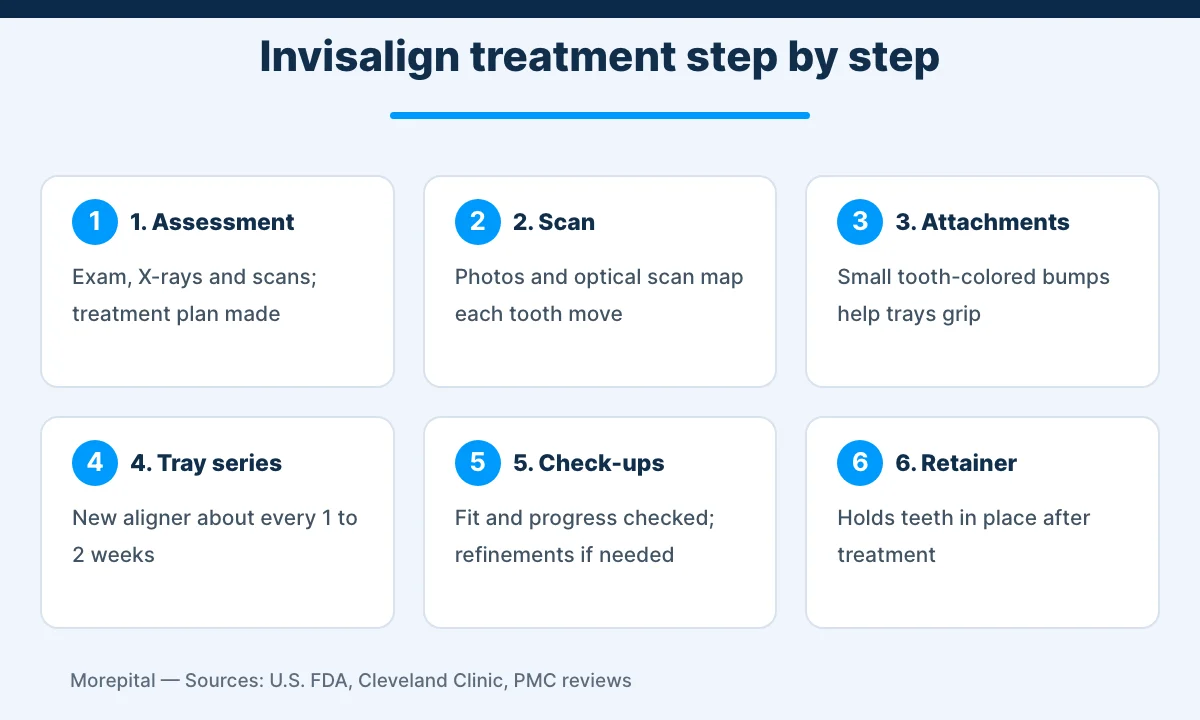
Invisalign treatment begins with an assessment. A dentist or orthodontist evaluates your teeth and bite, often using X-rays and digital scans, and creates a treatment plan. Digital photographs and an optical scan, or traditional impression molds, are used to map how each tooth will move. Laboratory technicians then make each aligner in the series.
Source: U.S. FDA, Cleveland Clinic
At the fitting appointment the clinician places any attachments, fits your first aligner and shows you how to put the trays in and take them out. You then switch to the next tray in the series at the interval you are given, typically every one to two weeks. Cleveland Clinic describes a new device about every two weeks with a follow-up appointment to check the fit; the FDA notes that progress is monitored periodically. Remote check-ins can be useful, but the FDA says periodic in-person visits help reduce risks and confirm that treatment is on track.
Source: Cleveland Clinic, U.S. FDA
Teeth do not always follow the digital Invisalign plan exactly. Research reviews note that most tooth movements may not be predictable enough to achieve with only one set of trays, so many patients need additional “refinement” aligners at the end, and some need a few months of fixed braces to finish small final adjustments. Ask at the start how refinements are handled and whether they are included in your plan.
Source: Ke et al., BMC Oral Health 2019, WebMD
When the planned movements are complete, you move to a retainer to hold the teeth in their new positions. Retention is covered in detail below because it decides whether your result lasts.
Source: U.S. FDA
Invisalign timeline: how long treatment takes
How long Invisalign takes depends on how far your teeth need to move. Cleveland Clinic states that slightly crooked teeth may need up to nine months of treatment, while more serious problems take several months longer. WebMD gives a typical range of 10 to 24 months, noting that adults with only minor shifting may need much less time.
Source: Cleveland Clinic, WebMD
Sources disagree on whether aligners are faster or slower than braces, and the answer seems to depend on the type of case. Cleveland Clinic says traditional braces may correct issues faster, and that aligners may need more time and more device changes to achieve similar results. In contrast, a meta-analysis of three studies of non-extraction cases (where no teeth were removed) found aligner treatment was on average about 6.3 months shorter than braces. In a study of cases that involved removing teeth, aligner treatment took longer: an average of 31.5 months compared with 22 months for braces.
Source: Cleveland Clinic, Ke et al., BMC Oral Health 2019
The 2022 overview of systematic reviews summarizes this best: the findings on treatment duration conflict, but aligners may be associated with shorter treatment in mild to moderate cases. For a realistic estimate, ask your clinician how many aligners your plan contains, how often you will change them and how many refinements are typical for a case like yours.
Source: Yassir et al., Clinical Oral Investigations 2022, U.S. FDA
For comparison, a fixed brace on the NHS usually stays in place for one to two years. After either treatment, the retention phase continues for much longer than active treatment.
Source: NHS
Living with aligners: wear time, eating and cleaning

With Invisalign, wear time is the single biggest factor you control. Cleveland Clinic advises wearing aligners 22 to 23 hours a day and removing them only for meals and for brushing and flossing; the FDA describes wearing them ideally at least 20 hours a day. Aligners work only when worn as directed, and the FDA lists not wearing them enough as a reason treatment may fail to progress. Frequent snacking can keep the trays out long enough to slow results.
Source: Cleveland Clinic, U.S. FDA, WebMD
Because Invisalign trays come out, you can eat most foods, which is one of the main advantages over fixed braces. The trade-off is routine: take the aligners out before eating or drinking anything other than water, brush your teeth before putting them back, and store them in their case so they are not lost or damaged. Food and sugary drinks trapped under the plastic sit against the teeth and raise the risk of decay and gum disease.
Source: Cleveland Clinic, WebMD, U.S. FDA
Keep up the same oral hygiene advised for anyone in orthodontic treatment: brush with fluoride toothpaste in the morning, at night and after meals, clean between your teeth daily, and keep going to regular dental check-ups. Untreated crowding itself can make teeth harder to clean and may contribute to tooth decay or gum disease, and ignored decay can progress to problems such as a tooth abscess.
Source: NHS, Cleveland Clinic
Discomfort is common with Invisalign, especially for the first few days of each new tray, when you may feel pressure or soreness while chewing or removing the device. Soft foods such as soup or scrambled eggs, an ice pack on the jaw and over-the-counter pain relievers can help. Some people notice temporary changes in speech, such as a slight lisp, when they start.
Source: Cleveland Clinic, U.S. FDA
Risks, side effects and limitations
Invisalign and other clear aligners are designed to be used under professional supervision, and even then they are not risk-free. The FDA lists the following possible problems:
- complex conditions may not be treated effectively;
- aligners can be lost or damaged;
- temporary speech changes;
- irritation of the mouth or allergic reactions to the materials;
- existing crowns, fillings and implants may loosen or come off;
- swelling and small cuts or scrapes in the mouth.
Source: U.S. FDA
Orthodontic treatment carries a risk of root resorption, a shortening of the tooth roots. The 2022 overview found this risk tended to be lower with aligners than with fixed braces, although it did not disappear. The same overview found relapse was greater after aligner treatment, which makes consistent retainer wear especially important.
Source: Yassir et al., Clinical Oral Investigations 2022
The biggest avoidable risk is not Invisalign itself but aligner treatment without proper supervision. The FDA has received reports involving non-authorized direct-to-consumer aligners in which people reported new or worsening tooth pain, jaw pain, bite problems, worsening misalignment and new gaps between teeth. An in-person examination, including X-rays where needed, checks for gum disease, decay and other problems before any tooth is moved.
Contact your dentist or orthodontist if you have sharp pain, pain that lasts more than a few days, bleeding or swollen gums, a tray that feels loose or does not fit, or any change in your bite you did not expect. In the United States, serious adverse events can also be reported to the FDA through its MedWatch program and to the manufacturer.
Source: Cleveland Clinic, U.S. FDA
Invisalign results and keeping them with retainers
When treatment is well planned and the trays are worn as directed, research reviews show clear aligners can produce clinically acceptable results in mild to moderate cases. Outcomes are less consistent for precise bite finishing: aligner patients in the 2019 meta-analysis had poorer contact between upper and lower teeth and poorer control of root angles than patients with braces. Realistic Invisalign results are good for the problems aligners handle well, with refinements sometimes needed to finish.
Source: Ke et al., BMC Oral Health 2019, Yassir et al., Clinical Oral Investigations 2022
Teeth tend to drift back after any orthodontic treatment, so a retainer is needed afterwards to stop them moving. The FDA notes that a retainer may be recommended after aligner treatment, and the NHS states that a retainer is needed after braces are removed; your orthodontist decides how long you should wear it.
Source: U.S. FDA, NHS, Yassir et al., Clinical Oral Investigations 2022
Retainer routines vary. One NHS hospital leaflet gives an example of gradually reducing wear after treatment: three nights a week for the first year, two nights a week for the second year, then one night a week for as long as you want your teeth to stay straight, while noting that some people need to wear them more often. The longer you keep wearing retainers, the straighter your teeth tend to stay, and replacement retainers usually have to be paid for.
Source: University Hospitals Plymouth NHS Trust
Straight teeth are only one part of how a smile looks; color and shape matter too. If you are thinking about a wider cosmetic change, read our guide to the Hollywood smile and ask your dentist whether orthodontic alignment should come before any other cosmetic work in your case.
Source: Cleveland Clinic, U.S. FDA
Choosing a provider at home or abroad
Because Invisalign and other aligners are prescription devices, the person treating you matters more than the brand of tray. Choose a registered dentist or orthodontist who examines you in person, takes your full medical and dental history, explains your options (including whether braces would suit your case better) and gives you a written treatment plan and cost estimate. In the United States you can ask your provider which product they use and check whether it is FDA-authorized; the FDA points out that “FDA-registered” does not mean a product has been reviewed and cleared.
Source: General Dental Council, U.S. FDA
Some people consider orthodontic treatment abroad, for example in Turkey. The UK General Dental Council (GDC) advises patients going abroad to research the country’s dental regulator, confirm the treating dentist’s registration, tell their own dentist about their plans and not commit on the same day if they are unsure. Invisalign brings an extra consideration: it lasts months and needs regular check-ups, refinements and retainers, so ask exactly how monitoring will work once you are home.
Source: General Dental Council, U.S. FDA
Useful questions to ask any clinic, at home or abroad, include:
- Who will plan and supervise my treatment, and what are their qualifications?
- Am I a good Invisalign candidate, or would braces give a more predictable result?
- How often will I need in-person check-ups, and who checks my progress between visits?
- Are refinement aligners and retainers included, and what happens if I am unhappy with the result?
- Who can I contact for advice after treatment, and who pays for extra travel or remedial work?
Source: General Dental Council, U.S. FDA
For under-18s in the UK, orthodontic treatment is usually free on the NHS when a qualifying problem is found after referral, although waiting lists can be long; adults usually pay privately, with the cost depending on complexity and the type of appliance.
Source: NHS
Considering Invisalign? Contact us for a free consultation and a treatment plan tailored to you.
Invisalign: frequently asked questions
Does Invisalign work as well as braces?
For mild to moderate problems, reviews find clear aligners an effective alternative. For severe cases, large rotations and precise bite finishing, fixed braces are more predictable.
Source: Yassir et al., Clinical Oral Investigations 2022, Ke et al., BMC Oral Health 2019
How many hours a day do I need to wear Invisalign?
Cleveland Clinic advises 22 to 23 hours a day; the FDA says ideally at least 20 hours. Take the trays out only to eat, drink anything other than water, brush and floss.
Source: Cleveland Clinic, U.S. FDA
How long does Invisalign take?
Slightly crooked teeth may take up to about nine months; more complex cases take longer. Your exact timeline depends on the number of aligners and how consistently you wear them.
Source: Cleveland Clinic, WebMD
Does Invisalign hurt?
Pressure or soreness is common for a few days after each new tray and usually eases. Soft foods, an ice pack and over-the-counter pain relievers can help. Sharp or lasting pain needs a check-up.
Source: Cleveland Clinic
Can I eat with Invisalign in?
No. Remove the trays before eating or drinking anything other than water, then brush before putting them back, so food and sugar are not trapped against your teeth.
Source: Cleveland Clinic, WebMD
Do I need a retainer after Invisalign?
Yes. Teeth tend to move back after any orthodontic treatment, and relapse is reported as greater after aligners, so your orthodontist will prescribe a retainer routine.
Source: U.S. FDA, Yassir et al., Clinical Oral Investigations 2022, University Hospitals Plymouth NHS Trust
Are mail-order alternatives to Invisalign safe?
The FDA has not authorized aligners sold directly to consumers without a prescription and professional supervision, and it has received reports of pain, bite problems and new gaps with non-authorized products.
Source: U.S. FDA
Disclaimer: this article is for general health education and does not replace advice from a qualified doctor who can assess your individual case. Last updated: October 2026.