
Penile implant
Penile prosthesis
A penile implant (penile prosthesis) is a device placed entirely inside the penis during surgery so that a man with erectile dysfunction can get an erection on demand. It is usually offered when medicines, injections or vacuum devices have not worked, and comes in inflatable and malleable types. Most men resume sexual activity after about 4 to 6 weeks, and devices last about 20 years on average.
Source: Cleveland Clinic, NIDDK (NIH), NHS Newcastle Hospitals
- What is a penile implant?
- Types of penile implants
- Who is a candidate for a penile implant?
- How to prepare for surgery
- How penile implant surgery is done
- Recovery timeline after a penile implant
- Results, satisfaction and how long implants last
- Risks and complications
- Alternatives to a penile implant
- Choosing a surgeon and treatment abroad
- When to call the doctor
- FAQ
- Sources
What is a penile implant?

A penile implant, also called a penile prosthesis, is a medical device placed entirely inside the body during surgery so that a man with erectile dysfunction (ED) can achieve an erection firm enough for intercourse. The device sits within the corpora cavernosa, the two spongy chambers that normally fill with blood during an erection. Once the wounds have healed, nothing is visible from the outside.
Source: Cleveland Clinic, NHS Newcastle Hospitals
Doctors regard a penile implant as a later-stage treatment. The US National Institute of Diabetes and Digestive and Kidney Diseases (NIDDK) explains that surgery is considered only when other options have not helped, and notes that most people with ED never need an operation. In England, the NHS commissions penile prosthesis surgery for end-stage ED, usually after tablets, injections, vacuum devices or urethral pellets have failed.
Source: NIDDK (NIH), NHS Newcastle Hospitals
Implants are a well-established treatment. Cleveland Clinic reports that more than 63,000 penile implants were placed worldwide between 2005 and 2012, about 86% of them in the United States. Once a device is in place, ED tablets no longer produce an erection; the implant itself is used whenever an erection is wanted.
Source: Cleveland Clinic
Types of penile implants
There are two broad families of devices: inflatable and non-inflatable (malleable or semi-rigid). Not every man is suitable for both, and the choice is made with the urologist based on health, anatomy, hand dexterity and personal preference.
Source: Cleveland Clinic, NHS Newcastle Hospitals
Three-piece inflatable implant
The three-piece inflatable penile prosthesis (IPP) has two cylinders placed in the penis, a small pump placed in the scrotum and a fluid reservoir placed under the lower abdominal muscles. Squeezing the pump moves saline from the reservoir into the cylinders to create rigidity; pressing a release valve sends the fluid back so the penis becomes soft again. A 2025 review in the Asian Journal of Andrology notes that three-piece devices account for more than 80% of the US market.
Source: Cleveland Clinic, Asian J Androl (PMC)
Two-piece inflatable implant
A two-piece device has cylinders and a scrotal pump but no separate abdominal reservoir. Reviewers describe it as an option for older men, men with weaker grip strength, men with scarring in the lower pelvis that makes reservoir placement difficult, and some men with spinal cord injury. UCLA Health also describes self-contained inflatable designs in which the pump and reservoir are built into the implant itself.
Source: Asian J Androl (PMC), UCLA Health
Malleable (semi-rigid) implant
A malleable implant consists of two firm but bendable rods, typically silicone over a flexible core. There is no pump: the penis is bent upward for intercourse and downward at other times, and its firmness never changes. It is simpler to use and has fewer parts, which reviewers note suits men with limited hand dexterity, but because it is always semi-firm it can be harder to conceal under clothing.
Source: Cleveland Clinic, Asian J Androl (PMC), UCLA Health
| Feature | Three-piece inflatable | Two-piece inflatable | Malleable |
|---|---|---|---|
| Components | Cylinders, scrotal pump, abdominal reservoir | Cylinders and scrotal pump | Two bendable rods |
| How it works | Pump fills cylinders; valve deflates | Pump fills cylinders | Bent into position by hand |
| Flaccid state | Most natural | Softer than malleable | Always semi-firm |
| Often suited to | Most candidates | Older men, weaker grip, pelvic scarring | Limited dexterity, some complex cases |
Source: Cleveland Clinic, Asian J Androl (PMC), UCLA Health
Who is a candidate for a penile implant?
Good candidates are mainly men with erectile dysfunction, with or without Peyronie’s disease, whose condition has not improved with medicines or a vacuum erection device. The NHS Newcastle service adds men whose erections have been damaged by priapism (a prolonged, painful erection). Common underlying causes of severe ED in implant candidates include diabetes, cardiovascular disease and treatment for prostate or bowel cancer.
Source: Cleveland Clinic, NHS Newcastle Hospitals
Peyronie’s disease
Peyronie’s disease causes scar tissue (plaque) inside the penis that leads to curvature. MedlinePlus states that a penile prosthesis may be the best choice when curvature occurs together with ED, and Cleveland Clinic notes that straightening techniques such as plication or grafting are sometimes performed during the same operation. Grafting alone is not recommended for men who already have ED, because it can worsen erections.
Source: MedlinePlus, Cleveland Clinic, J Med Life (PMC)
Who may not be suitable, or should wait
- Men with an active skin, genital or urinary infection, which should be treated first because infection raises the risk of the implant becoming infected
- Men with genital skin disease or inflammation (for example balanitis), which a 2012 review lists as a contraindication until treated
- Men who have not yet tried, or are not suitable for, less invasive ED treatments
- Men with poorly controlled diabetes, who are usually advised to improve blood-sugar control before elective surgery
Source: Cleveland Clinic, J Med Life (PMC), Int J Impot Res (PMC)
How to prepare for surgery
Before a penile implant, the urology team reviews general health and measures vital signs, and checks how well the bladder empties. It is important to list every medicine, supplement and allergy. Aspirin, anti-inflammatory drugs, some herbal products and blood thinners increase bleeding risk, but they should not be stopped without the doctor’s advice.
Source: Cleveland Clinic
- Report any infection, rash or wound in the genital area in advance
- Do not eat or drink after midnight before surgery unless told otherwise; take essential medicines with a small sip of water
- Wash the abdomen and groin the day before and the morning of surgery; hair removal is done by the team in the operating room
- Arrange for an adult to drive you home and, ideally, help for the first day or two
- Discuss which device type suits you, how long it lasts and what happens if it fails
Source: Cleveland Clinic, NHS Newcastle Hospitals
Infection control is a central part of preparation. A review in the International Journal of Impotence Research reports that in a randomized trial, chlorhexidine-alcohol skin preparation left positive skin cultures in 8% of patients, compared with 32% after povidone-iodine, and that surgeons try to optimize blood-sugar control in men with poorly controlled diabetes before operating.
Source: Int J Impot Res (PMC)
How penile implant surgery is done
Penile implant surgery is performed by a urologist, usually under general anesthesia, and typically takes about 1 to 2 hours. Antibiotics are given to reduce infection risk.
Source: Cleveland Clinic, UCLA Health
- A thin catheter is passed into the bladder to drain urine during and shortly after surgery.
- Local anesthetic may be injected so that numbness continues after waking.
- The surgeon makes an incision, most often where the penis meets the scrotum (penoscrotal approach) or above the base of the penis (infrapubic approach).
- Each corpus cavernosum is gently dilated, measured, and a cylinder of the right length is inserted; the surgeon uses the largest size that is safe.
- For inflatable devices, the pump is placed in the scrotum and the reservoir behind the abdominal wall, sometimes through a small second incision.
- The device is tested, and the incisions are closed with dissolvable stitches. A small drain and dressing may be applied.
Source: Cleveland Clinic, NHS Newcastle Hospitals, Asian J Androl (PMC)
Each approach has trade-offs. According to the 2025 Asian Journal of Andrology review, the penoscrotal route gives good access to the corpora and the pump site and lowers the risk of injury to the nerves on the upper side of the penis, while the infrapubic route offers shorter implantation time and better visibility for reservoir placement.
Source: Asian J Androl (PMC)
Recovery timeline after a penile implant
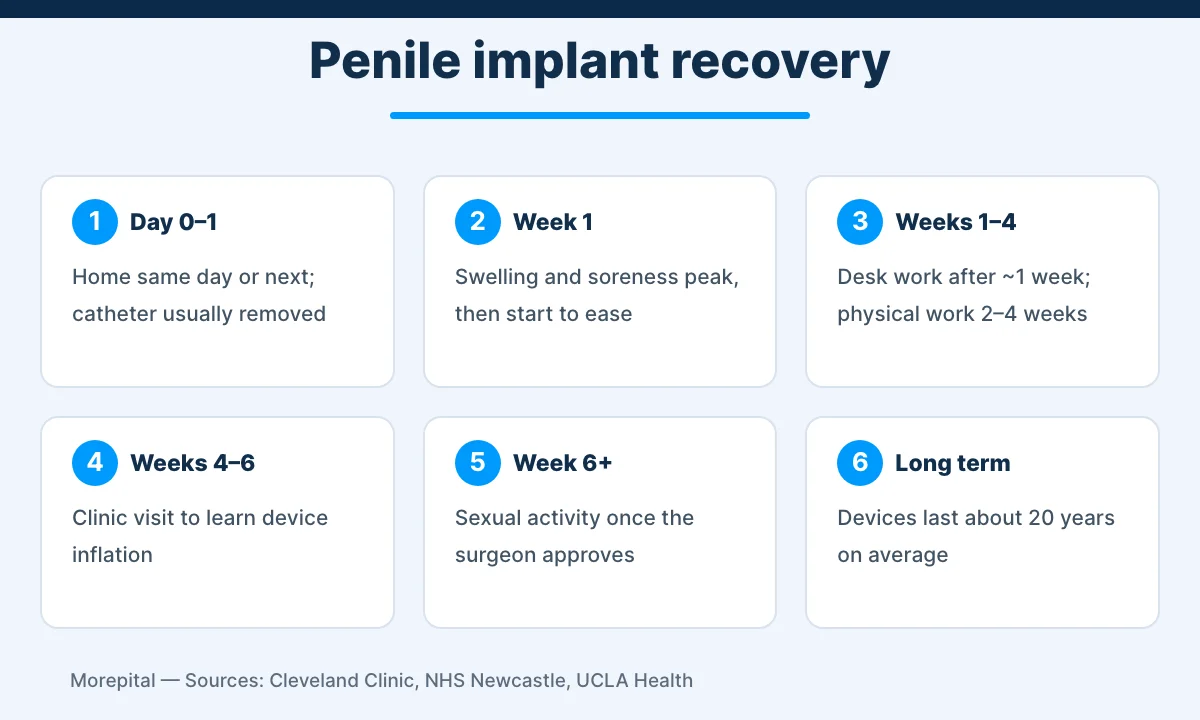
Many men go home the same day, while others stay one night; NHS Newcastle reports an average stay of 1 day, and UCLA Health describes 1 to 2 days. Swelling and bruising of the penis and scrotum are expected and can last up to about 10 days. Pain and swelling usually ease after the first week, though tenderness can persist for up to six weeks.
Source: Cleveland Clinic, NHS Newcastle Hospitals, UCLA Health
| Time after surgery | What usually happens |
|---|---|
| Day 0–1 | Recovery room; catheter and any drain usually removed by the next morning or within 1–3 days; discharge once urinating normally |
| Week 1 | Swelling, bruising and soreness peak then ease; pain relief, antibiotics as prescribed, short ice-pack sessions |
| 1–4 weeks | Return to desk work after about a week; physically demanding work after 2–4 weeks; avoid heavy lifting and strenuous exercise |
| 4–6 weeks | Follow-up visit to learn how to inflate and deflate the device (“cycling”) |
| About 4–6 weeks onward | Sexual activity resumes once the surgeon approves |
Source: Cleveland Clinic, NHS Newcastle Hospitals, UCLA Health
Guidance on timing varies between centers. Cleveland Clinic advises avoiding sexual activity for at least four weeks and says most people resume it at about six weeks; UCLA Health gives about one month for strenuous activity and sex; NHS Newcastle advises against intercourse for at least six weeks and against inflating the device until the six-week clinic visit. Always follow your own surgeon’s instructions.
Source: Cleveland Clinic, UCLA Health, NHS Newcastle Hospitals
With inflatable devices, tight underwear or clothing should be avoided until the incisions heal, and for up to six weeks to avoid pushing the reservoir out of position. UCLA Health describes antibiotics being continued for two weeks after surgery.
Source: UCLA Health
Results, satisfaction and how long implants last
A penile implant provides an erection on demand that can be maintained for as long as desired. Cleveland Clinic reports that more than 90% of people are satisfied with the result, and studies cited in a 2025 review report satisfaction in the range of about 75% to 93% depending on the device and population. Partner satisfaction is often somewhat lower: one small study of a two-piece device found 73% patient and 59% partner satisfaction.
Source: Cleveland Clinic, Asian J Androl (PMC), Cureus (PMC)
Sensation, orgasm and size
Skin sensation, orgasm and ejaculation are not changed by the device, although adjustment can take a few weeks to a couple of months. An implant cannot make the penis larger than before surgery; the erection is usually comparable to the stretched length before the operation and may seem shorter than natural erections did. The head of the penis does not become firm because the cylinders do not extend into it. A 2021 review notes that up to half of men report a subjective sense of length loss, so this should be discussed beforehand.
Source: Cleveland Clinic, Faculty Reviews (PMC)
Durability
Implants are durable but mechanical parts can eventually wear out. Cleveland Clinic gives an average lifespan of about 20 years. A 2021 review reports device survival of about 90.8% at 5 years and 85% at 10 years, and a 2023 review notes that newer devices show median survival above 50% at 20 years. A failed device can usually be replaced with revision surgery.
Source: Cleveland Clinic, Faculty Reviews (PMC), Int J Impot Res (PMC)
Risks and complications
Penile implant surgery is considered safe, and most men have no serious problems, but complications can occur. Infection is the most serious, because it usually requires removal of the whole device.
Source: Cleveland Clinic, NHS Newcastle Hospitals
- Infection: about 1–4% after a first implant and around 10% after revision surgery (2021 review); NHS Newcastle quotes a 2–3% risk. Antibiotic-coated or hydrophilic devices and strict infection-control techniques have lowered rates, with some series reporting under 1%.
- Mechanical failure: reported in about 3.1–19% of cases, sometimes many years later, and may require replacing part or all of the device.
- Erosion: a device part wearing through tissue, reported in roughly 3–5% in the 2021 review.
- Bleeding or hematoma: collection of blood in the scrotum, reported in about 1–5%.
- Glans problems: numbness of the head of the penis from nerve injury, or rarely reduced blood flow to the glans.
- Other: urethral injury, scar tissue, pump or reservoir displacement, rare bowel or bladder injury during reservoir placement, and a perception of shorter length.
Source: Faculty Reviews (PMC), NHS Newcastle Hospitals, Asian J Androl (PMC), Cleveland Clinic
Several factors raise risk. A 2021 review lists diabetes, revision surgery, spinal cord injury and HIV as risk factors for infection, and diabetes, smoking, severe vascular disease and pelvic radiotherapy as factors linked to glans complications. Peyronie’s disease, a body mass index over 30 and previous radical prostatectomy were associated with lower satisfaction.
Source: Faculty Reviews (PMC)
Alternatives to a penile implant
Because an implant is permanent and replaces the natural erection mechanism, doctors normally recommend trying less invasive treatments first.
Source: NIDDK (NIH), Cleveland Clinic
- Lifestyle changes: stopping smoking, limiting alcohol, avoiding recreational drugs, exercising and keeping a healthy weight
- Oral medicines (PDE5 inhibitors): improve blood flow to the penis; testosterone may be added if levels are low
- Penile injections and urethral suppositories: medicines that produce an erection fairly quickly
- Vacuum erection devices: a tube and pump draw blood into the penis and a ring helps keep the erection
- Vascular surgery: repair of arteries, which works best in selected younger men
- For Peyronie’s disease: collagenase injections, traction therapy, plication or grafting, depending on stage and erectile function
Source: NIDDK (NIH), Cleveland Clinic
Choosing a surgeon and treatment abroad
Choose a urologist with specific training and regular experience in prosthetic surgery. In England, implants are placed at specialist implant centers after multidisciplinary review. A 2025 review reports that surgeons with lower annual volumes had at least twice the reoperation risk for inflatable implant infection compared with higher-volume surgeons. Useful questions include which device is best for you, how long it is likely to last, what happens if it fails, and the full list of risks.
Source: NHS Newcastle Hospitals, Asian J Androl (PMC), Cleveland Clinic
Some men travel abroad for implant surgery. The CDC advises discussing plans with your home doctor well in advance, checking facility accreditation and surgeon credentials, agreeing how complications and follow-up will be handled, obtaining medical records in English and avoiding strenuous activity during recovery. Surgery combined with flying also increases the risk of blood clots. Specialized centers such as Male Hospital in Istanbul offer penile prosthesis surgery; whichever clinic you consider, plan for the six-week recovery and device-training visit before you travel.
Source: CDC Yellow Book
When to call the doctor
Some swelling, bruising and discomfort are normal after a penile implant. Contact your surgeon promptly if anything suggests infection or bleeding, because early treatment matters.
Source: Cleveland Clinic, NHS Newcastle Hospitals
- Fever of 100°F (38°C) or higher
- Heavy bleeding from the incisions
- Increasing redness, throbbing or discharge at the wound
- Pain that keeps getting worse instead of better
- Dark or discolored skin on the head of the penis, or a device part pushing through the skin
- Inability to pass urine
Source: Cleveland Clinic, NHS Newcastle Hospitals, Faculty Reviews (PMC)
Related conditions
Penile implant: frequently asked questions
Is a penile implant permanent?
The device stays in the body long term and is designed to last many years, about 20 years on average according to Cleveland Clinic. Placement alters the erectile tissue, so natural erections and ED tablets no longer work afterward.
Source: Cleveland Clinic
How long does penile implant surgery take?
The operation usually takes about 1 to 2 hours under general anesthesia. Many men go home the same day or after one night.
Source: Cleveland Clinic, NHS Newcastle Hospitals
When can I have sex after a penile implant?
Usually after about 4 to 6 weeks, once your surgeon approves and you have been taught to use the device. Centers differ, so follow your own surgeon's advice.
Source: Cleveland Clinic, NHS Newcastle Hospitals, UCLA Health
Does a penile implant change sensation or orgasm?
No. Skin sensation, orgasm and ejaculation are not affected, although it can take a few weeks to adjust.
Source: Cleveland Clinic
Will a penile implant make the penis longer?
No. An implant cannot increase size beyond what it was before surgery, and the erection may seem shorter than natural erections. Discuss expectations with your surgeon.
Source: Cleveland Clinic, Faculty Reviews (PMC)
Can other people tell I have an implant?
An inflatable implant sits fully inside the body and is not noticeable once healed. A malleable implant is always semi-firm, so it can be harder to conceal under clothing.
Source: Cleveland Clinic, NHS Newcastle Hospitals
What is the biggest risk of a penile implant?
Infection, which usually requires removing the device. Rates are about 1–4% after a first implant and higher after revision surgery.
Which is better, an inflatable or a malleable implant?
Inflatable devices give a more natural soft and firm state and tend to score higher on satisfaction, while malleable rods are simpler and suit men with limited hand dexterity. The right choice depends on your health and anatomy.
Source: Cleveland Clinic, Asian J Androl (PMC)
Can a penile implant treat Peyronie's disease?
Yes, when curvature occurs together with erectile dysfunction, a prosthesis may be the best option, sometimes combined with straightening techniques during the same operation.
Source: MedlinePlus, Cleveland Clinic
Talk to a men's health specialist about a penile implant
Sources
- Cleveland Clinic — Penile Implant: Purpose, Procedure, Risks & Recovery
- NHS Newcastle Hospitals — Insertion of penile prosthesis for erectile dysfunction
- NIDDK (NIH) — Treatment for Erectile Dysfunction
- UCLA Health — Penile Implants
- Cleveland Clinic — Peyronie's Disease Treatment
- MedlinePlus — Curvature of the penis
- Asian Journal of Andrology (PMC) — Update on penile prosthesis (Mykoniatis et al., 2025)
- Faculty Reviews (PMC) — Penile implant surgery-managing complications (Cayetano-Alcaraz et al., 2021)
- International Journal of Impotence Research (PMC) — Maximizing outcomes in penile prosthetic surgery (Hammad et al., 2023)
- Journal of Medicine and Life (PMC) — Penile prosthesis in the surgical treatment of Peyronie's disease (Ateia et al., 2012)
- Cureus (PMC) — Satisfaction and outcomes of two-piece inflatable penile prosthesis implantation (Pazir et al., 2022)
- CDC Yellow Book — Medical Tourism
This page is part of the Morepital medical reference. It is for general health education and does not replace a consultation with a qualified doctor. Last reviewed: October 2026.