
Breast augmentation
Augmentation mammoplasty (breast enlargement, breast implants)
Breast augmentation is a cosmetic operation that enlarges or reshapes the breasts, usually with saline or silicone implants placed behind the breast tissue or chest muscle, and sometimes with the patient's own fat. It takes about 60 to 90 minutes and most people return to light work within days to two weeks. Implants are not lifetime devices, so future monitoring and surgery are likely.
- What is breast augmentation?
- Types of breast implants and techniques
- Who is a good candidate for breast augmentation?
- How to prepare
- How breast augmentation is done
- Recovery timeline
- Results and how long implants last
- Risks and complications, including BIA-ALCL and breast implant illness
- Alternatives to breast augmentation
- Choosing a surgeon and having surgery abroad
- When to call your doctor
- FAQ
- Sources
What is breast augmentation?

Breast augmentation is an operation that makes the breasts larger or changes their shape, most often by placing a breast implant behind each breast and sometimes by moving the patient’s own fat into the breasts. It is also known as breast enlargement, augmentation mammoplasty or, informally, a “boob job.” People choose it to add fullness and projection, to restore volume lost after pregnancy, weight loss or aging, or to make naturally uneven breasts more balanced.
Source: NHS, ASPS, Cleveland Clinic
Cleveland Clinic describes breast augmentation as the most popular cosmetic surgery in the United States, with about 300,000 procedures a year. Implants are also used for breast reconstruction after mastectomy or injury, but this page focuses on cosmetic augmentation. The NHS stresses that breast augmentation is major surgery: results are not guaranteed and the risks are real.
Source: Cleveland Clinic, ASPS, NHS
One limitation matters from the start: breast augmentation adds volume but does not lift breasts that sag significantly. When the breasts droop (breast ptosis), a breast lift may be needed, either in the same operation or as a separate one.
Source: ASPS
Types of breast implants and techniques
Implant fillings
- Saline implants have a silicone shell filled with sterile salt water. Some are pre-filled and others are filled during surgery. If the shell leaks, the implant deflates and the body absorbs the saline safely. The NHS notes they are more likely than silicone to fold, rupture or deflate over time.
- Structured saline implants are saline implants with an internal structure designed to feel more natural.
- Silicone gel implants have a silicone shell filled with silicone gel. They are the most common type in the UK and are less likely to wrinkle, but a rupture may stay inside the shell or leak into the breast, so regular checks are advised.
- Form-stable (“gummy bear”) implants use a thicker, firmer silicone gel that holds its shape even if the shell breaks; they need a longer incision.
Source: FDA, Cleveland Clinic, NHS
Age approvals in the US
The FDA approves saline implants for cosmetic augmentation in women aged 18 or older and silicone gel implants for augmentation in women aged 22 or older. Both types may be used for reconstruction at any age.
Source: FDA
Surface and shape
Implants used for breast augmentation are either smooth or textured. Smooth implants usually feel softest and move most naturally. Textured surfaces let scar tissue grip the implant so it moves less, but textured implants are linked to most cases of the rare lymphoma BIA-ALCL (see Risks below). Round implants give a fuller look and generally keep their appearance even if they rotate.
Source: Cleveland Clinic, FDA
Fat transfer augmentation
In fat transfer breast augmentation, instead of an implant, the surgeon uses liposuction to take fat from the abdomen, flanks, back or thighs and inject it into the breasts. Cleveland Clinic notes this is usually suited to a relatively modest increase in size.
Source: Cleveland Clinic, ASPS
Who is a good candidate for breast augmentation?
According to the American Society of Plastic Surgeons (ASPS), you may be a candidate for breast augmentation if you:
- are physically healthy and not pregnant or breastfeeding;
- have fully developed breasts;
- feel your breasts are too small, or have lost volume or shape after pregnancy, weight loss or aging;
- have breasts that are noticeably uneven in size or shape (breast asymmetry), or that did not develop normally;
- have realistic expectations and are making the decision for yourself, not to please someone else.
Source: ASPS
Cleveland Clinic adds that good physical and mental health matter. People who smoke are asked to stop well before surgery, because smoking slows healing. Breast augmentation is usually not the right choice if your main concern is significant sagging (a lift may be more appropriate), if you are pregnant or breastfeeding, or if you are under the FDA age limit for the implant type you want.
Source: Cleveland Clinic, ASPS, FDA
In the UK, breast augmentation is usually paid for privately. The NHS may fund it only in specific situations, such as very uneven breasts or the absence of breast tissue, and the rules vary by area.
Source: NHS
How to prepare
Before breast augmentation you will meet the surgeon to discuss your goals, implant type, size, placement and incision site, and to review the risks. The NHS advises always meeting the surgeon in person and asking about their qualifications, how many of these operations they have done, their complication rates, the implant type and manufacturer, and what happens if something goes wrong. In the US, the FDA requires the surgeon to go through a patient decision checklist with you, which you initial and sign.
Typical preparation steps include:
- a blood test, and a review of your previous mammograms and family history of breast problems;
- stopping smoking and recreational drugs;
- avoiding aspirin and certain anti-inflammatory medicines that increase bleeding, and adjusting other medicines as your surgeon directs;
- having the operation in an accredited ambulatory surgery center or hospital;
- arranging for someone to drive you home and stay with you for at least the first night.
Source: ASPS, Cleveland Clinic
How breast augmentation is done
- Anesthesia. Breast augmentation is done under general anesthesia or intravenous sedation; the NHS notes general anesthesia is usual.
- Incision. The surgeon makes a cut in a discreet place: in the crease under the breast (inframammary fold), along the edge of the areola (periareolar) or in the armpit (transaxillary). ASPS notes a belly-button approach has a higher complication rate.
- Creating a pocket and placing the implant. The implant goes either behind the breast tissue, over the chest muscle (subglandular), or under the pectoral muscle (submuscular). The choice depends on implant type, desired size, body type and the surgeon’s advice.
- Closing. Breast tissue is closed in layers, and the skin with stitches, skin adhesive or surgical tape.
Source: ASPS, NHS, Cleveland Clinic
The NHS says breast augmentation surgery takes 60 to 90 minutes. Many patients go home the same day after about an hour of monitoring once stable, while some stay overnight. The new size is visible immediately, although the breasts take months to settle.
Recovery timeline
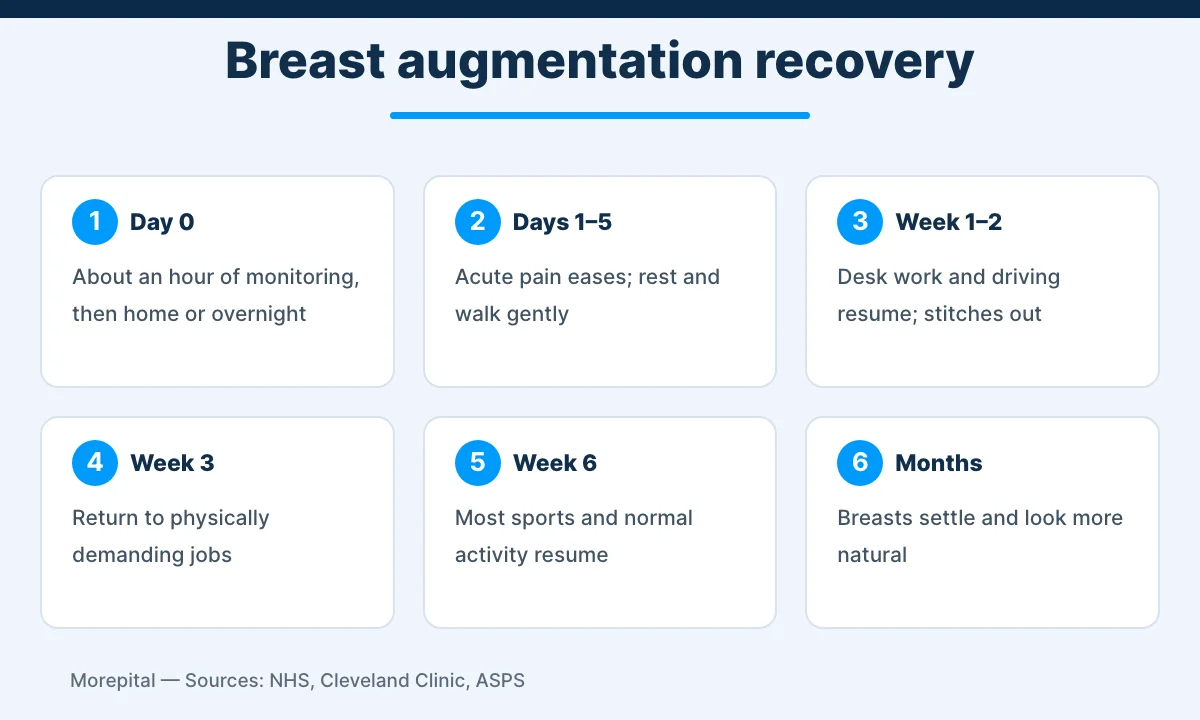
After breast augmentation the breasts are wrapped in gauze and an elastic bandage or support bra, which you wear as directed to limit swelling. Bleeding into the implant pocket is possible during the first several days, so activity should be kept light. Acute pain usually eases within 1 to 5 days, while soreness and swelling can last a few weeks.
Source: ASPS
| Time after surgery | What to expect |
|---|---|
| Day of surgery | Monitored for about an hour, then home with a driver, or overnight stay |
| Days 1–5 | Acute pain subsides; rest and walk gently |
| 3 days–2 weeks | Return to desk work (Cleveland Clinic: at least 3 days; NHS: a week or two) |
| 1 week | Stitches out if not dissolvable (1–2 weeks); no driving for at least 1 week (NHS) |
| About 3 weeks | Return to physically demanding jobs |
| 4 weeks | Still no heavy lifting or strenuous exercise |
| About 6 weeks | Most normal activities and sports resume; scars begin to fade |
| 6–8 weeks | Average full recovery |
| Up to 3 months | Some surgeons advise a sports bra day and night |
| A few months | Breasts look and feel more natural |
Source: Cleveland Clinic, NHS, ASPS
Breast augmentation recovery timelines differ between surgeons and patients, so follow your own surgeon’s schedule for exercise and bra wear. The NHS states that flying and sunbathing are considered safe once you have implants, but it separately advises avoiding flights for 5 to 7 days after breast surgery because of blood clot risk.
Results and how long implants last
Cleveland Clinic reports that satisfaction with breast augmentation is usually high. Breast augmentation results do not stay fixed forever, though: pregnancy, weight changes, menopause and aging continue to change how the breasts look.
Source: Cleveland Clinic
Breast implants are not lifetime devices. The FDA says the longer you have them, the more likely complications, removal or replacement become, and their lifespan cannot be predicted for any one person. The NHS notes that some women need further surgery after about 10 years because of implant problems or changes in breast shape. Insurance often does not cover removal or replacement of cosmetic implants, even when there is a complication.
Long-term monitoring
Most silicone ruptures are “silent,” causing no change you can see or feel. Under its 2020 labeling recommendations, the FDA advises people with silicone gel implants to have an ultrasound or MRI 5 to 6 years after surgery and then every 2 to 3 years, even without symptoms; MRI is the most effective test for silent rupture. Breast cancer screening still matters: mammograms are safe with implants, but implants can make cancer harder to see, so tell the staff and use an accredited imaging center; a modified technique may be needed.
Source: FDA, ASPS, NHS, Cleveland Clinic
Breastfeeding
Some women can breastfeed after breast augmentation and some cannot, and the NHS notes milk supply may be slightly reduced. Cleveland Clinic says implants placed under the muscle and incisions away from the areola generally affect breastfeeding less.
Source: FDA, NHS, Cleveland Clinic
Risks and complications, including BIA-ALCL and breast implant illness
Surgical and implant complications
Like any operation, breast augmentation carries a risk of bleeding, blood clots, infection and reactions to anesthesia or materials. The FDA lists capsular contracture, reoperation and implant removal as the most common implant complications. Others include:
- Capsular contracture – the scar capsule around the implant tightens and hardens the breast; severe grades may need another operation.
- Rupture or deflation – causes include aging of the shell, trauma and compression; a ruptured implant needs removal or replacement.
- Hematoma (collected blood) or seroma (collected fluid).
- Implant malposition, rotation, wrinkling or rippling, and symmastia (implants meeting across the midline).
- Thick or visible scars, asymmetry and persistent pain.
- Temporary or permanent changes in nipple and breast sensation.
Source: FDA, FDA, NHS, Cleveland Clinic
BIA-ALCL (breast implant-associated anaplastic large cell lymphoma)
BIA-ALCL is a rare type of non-Hodgkin lymphoma, a cancer of the immune system, that develops in the scar tissue or fluid around an implant. It is not breast cancer. The FDA states it occurs more often with textured implants. As of June 30, 2024, the FDA had received reports of 1,380 cases worldwide, 73% involving textured implants and 3% smooth implants (the rest unspecified), and 64 deaths. The median time from implant to diagnosis was 8 years. The FDA cautions that these reports cannot measure how common the disease is. The UK regulator (MHRA) reports a rate of about 1 confirmed case per 12,187 implants sold.
Source: FDA, FDA, MHRA (GOV.UK)
In people who have had breast augmentation or reconstruction, the usual sign of BIA-ALCL is a late, often painless swelling of the breast caused by fluid around the implant, typically years after surgery; a lump in the capsule is less common. Diagnosis involves examination, imaging and testing of the fluid or tissue. Treatment is removal of the implant together with the surrounding capsule, and some patients also need chemotherapy or radiation. The MHRA advises that people with textured implants and no symptoms do not need them removed.
Source: MHRA (GOV.UK), FDA, FDA
The FDA has also received reports of squamous cell carcinoma and other lymphomas in the capsule around implants (both saline and silicone, smooth and textured) and is still collecting data.
Source: FDA
Breast implant illness (BII)
“Breast implant illness” is a term some patients use for a range of symptoms they link to their implants, including fatigue, memory problems, “brain fog,” rash, anxiety and joint or muscle pain. The FDA says these symptoms and their causes are poorly understood and research is ongoing, and that some people report improvement after removal without replacement. The MHRA states BII is not a recognized diagnosis, that no single disease explains the reports, and that there is no definitive evidence that implants cause these symptoms. Both agencies recommend that surgeons discuss these reports before surgery.
Source: FDA, FDA, MHRA (GOV.UK)
The FDA has not found an association between silicone gel implants and connective tissue disease, breast cancer or reproductive problems. Since 2021, US implants carry a boxed warning, and they may only be sold to providers who review the risks with patients.
Alternatives to breast augmentation
- Fat transfer – uses your own fat for a modest, implant-free increase in size.
- Breast lift (mastopexy) – reshapes and raises sagging breasts without adding volume; it can be combined with implants when both lift and size are wanted.
- Breast reduction – may be part of the plan for asymmetry, reducing the larger breast instead of enlarging the smaller one.
- No surgery – instead of breast augmentation, padded or shaping bras and external prostheses change appearance without any surgical risk.
Source: Cleveland Clinic, ASPS
Choosing a surgeon and having surgery abroad
Choose a board-certified plastic surgeon with significant experience in breast augmentation, and ask about training, how many augmentations they perform and their complication rates. ASPS warns that surgeons operating in informal settings may not be board-certified. In England, the NHS advises checking that the clinic is registered with the Care Quality Commission and the surgeon is on the GMC specialist register; elsewhere, check how surgeons and clinics are regulated in that country.
Source: Cleveland Clinic, ASPS, NHS, NHS
Many people travel abroad for breast augmentation. The NHS advises caution with surgery sold as part of a holiday package and recommends:
- two consultations with the operating surgeon, with a cooling-off period between them;
- a surgeon who speaks a language you understand well;
- clear answers on aftercare, follow-up and who pays if complications or revision occur;
- checking insurance, since travel insurance usually does not cover surgical complications;
- no sightseeing, swimming, sun or alcohol right after surgery, and no flying for 5 to 7 days after breast surgery.
Source: NHS
Keep a record of your implant manufacturer, model and serial numbers (US implants come with a patient device card), as you will need them if a safety notice is issued.
Source: FDA, MHRA (GOV.UK)
When to call your doctor
After breast augmentation, contact your surgeon promptly if you notice unexpected pain, burning, unusual swelling or changes in skin color after surgery. Years later, see your surgeon or doctor about any new swelling, lump, persistent pain, change in breast shape or size, hardening, or lumps in the armpit or neck. A seroma, lump or swelling that appears more than a year after implantation should always be checked for BIA-ALCL.
Source: NHS, MHRA (GOV.UK), MHRA (GOV.UK)
- you have chest pain, sudden shortness of breath or coughing up blood (possible blood clot);
- one leg is swollen, warm and painful;
- a breast swells rapidly and becomes tight and painful soon after surgery (possible bleeding);
- you have a high fever, spreading redness or a sunburn-like rash with feeling very unwell (possible serious infection, including toxic shock syndrome).
Breast augmentation: frequently asked questions
How long do breast implants last?
Is breast augmentation painful?
How soon can I go back to work after breast augmentation?
Desk workers often return after 3 days to 2 weeks; physically demanding jobs need about 3 weeks.
Source: Cleveland Clinic, NHS
Saline or silicone: which is better?
Neither is better for everyone. Silicone feels more natural and wrinkles less but ruptures can be silent; saline deflates visibly and the fluid is absorbed safely. In the US, saline is approved from 18 and silicone from 22.
Source: NHS, FDA, Cleveland Clinic
What is BIA-ALCL and should I remove my implants?
It is a rare lymphoma in the tissue around implants, more common with textured implants. UK regulators advise that people with no symptoms do not need removal.
Source: FDA, MHRA (GOV.UK)
Is breast implant illness real?
Patients report symptoms such as fatigue, brain fog and joint pain. It is not a recognized diagnosis and a causal link is unproven, but research continues and some people improve after removal.
Source: FDA, MHRA (GOV.UK)
Can I breastfeed with breast implants?
Many women can, though some cannot and supply may be slightly reduced. Under-muscle placement and incisions away from the areola usually have less effect.
Source: FDA, NHS, Cleveland Clinic
Do I need MRI scans with silicone implants?
Will breast augmentation lift sagging breasts?
No. Implants add volume but do not correct significant sagging; a breast lift may be needed, at the same time or separately.
Source: ASPS
Can I fly after breast augmentation?
The NHS advises avoiding flights for 5 to 7 days after breast surgery because of blood clot risk.
Source: NHS
Ask about breast augmentation
Sources
- NHS — Breast enlargement (implants)
- NHS — Cosmetic surgery abroad
- Cleveland Clinic — Breast Augmentation
- ASPS — Breast Augmentation
- ASPS — Breast Augmentation Candidates
- ASPS — Breast Augmentation Preparation
- ASPS — Breast Augmentation Procedure Steps
- ASPS — Breast Augmentation Recovery
- ASPS — Few Patients Undergo Recommended MRI Screening After Silicone Implant Breast Surgery
- FDA — Risks and Complications of Breast Implants
- FDA — Types of Breast Implants
- FDA — Things to Consider Before Getting Breast Implants
- FDA — Medical Device Reports of Breast Implant-Associated Anaplastic Large Cell Lymphoma
- MHRA (GOV.UK) — Breast implants and Anaplastic Large Cell Lymphoma (ALCL)
- MHRA (GOV.UK) — Symptoms sometimes referred to as Breast Implant Illness
This page is part of the Morepital medical reference. It is for general health education and does not replace a consultation with a qualified doctor. Last reviewed: October 2026.