H. pylori infection is a long-lasting stomach infection with the bacterium Helicobacter pylori; most people who carry it never feel ill, but it is one of the two main causes of stomach and duodenal ulcers and it raises the risk of stomach cancer. It is diagnosed with a breath test, a stool test or biopsies taken during an endoscopy, and treated with a combination of antibiotics and acid-reducing medicine, usually for 14 days, followed by a repeat test to confirm the bacteria are gone.
Source: MedlinePlus, NHS, Cleveland Clinic
Source: Cleveland Clinic, ACG, Polish Society of Gastroenterology, World J Gastroenterol
Contents
- What is H. pylori infection?
- How H. pylori infection spreads and who gets it
- H. pylori infection symptoms
- Complications: ulcers, anemia and stomach cancer
- Who should be tested for H. pylori infection?
- Tests for H. pylori infection: breath, stool, blood and endoscopy
- H. pylori infection treatment regimens
- Side effects and why finishing the course matters
- Confirming cure and the risk of reinfection
- Prevention and when to see a doctor
- FAQ
What is H. pylori infection?
Helicobacter pylori is a spiral-shaped bacterium that lives in the lining of the stomach. Cleveland Clinic describes it as the most common chronic bacterial infection in humans, affecting more than half of the world’s population, while the US National Cancer Institute quotes a CDC estimate of about two-thirds of people worldwide. In the United States, MedlinePlus puts the figure at roughly 30 to 40% of the population. Most people acquire the bacterium as children and carry it for decades without knowing.
Source: Cleveland Clinic, NCI, MedlinePlus
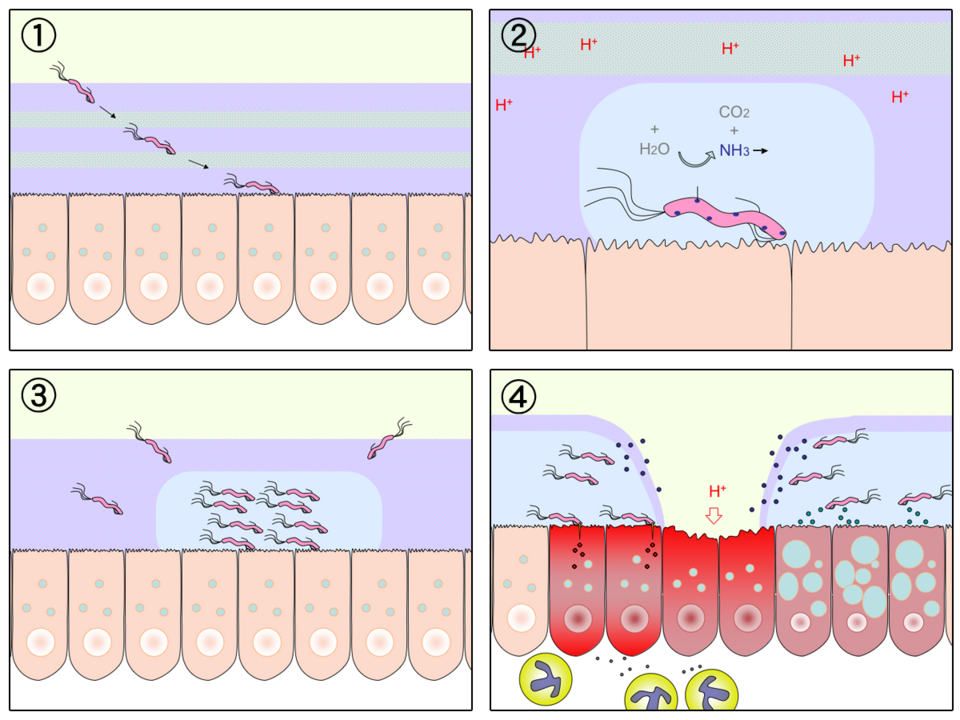
The stomach is normally too acidic for most microbes, but H. pylori has a survival trick: it produces an enzyme called urease that breaks down urea into ammonia, which neutralizes acid around the bacterium. It then burrows through the protective mucus layer, attaches to the cells of the stomach lining and causes chronic inflammation (gastritis). Over time, in some people, that inflammation damages the lining enough to form an ulcer. The same urease activity is what the breath test detects, as explained below.
Source: MedlinePlus, MedlinePlus, NIDDK
An H. pylori infection on its own does not always need urgent action. What matters is whether it causes problems now (an ulcer, gastritis) or might later (a raised stomach cancer risk), which is why guidelines focus on who should be tested rather than screening everyone.
Source: Cleveland Clinic, NCI, Polish Society of Gastroenterology
How H. pylori infection spreads and who gets it
Researchers are still not certain exactly how H. pylori infection passes between people. The leading explanation is person-to-person spread through saliva, vomit or stool, for example by sharing utensils or through unwashed hands after using the toilet. Contaminated food or water can also carry it, and the bacteria have been found in saliva, stool and dental plaque.
Source: NIDDK, Cleveland Clinic, MedlinePlus
Infection usually happens in childhood and is more common in developing countries, in crowded households and where sanitation is poor. In the United States, Cleveland Clinic reports that about 5% of children under 10 carry H. pylori. National Cancer Institute figures from 1999–2000 showed large differences between US population groups: about 21% of non-Hispanic White, 52% of non-Hispanic Black and 64% of Mexican American people tested positive for H. pylori infection.
Source: Cleveland Clinic, NCI
H. pylori infection symptoms

Most people with H. pylori infection have no symptoms at all. Cleveland Clinic notes that only about 5 to 10% of infected children develop symptoms, and many adults only find out they are infected when an ulcer or its complications appear. When symptoms do occur, they usually come from gastritis or a peptic ulcer rather than from the bacterium itself.
Source: Cleveland Clinic, MedlinePlus, NIDDK
Typical symptoms include:
- Upper abdominal pain: a dull or burning pain between the belly button and the breastbone, which tends to come and go and is often worse on an empty stomach, a few hours after meals or at night.
- Feeling full quickly: early fullness, or feeling uncomfortably full after a normal meal.
- Bloating and belching: frequent burping and a swollen feeling in the upper abdomen.
- Nausea and vomiting.
- Loss of appetite and unexplained weight loss.
- Indigestion (dyspepsia): general discomfort in the upper abdomen.
Source: NIDDK, Cleveland Clinic, MedlinePlus
These symptoms are not specific to H. pylori infection, and other digestive problems can feel similar. If your main problems are cramping lower in the abdomen with diarrhea, constipation or both, a different condition such as irritable bowel syndrome is more likely, and a negative H. pylori test simply tells your doctor to look for other causes.
Source: NIDDK, MedlinePlus
Warning signs that need urgent care
Seek urgent medical help if you have black or tarry stools, red or maroon blood in your stool, vomit that contains blood or looks like coffee grounds, sudden sharp abdominal pain that does not go away, dizziness or fainting, or a rapid pulse. These can be signs of a bleeding or perforated ulcer.
Source: NIDDK, Cleveland Clinic
Complications: ulcers, anemia and stomach cancer
Gastritis and peptic ulcers
H. pylori and non-steroidal anti-inflammatory drugs (NSAIDs) such as aspirin, ibuprofen and naproxen are the two most common causes of peptic ulcers. The risks add up: taking NSAIDs while infected makes an ulcer more likely. Ulcers caused by H. pylori infection can bleed, and in rare cases they perforate the stomach wall, which can lead to peritonitis, a medical emergency.
Iron deficiency anemia
Slow bleeding from an ulcer can lead to iron deficiency anaemia, which the NHS lists among the complications of stomach ulcers. The Polish Society of Gastroenterology recommendations also advise testing for H. pylori when doctors investigate iron deficiency anemia, vitamin B12 deficiency or immune thrombocytopenia (a low platelet count). If you have been told your iron is low, our guide to anemia symptoms explains the signs and the blood tests involved.
Source: NHS, Polish Society of Gastroenterology
Stomach cancer and MALT lymphoma
In 1994 the International Agency for Research on Cancer classified H. pylori as a human carcinogen. Chronic H. pylori infection increases the risk of non-cardia gastric adenocarcinoma (cancer of the main part of the stomach), although most infected people never develop cancer. The bacterium is also linked to gastric MALT lymphoma, a rare cancer of immune tissue in the stomach; nearly all patients with it show signs of the infection, and the tumors often shrink when antibiotics clear the bacteria.
Source: NCI, Cleveland Clinic, NHS
Treating H. pylori infection appears to lower the cancer risk. The National Cancer Institute describes a randomized trial in China in which two weeks of antibiotics cut gastric cancer incidence by nearly 50% over 22 years, and a trial after surgery for early gastric cancer in which patients given eradication therapy were half as likely to develop new lesions.
Source: NCI
Who should be tested for H. pylori infection?
Testing for H. pylori infection makes sense when the result would change what your doctor does. The Polish Society of Gastroenterology recommendations list these main indications:
- Indigestion (dyspepsia) that has not been investigated, using a non-invasive test in people under 45 without warning signs.
- A current or past stomach or duodenal ulcer, including complicated ulcers.
- Gastric MALT lymphoma.
- A first-degree relative (parent, sibling or child) with stomach cancer.
- Unexplained iron deficiency anemia, vitamin B12 deficiency or immune thrombocytopenia.
- Before starting long-term aspirin, NSAIDs or other antiplatelet medicines, especially with a history of ulcers.
Source: Polish Society of Gastroenterology
Cleveland Clinic adds that people with a strong family history of stomach cancer may be advised to get tested even if they have no symptoms. If you have an H. pylori infection without symptoms or risk factors, your doctor can discuss whether treatment is worthwhile.
Source: Cleveland Clinic, Polish Society of Gastroenterology
Testing before weight-loss surgery is a grey area. A recent systematic review of gastric infections in bariatric surgery candidates found H. pylori was the most common one but described routine screening as debatable and called for larger studies. If you are planning a procedure such as a gastric sleeve, ask your surgical team whether they want you tested beforehand.
Source: Chirurgia
Tests for H. pylori infection: breath, stool, blood and endoscopy
Several tests can detect H. pylori infection; the choice depends on your age, symptoms and whether you need an endoscopy anyway.
Source: MedlinePlus, MedlinePlus
Urea breath test
You breathe into a container to give a baseline sample, then swallow a drink containing urea labeled with a special form of carbon. If H. pylori is present, its urease breaks the urea down and releases labeled carbon dioxide, which shows up in a second breath sample taken a little later. The Polish recommendations report that the 13C urea breath test and the monoclonal stool antigen test both have sensitivity of about 94–95% and specificity of 97–100%.
Source: MedlinePlus, NIDDK, Polish Society of Gastroenterology
Stool antigen test
A stool antigen test looks for H. pylori proteins in a stool sample you collect at home with a kit, keeping it free of urine, toilet water and toilet paper. Some labs use PCR to detect the bacterium’s genetic material instead.
Source: MedlinePlus
Blood antibody test
A blood test checks for antibodies against H. pylori. It cannot tell a current H. pylori infection from one already cleared, so it is rarely used for diagnosis and cannot check whether treatment worked. A negative result usually means you were not infected when the blood was taken.
Source: MedlinePlus, Polish Society of Gastroenterology
Endoscopy with biopsy
During an upper endoscopy (gastroscopy), a thin flexible tube with a camera is passed through the mouth into the stomach and duodenum, usually with a throat spray and sedation. Small tissue samples can be tested for the bacterium under the microscope or with a rapid urease test. The Polish recommendations advise endoscopy rather than a non-invasive test for people over 45 or with alarm symptoms.
Source: MedlinePlus, NIDDK, Polish Society of Gastroenterology
Medicines that affect H. pylori test results
Some medicines suppress the bacteria and can hide an H. pylori infection, giving a false-negative result. The Polish recommendations advise stopping proton pump inhibitors (PPIs) such as omeprazole for 14 days, and antibiotics and bismuth for 4 weeks, before a breath, stool or biopsy test. MedlinePlus says you may need to stop certain medicines for two weeks to a month. Never stop a prescribed medicine without checking with your doctor first.
Source: Polish Society of Gastroenterology, MedlinePlus
H. pylori infection treatment regimens

H. pylori infection is treated with two or more antibiotics plus a PPI to reduce stomach acid, sometimes with bismuth added, usually for 14 days. Doctors avoid antibiotics you have taken before, because the bacteria may already be resistant.
Source: NIDDK, Cleveland Clinic, MedlinePlus
Antibiotic resistance has changed which combinations work. Resistance to clarithromycin and levofloxacin has risen sharply, and the ACG summary notes that PPI-clarithromycin triple therapy, still the most commonly prescribed regimen, clears only about 30% of clarithromycin-resistant strains. For that reason the 2024 ACG guideline recommends against clarithromycin triple therapy unless a susceptibility test shows the strain is sensitive.
Source: ACG
First-line options in the 2024 ACG guideline
- Optimized bismuth quadruple therapy (preferred), 14 days: a PPI twice daily, tetracycline 500 mg four times daily, metronidazole 500 mg three or four times daily, and bismuth subcitrate or subsalicylate four times daily. The guideline advises against substituting doxycycline for tetracycline.
- Rifabutin triple therapy, 14 days: an alternative suggested regimen for people without a penicillin allergy; a combined capsule of rifabutin, amoxicillin and omeprazole (Talicia) is available in the US.
- Vonoprazan-amoxicillin dual therapy, 14 days: an alternative based on a potassium-competitive acid blocker (PCAB), given a conditional recommendation because the evidence is of lower quality. Amoxicillin resistance is about 1%.
Source: ACG, HealthDay, Cleveland Clinic
How European recommendations compare
The Polish Society of Gastroenterology also prefers 14 days of bismuth quadruple therapy for H. pylori infection (10 days if proven effective locally). Its bismuth-free alternative is a 14-day course of a PPI, amoxicillin, metronidazole and clarithromycin, and it does not recommend classic triple therapy. Because local resistance patterns differ, your doctor’s choice may not match any single guideline.
Source: Polish Society of Gastroenterology
If the first treatment fails
If H. pylori infection persists after treatment, a different combination is prescribed. The ACG recommends bismuth quadruple therapy for people who have not had it, and rifabutin triple therapy for those who have. Clarithromycin or levofloxacin rescue regimens should be guided by susceptibility testing.
| Regimen | Medicines | Duration | Guideline position |
|---|---|---|---|
| Bismuth quadruple therapy | PPI + bismuth + tetracycline + metronidazole | 14 days | Preferred first-line (ACG 2024, Polish Society) |
| Rifabutin triple therapy | Rifabutin + amoxicillin + PPI (omeprazole) | 14 days | Alternative first-line; rescue option |
| Vonoprazan dual therapy | Vonoprazan + amoxicillin | 14 days | Alternative (conditional, ACG) |
| Bismuth-free quadruple therapy | PPI + amoxicillin + metronidazole + clarithromycin | 14 days | Alternative (Polish Society) |
| Clarithromycin triple therapy | PPI + clarithromycin + amoxicillin or metronidazole | Varies | Only if strain is proven sensitive (ACG); not recommended (Polish Society) |
Source: ACG, HealthDay, Polish Society of Gastroenterology
Side effects and why finishing the course matters
Taking several medicines several times a day for two weeks is demanding. Stopping early can let surviving bacteria multiply and become resistant, so NIDDK stresses taking every dose of H. pylori infection treatment exactly as prescribed.
Source: NIDDK, MedlinePlus
- Dark stool or tongue from bismuth: harmless, and usually fades a few days after the course ends. It is different from the black, tarry stool of a bleeding ulcer, so tell your doctor if you are unsure.
- Metallic taste from metronidazole: a sharp, unpleasant taste is a recognized side effect.
- No alcohol with metronidazole: avoid alcohol and products containing alcohol or propylene glycol during treatment and for at least 3 days after the last dose, as the combination can cause nausea, vomiting, cramps, headache and flushing.
- Penicillin allergy: tell your doctor; the amoxicillin-based alternatives are meant for people without a penicillin allergy, and the Polish recommendations advise bismuth quadruple therapy if the allergy is confirmed.
Source: MedlinePlus, MedlinePlus, HealthDay, Polish Society of Gastroenterology
The Polish recommendations note that certain probiotic strains, such as Saccharomyces boulardii and some Lactobacillus strains, can reduce side effects of eradication therapy. Avoid NSAIDs where possible, as they raise ulcer risk.
Source: Polish Society of Gastroenterology, Cleveland Clinic
Confirming cure and the risk of reinfection
Feeling better does not prove the H. pylori infection is gone. The ACG recommends confirming eradication in everyone treated, using a urea breath test, a stool antigen test or biopsies. The test should be done at least 4 weeks after finishing antibiotics, and PPIs or PCABs should be stopped at least 2 weeks before it; H2 blockers or antacids can be used in the meantime to control symptoms.
Source: ACG, NIDDK, Polish Society of Gastroenterology
Ulcers usually heal once the H. pylori infection is cleared, but symptoms may take weeks to months to settle. If they persist after a negative test, see your doctor.
Source: Cleveland Clinic
How often does H. pylori come back?
Doctors distinguish two ways an H. pylori infection can return. Recrudescence means the original strain was suppressed but not fully cleared and reappears, generally within 12 months. Reinfection means catching a new strain, generally more than a year after treatment. A meta-analysis summarized in the World Journal of Gastroenterology found annual recurrence of about 2.67% in developed countries versus 13% in developing countries. In developed countries recurrence fell by 46% after the first year, while in developing countries reinfection continued at a steady rate.
Source: World J Gastroenterol
Cleveland Clinic states that if the full course is completed, the chance of reinfection within three years is under 10%. The Polish recommendations find too little evidence for routine treatment of whole families, but first-degree relatives of people with stomach cancer should be tested for H. pylori infection.
Source: Cleveland Clinic, Polish Society of Gastroenterology
Prevention and when to see a doctor
There is no vaccine against H. pylori infection. You can reduce your risk of catching or passing it on by:
- Washing your hands with soap and water for 20 seconds after using the toilet and before eating or preparing food.
- Drinking clean, safe water and using it to prepare food, especially when traveling to areas where water may be contaminated.
- Eating food that has been properly prepared.
- For people with a family history of stomach cancer, eating more fruit, vegetables and fiber and attending regular checkups.
Source: MedlinePlus, Cleveland Clinic
See a doctor if you keep getting indigestion, have severe pain, lose a lot of weight without trying, have difficulty swallowing, keep vomiting, have been told you have iron deficiency anemia, or feel a lump in your abdomen. Go to an emergency department straight away if you vomit blood, pass black or bloody stools, or develop sudden severe abdominal pain.
H. pylori infection: frequently asked questions
Is H. pylori infection contagious?
Yes. H. pylori infection is thought to spread through saliva, vomit or stool, and through contaminated food or water.
Source: NIDDK, Cleveland Clinic
Can H. pylori infection go away on its own?
It is a chronic infection that usually persists for years without treatment. Clearing an H. pylori infection needs a combination of antibiotics and acid-reducing medicine.
Source: Cleveland Clinic, MedlinePlus
How long does H. pylori infection treatment take?
Most current regimens last 14 days. The NHS says stomach ulcer treatment, including acid-reducing medicine, usually lasts from 1 week to 2 months, and a follow-up test is usually needed.
Source: Cleveland Clinic, ACG, NHS
Does H. pylori infection cause stomach cancer?
It raises the risk of stomach cancer, but most infected people never develop it. Treatment has been shown in trials to lower that risk.
Source: NCI
Do I need to stop omeprazole before an H. pylori test?
Usually yes. PPIs are typically stopped about 2 weeks before a breath, stool or biopsy test, and antibiotics and bismuth about 4 weeks before. Ask your doctor before stopping any medicine.
Source: Polish Society of Gastroenterology, ACG
Can I drink alcohol during H. pylori infection treatment?
Not if your regimen includes metronidazole. Avoid alcohol during treatment and for at least 3 days after the last dose.
Source: MedlinePlus
Can you get H. pylori infection again after treatment?
Yes, but it is uncommon in high-income countries. Recurrence rates are much higher in regions where the infection is widespread.
Source: World J Gastroenterol, Cleveland Clinic
Disclaimer: this article is for general health education and does not replace advice from a qualified doctor who can assess your individual case. Last updated: October 2026.