
Root canal treatment
Endodontic treatment (root canal therapy)
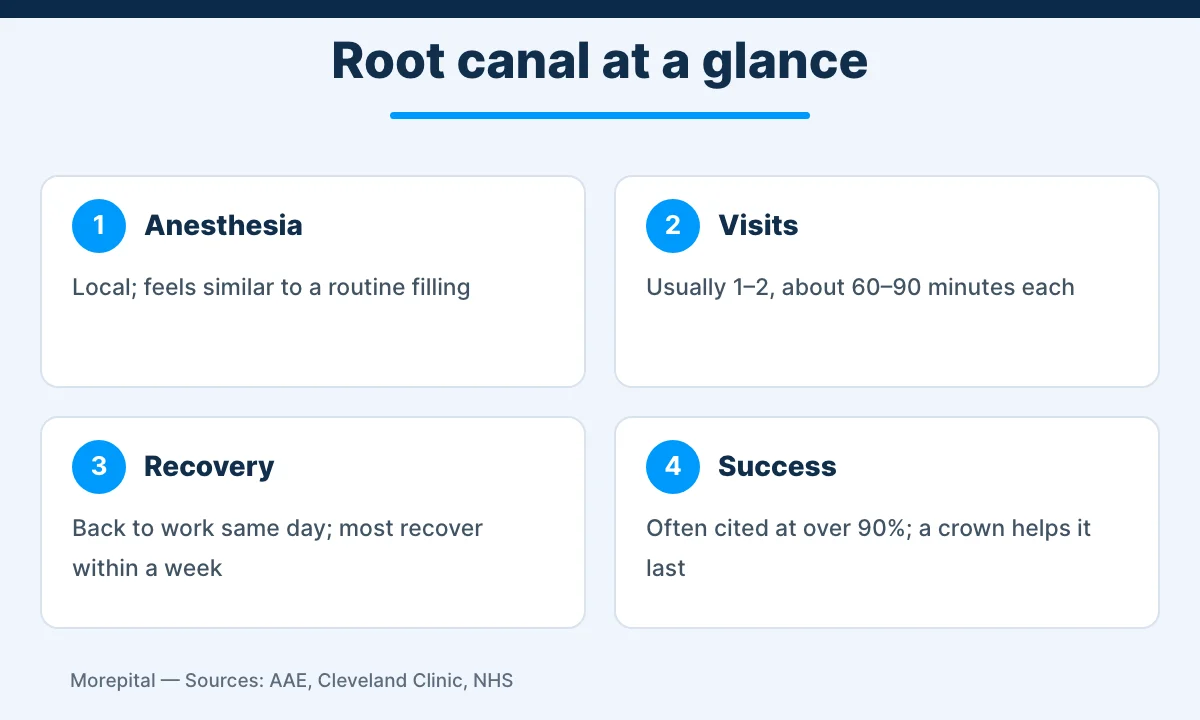
Root canal treatment is a dental procedure that removes infected or inflamed pulp from inside a tooth, then cleans, fills and seals the root canals to save the natural tooth instead of extracting it. It is done under local anesthesia, usually over one or two visits, and feels similar to having a filling. Success rates are often cited at over 90%, and with a timely crown or filling a treated tooth can last many years, often a lifetime.
Source: NHS, AAE, AAE, Cleveland Clinic
- What is root canal treatment?
- Who needs root canal treatment, and who does not?
- How to prepare
- How root canal treatment is done, step by step
- Recovery after root canal treatment
- Success rate and how long a root canal lasts
- Risks and complications
- Alternatives to root canal treatment
- Choosing a dentist or endodontist, and treatment abroad
- When to call your dentist
- FAQ
- Sources
What is root canal treatment?
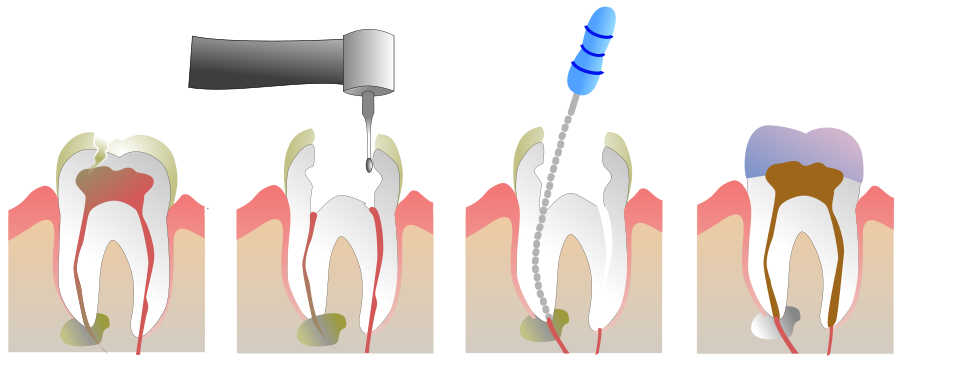
Root canal treatment, also called endodontic treatment, is a dental procedure that removes inflamed or infected pulp from inside a tooth, then cleans, disinfects, fills and seals the space so bacteria cannot return. Its goal is to clear the infection and keep your natural tooth instead of pulling it out.
Source: AAE, NHS, Cleveland Clinic
The pulp is the soft tissue in the center of the tooth, beneath the enamel and dentin. It contains nerves, blood vessels and connective tissue and runs down through narrow channels in the roots, called root canals. The pulp helps a tooth grow while it develops, but a fully formed adult tooth can survive without it because the surrounding tissues keep nourishing it.
Source: AAE, ADA MouthHealthy
Why the pulp becomes infected
- Deep tooth decay (a deep cavity)
- Repeated dental procedures on the same tooth, or problems with an earlier filling or crown
- A chipped, cracked or broken tooth
- An injury to the tooth, even when no crack or chip is visible
- Gum disease or a deep gum pocket around the tooth
Source: AAE, NHS, MedlinePlus, ADA MouthHealthy
Left untreated, an inflamed or infected pulp can cause pain and swelling, and a pocket of pus (a dental abscess) can form at the tip of the root. The bacteria can damage the surrounding bone and may eventually cause the tooth to be lost. That is why dentists recommend root canal treatment as a way to save a tooth that would otherwise need to come out.
Source: ADA MouthHealthy, NHS, Cleveland Clinic
Root canal treatment can be done by a general dentist or by an endodontist, a dentist who specializes in the pulp and the tissues around the tooth roots.
Source: NHS, ADA MouthHealthy
Who needs root canal treatment, and who does not?
You may need root canal treatment if the pulp of a tooth is inflamed or infected. Only a dentist can confirm this, usually with an examination and dental X-rays, but common warning signs include:
- Severe pain when chewing or biting, or pain that spreads to the jaw, face or nearby teeth
- Sensitivity to hot or cold that lingers after the food or drink is gone
- A pimple or boil on the gum that may ooze pus
- Swollen or tender gums, or a swollen jaw
- A tooth that has darkened in color, or a tooth that feels loose
- A chipped or cracked tooth
Source: AAE, Cleveland Clinic, ADA MouthHealthy
The best candidate for root canal treatment is a tooth that still has enough healthy structure and bone support to be restored. Not every tooth can be saved: severe damage, a fracture that extends below the gum line or too little supporting bone may mean extraction is the better choice. A dentist or endodontist assesses each case individually.
Source: AAE, MedlinePlus
Whether a tooth can be saved also depends on where the infection came from and how far the decay has spread. If you are nervous about root canal treatment, tell your dentist; local anesthesia is standard and calming medication may be offered.
Source: MedlinePlus, Cleveland Clinic
How to prepare
Before root canal treatment, the dentist examines the tooth and takes X-rays to see the shape of the root canals and any signs of infection in the surrounding bone. Endodontists also use digital radiographs and 3D imaging to show fine tooth anatomy.
Source: ADA MouthHealthy, AAE
- Tell your dentist about your general health, medical conditions and all medicines you take.
- Ask how many visits are planned and whether a crown will be needed afterward, because the tooth usually needs a permanent restoration once the root canal is finished.
- If you are anxious, ask whether calming medication is available. It may make you drowsy, so arrange for someone to take you home.
- If antibiotics are prescribed because the infection has spread, take them exactly as directed.
Source: Cleveland Clinic, ADA MouthHealthy, MedlinePlus, NHS
How root canal treatment is done, step by step
Root canal treatment is done under local anesthesia, so you stay awake but should not feel pain. The dentist may apply a numbing gel before the injection. Most people say root canal treatment feels similar to having a routine filling, although you may feel some pressure.
Source: NHS, MedlinePlus, Cleveland Clinic, AAE
- Numbing and isolation. The area is numbed and a thin rubber sheet called a dental dam is placed around the tooth to keep it clean and dry.
- Access. A small opening is drilled through the top of the tooth to reach the pulp chamber.
- Removing the pulp. The dead or infected pulp is removed with very fine instruments called files. If there is an abscess, it is drained.
- Cleaning and shaping. The canals are cleaned with a disinfecting solution and shaped so they can be filled. Medicine may be placed inside to kill remaining bacteria.
- Filling. The canals are filled and sealed with gutta-percha, a rubber-like material.
- Temporary seal. A temporary filling closes the opening until the final restoration is placed.
- Final restoration. At a later visit, the temporary filling is replaced by a permanent filling or a crown. A small post may be placed in a canal to help support the crown.
Source: Cleveland Clinic, MedlinePlus, NHS, ADA MouthHealthy, AAE
How long does it take?
Sources differ slightly. Cleveland Clinic says most root canal treatment visits take about 60 to 90 minutes, while the NHS says each appointment lasts about 1 to 2 hours, sometimes longer. The AAE and ADA say root canal treatment usually needs one or two visits; the NHS and Oral Health Foundation say two or more. If a crown is needed, expect further appointments to prepare and fit it.
Source: Cleveland Clinic, NHS, AAE, ADA MouthHealthy, Oral Health Foundation
One visit or several?
A 2022 Cochrane review of 47 trials with 5,805 participants found no clear difference between single-visit and multiple-visit root canal treatment in healing on X-rays after one year, swelling or flare-ups. People treated in a single visit were somewhat more likely to report pain during the first week, mainly when the tooth was still vital. The authors concluded that neither approach is clearly more effective.
Source: Cochrane
Recovery after root canal treatment
Recovery after root canal treatment is usually quick. Numbness typically wears off in 2 to 4 hours, and most people go back to work or school the same day. Do not eat until the numbness has gone, and for the first hour avoid chewing and very hot or cold drinks.
Source: AAE, AAE, MedlinePlus
| Time after treatment | What to expect |
|---|---|
| First few hours | Numbness of the lip, jaw and face while the local anesthetic wears off |
| First few days | Tenderness around the tooth and mild jaw soreness from keeping the mouth open; eat soft foods |
| About 1 week | Most people have recovered; some sensitivity may linger |
| Up to a couple of weeks | Any swelling and soreness around the tooth should have settled |
| Until the final restoration | Avoid biting hard on the tooth until the permanent filling or crown is fitted |
Source: NHS, Cleveland Clinic, AAE
Aftercare tips
- Take over-the-counter pain relief such as ibuprofen or acetaminophen (paracetamol) as directed.
- Eat soft foods such as yogurt, mashed potatoes or well-cooked pasta for a few days.
- Keep brushing twice a day and cleaning between your teeth, but be gentle around the treated tooth.
- Avoid smoking, which can slow healing.
- Book your crown or permanent filling promptly and keep all follow-up appointments, which may include an X-ray to check that the infection has cleared.
Source: NHS, Cleveland Clinic, AAE, MedlinePlus
It is normal for the treated tooth to feel slightly different for a while, and for a thin layer of the temporary filling to wear away.
Source: AAE
Success rate and how long a root canal lasts
Root canal treatment is very effective, and millions of teeth are treated and saved each year. The AAE says success rates are often cited at over 90%, and that most treated teeth can last a lifetime with a timely crown or filling and good oral hygiene. The Oral Health Foundation is more cautious, saying a root-filled tooth lasts on average 5 to 10 years, although many last much longer.
Source: AAE, AAE, Oral Health Foundation
Results depend on how outcomes are measured. “Survival” means the tooth is still in the mouth, while “success” usually also requires healing on X-rays. For root canal treatment, studies cited in a 2024 review report 2- to 10-year survival of 86% to 93%, and a large Korean study found 5-year survival of 90.8% after a first root canal and 88.4% after retreatment.
Source: Iran Endod J (PMC)
Why the crown matters
A tooth without a living nerve can become more brittle and more likely to break. A 2025 systematic review found that, in the first three years, teeth restored with crowns or with direct composite fillings both survived well, but after about 8 to 10 years crowned teeth did better, especially when four or five tooth surfaces had been lost. Keeping as much natural tooth structure as possible was the most important factor. Your dentist will advise whether a filling is strong enough or a crown is needed.
Source: Oral Health Foundation, Cureus (PMC), Cleveland Clinic
A tooth that has had root canal treatment can still decay, so it needs the same daily care and regular check-ups as your other teeth.
Source: Oral Health Foundation, ADA MouthHealthy
Risks and complications
Root canal treatment is generally safe, but like any procedure it carries some risks:
- Infection that persists or returns at the root tip (an abscess)
- Fracture of the tooth, particularly before it has been crowned
- Nerve damage
- Loss of the tooth if treatment fails
Source: MedlinePlus, Cleveland Clinic, Oral Health Foundation
Why some root canals fail
A tooth that has had root canal treatment can become painful or diseased months or even years later. Reasons include narrow, curved or extra canals that were not found the first time, a crown placed too late, a restoration that lets saliva leak in, new decay, a loose or cracked crown or filling, and a fracture of the tooth. Throbbing pain after treatment may mean some infected pulp remains.
Source: AAE, Cleveland Clinic, AAE
Failed root canal treatment does not always mean losing the tooth. Options include retreatment, endodontic surgery, or extraction followed by an implant or bridge.
Source: AAE, Cleveland Clinic
Do root canals cause illness?
No. Claims that root canal treatment causes cancer or chronic disease trace back to the “focal infection theory” of the early 1900s, which was based on flawed research done before modern sterilization and microbiology. Current peer-reviewed research does not support these claims, and leaving an infection untreated is the greater health risk.
Source: AAE
Alternatives to root canal treatment
The main alternative to root canal treatment is removing the tooth (extraction). Extraction ends the pain and infection, but it leaves a gap. Nearby teeth can drift into the space, so the missing tooth usually needs to be replaced to keep your bite aligned and restore chewing.
- Dental implant or bridge. These replace an extracted tooth but usually take more time and visits, sometimes with bone grafts or sinus lifts, and generally cost more than root canal treatment plus a crown. Read more in our guide to dental implants in Turkey.
- Endodontic retreatment. For a previously treated tooth that has become infected again, the old filling material is removed, the canals are cleaned again and refilled.
- Endodontic surgery (apicoectomy). If infection persists in the bone around the root tip, the gum is opened, the inflamed tissue and the very end of the root are removed, and the root end is sealed. Most people return to normal activities the next day, and the bone heals over the following months.
Saving your natural tooth with root canal treatment is preferred when possible, because it keeps normal biting force, sensation and appearance. Ozone therapy and other “biologic” approaches do not replace the cleaning, shaping and sealing that root canal treatment provides.
Choosing a dentist or endodontist, and treatment abroad
General dentists provide much of the root canal treatment people need, but complex cases, such as molars with curved or hidden canals, retreatment or surgery, are often referred to an endodontist. Endodontists complete two to three extra years of specialist training after dental school and average about 25 root canal treatments a week, compared with about two for a typical general dentist. They use operating microscopes and 3D imaging to see fine canal anatomy.
Source: AAE, ADA MouthHealthy
The cost of root canal treatment depends on the tooth and how complex the case is; molars usually cost more, and most dental insurance plans offer some coverage. In England, root canal treatment is an NHS band 2 treatment. Ask for a written estimate that includes the final crown or filling.
If you plan to have dental treatment abroad, UK regulators and patient charities advise that you:
- Talk to your regular dentist first and tell them your plans.
- Check that the dentist is qualified and registered to practise in that country.
- Are examined by a dentist, with a full medical history, before you receive a treatment plan and price.
- Get a clear written plan with a full cost breakdown, and ask what aftercare and guarantee are included.
- Ask who pays for extra travel, accommodation or corrective work if something goes wrong.
- Do not feel pressured to agree on the same day.
Source: General Dental Council, Oral Health Foundation
Because root canal treatment often needs more than one visit and a crown afterward, plan enough time for every stage and for a follow-up check. Fixing problems after you return home can cost more than the original treatment.
Source: Oral Health Foundation, NHS, Cleveland Clinic
When to call your dentist
Some tenderness for a few days after root canal treatment is normal. Contact your dentist or endodontist promptly if you notice any of the following:
- You have swelling inside or outside your mouth, especially if it is spreading
- You have severe or throbbing pain or pressure that lasts more than a few days
- You have signs of an allergic reaction to a medicine, such as a rash, hives or itching
Source: AAE, Cleveland Clinic
Also call your dentist if your bite feels uneven, the temporary filling or crown falls out, pain lasts longer than about a week, or the symptoms you had before treatment come back.
Source: AAE, Cleveland Clinic
Related treatments
Related conditions
Further reading
Root canal treatment: frequently asked questions
Is root canal treatment painful?
With local anesthesia, root canal treatment usually feels no more painful than a filling. Most of the pain people link to root canals comes from the infection, which the treatment removes. Mild soreness for a few days afterward is common.
Source: AAE, AAE, Cleveland Clinic
How long does root canal treatment take?
Most root canals take about 60 to 90 minutes per visit, and the NHS says appointments can last 1 to 2 hours. Treatment usually needs one or two visits, plus extra visits if a crown is fitted.
Source: Cleveland Clinic, NHS, AAE
Can I go to work after root canal treatment?
Yes. Most people return to work or school the same day after root canal treatment. Wait until the numbness wears off before eating.
Source: AAE, MedlinePlus
Do I need a crown after root canal treatment?
Often, yes, especially on back teeth or teeth with a lot of lost structure. A root-filled tooth can become brittle, and long-term studies show crowned teeth survive better when much of the tooth has been lost.
Source: Oral Health Foundation, Cureus (PMC), Cleveland Clinic
How long does a root canal last?
With a timely crown or filling and good care, most treated teeth can last a lifetime, according to the AAE. The Oral Health Foundation gives an average of 5 to 10 years, with many lasting much longer.
Source: AAE, Oral Health Foundation
What is the success rate of root canal treatment?
The AAE says success rates are often cited at over 90%. Studies report 2- to 10-year tooth survival of about 86% to 93%.
Source: AAE, Iran Endod J (PMC)
Is it better to pull the tooth instead?
Can root canal treatment fail?
Do root canals cause cancer or other diseases?
No. That idea comes from a discredited early 1900s theory, and current peer-reviewed research does not support it.
Source: AAE
Have a painful or infected tooth? Contact us for a free consultation and an honest opinion on whether your tooth can be saved.
Sources
- NHS — Root canal treatment
- Cleveland Clinic — Root Canal: What It Is, Why You Need It, Procedure & Recovery
- AAE — What Is a Root Canal?
- AAE — Myths About Root Canals
- AAE — Endodontic Retreatment
- AAE — Endodontic Surgery
- AAE — Post-Treatment Care
- AAE — Root Canal vs. Extraction
- AAE — What's the Difference Between a Dentist and an Endodontist?
- ADA MouthHealthy — Root Canals
- Oral Health Foundation — Root canal treatment
- Oral Health Foundation — Going abroad for dental treatment: risks
- General Dental Council — Going abroad for dental treatment
- MedlinePlus — Root canal
- Cochrane — Single versus multiple visits for endodontic treatment of permanent teeth
- Iran Endod J (PMC) — Success of nonsurgical endodontically treated posterior teeth with complex restorative/prosthodontic treatments: a retrospective study
- Cureus (PMC) — Remaining tooth structure and prognosis of restored endodontically treated teeth: a systematic review
This page is part of the Morepital medical reference. It is for general health education and does not replace a consultation with a qualified doctor. Last reviewed: October 2026.