
Dental crowns
Dental caps (full-coverage crown restorations)
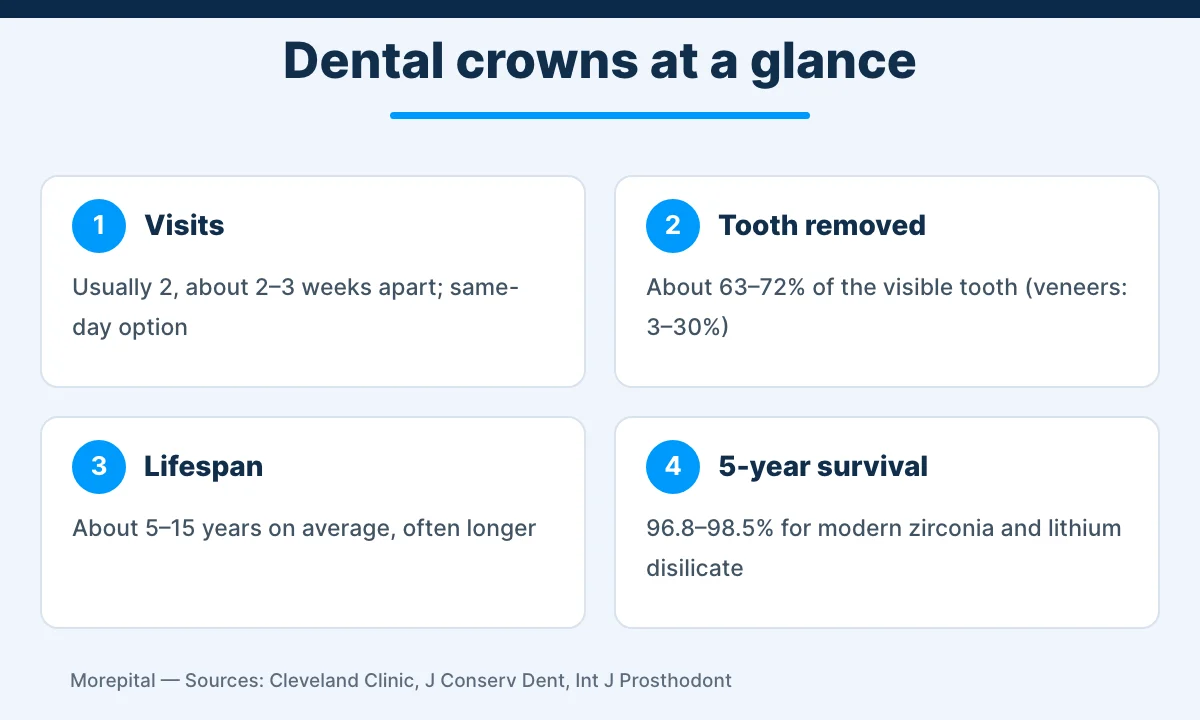
Dental crowns are custom-made, tooth-shaped caps that cover the whole visible part of a damaged, weak, root canal-treated or discolored tooth to restore its shape, strength and appearance. Fitting a crown usually takes two visits, or one with a same-day milled ceramic crown, and requires reshaping the tooth. Crowns last on average 5 to 15 years, and many last 15 to 20 years or longer with good care.
Source: Cleveland Clinic, MedlinePlus, Oral Health Foundation
- What are dental crowns?
- Types of dental crowns and materials
- Who is a good candidate for a crown and who is not
- Preparing for dental crowns
- How dental crowns are fitted, step by step
- Recovery after getting a crown
- Results and how long dental crowns last
- Risks and complications of dental crowns
- Alternatives to dental crowns
- Choosing a dentist and getting crowns abroad
- When to call your dentist
- FAQ
- Sources
What are dental crowns?

A dental crown is a custom-made, tooth-shaped cap that fits over the whole visible part of a tooth, the portion above the gum line. Once cemented, it restores the tooth’s shape, size and strength and improves how it looks. People often call it a cap; dentists use the two words for the same restoration. A crown is fixed in place, so you cannot take it out like a denture, and after fitting it works much like a natural tooth.
Source: Cleveland Clinic, MedlinePlus, Oral Health Foundation
Dental crowns are mainly a restorative treatment rather than a purely cosmetic one. A veneer covers only the front surface of a tooth, while a crown wraps around every side of it, which is why crowns are used when a tooth is weak, broken or heavily filled. Dental crowns can be made from metal, porcelain fused to metal, ceramic, zirconia or resin, and they can also sit on top of dental implants.
Source: Cleveland Clinic, NHS
Why a dentist may recommend a crown
- To protect a weak tooth from breaking, or hold together a tooth that is cracked
- To restore a tooth that is already broken or badly worn down, for example by grinding
- To strengthen a tooth with a large filling when too little natural tooth is left to hold the filling
- To cover and seal a tooth after root canal treatment
- To anchor a dental bridge or help hold a denture firmly
- To cover a dental implant
- To cover a badly discolored or misshapen tooth
Source: ADA MouthHealthy, Cleveland Clinic, MedlinePlus, Oral Health Foundation
Types of dental crowns and materials
The best material for dental crowns depends on where the tooth is, how hard you bite, how visible the tooth is and your budget. Each option trades off strength, appearance and the amount of tooth that needs to be removed.
Source: Cleveland Clinic, Oral Health Foundation
| Material | Strengths | Drawbacks | Typical use |
|---|---|---|---|
| Metal (gold alloy, palladium, nickel or chromium alloys) | Rarely chips, wears well, needs little tooth removed, withstands heavy biting | Metallic color | Back teeth that are out of sight |
| Porcelain fused to metal (PFM) | Metal strength with a tooth-colored surface that can be shade-matched; one of the most common types | Porcelain layer can chip and show metal; can wear opposing teeth | Front and back teeth |
| All-ceramic / all-porcelain (including lithium disilicate) | Most natural look; suitable for people with metal allergies | Traditional porcelain is less strong than some options; can wear opposing teeth more than metal | Front teeth and, with stronger ceramics, back teeth |
| Zirconia | Very strong, handles heavy biting forces, causes less wear on opposing teeth | Conventional zirconia looks more opaque than glass-ceramic | Back teeth; translucent forms for front teeth |
| Resin | Least expensive | Fragile, wears faster, more likely to crack | Mostly temporary crowns |
| Stainless steel (pre-made) | Quick to place | Not tooth-colored | Often temporary crowns for children |
Source: Cleveland Clinic, MedlinePlus, Oral Health Foundation, BMC Oral Health (PMC)
Lithium disilicate versus zirconia
Among modern metal-free dental crowns, two materials dominate. Lithium disilicate is a glass-ceramic that a 2019 narrative review describes as about 30% more translucent than conventional zirconia, which makes it attractive for visible teeth. Zirconia is much stronger, with a flexural strength of roughly 500 to 1,200 MPa, and conventional zirconia transmits only about a quarter of light, so it hides dark tooth structure well but looks less lifelike. Newer translucent zirconias trade some strength for better appearance. A monolithic zirconia crown can be as thin as about 0.5 mm, which can help preserve tooth structure.
Source: BMC Oral Health (PMC)
Same-day (CAD/CAM) crowns
Some clinics design the crown on a computer from a digital scan and mill it from a solid ceramic block in the office, so the crown can be fitted in a single visit. These chairside crowns are not suitable for every tooth or every patient, and the Oral Health Foundation notes they often cost more than other types. Ask your dentist whether the option suits your case.
Source: Cleveland Clinic, Oral Health Foundation
Post crowns
If a tooth is badly broken but its root is still strong, often after root canal treatment, the dentist may place a small post inside the root and build the crown on top of it.
Source: Oral Health Foundation
Who is a good candidate for a crown and who is not
A dental crown is usually suggested when a tooth is too damaged for a filling but still has a healthy, stable root. Typical candidates have a large cavity, a cracked or chipped tooth, a tooth worn down by grinding, a root canal-treated back tooth, a misshapen or stained tooth, or a missing tooth being replaced with an implant or bridge.
Source: MedlinePlus, Cleveland Clinic, ADA MouthHealthy
A crown may not be the right choice in some situations:
- Too little damage: if a tooth only needs a moderate repair, an inlay or onlay can restore it while keeping more natural tooth.
- Cosmetic concerns only: for chips or stains on otherwise healthy front teeth, veneers or bonding may be enough.
- Too much damage: when a tooth is so decayed or broken that a crown is not a predictable option, removing it and replacing it with an implant may be advised.
- A weak core: a crown can come loose if the tooth underneath is too weak to hold it.
Source: Cleveland Clinic, MedlinePlus
For root canal-treated teeth, how much sound tooth is left matters most. A 2025 systematic review found that crowns and direct composite fillings performed similarly in the short term, but over about 8 to 10 years crowned teeth survived better, by roughly 13 to 19 percentage points in two of the studies, especially when four or five surfaces of the tooth had been lost. A band of sound tooth about 1.5 to 2 mm high around the base (called a ferrule) improved resistance to fracture. The authors rated the certainty of this evidence as low to moderate.
Source: Cureus (PMC)
Preparing for dental crowns
Preparation for dental crowns starts with an examination. Your dentist checks the tooth and the gum around it, may take X-rays, and decides whether the tooth needs other treatment first. If decay or infection has reached the pulp in the center of the tooth, root canal treatment is done before the crown, and the crown then seals the tooth to help prevent it from becoming infected again.
Source: MedlinePlus, NHS
Before you agree to treatment, ask which material your dentist recommends and why, how many visits you will need, how long the crown is expected to last and what it will cost. In England, an NHS crown falls under Band 3, which costs £332.10 and also covers any Band 1 and Band 2 work in the same course of treatment; elsewhere and in private practice prices vary widely, so ask for a written estimate.
Source: NHS, NHS, Oral Health Foundation
Tell your dentist if you clench or grind your teeth, because this raises the chance of a crown chipping, and about any known metal allergy, which may point toward an all-ceramic crown.
Source: MedlinePlus, Cleveland Clinic
How dental crowns are fitted, step by step
A traditional dental crown usually takes two visits. The steps are broadly the same whichever lab-made material you choose.
Source: Oral Health Foundation, MedlinePlus
First visit
- Numbing: the dentist numbs the tooth and the surrounding gum with a local anesthetic. If you feel pain during treatment, say so; more anesthetic can be given.
- Shaping: decay and old fillings are removed, then the outer layer of the tooth is reshaped so the crown can fit over it. If the tooth is badly broken, filling material may be used to build it back up first.
- Impression or scan: a putty impression or a digital scan with a handheld scanner records the shape of the prepared tooth and your bite, and is sent to a dental laboratory.
- Temporary crown: a temporary crown, usually made of resin or acrylic, protects the tooth while the permanent one is made, which typically takes two to three weeks, sometimes longer.
Source: MedlinePlus, Cleveland Clinic, Oral Health Foundation
Second visit
- The temporary crown is removed.
- The dentist checks the new crown’s shape, color and fit, sometimes with an X-ray, and adjusts your bite.
- The crown is permanently fixed with strong dental cement.
Source: Cleveland Clinic, MedlinePlus, Oral Health Foundation
With a same-day CAD/CAM crown, the scan, design, milling and fitting all happen at one appointment, so no temporary crown is needed.
Source: Cleveland Clinic
Shaping the tooth means removing a meaningful amount of it. A laboratory study cited in the Journal of Conservative Dentistry found that preparing a tooth for an all-ceramic or metal-ceramic crown removed about 63% to 72% of the visible tooth structure, compared with about 3% to 30% for veneers. For this reason, a crowned tooth will always need a crown.
Source: J Conserv Dent (PMC), Cleveland Clinic
Recovery after getting a crown
Recovery after dental crowns is short. Most people return to work, school and normal routines straight after the appointment.
Source: Cleveland Clinic
| When | What to expect |
|---|---|
| Same day | Numbness wears off over a few hours; normal activities can resume right away |
| While wearing a temporary crown | Chew on the other side, avoid sticky and hard foods, and slide floss out sideways instead of lifting it up |
| First few days | Gum soreness around the tooth is normal and should settle; it takes a few days to get used to the new crown |
| First couple of weeks | Sensitivity to heat and cold is common and should fade |
Source: Cleveland Clinic, MedlinePlus
Over-the-counter pain relievers such as acetaminophen or ibuprofen can ease discomfort. A crown should never hurt enough to keep you awake at night; if it does, contact your dentist.
Source: Cleveland Clinic
Results and how long dental crowns last
Dental crowns usually make chewing more comfortable and improve the appearance of the tooth. How long they last depends on the material, the tooth, your bite and how well you care for your mouth. Sources give somewhat different ranges: Cleveland Clinic puts the average at 5 to 15 years and says some last more than 30 years, while MedlinePlus says most last at least 5 years and many last 15 to 20.
Source: Cleveland Clinic, MedlinePlus
What the research shows
A 2015 systematic review of 67 studies covering more than 14,000 single crowns estimated 5-year survival at 94.7% for metal-ceramic crowns, 96.6% for leucite or lithium disilicate glass-ceramic crowns and 92.1% for zirconia crowns, with weaker feldspathic ceramics doing worse. At that time, veneered zirconia crowns had more chipping and loosening, and the authors did not recommend them as a first choice.
Source: Dent Mater (Sailer 2015)
A 2026 update of that review, based on 64 studies and more than 11,500 crowns, reported higher figures for newer designs: 98.5% 5-year survival for monolithic (single-piece) lithium disilicate, 97.3% for veneered zirconia, 97.1% for metal-ceramic and 96.8% for monolithic zirconia. Monolithic lithium disilicate and zirconia crowns had significantly fewer ceramic fractures and chips than layered designs, and the authors concluded these all-ceramic crowns now perform comparably to metal-ceramic ones.
Source: Int J Prosthodont (Pjetursson 2026)
Caring for a crown
- Brush twice a day for two minutes with fluoride toothpaste and a soft brush
- Clean between the teeth daily with floss or interdental brushes
- Avoid biting ice, hard candy, popcorn kernels and very hard nuts
- Ask about a custom night guard if you grind or clench your teeth
- Keep up regular check-ups and cleanings
Source: Oral Health Foundation, Cleveland Clinic, MedlinePlus
Risks and complications of dental crowns
Dental crowns are a routine, well-established treatment, but they have downsides that are worth knowing before you start.
Source: Cleveland Clinic
- Loss of natural tooth: shaping the tooth removes enamel permanently.
- Sensitivity: the tooth may react to hot and cold, especially in the first weeks. If the nerve becomes irritated and does not settle, root canal treatment may be needed.
- Decay under the crown: the tooth underneath can still get cavities, and a poorly fitting crown can trap bacteria.
- Chipping or fracture: porcelain can chip, particularly in people who grind their teeth; with PFM crowns the metal underneath may then show.
- Loose or lost crown: a crown can come off if the tooth core is too weak, which may lead to root canal treatment or extraction and an implant.
- Wear on opposing teeth: some porcelain and ceramic crowns wear down the teeth they bite against more than metal does.
- Allergy: a reaction to crown materials is possible but rare.
- Cost: crowns can be expensive, and they will eventually need replacing.
Source: Cleveland Clinic, MedlinePlus
Research on zirconia dental crowns also highlights technical problems with older layered designs, such as chipping of the porcelain on top and loss of retention, which is one reason monolithic designs have become more popular.
Source: Dent Mater (Sailer 2015), Int J Prosthodont (Pjetursson 2026)
Alternatives to dental crowns
Dental crowns are not the only way to repair a tooth. Depending on how damaged the tooth is and what you want to achieve, your dentist may offer:
- Fillings: for smaller areas of decay or damage.
- Inlays and onlays: lab-made pieces that fit into or onto the damaged part of a tooth that is too broken for a filling but not damaged enough to need a full crown.
- Veneers: thin shells bonded to the front of the teeth for cosmetic problems such as chips, cracks or discoloration when the tooth is otherwise sound.
- Extraction and a dental implant: when a tooth is too decayed or broken for a crown to be reliable.
- Bridges or dentures: to replace teeth that are already missing.
Source: Cleveland Clinic, NHS
Choosing a dentist and getting crowns abroad
Whether at home or abroad, choose a registered dentist who examines you in person, takes a full medical and dental history, explains the options and gives you a written treatment plan with costs before you commit. Do not feel pressured to agree to dental crowns on the spot.
Source: General Dental Council, Oral Health Foundation
Many people travel abroad for dental crowns to save money. UK dental bodies point out that problems reported after treatment abroad include ongoing pain, infection, more extensive treatment than expected, and crowns, bridges or veneers that break or fit poorly. Fixing these at home can cost more than the original work. Before booking, check:
- Where the dentist trained and that they are registered and legally allowed to practice in that country
- How often the clinic does this treatment and what guarantee it offers, and for how long
- How long the crowns are expected to last and who pays to remake or correct one that fails
- What aftercare is included, who to contact once you are home, and how complaints are handled
- That you can communicate clearly with the team, or that an interpreter is provided
Source: Oral Health Foundation, General Dental Council
The NHS advises choosing treatment abroad on the quality of care rather than the destination, being wary of hard selling or clinics that do not discuss complications or aftercare, allowing for return trips in your budget, telling your travel insurer, and staying long enough to recover before you travel. Talk to your own dentist before you go so they know your plans if anything goes wrong later.
Source: NHS, General Dental Council
When to call your dentist
Contact your dentist if any of these happen after getting a temporary or permanent dental crown:
- Swelling gets worse instead of better
- Pain is not relieved by over-the-counter painkillers, or keeps you awake
- Your bite feels uneven or the tooth feels out of place
- The temporary crown comes off, or the permanent crown feels loose
- The crown cracks or chips, or has a sharp edge that irritates your tongue or gums
- You notice persistent bad breath or a bad taste around the tooth
Source: MedlinePlus, Cleveland Clinic
Related treatments
Related conditions
Further reading
Dental crowns: frequently asked questions
How long do dental crowns last?
Cleveland Clinic gives an average of 5 to 15 years, and MedlinePlus says many crowns last 15 to 20 years. Good brushing, flossing, regular check-ups and avoiding very hard foods help a crown last longer.
Source: Cleveland Clinic, MedlinePlus
Does getting a dental crown hurt?
The tooth is numbed with local anesthetic, so the procedure itself should not be painful. Afterward, mild gum soreness for a few days and sensitivity to hot and cold for a couple of weeks are normal.
Source: MedlinePlus, Cleveland Clinic
How many visits does a crown take?
A lab-made dental crown usually takes two visits a few weeks apart, with a temporary crown in between. Some clinics can design and mill a ceramic crown in the office and fit it the same day.
Source: Oral Health Foundation, Cleveland Clinic
What is the best material for a dental crown?
It depends on the tooth. Metal and zirconia suit back teeth that take heavy biting forces, while all-ceramic crowns such as lithium disilicate look the most natural on front teeth. Recent research shows modern all-ceramic dental crowns survive about as well as metal-ceramic ones.
Source: Cleveland Clinic, Oral Health Foundation, Int J Prosthodont (Pjetursson 2026)
Do I need a crown after a root canal?
Often, especially on back teeth. After root canal treatment the tooth is sealed with a filling or a crown. Research suggests crowns improve long-term survival when much of the tooth structure has been lost.
Source: NHS, Cureus (PMC)
What is the difference between a crown and a veneer?
A veneer is a thin shell bonded to the front of a tooth, mainly for cosmetic reasons. A crown covers the entire tooth and is used to restore and protect damaged or weakened teeth.
Source: Cleveland Clinic
Can a tooth with a crown still get a cavity?
Yes. The natural tooth underneath can still decay, particularly at the edge where the crown meets the tooth, so daily brushing and cleaning between the teeth remain essential.
Source: MedlinePlus, Cleveland Clinic
What should I do if my crown falls off?
Keep the crown and call your dentist as soon as possible. A crown can come off if the tooth core is weak; depending on the cause, it may be recemented, remade, or the tooth may need further treatment.
Source: MedlinePlus, Cleveland Clinic
Need a dental crown? Contact us for a free consultation and an honest assessment of which material suits your tooth.
Sources
- Cleveland Clinic — Dental Crowns: Types, Procedure & Care
- MedlinePlus — Dental crowns
- ADA MouthHealthy — Crowns
- Oral Health Foundation — Crowns
- Oral Health Foundation — Going abroad for dental treatment
- NHS — Dental treatments
- NHS — Understanding NHS dental charges
- NHS — Treatment abroad checklist
- General Dental Council — Going abroad for dental treatment
- Dental Materials (PubMed) — All-ceramic or metal-ceramic tooth-supported fixed dental prostheses? A systematic review of the survival and complication rates. Part I: Single crowns
- Int J Prosthodont (PubMed) — Survival, failure and complication rates of metal-ceramic, veneered and monolithic all-ceramic tooth-supported single crowns: systematic review and meta-analysis, Part 1
- BMC Oral Health (PMC) — Current status on lithium disilicate and zirconia: a narrative review
- J Conserv Dent (PMC) — Survival rates of porcelain laminate restoration based on different incisal preparation designs
- Cureus (PMC) — Remaining tooth structure and prognosis of restored endodontically treated teeth: a systematic review
This page is part of the Morepital medical reference. It is for general health education and does not replace a consultation with a qualified doctor. Last reviewed: October 2026.