
Periodontitis
Periodontal disease (advanced gum disease)
Periodontitis is a serious, chronic gum infection that damages the gums, ligaments and jawbone supporting the teeth, and it is the leading cause of tooth loss in adults. It develops when plaque and tartar are not removed and gingivitis is left untreated. It cannot be fully reversed, but deep cleaning, sometimes surgery and lifelong good oral hygiene can stop or slow it.
Source: MedlinePlus, Cleveland Clinic, CDC
- What is periodontitis?
- Symptoms of periodontitis
- Causes and risk factors
- Stages and grades of periodontitis
- How periodontitis is diagnosed
- Treatment options for periodontitis
- Long-term care after treatment
- Complications
- Prevention and living with periodontitis
- When to see a dentist
- FAQ
- Sources
What is periodontitis?
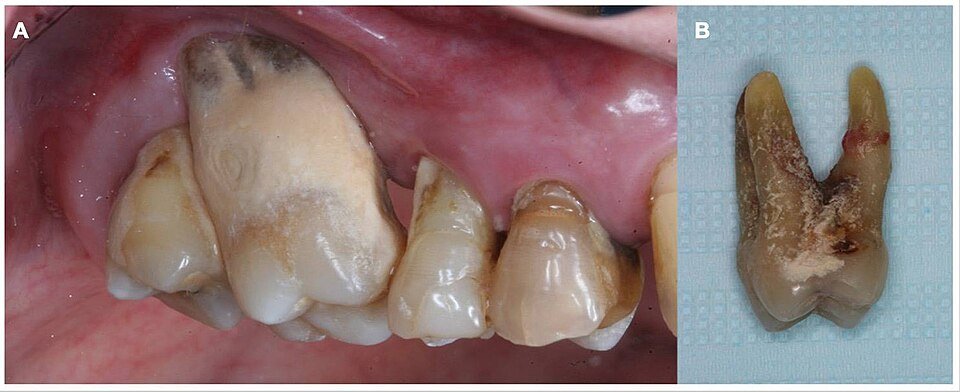
Periodontitis is the advanced form of gum (periodontal) disease. It is a chronic bacterial infection and inflammation of the gums, the ligaments and the jawbone that hold the teeth in place. It usually develops when gingivitis, the mild and reversible first stage of gum disease, is left untreated. As periodontitis progresses, the gums pull away from the teeth, deep spaces called periodontal pockets form, and the bone supporting the teeth is slowly destroyed.
Source: MedlinePlus, Cleveland Clinic, American Academy of Periodontology
Periodontitis is the leading cause of tooth loss in adults. Because it is often painless in its early and middle stages, many people do not realize they have it until teeth start to feel loose or shift. The disease cannot be fully reversed once bone has been lost, but with professional treatment and good daily cleaning it can be stopped or slowed and kept under control for life.
Source: Cleveland Clinic, MedlinePlus, CDC, ADA MouthHealthy
How common is periodontitis?
Periodontitis is one of the most common chronic diseases in the world. The WHO estimates that severe periodontal disease accounts for more than 1 billion cases worldwide, and a 2021 review puts severe periodontitis at about 11% of the global population (around 743 million people). In the United States, CDC data from 2009–2014 show that about 4 in 10 adults aged 30 or older have some degree of periodontitis, rising to about 60% of adults aged 65 and over. The ADA cites a slightly higher figure of 47.2% of US adults over 30 for chronic periodontitis; the difference reflects different survey periods and definitions.
Source: WHO, Int Dent J (PMC), CDC, ADA MouthHealthy
Symptoms of periodontitis
The early signs of periodontitis look much like gingivitis, and the disease is often silent until it is advanced. Common symptoms include:
- Red, dark red or purplish gums instead of firm, pale pink gums
- Swollen, puffy, shiny or tender gums
- Gums that bleed easily when you brush, floss or bite into hard food
- Gums that recede (pull away from the teeth), making the teeth look longer
- Persistent bad breath or a bad taste in the mouth
- Pus between the gums and teeth
- Pain or tenderness when chewing and sensitivity to hot or cold
- Loose, shifting or separating teeth, or new gaps between teeth
- A change in how your teeth fit together when you bite, or in how partial dentures fit
- Hard yellow, brown or white deposits (tartar) along the gumline
Source: Cleveland Clinic, MedlinePlus, American Academy of Periodontology, CDC
Because periodontitis often does not hurt, the absence of pain does not mean the gums are healthy. The CDC notes that gum disease can become serious before any symptoms appear, which is why regular dental checkups matter even when your mouth feels fine.
Source: CDC, ADA MouthHealthy, Cleveland Clinic
Causes and risk factors
Periodontitis starts with plaque, the sticky film of bacteria that constantly forms on teeth. If plaque is not removed by brushing and cleaning between the teeth, it irritates the gums and hardens into tartar (calculus), which only a dentist or hygienist can remove. Bacteria then spread below the gumline into pockets where brushing cannot reach. The body’s inflammatory response to these bacteria is what gradually breaks down the gum attachment, ligament and bone around the teeth.
Source: NIDCR (NIH), Cleveland Clinic, MedlinePlus, NHS
Risk factors
- Smoking and tobacco use – the most important risk factor. It raises the risk of bone and attachment loss, slows healing and makes treatment less successful. Vaping is also listed as a risk factor.
- Diabetes – especially poorly controlled diabetes. WHO describes a two-way link between diabetes and periodontal disease.
- Poor oral hygiene and skipped professional cleanings.
- Genetics and a family history of gum disease.
- Older age and male sex – gum disease is more common and more severe in men.
- Hormonal changes such as pregnancy or menopause.
- Stress, a weakened immune system and conditions such as rheumatoid arthritis, cardiovascular disease or HIV/AIDS.
- Medicines that cause dry mouth or affect the gums, including some steroids, anti-epileptic drugs, cancer drugs, certain calcium channel blockers and oral contraceptives.
- Crooked teeth, clenching or grinding, and dental work that is hard to keep clean.
- Poor nutrition, vitamin C deficiency and obesity.
Source: NIDCR (NIH), CDC, Cleveland Clinic, ADA MouthHealthy, WHO
Some groups are affected far more often. According to the CDC, periodontitis is found in about 62% of current smokers aged 30 and older and about 60% of US adults with diabetes. A 2021 review reports that heavy smokers have roughly seven times the odds of bone loss around the teeth compared with non-smokers.
Source: CDC, Int Dent J (PMC)
Stages and grades of periodontitis
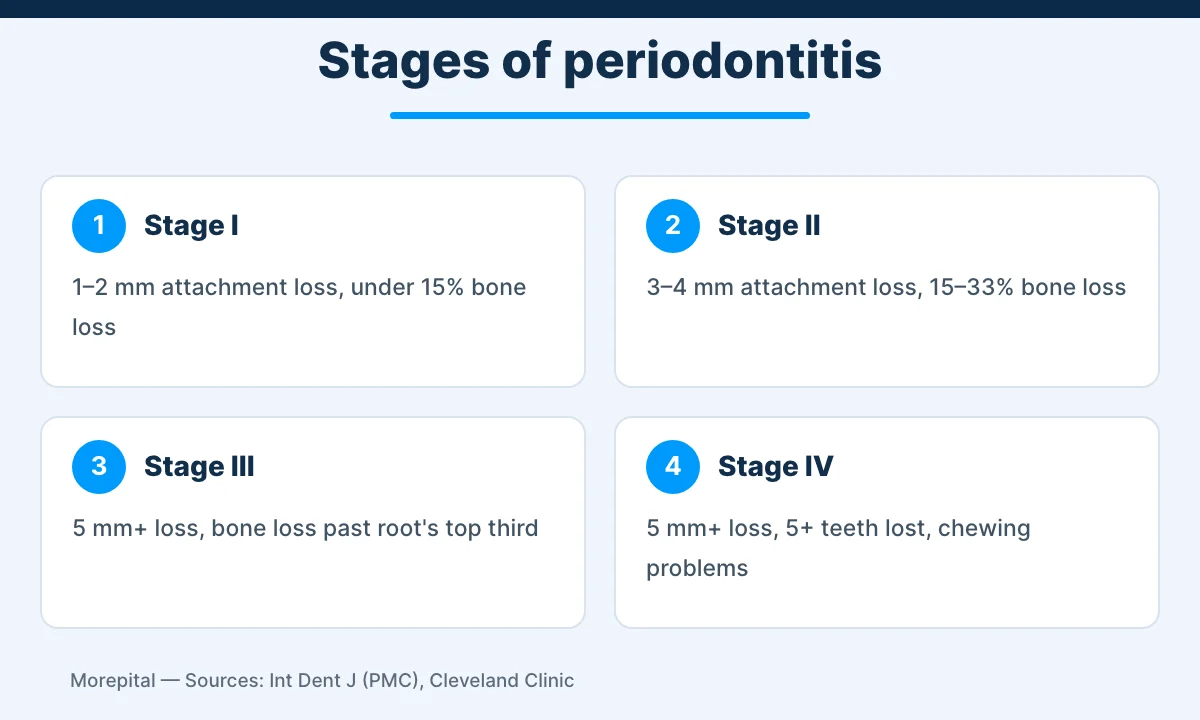
Gum disease moves along a spectrum. Gingivitis affects only the gums and can be reversed with professional cleaning and good home care. Periodontitis begins when the infection destroys the tissue and bone that anchor the teeth. Since 2017, dentists and periodontists describe periodontitis with two labels: a stage (how severe and complex it is) and a grade (how fast it is progressing and how likely it is to respond to treatment).
Source: American Academy of Periodontology, Cleveland Clinic, Int Dent J (PMC)
Stages
| Stage | Attachment loss between teeth | Bone loss on X-ray | Teeth lost to periodontitis |
|---|---|---|---|
| Stage I (initial) | 1–2 mm | Less than 15% (top third of the root) | None |
| Stage II (moderate) | 3–4 mm | 15–33% (top third of the root) | None |
| Stage III (severe) | 5 mm or more | Reaches the middle or lower third of the root | 4 or fewer |
| Stage IV (advanced) | 5 mm or more | Reaches the middle or lower third of the root | 5 or more, with problems chewing and fewer than 20 teeth left |
Source: Int Dent J (PMC)
Disease is also described by its extent: localized when fewer than 30% of teeth are involved, generalized when more are affected, or a molar/incisor pattern.
Source: Int Dent J (PMC)
Grades
- Grade A – slow progression: no further loss over 5 years.
- Grade B – moderate progression: less than 2 mm of loss over 5 years.
- Grade C – rapid progression: 2 mm or more of loss over 5 years.
Smoking 10 or more cigarettes a day, or diabetes with an HbA1c of 7.0% or higher, pushes the grade toward C. Older terms such as “chronic” and “aggressive” periodontitis are still seen; the ADA describes aggressive periodontitis as a rarer, highly destructive form that occurs in otherwise healthy people.
Source: Int Dent J (PMC), Cleveland Clinic, ADA MouthHealthy
How periodontitis is diagnosed
Periodontitis is usually found during a routine dental exam. A dentist or dental hygienist will typically:
- Ask about symptoms, medical history, medicines, smoking and diabetes
- Look at the gums for redness, swelling, bleeding and recession
- Measure the space between each tooth and the gum with a thin periodontal probe, like a tiny ruler; healthy pockets are usually 1 to 3 mm deep, and deeper pockets suggest disease
- Check whether any teeth are loose or have moved
- Take dental X-rays to see how much supporting bone has been lost
Source: NIDCR (NIH), Cleveland Clinic, MedlinePlus
If the disease is more than mild, you may be referred to a periodontist, a dentist with up to three extra years of specialist training in treating gum disease and placing dental implants.
Source: Cleveland Clinic, NIDCR (NIH), American Academy of Periodontology
Treatment options for periodontitis
The main goal of treatment is to control the infection, reduce inflammation and the depth of the gum pockets, and stop further bone loss. The choice of treatment depends on the stage of disease and how well you can keep your teeth clean at home. Whatever treatment you have, quitting tobacco and keeping up excellent daily oral hygiene are essential for it to work.
Source: NIDCR (NIH), MedlinePlus, Cleveland Clinic
Non-surgical treatment
- Oral hygiene coaching – your dentist or hygienist shows you how to brush and clean between the teeth properly, often with interdental brushes, and may suggest an antibacterial rinse such as chlorhexidine.
- Scaling and root planing (deep cleaning) – plaque and tartar are removed from above and below the gumline and the root surfaces are smoothed so the gums can reattach. It is done under local anesthetic.
- Antibiotics – given as tablets or placed directly into the gum pockets (for example minocycline microspheres or a chlorhexidine chip). Reviews find that amoxicillin plus metronidazole adds a modest extra benefit to deep cleaning in some patients.
- Fixing local problems – such as rough fillings or dental appliances that trap plaque.
Source: Cleveland Clinic, NHS, Int Dent J (PMC), MedlinePlus
Results are usually checked again about 4–6 weeks after deep cleaning. Sites up to about 5 mm deep can often be managed without surgery, while pockets of 6 mm or more that do not heal may need a surgical approach.
Source: Int Dent J (PMC)
Surgical treatment
- Pocket reduction (flap or osseous) surgery – the gum is lifted back so the roots can be cleaned thoroughly and bone defects reshaped, then the gum is stitched back in place.
- Bone grafts – to rebuild jawbone lost to the disease.
- Guided tissue regeneration – a membrane is placed to encourage bone and ligament to regrow instead of gum tissue.
- Gum (soft tissue) grafts – to cover exposed roots where the gums have receded.
- Platelet-rich plasma and growth factors – substances made from your own blood or proteins that may help rebuild tissue.
- Tooth extraction – when a tooth cannot be saved.
Source: Cleveland Clinic, Int Dent J (PMC), NHS
Replacing lost teeth
Teeth lost to periodontitis can be replaced with dental implants, bridges or dentures. People with a history of periodontitis can have implants, but they have a higher risk of peri-implantitis (gum disease around the implant), so gum health must be controlled first and maintained afterward. If you are considering treatment abroad, see our guide to dental implants in Turkey.
Source: Cleveland Clinic, Int Dent J (PMC), American Academy of Periodontology
Long-term care after treatment
Periodontitis is a chronic condition that can come back. After active treatment you will need regular periodontal maintenance visits. MedlinePlus mentions professional cleanings every 3 months, while a 2021 review notes that the interval is usually set somewhere between 2 and 6 months depending on your risk factors, any remaining deep pockets and how well you clean at home. Patients who keep up maintenance lose significantly fewer teeth.
Source: MedlinePlus, Int Dent J (PMC), Cleveland Clinic
Bleeding and tenderness of the gums usually settle within 3 to 4 weeks of treatment, but careful brushing and cleaning between the teeth must continue for life.
Source: MedlinePlus
Complications
Untreated periodontitis can lead to:
- Loose teeth, teeth that drift or flare out, and eventually tooth loss
- A changed or misaligned bite (malocclusion)
- Gum abscesses and tooth abscesses
- Infection of the jawbone
- Necrotizing gum infection (trench mouth)
- Recurrence of periodontitis after treatment
Source: MedlinePlus, Cleveland Clinic, NHS
Links with general health
Long-standing gum infection has been associated with heart disease, complications of diabetes, lung conditions such as COPD, dementia and Alzheimer’s disease, and low birth weight when periodontitis occurs during pregnancy. The link with diabetes works both ways. However, the ADA notes that research into links with conditions such as diabetes and stroke is ongoing and that a direct cause-and-effect relationship has not been proven.
Source: Cleveland Clinic, WHO, ADA MouthHealthy
Prevention and living with periodontitis
Most periodontitis can be prevented, and the same habits keep treated disease under control:
- Brush twice a day with fluoride toothpaste; spit, but do not rinse straight after brushing
- Clean between your teeth every day with floss, interdental brushes, picks or a water flosser
- Do not smoke or use any tobacco products
- Have regular dental checkups and professional cleanings – at least once a year, or more often if you are prone to gum disease
- Eat a balanced diet
- If you have diabetes, keep your blood sugar well controlled and tell your dentist about it
- Treat gingivitis early, before it can progress to periodontitis
Source: NHS, NIDCR (NIH), CDC, ADA MouthHealthy, MedlinePlus
The NHS advises people with type 2 diabetes and pregnant women to have more regular dental checks, as both raise the risk of gum disease.
Source: NHS, Cleveland Clinic
When to see a dentist
Book a dental appointment if your gums bleed when you brush or eat, if they are red, swollen or sore, if you have bad breath that does not go away, or if your gums are receding. Early treatment is simpler, cheaper and saves more teeth. Even without symptoms, have a checkup at least once a year.
Source: NHS, Cleveland Clinic, CDC
- Your gums are very sore and swollen
- Teeth suddenly become loose or fall out
- You have swelling of the face, jaw or neck, or a fever with a painful gum
- You notice ulcers or red patches in the mouth, or a lump in the mouth or on the lip
Source: NHS, MedlinePlus
Related treatments
Related conditions
Further reading
Periodontitis: frequently asked questions
What is the difference between gingivitis and periodontitis?
Gingivitis is inflammation of the gums only and can be reversed with professional cleaning and good home care. Periodontitis is the advanced stage, in which the infection destroys the ligament and bone that hold the teeth, causing pockets, receding gums and loose teeth.
Source: American Academy of Periodontology, ADA MouthHealthy, MedlinePlus
Can periodontitis be cured?
Lost bone and gum attachment do not fully grow back on their own, so periodontitis is not considered curable. It can, however, be stopped or slowed and controlled for life with deep cleaning, sometimes surgery, and regular maintenance visits.
Source: Cleveland Clinic, CDC
Can periodontitis be reversed?
No. The CDC states that periodontitis cannot be reversed, only slowed and managed, whereas gingivitis is reversible. Regenerative surgery such as bone grafts and guided tissue regeneration can rebuild some lost support in selected cases.
Source: CDC, Cleveland Clinic
What causes periodontitis?
It is caused by plaque bacteria that build up on the teeth and harden into tartar. The body's inflammatory reaction to bacteria below the gumline breaks down gum and bone. Smoking, diabetes, genetics and poor oral hygiene greatly raise the risk.
Source: NIDCR (NIH), Cleveland Clinic
Is periodontitis painful?
Often not. Periodontitis can progress with little or no pain, which is why many people only notice it when gums bleed, recede or teeth become loose. Some people do have tenderness when chewing or sensitivity to hot and cold.
Source: Cleveland Clinic, ADA MouthHealthy
How is periodontitis treated?
Treatment starts with improved home cleaning and scaling and root planing (deep cleaning under the gums), sometimes with antibiotics. Deep pockets that do not heal may need flap surgery, bone or gum grafts or guided tissue regeneration, followed by regular maintenance.
Source: Cleveland Clinic, Int Dent J (PMC), NIDCR (NIH)
Can you keep your teeth with periodontitis?
Many people keep their teeth for life when the disease is treated early and they attend regular maintenance visits; patients who keep up maintenance lose significantly fewer teeth. Advanced, untreated disease is the main cause of tooth loss in adults.
Source: Int Dent J (PMC), MedlinePlus
Does periodontitis affect the rest of the body?
Long-term gum infection is associated with heart disease, diabetes complications, lung disease, dementia and low birth weight, and it has a two-way relationship with diabetes. Research is ongoing, and cause and effect is not proven for every condition.
Source: Cleveland Clinic, WHO, ADA MouthHealthy
Can I get dental implants if I have periodontitis?
Yes, but gum disease should be treated and controlled first. People with a history of periodontitis have a higher risk of peri-implantitis around implants, so good hygiene and regular maintenance are important afterward.
Source: Int Dent J (PMC), American Academy of Periodontology
Worried about bleeding gums or loose teeth? Contact us to discuss gum treatment and tooth replacement options with our dental team.
Sources
- NHS — Gum disease
- Cleveland Clinic — Periodontitis: Symptoms, Causes & Treatment
- CDC — About Periodontal (Gum) Disease
- NIDCR (NIH) — Periodontal (Gum) Disease
- WHO — Oral health – fact sheet
- MedlinePlus — Periodontitis – Medical Encyclopedia
- American Academy of Periodontology — Gum Disease Information
- ADA MouthHealthy — Gum Disease – Periodontal Disease
- Int Dent J (PMC) — Kwon, Lamster, Levin – Current Concepts in the Management of Periodontitis (2021)
This page is part of the Morepital medical reference. It is for general health education and does not replace a consultation with a qualified doctor. Last reviewed: October 2026.