
Liposuction in Turkey is the same operation offered in the UK, Europe or the US: a surgeon removes stubborn pockets of fat through small cuts with a thin suction tube to reshape areas such as the tummy, hips, thighs or arms. It is a body-contouring procedure, not a weight-loss treatment, and it works best for healthy adults near their ideal weight with firm skin. Safety abroad depends on choosing a qualified plastic surgeon and a licensed hospital, and on planning enough time to recover before flying home.
Source: NHS, American Society of Plastic Surgeons, NHS (cosmetic surgery abroad)
Source: NHS, Cleveland Clinic, BAAPS and TSPRAS
Contents
- What liposuction in Turkey involves
- Liposuction techniques explained
- Who is a good candidate for liposuction in Turkey?
- What happens on the day of surgery
- Recovery timeline after liposuction in Turkey
- Liposuction in Turkey: risks and complications
- Choosing a surgeon and hospital for liposuction in Turkey
- Planning the trip and flying home
- Results and how to keep them
- Frequently asked questions
What liposuction in Turkey involves
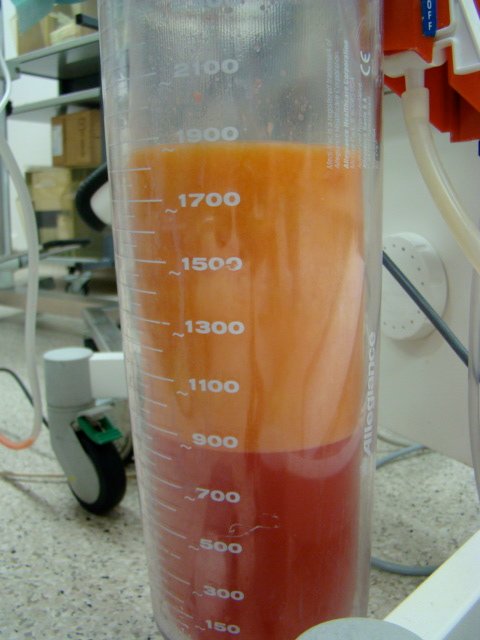
Liposuction (also called lipoplasty or liposculpture) removes localized fat with suction through a hollow tube called a cannula. Common target areas for liposuction in Turkey include the abdomen and waist, back, hips and buttocks, thighs, inner knees, calves and ankles, upper arms, chest, and the chin and neck. It can be done on its own or combined with other operations such as a tummy tuck, breast reduction or facelift. For a full overview of the procedure itself, see our liposuction treatment guide.
Source: American Society of Plastic Surgeons, MedlinePlus
The UK Foreign, Commonwealth and Development Office notes that cosmetic surgery is one of the most common treatments people travel to Turkey for, alongside dental work and cardiac surgery. It also warns that standards of facilities and treatment vary widely, both between countries and within Turkey, so the clinic you choose matters more than the country. Planning liposuction in Turkey therefore starts with the same medical questions you would ask at home: am I a good candidate, which technique suits me, what are the risks, and who will look after me if something goes wrong?
Source: GOV.UK (FCDO Turkey travel advice)
What liposuction in Turkey cannot do is just as important. It is not a treatment for obesity or a substitute for a healthy diet and exercise, and it does not remove cellulite, stretch marks or loose skin. If dimpled skin is your main concern, our guide to cellulite and its treatments explains the options. If excess skin is the problem, a skin-removing operation may be needed instead of, or as well as, liposuction.
Source: NHS, American Society of Plastic Surgeons
Liposuction techniques: tumescent, ultrasound, laser and power-assisted
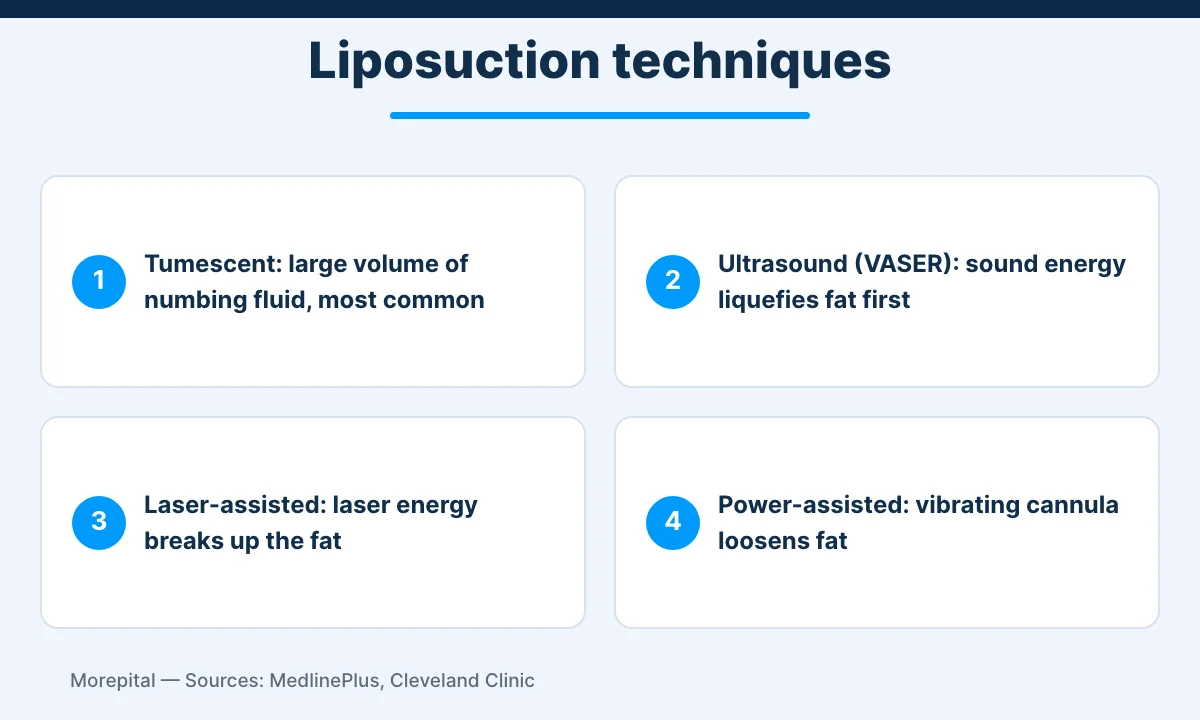
Almost all modern liposuction begins by injecting a “wetting” solution into the fat. It contains a local anesthetic and medicine that narrows blood vessels, which reduces bleeding, bruising and swelling. For liposuction in Turkey, as anywhere, the methods differ mainly in how much fluid is used and how the fat is loosened before it is suctioned out.
Source: NHS, Shridharani et al., Eplasty (PMC)
Tumescent and super-wet liposuction
Tumescent liposuction is the most common type. The surgeon injects a large volume of solution, which can be up to three times the volume of fat removed. In the super-wet technique the amount of fluid roughly equals the volume of fat removed; it takes less time but often needs sedation or general anesthesia. A review in the journal Eplasty reports blood loss below 1% of the suctioned volume with both methods, compared with far higher losses with the older “dry” technique.
Source: MedlinePlus, Shridharani et al., Eplasty (PMC)
Energy- and power-assisted methods
- Ultrasound-assisted liposuction (UAL), including VASER: sound-wave energy liquefies fat before removal. The American Society of Plastic Surgeons lists thermal burns as a specific risk of this technique.
- Laser-assisted liposuction: laser energy is used to break up fat (brand names include SmartLipo and SlimLipo).
- Power-assisted liposuction (PAL): a vibrating cannula loosens fat, which can help in larger or more fibrous areas.
- Suction-assisted liposuction: the traditional method, using suction alone after the wetting solution.
Source: Cleveland Clinic, American Society of Plastic Surgeons
Clinics offering liposuction in Turkey often market one branded device over another. No single method suits everyone; the choice depends on the area treated, the amount of fat, your skin quality and your surgeon’s experience. Ask which technique the surgeon recommends for you, why, and how many procedures they have done with it.
Source: Cleveland Clinic, NHS
Who is a good candidate for liposuction in Turkey?
The American Society of Plastic Surgeons describes the ideal candidate as an adult within about 30% of their ideal weight, with firm, elastic skin and good muscle tone, no serious illness that could affect healing, a non-smoker and non-vaper, and someone with clear, realistic goals. Cleveland Clinic adds that liposuction suits people of average or slightly above-average weight with localized fat that does not respond to diet and exercise. Age is not usually a barrier, although skin tends to be less firm after 65.
Source: American Society of Plastic Surgeons, Cleveland Clinic
When liposuction may not be right
- You are significantly overweight: liposuction does not treat obesity, and weight-loss treatment may be more appropriate first.
- Your main concern is loose or overhanging skin, which may need skin removal or tightening surgery.
- You have health problems that are not under control. MedlinePlus advises that conditions such as heart problems, high blood pressure and diabetes should be well controlled before surgery.
- You smoke or vape and cannot stop before and after surgery.
- You expect a “perfect” body shape; MedlinePlus notes liposuction can improve appearance but probably will not produce an ideal figure.
Source: MedlinePlus, American Society of Plastic Surgeons, Cleveland Clinic
If your tummy has loose skin or separated muscles after pregnancy or weight loss, liposuction in Turkey alone may disappoint. Our tummy tuck guide and the companion article on a tummy tuck in Turkey explain when skin removal is the better option. Some people use the fat removed by liposuction for fat grafting elsewhere, as in a Brazilian butt lift; our guide to BBL in Turkey covers that combined procedure and its specific risks.
Source: American Society of Plastic Surgeons, MedlinePlus
What happens on the day of surgery
For liposuction in Turkey, a responsible surgeon will see you in person before the operation to examine you, review your medical history and medicines, mark the areas to be treated, and go through consent. The British Association of Aesthetic Plastic Surgeons (BAAPS) and the Turkish Society of Plastic, Reconstructive and Aesthetic Surgeons (TSPRAS) say a comprehensive consent form should be completed before you travel, and treat a missing one as a warning sign.
Source: BAAPS and TSPRAS, American Society of Plastic Surgeons
Step by step
- Anesthesia: usually general anesthesia; an epidural may be used for the lower body, and small areas can be treated under local anesthesia.
- Wetting solution: fluid with anesthetic and blood-vessel-narrowing medicine is injected into the fat.
- Fat removal: the fat is loosened and suctioned out through small cuts with a cannula.
- Closing: excess fluid and blood are drained, the cuts are stitched and the area is bandaged; some patients have small drainage tubes.
- Compression: a compression garment or elastic bandages are applied to control swelling.
Source: NHS, Cleveland Clinic, American Society of Plastic Surgeons
Liposuction in Turkey takes 1 to 3 hours depending on how many areas are treated. The NHS says most people stay overnight, while BAPRAS notes that small procedures may need only a few hours in hospital and an overnight stay is advised when a large amount of fat is removed. The American Society of Plastic Surgeons recommends that large-volume liposuction, defined as more than 5,000 mL (about 5 liters, or roughly 1.3 US gallons) of total aspirate, is done in an acute-care hospital with overnight monitoring.
Source: NHS, BAPRAS, Shridharani et al., Eplasty (PMC)
Recovery timeline after liposuction in Turkey
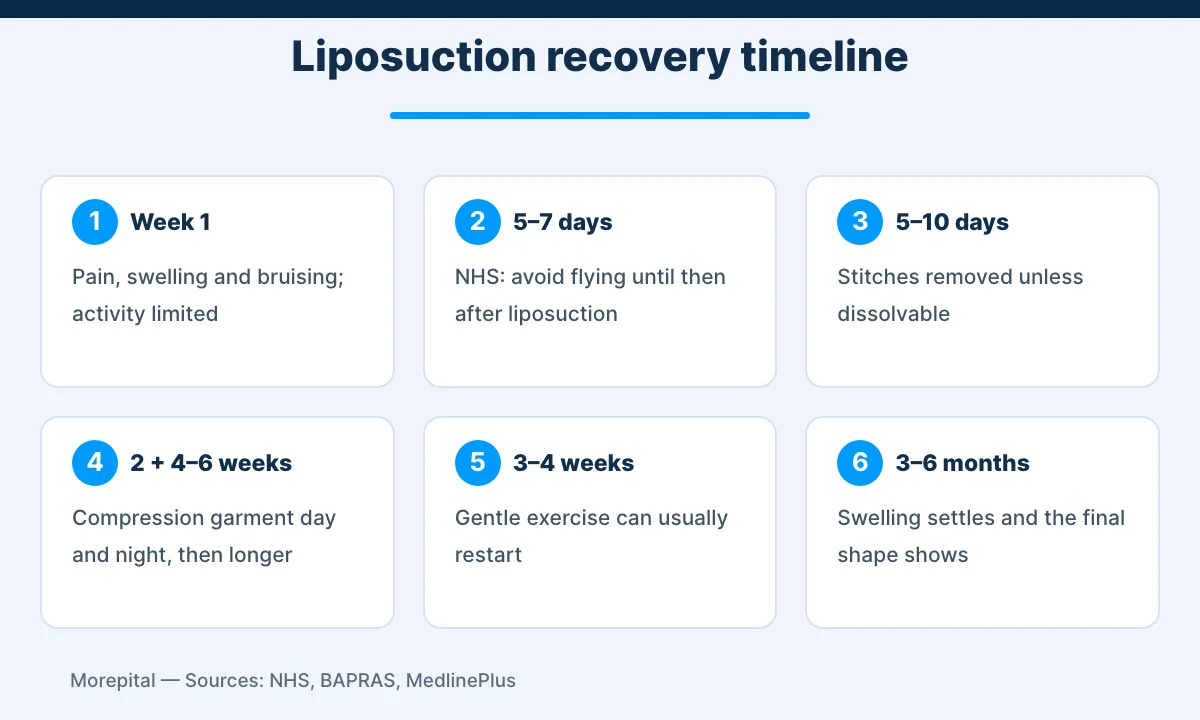
Week 1
After liposuction in Turkey, pain, swelling and bruising are expected and are managed with medicines; activity is significantly limited. After a general anesthetic, someone should accompany you and stay with you for the first 24 hours. Walking and light movement are encouraged, but avoid strenuous activity for the first couple of weeks. Stitches are usually removed after 5 to 10 days unless they dissolve on their own.
Source: American Society of Plastic Surgeons, NHS, MedlinePlus
Weeks 2 to 6
Most people feel much better 1 to 2 weeks after liposuction in Turkey. BAPRAS says people who had a small amount of fat removed may return to work within 1 to 2 days and usually resume normal routines within 3 to 4 weeks. The compression garment is typically worn day and night for at least 2 weeks and then for another 4 to 6 weeks, removed only to shower. Bruising usually settles by weeks 4 to 5, and gentle exercise can start from around 3 to 4 weeks.
Source: BAPRAS, NHS, American Society of Plastic Surgeons
Months 2 to 6
The NHS advises avoiding strenuous activity for 10 to 12 weeks and checking with your surgeon first; Cleveland Clinic says a return to regular exercise can take up to six weeks, so follow the advice you are given for your case. Numbness usually fades within 6 to 8 weeks. Swelling can take 3 to 6 months to resolve fully, and the treated area can take up to 6 months to settle completely.
Source: NHS, Cleveland Clinic
Liposuction in Turkey: risks and complications
Common, usually temporary effects of liposuction in Turkey include bruising and swelling (which can last up to 6 months), numbness, scarring at the small cuts, inflammation, fluid leaking from the cuts, and swollen ankles if the legs were treated. Pain can be considerable, especially after large-volume liposuction, and the area may look lumpy while the remaining fat settles.
Less common but serious complications
- Uneven contours, asymmetry, rippling or loose skin, and changes in skin color
- Bleeding under the skin (hematoma) or fluid collection (seroma)
- Infection and poor wound healing
- Blood clots in the legs (deep vein thrombosis) or lungs (pulmonary embolism)
- Fat embolism and fluid build-up in the lungs
- Damage to nerves, blood vessels, muscles, lungs or abdominal organs
- Thermal burns with ultrasound-assisted methods, and anesthesia risks
- A need for revision surgery if the result is not as expected
Source: American Society of Plastic Surgeons, NHS, MedlinePlus
How often do complications happen?
Published figures vary with how complications are defined and recorded. A 2022 meta-analysis of 60 studies (21,776 patients) of liposuction performed on its own found an overall complication rate of about 12%, falling to around 5–6% when bruising and swelling were excluded, with major complications in about 1%. A 2023 national analysis of 246,119 cases in accredited US outpatient facilities reported a confirmed complication rate of 0.40%, venous thromboembolism in 0.03% and a death rate of 0.009%; the authors caution that incomplete reporting probably underestimates the true rate.
Source: Aljerian et al., Plastic Surgery (PMC), Aesthetic Surgery Journal Open Forum (PMC)
For liposuction in Turkey, as elsewhere, risk rises with larger volumes, more treated areas and longer operations, which is one reason to be cautious about packages that combine several procedures in one session. Cleveland Clinic notes that risks are lower with a board-certified plastic surgeon and with smaller treatment areas. The FCDO reports that it was aware of 7 British nationals who died in Turkey in 2025 after medical procedures, and of others who needed further treatment, a reminder that careful selection of the clinic is essential for liposuction in Turkey.
Source: Aesthetic Surgery Journal Open Forum (PMC), Cleveland Clinic, GOV.UK
When to get urgent help
Contact your surgeon or seek emergency care for chest pain or shortness of breath, fever, severe or worsening pain, severe or lasting swelling, or fluid or blood leaking from the wounds. Chest pain and breathlessness always need immediate attention.
Source: Cleveland Clinic, CDC
Choosing a surgeon and hospital for liposuction in Turkey
BAAPS and TSPRAS issued a joint statement in 2023 because of concerns about poor practice in cosmetic surgery abroad. They point out that UK safeguards such as the GMC Specialist Register and Care Quality Commission inspection do not apply in Turkey, so patients must check credentials themselves. Their recommendations for anyone considering liposuction in Turkey include:
- The surgeon should hold Turkish board certification in plastic surgery and show the certificate on request; EBOPRAS (European board) membership is desirable.
- Check TSPRAS membership through the society’s online member listing at plastikcerrahi.org.tr.
- The surgeon should have at least 5 years of experience in plastic, reconstructive and aesthetic surgery, and ideally at least 3 years with the clinic or company.
- Confirm the surgeon’s specialty directly, because some practitioners claim to be plastic surgeons when they are not.
- Know your surgeon’s name and how to contact them, and expect a written aftercare plan.
- Surgery should take place in a fully recognized hospital; the statement suggests one with at least 30 beds.
Source: BAAPS and TSPRAS
Turkish law requires hospitals and agencies serving international patients to hold an International Health Tourism Authorization Certificate. The Ministry of Health’s Health Türkiye platform lists authorized facilities and facilitators, and the FCDO points travelers to this list. For liposuction in Turkey, being listed does not guarantee a good outcome, but an unlisted provider is a red flag. The FCDO also advises researching independently rather than relying only on marketing from companies that profit from selling treatment.
Source: Health Türkiye (Ministry of Health), GOV.UK, CDC
Questions to ask before booking liposuction in Turkey
- What are your qualifications, and how many liposuctions have you done, with what complications?
- Which technique do you recommend for me, and how much fat do you plan to remove?
- How long must I wear the compression garment, and when are follow-up visits?
- What happens if I have a complication after I fly home, and what would further treatment cost?
Source: NHS (cosmetic surgery abroad), NHS, American Society of Plastic Surgeons
Planning the trip and flying home
Flying soon after surgery raises the risk of a potentially life-threatening blood clot. The NHS advises avoiding flights for 5 to 7 days after liposuction (and 7 to 10 days after a tummy tuck), while the CDC suggests delaying air travel for 10 to 14 days after major surgery. If liposuction in Turkey is combined with other procedures, ask your surgeon which interval applies to you and plan your stay around the longer one.
Source: NHS (cosmetic surgery abroad), CDC
A practical checklist
- See your own doctor or a travel-medicine clinician at least 4 to 6 weeks before the trip.
- Bring your medical records, test results, allergy list and enough of your regular medicines in their original packaging.
- Check what insurance the clinic and surgeon hold; ordinary travel insurance usually does not cover problems caused by surgery.
- Get copies of your operation notes and discharge letter, translated into English if needed, before you leave.
- Arrange follow-up care at home in advance, and budget for extra costs.
Source: CDC, NHS (cosmetic surgery abroad)
Results and how to keep them
A new shape starts to appear within the first couple of weeks and becomes clearer at 4 to 6 weeks as swelling falls, but the final result typically takes 3 to 6 months. Removed fat cells do not grow back, so results of liposuction in Turkey are long-lasting if your weight stays stable. However, the body can still store fat in treated areas if you gain weight, and liposuction does not prevent weight gain. Healthy eating and regular exercise help maintain the result.
Source: MedlinePlus, Cleveland Clinic, Shridharani et al., Eplasty (PMC)
| Topic | What the guidance says |
|---|---|
| Best candidates | Healthy non-smokers near ideal weight, with firm, elastic skin |
| Operation time | 1 to 3 hours, usually under general anesthesia |
| Hospital stay | A few hours to one night; overnight hospital monitoring for more than 5,000 mL removed |
| Compression garment | Day and night for at least 2 weeks, then a further 4 to 6 weeks |
| Flying home | NHS: wait 5 to 7 days; CDC: 10 to 14 days after major surgery |
| Strenuous exercise | Gentle exercise from 3 to 4 weeks; strenuous activity after 10 to 12 weeks (NHS) |
| Final result | 3 to 6 months, once swelling settles |
| Surgeon checks in Turkey | Turkish board certification, TSPRAS membership, a Ministry-authorized hospital |
Source: NHS, BAPRAS, CDC, BAAPS and TSPRAS
Some people feel they need a second operation because the first did not achieve the effect they wanted, and loose skin may need separate surgery. Before liposuction in Turkey, discuss realistic outcomes, how likely each risk is, and what follow-up you can expect if things go wrong before you commit, and keep in touch with your surgeon through the months it takes for liposuction in Turkey to show its final result.
Source: NHS, American Society of Plastic Surgeons
Considering liposuction in Turkey? Contact us for a free consultation and a treatment plan tailored to you.
Liposuction in Turkey: frequently asked questions
Is liposuction in Turkey safe?
It can be, when done by a qualified plastic surgeon in an authorized hospital. Standards vary widely between clinics, so check board certification, TSPRAS membership and the hospital’s Ministry of Health authorization before booking.
Source: GOV.UK, BAAPS and TSPRAS
How long should I stay in Turkey after liposuction?
Plan to stay at least 5 to 7 days, the NHS minimum before flying after liposuction; the CDC suggests 10 to 14 days after major surgery. Your surgeon should confirm the date based on your procedure.
Will liposuction in Turkey help me lose weight?
No. Liposuction reshapes specific areas and is not a treatment for obesity or a substitute for diet and exercise.
Source: American Society of Plastic Surgeons
Can the fat come back after liposuction in Turkey?
Removed fat cells do not return, but if you gain weight the body can still store new fat, including in treated areas. A stable weight keeps the result.
Source: Cleveland Clinic
Does liposuction remove cellulite or loose skin?
No. It does not treat cellulite or stretch marks and can make loose skin look worse; skin-removal surgery may be needed.
Source: NHS, American Society of Plastic Surgeons
How long do I wear a garment after liposuction in Turkey?
Usually day and night for at least 2 weeks, then for another 4 to 6 weeks, removing it only to shower, unless your surgeon advises otherwise.
Source: BAPRAS
When will I see the final result of liposuction in Turkey?
Changes show within weeks, but swelling takes 3 to 6 months to settle, so the final shape appears around then.
Source: Cleveland Clinic, NHS
Disclaimer: this article is for general health education and does not replace advice from a qualified doctor who can assess your individual case. Last updated: October 2026.