
Laser hair removal is a non-invasive cosmetic treatment that uses concentrated light to heat and damage hair follicles so they produce fewer, finer hairs. Most people need a course of about 2 to 8 sessions spaced several weeks apart, and each session reduces hair by roughly 10% to 25%. It works best on dark, coarse hair, results last months to years rather than always being permanent, and the main risks (burns, pigment changes and scarring) are lowest when an experienced, medically supervised provider sets the laser for your skin type.
Source: Cleveland Clinic, AAD
Contents
- What is laser hair removal and how does it work?
- Who is a good candidate for laser hair removal?
- Laser types and skin tone
- How to prepare for laser hair removal
- What happens during a session and afterward
- Laser hair removal results: sessions, timeline and permanence
- Laser hair removal side effects and risks
- Excess hair, hirsutism and PCOS
- Choosing a clinic and having treatment abroad
- Laser hair removal: frequently asked questions
What is laser hair removal and how does it work?
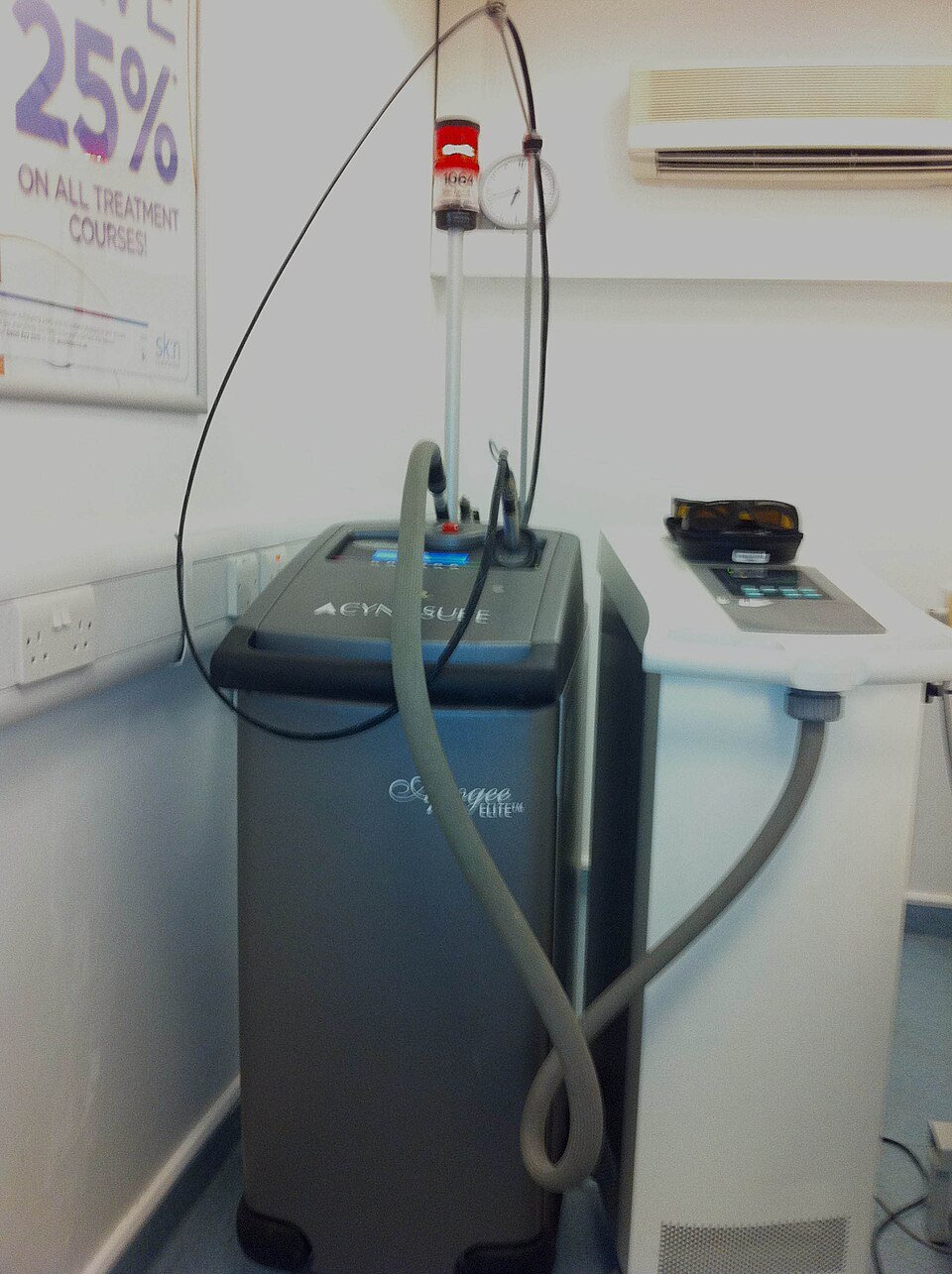
Laser hair removal relies on selective photothermolysis. The device emits light that is absorbed mainly by melanin, the dark pigment in the hair, and the absorbed light turns into heat that damages the follicle while sparing most of the surrounding skin. Because it does not cut the skin, it is a non-invasive procedure.
Source: Cleveland Clinic, Bhat et al. (2020)
Hair grows in cycles, and laser hair removal only works on follicles in the active growth phase (anagen). Resting follicles escape the heat, so one visit is never enough and sessions are spaced weeks apart.
Source: Cleveland Clinic, Bhat et al. (2020)
The most commonly treated areas are the face (especially the upper lip and chin), underarms, bikini line, legs, back, chest, neck and shoulders. Laser hair removal is usually a cosmetic choice, but doctors also use it for conditions that cause excess hair, such as hirsutism and hypertrichosis.
Source: AAD, Cleveland Clinic
Who is a good candidate for laser hair removal?
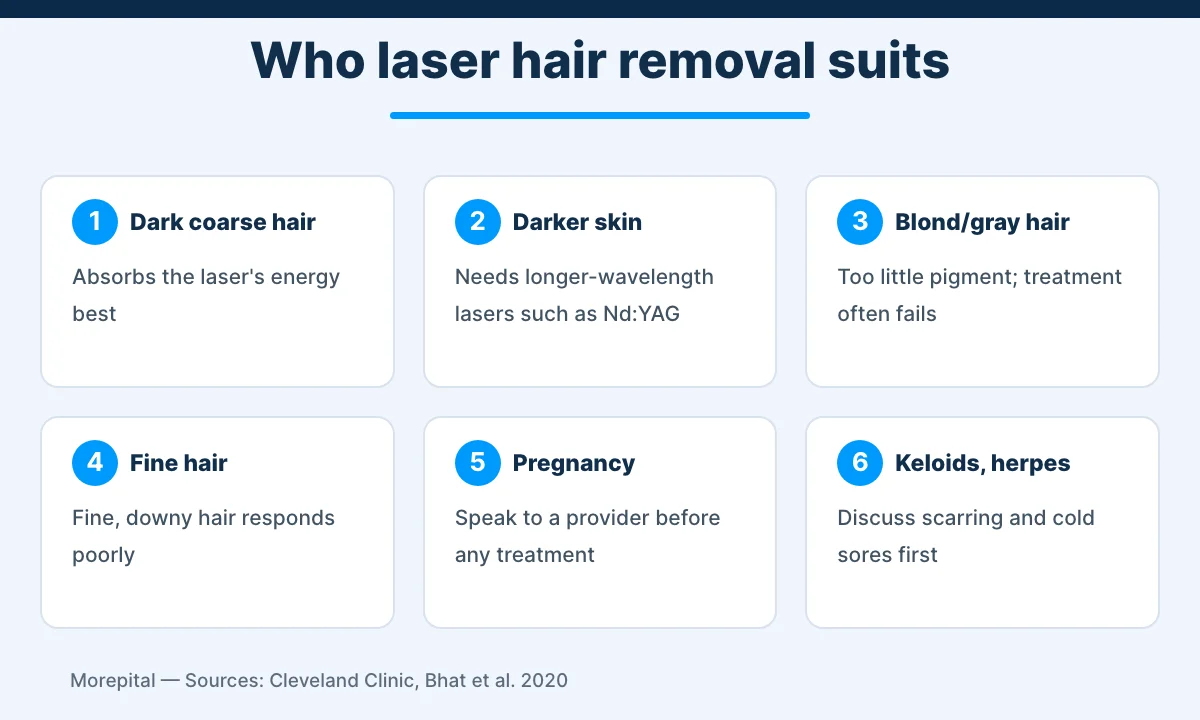
Because the laser targets pigment, contrast matters. Laser hair removal works best on thick, dark hair with light skin, because the hair absorbs the heat while the skin absorbs little. A review of laser treatment for hirsutism describes Fitzpatrick skin types I to IV with dark hair as the ideal profile.
Source: Cleveland Clinic, Bhat et al. (2020)
Results tend to be poorer, or the treatment may fail, in these situations:
- Blond, gray, white or red hair: these hairs contain little of the pigment the laser targets.
- Fine, downy (vellus) hair: responds poorly.
- Darker skin (types V and VI): the skin’s own pigment competes with the hair for the energy, which raises the risk of side effects unless a suitable laser is used.
Source: Cleveland Clinic, Bhat et al. (2020)
More men are seeking laser hair removal too. The American Academy of Dermatology (AAD) notes it can help people who get razor burn, razor bumps or ingrown hairs from shaving, waxing or plucking.
Source: AAD
When to talk to a doctor first
Some people should not be treated, or should be assessed by a doctor first. This includes anyone who is pregnant, who takes certain medicines such as some acne treatments, who tends to get cold sores or genital herpes, who forms keloid scars, or who has or has had skin cancer.
Source: Cleveland Clinic, AAD
Laser types and skin tone
Devices used for laser hair removal differ mainly in wavelength. Longer wavelengths penetrate deeper and are absorbed less by skin pigment, which makes them safer for darker skin.
- Alexandrite (755 nm): deeper penetration than the older ruby laser and considered relatively safe in skin types I to IV.
- Diode (about 800 to 1,000 nm): widely used; better tolerated than ruby in darker skin types V and VI.
- Long-pulsed Nd:YAG (1,064 nm): preferred for the darkest and tanned skin, although it generally removes less hair than alexandrite or ruby.
- Intense pulsed light (IPL): not a true laser but a broad-spectrum flash lamp; it usually needs more sessions.
Source: Bhat et al. (2020)
A 2020 meta-analysis of 12 comparative trials in people with skin types III to VI noted that pigmented skin is more prone to laser-related side effects and found broadly similar outcomes across devices. However, the alexandrite laser reduced hair counts more than IPL, the long-pulsed Nd:YAG caused less post-inflammatory darkening than IPL, and the lasers overall showed a trend toward better hair reduction than IPL, though with higher pain scores.
Source: Dorgham (2020)
In a small randomized trial in 30 women with hirsutism and darker skin, hair reduction after eight sessions was 92% with a diode laser, 90% with Nd:YAG and 70% with IPL, while pain was highest with Nd:YAG. With 10 women per group, these figures are no promise for an individual, but they show why the device should match your skin and hair.
Source: Puri (2015)
How to prepare for laser hair removal
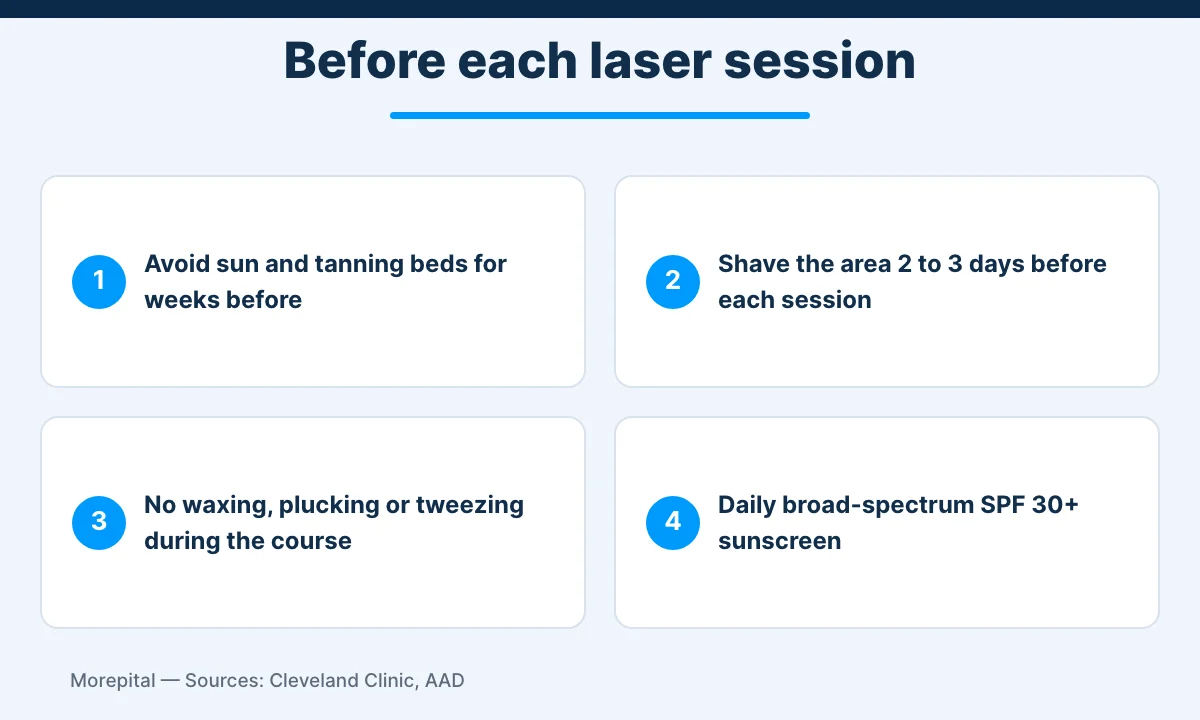
Good preparation lowers the risk of side effects. The most important rule is sun protection: tanned skin can make laser hair removal less effective and increase side effects, so stay out of the sun and avoid tanning beds in the weeks before treatment. The AAD also advises avoiding sunless tanning products and wearing a broad-spectrum, water-resistant sunscreen with SPF 30 or higher every day.
Source: Cleveland Clinic, AAD
Cleveland Clinic advises shaving the area 2 to 3 days before each session, because hair longer than a grain of rice will not respond well. Once your course begins, stop waxing, tweezing and plucking in the treated area: they remove the hair root the laser needs to target.
Source: Cleveland Clinic
At your consultation, mention any medicines you take, including over-the-counter products such as aspirin, and tell the dermatologist if you have ever taken isotretinoin for acne. Also mention cold sores, keloids or a tendency to scar. If you are being treated for acne, ask whether your medicine affects the timing of laser hair removal.
Source: AAD
What happens during a session and afterward
The provider cleans the skin and may apply a numbing gel to small, sensitive areas, which takes 30 to 60 minutes to work. Everyone in the room wears protective eyewear and the skin is held taut. Most people describe each pulse as a warm pinprick or a rubber band snapping against the skin, and a smell of singed hair is normal.
Source: AAD, Cleveland Clinic
An upper lip takes a few minutes, while the back or full legs can take an hour or more. In clinical trials, the skin was cooled with chilled air during treatment and ice packs before and after each session to keep it comfortable.
Source: AAD, Puri (2015)
Aftercare and downtime
Expect redness and swelling that often resemble a mild sunburn. A cool compress helps. There is generally no real downtime. Keep the treated skin out of direct sunlight and away from tanning beds and sun lamps, and follow the specific aftercare instructions you are given.
Source: AAD, Cleveland Clinic
Laser hair removal results: sessions, timeline and permanence
Most people see a 10% to 25% reduction in hair after the first treatment. A review in hirsutism puts the single-session effect a little wider, at 10% to 40%, with repeated treatments reaching up to 90% reduction in some studies. After the full course, many patients have no hair in the treated area for months or even years, and any regrowth is usually sparser, finer and lighter.
Source: AAD, Cleveland Clinic, Bhat et al. (2020)
Sources differ on how many sessions to expect. The AAD says most patients need 2 to 6 treatments, generally once every 4 to 6 weeks, while Cleveland Clinic says most people need about six, sometimes eight, spaced 6 to 8 weeks apart. The AAD stresses that your dermatologist sets the safe interval for you.
Source: AAD, Cleveland Clinic
Is laser hair removal permanent?
Here sources disagree. The AAD describes results as permanent on most areas of the body but states that, because of hormones, they are not permanent on a woman’s face. Cleveland Clinic says laser hair removal is not permanent and some hair may regrow, and the NHS calls it longer-lasting but usually not permanent. Expect a large, long-lasting reduction, not a guarantee of zero hair, plus possible maintenance sessions.
Source: AAD, Cleveland Clinic, NHS
| Question | Typical answer |
|---|---|
| Number of sessions | About 2 to 8, depending on the source, area and hair |
| Interval between sessions | Roughly 4 to 8 weeks |
| Session length | Minutes (upper lip) to over an hour (back, legs) |
| Reduction after one session | About 10% to 25% |
| Downtime | Usually none; redness and swelling for 1 to 3 days |
| Best response | Dark, coarse hair |
| Poor response | Blond, gray, white, red or fine hair |
| Insurance or NHS cover | Generally not covered when cosmetic |
Source: AAD, Cleveland Clinic, AAD, NHS
Laser hair removal side effects and risks
The common laser hair removal side effects are minor and short-lived: discomfort, redness and swelling that usually settle within 1 to 3 days. When the procedure is done by or under the direct supervision of a dermatologist, more serious problems are rare. These include blistering, cold sore outbreaks, infection, scarring and lightening or darkening of the skin. Color changes usually fade, but some are permanent.
Source: AAD, Cleveland Clinic
The AAD warns that burns, permanent color changes and scars can occur when laser hair removal is done by inexperienced operators. People with darker skin face a higher risk of pigment changes, which is why the device and settings matter so much for them. If you already have pigment problems such as melasma, ask specifically how the clinic will avoid making them worse.
Source: AAD, Dorgham (2020)
Paradoxical hair growth
A 2021 meta-analysis covering 9,733 patients found paradoxical hypertrichosis (more hair growth near the treated area) in about 3% of patients overall, but in only 0.08% of cases outside the face and neck. In three of four studies that followed it, the extra growth gradually improved with continued treatment.
Source: Snast et al. (2021)
Eye safety
Lasers can injure the eye, especially during facial and eyebrow-area treatment. Reported injuries include corneal inflammation, iris damage, uveitis and retinal burns. In a review of 21 published cases, 62% of the patients were not wearing eye protection when the laser was used. Insist on wavelength-specific goggles or shields, and never look toward the beam.
Source: Plăcintă et al. (2020)
At-home devices
The FDA has approved some laser hair removal devices for home use. Without supervision by an experienced provider, the risk of misuse or injury increases, so use protective eyewear and take extreme care.
Source: Cleveland Clinic
Excess hair, hirsutism and PCOS
Hirsutism is excess thick, dark hair in women on the face, neck, chest, tummy, lower back, buttocks or thighs. It is usually linked to higher levels of androgens or to greater sensitivity to them. The most common cause is the ovarian hormone condition long known as polycystic ovary syndrome (PCOS), which the NHS now calls polyendocrine metabolic ovarian syndrome (PMOS); it can also cause acne and irregular periods.
Source: NHS
See a doctor if you have thick, dark hair in these areas, especially with irregular periods, because a hormone blood test may be needed. Seek an urgent appointment if new thick, dark hair appears suddenly on your face and body, your voice deepens or your muscles get bigger. Medical options include weight loss, a contraceptive pill and a prescription cream (eflornithine) that slows facial hair growth.
Source: NHS
Laser hair removal does reduce hormone-related hair, but treatment must continue for months because only growing hairs are affected. The NHS notes it is not usually available on the NHS for hirsutism and can be expensive.
Source: Bhat et al. (2020), NHS
Choosing a clinic and having treatment abroad
The single biggest factor in safety is who holds the laser. The AAD recommends a board-certified dermatologist and suggests asking these questions before you book:
- Who will perform the treatment, and what are their qualifications?
- How many treatments has the provider performed on people with your skin color?
- How many sessions will you need, and what results are realistic?
- What must you do beforehand, and what are your personal risks?
- Can you see before-and-after photos, and what will the full course cost?
Source: AAD
The NHS adds general warnings for cosmetic treatments: meet the person who will treat you before paying, and avoid discount vouchers, group events, mobile services in homes or hotels, and practitioners who only advertise on social media. In the UK, voluntary registers such as the JCCP and Save Face list non-surgical practitioners who meet training and insurance standards.
Source: NHS
Treatment abroad, including Turkey
If you are thinking of having treatment abroad, for example in Turkey, the key planning issue is time: sessions are spaced weeks apart, so a full course usually means either several trips, or starting abroad and continuing with a provider at home. Ask the clinic to give you a record of the device and settings used so another provider can continue safely.
Source: AAD, Cleveland Clinic
The NHS advice on treatment abroad applies here too: research how clinics are regulated, make sure you can communicate in a language you understand, ask where follow-up will happen if complications occur, and check insurance, because travel insurance usually does not cover complications. Plan to avoid sun exposure after each laser hair removal session, which can be hard on a beach holiday.
Source: NHS, Cleveland Clinic
If you plan other treatments on the same trip, such as Botox or an acne treatment plan, tell each provider about every procedure.
Source: NHS
Laser compared with other methods
Shaving, waxing, plucking, creams and bleaching need constant repetition. Electrolysis, which uses an electric current to stop hair growing, also lasts longer. Compared with electrolysis, laser hair removal generally needs fewer treatments, causes less pain and carries a lower risk of ingrown hairs.
Source: NHS, Cleveland Clinic, Bhat et al. (2020)
Considering laser hair removal? Contact us for a free consultation and a treatment plan tailored to you.
Laser hair removal: frequently asked questions
Does laser hair removal hurt?
Most people feel each pulse as a warm pinprick or a snapping rubber band. A numbing gel can be used on small, sensitive areas. Discomfort, redness and swelling usually fade within 1 to 3 days.
Source: AAD
How many laser hair removal sessions will I need?
Laser hair removal usually takes 2 to 8 sessions, depending on the area, your hair and the device. Sessions are typically 4 to 8 weeks apart, and some people need occasional maintenance treatments afterward.
Source: AAD, Cleveland Clinic
Does laser hair removal work on blond, gray or red hair?
Generally not well. These hairs contain too little pigment to absorb the laser’s energy, so treatment often fails. Ask a dermatologist about alternatives such as electrolysis.
Source: Cleveland Clinic, Bhat et al. (2020)
Is laser hair removal safe for dark skin?
It can be, with the right device and an experienced provider. Darker skin has a higher risk of pigment changes and burns, and long-wavelength lasers such as the Nd:YAG are preferred because they are absorbed less by skin pigment.
Source: Bhat et al. (2020), Dorgham (2020)
Can I have laser hair removal while pregnant?
Pregnancy is listed among the situations where you should not be treated or should speak to a provider first. Pregnancy was also an exclusion criterion in clinical trials of laser treatment for excess hair.
Source: Cleveland Clinic, Puri (2015)
Can I shave between sessions?
Yes. Shaving is compatible with laser hair removal and is recommended before each session, ideally 2 to 3 days beforehand. Avoid waxing, plucking and tweezing, which remove the hair root the laser targets.
Source: Cleveland Clinic
Is laser hair removal covered by insurance or the NHS?
Usually not. The AAD notes that insurance does not cover laser hair removal, and the NHS says laser removal is not usually available on the NHS, even for hirsutism.
Disclaimer: this article is for general health education and does not replace advice from a qualified doctor who can assess your individual case. Last updated: October 2026.