
Enlarged prostate, or benign prostatic hyperplasia (BPH), is a non-cancerous growth of the prostate gland that becomes very common after 50 and can squeeze the urethra, causing a weak stream, straining, frequent or urgent urination and getting up at night to pee. An enlarged prostate is not cancer and does not raise your risk of prostate cancer, but the symptoms overlap, so they should always be checked. Treatment ranges from simple lifestyle changes and medicines to minimally invasive procedures and surgery.
Source: NHS, NIDDK, MedlinePlus
Source: Cleveland Clinic, EAU Guidelines
Contents
- What is an enlarged prostate?
- Enlarged prostate symptoms
- Warning signs and complications
- How an enlarged prostate is diagnosed
- Lifestyle changes and watchful waiting
- Enlarged prostate medicines
- Enlarged prostate procedures and surgery
- Sex life, prostate cancer and BPH
- Treatment abroad and in Turkey: choosing a clinic
- Enlarged prostate: frequently asked questions
What is an enlarged prostate?
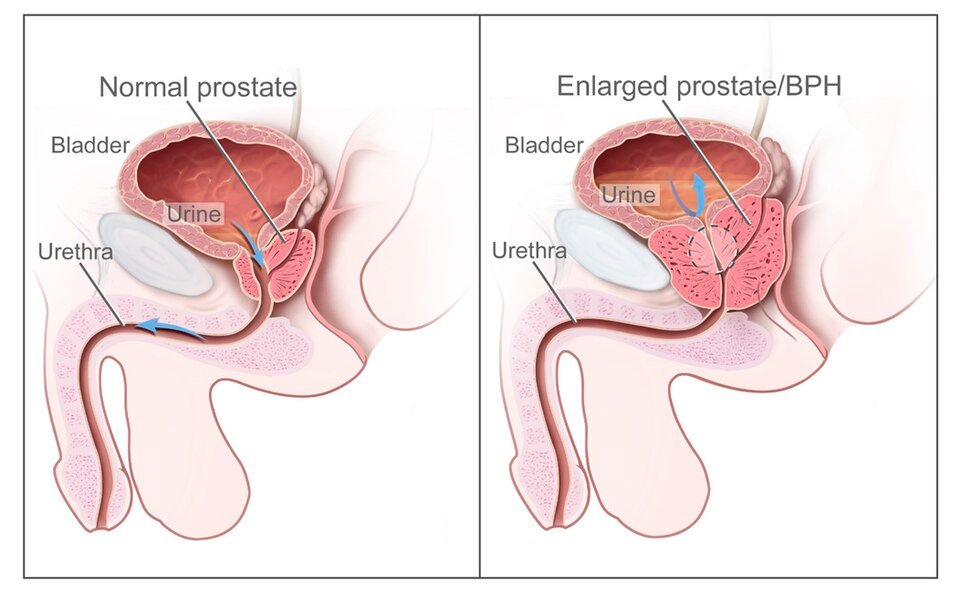
The prostate is a small gland that sits below the bladder and wraps around the urethra, the tube that carries urine out of the body. It makes part of the fluid in semen. In a young man it is about the size of a walnut, but from the age of 60 it may be as large as a lemon. Growth presses on the urethra and bladder, so an enlarged prostate mainly causes urinary problems.
Source: MedlinePlus, NHS
The prostate doubles in size early in puberty and starts a second, slower growth phase around age 25 that continues for life; an enlarged prostate usually appears late in this second phase. NIDDK estimates that an enlarged prostate affects 5% to 6% of men aged 40 to 64 and 29% to 33% of men aged 65 and over, and it rarely causes symptoms before 40. MedlinePlus puts the figure at more than 90% of men over 80.
Source: NIDDK, MedlinePlus
Causes and risk factors
The exact cause is unknown. Ageing and changing hormone levels, including testosterone, are thought to drive the growth; men whose testicles were removed at a young age do not develop BPH. NIDDK lists these risk factors:
- Age 40 or older and a family history of BPH
- Heart and blood vessel disease, type 2 diabetes and obesity
- Chronic kidney disease and erectile dysfunction
- Lack of physical activity
Source: NIDDK, MedlinePlus
Enlarged prostate symptoms
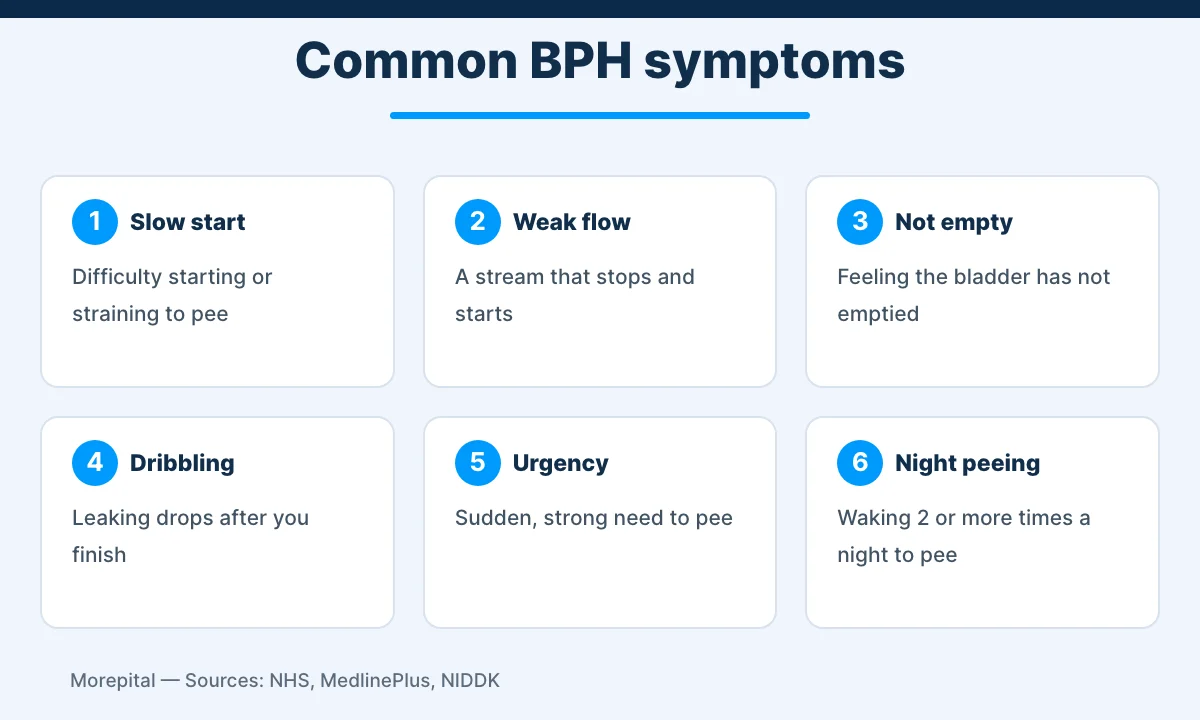
Fewer than half of men with an enlarged prostate have symptoms at all, and symptom severity does not always match gland size. When enlarged prostate symptoms appear, they usually develop slowly and fall into two groups. Doctors call them lower urinary tract symptoms, or LUTS.
Source: MedlinePlus, NIDDK, NHS
Emptying (voiding) symptoms
- Difficulty starting to pee, or having to push or strain
- A weak flow that stops and starts and takes longer than usual
- Feeling that the bladder has not fully emptied
- Dribbling after you finish
Storage symptoms
- Needing to pee more often, or a strong, sudden urge
- Waking two or more times a night to urinate (nocturia)
- Leaking urine (incontinence)
Source: NHS, MedlinePlus, Cleveland Clinic
Some everyday medicines can make an enlarged prostate feel worse. NIDDK and MedlinePlus name over-the-counter decongestants and antihistamines (common in cold and sinus remedies), tranquilizers, some antidepressants and diuretics. Never stop a prescribed medicine without advice.
Source: NIDDK, MedlinePlus
Warning signs and complications
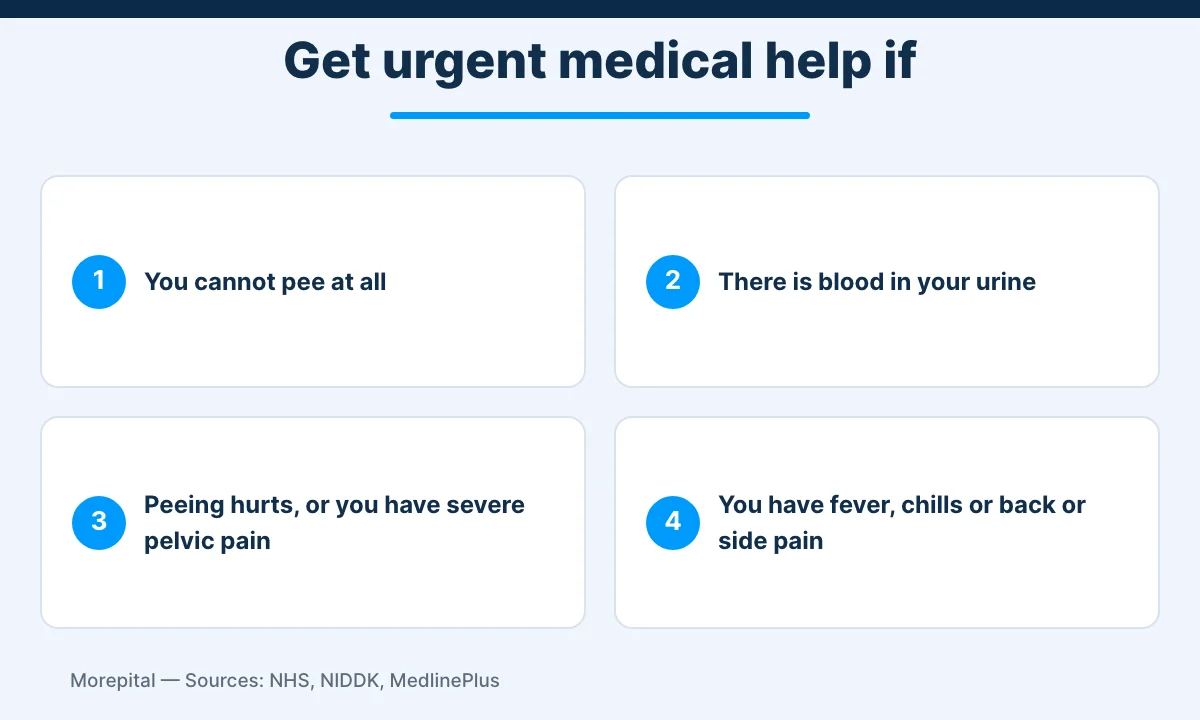
See a doctor for any new difficulty peeing or needing to go more often; these symptoms are not just a normal part of ageing, and they can occasionally be caused by something more serious, such as prostate cancer. Seek care the same day if you cannot pee at all, have blood in your urine (pink, red or brown), have pain when peeing or severe pelvic pain. MedlinePlus also advises contacting a provider right away for passing much less urine than usual, fever or chills, back, side or abdominal pain, or pus in the urine.
Source: NHS, NIDDK, MedlinePlus
Left untreated, a long-standing enlarged prostate can lead to complications as the bladder muscle weakens and urine backs up:
- Acute urinary retention: sudden, painful inability to pee, which needs a catheter
- Urinary tract infections from urine left in the bladder
- Bladder stones and blood in the urine
- Kidney damage when pressure backs up toward the kidneys
Source: NIDDK, Cleveland Clinic, MedlinePlus
How an enlarged prostate is diagnosed
Diagnosing an enlarged prostate starts with your family doctor or GP. You will be asked about your symptoms and how much they bother you, often with a validated questionnaire such as the International Prostate Symptom Score (IPSS). It runs from 0 to 35: the European Association of Urology (EAU) classes 1 to 7 as mild, 8 to 19 as moderate and 20 to 35 as severe.
Source: EAU Guidelines, NHS
Tests at the GP surgery
- Physical examination of the abdomen and penis, plus a digital rectal examination, in which the doctor feels the prostate with a gloved finger to judge its size and texture
- Bladder diary: a record of what you drink and how often and how much you pee, for at least 3 days
- Urine test to look for infection or blood
- PSA blood test, after discussing what a raised result could mean
Source: NHS, EAU Guidelines
Specialist tests
A urologist may add a urine flow test (uroflowmetry), which measures how fast you pee and works best with a voided volume above 150 mL (about 5 fl oz); an ultrasound to measure urine left in the bladder after peeing (post-void residual); and blood tests of kidney function when kidney problems are suspected or surgery is planned. The EAU recommends imaging the prostate before surgery, and cystoscopy (a camera passed into the bladder) or urodynamic pressure studies are used only when they may change the diagnosis or treatment.
Source: EAU Guidelines, MedlinePlus
Lifestyle changes and watchful waiting
Lifestyle changes are usually tried first when an enlarged prostate causes mild symptoms. The EAU says watchful waiting suits men with mild to moderate symptoms who are not much bothered by them; in studies, about 85% of men with mild symptoms were stable after one year, but in one trial comparing it with surgery, 36% of men in the watchful-waiting group had surgery within five years.
Source: EAU Guidelines, NHS
Self-care habits that help an enlarged prostate
- Cut down on alcohol and caffeine, especially after dinner
- Spread drinks through the day and avoid fluids in the 2 hours before bed or before going out, but do not cut fluids so much that you risk infection
- Do not strain; wait a moment after peeing and try again, and gently press along the underside of the penis to clear the last drops
- Eat enough fiber to prevent constipation, which presses on the bladder
- Keep to a healthy weight and stay active
- Pee when you first feel the urge, or follow a timed schedule; bladder training and pelvic floor exercises can help
Source: NHS, MedlinePlus, NIDDK
Cleveland Clinic suggests a Mediterranean-style diet and controlling cholesterol, blood pressure and blood sugar. Herbal products such as saw palmetto are widely used, but MedlinePlus notes that study results are mixed. If your symptoms have not improved after 2 months of self-care, go back to your doctor.
Source: Cleveland Clinic, MedlinePlus
Enlarged prostate medicines
Enlarged prostate medicines are offered for moderate or severe symptoms. The choice depends on your main symptoms, gland size and risk of progression.
Source: NHS
Alpha-blockers
Alpha-blockers such as tamsulosin, alfuzosin, doxazosin, terazosin and silodosin relax the muscle in the prostate and bladder neck so urine flows more easily. Symptom scores typically fall by about 30% to 40%, and most men notice improvement within 3 to 7 days. They do not shrink the prostate or prevent retention or surgery in the long term.
Source: EAU Guidelines, Cleveland Clinic, MedlinePlus
Tamsulosin is taken once a day about 30 minutes after the same meal. It can cause dizziness or fainting when you stand up quickly, especially after the first doses, so get out of bed slowly. Difficulty ejaculating is a common side effect, and the EAU finds it far more often with tamsulosin and silodosin than with placebo. Tell your eye surgeon before cataract surgery if you take or have taken an alpha-blocker, because it raises the risk of “floppy iris” syndrome.
Source: MedlinePlus, EAU Guidelines
5-alpha reductase inhibitors
Finasteride and dutasteride lower the hormone DHT and slowly shrink an enlarged prostate, by 18% to 28% in volume after 6 to 12 months. They need at least 6 months to work and are best for larger glands; the EAU recommends them when the prostate is over 40 mL. Unlike alpha-blockers, they cut the long-term risk of acute retention and surgery. Side effects include lower sex drive, erection problems, less often ejaculation problems, and breast enlargement in 1% to 2%. They also roughly halve the PSA level, so make sure anyone checking your PSA knows you take one.
Source: EAU Guidelines, Cleveland Clinic, MedlinePlus
Combination therapy, tadalafil and bladder medicines
Combining an alpha-blocker with a 5-alpha reductase inhibitor works better than either alone for men at risk of progression. In the CombAT trial it cut acute retention by 68% and surgery by 71% versus tamsulosin, with more ejaculation problems. Tadalafil 5 mg once daily, a PDE5 inhibitor, is licensed for urinary symptoms and gives a modest benefit, which is useful when erectile dysfunction is also present; it must never be combined with nitrate medicines. For mainly urgency and frequency, doctors may add oxybutynin or tolterodine, although the EAU advises against adding one to an alpha-blocker when more than 150 mL of urine is left in the bladder.
Source: EAU Guidelines, NHS, NIDDK
Enlarged prostate procedures and surgery
A procedure for an enlarged prostate is considered when medicines do not help, symptoms are severe or complications develop. The EAU lists repeated or persistent retention, overflow incontinence, recurrent infections, bladder stones, bleeding that does not respond to treatment and kidney swelling caused by obstruction as strong reasons for surgery. The technique depends on prostate size, health, wish to preserve ejaculation and local expertise.
Source: EAU Guidelines, MedlinePlus
TURP and enucleation
Transurethral resection of the prostate (TURP) is the most common and best-proven operation: a thin instrument passed up the penis removes obstructing tissue piece by piece. The EAU considers it standard for glands of 30 to 80 mL, with symptom scores falling about 70%. Holmium laser enucleation (HoLEP) works as well as TURP at any prostate size, with less bleeding and a shorter catheter time and hospital stay. For very large glands, an open or robotic simple prostatectomy removes the inner part of the prostate. Small glands under 30 mL without a middle lobe can be treated with small incisions (TUIP).
Source: EAU Guidelines, MedlinePlus, NHS
Laser vaporization and aquablation
GreenLight laser vaporization heats and vaporizes tissue and is an alternative to TURP for 30 to 80 mL glands, including in some men on blood thinners. Aquablation uses a robot-guided water jet; in its main trial, loss of ejaculation affected 10% of sexually active men compared with 36% after TURP, though retreatment at five years was higher (5.1% versus 1.5%).
Source: EAU Guidelines, Cleveland Clinic
Minimally invasive options
The prostatic urethral lift (UroLift) places 2 to 6 small implants that hold the lobes apart, and water vapor therapy (Rezum) uses steam to destroy tissue that the body then absorbs. Both are usually outpatient procedures with a return to normal activities within a few days and symptom improvement over 3 to 6 weeks. The EAU recommends the urethral lift for men who want to preserve ejaculation with a prostate under 70 mL and no middle lobe, but warns that it is less effective than TURP and more often needs repeat treatment. Prostatic artery embolization, which blocks the gland’s blood supply through a catheter in an artery, is still considered investigational and should be done only where urologists and interventional radiologists work together.
Source: Cleveland Clinic, EAU Guidelines
Recovery and risks after surgery
A catheter is often needed for several days after surgery. Possible complications include painful or difficult peeing, temporary leakage, blood in the urine, infection, scar tissue narrowing the urethra and sexual problems such as erectile dysfunction, retrograde ejaculation (semen going back into the bladder) and infertility. About 10% of men need another operation within 20 years, because an enlarged prostate can regrow.
Source: NIDDK, MedlinePlus
Enlarged prostate treatments compared
| Treatment | Best suited to | Key point |
|---|---|---|
| Watchful waiting + lifestyle | Mild, non-bothersome symptoms | ~85% stable at 1 year |
| Alpha-blocker | Moderate to severe symptoms | Works in days; ejaculation changes |
| 5-alpha reductase inhibitor | Prostate over 40 mL | Needs 6+ months; halves PSA |
| Combination tablets | Men at risk of progression | Fewer retentions and operations |
| Tadalafil 5 mg daily | Urinary symptoms plus ED | Modest benefit; no nitrates |
| Oxybutynin / tolterodine | Mainly urgency and frequency | Avoid if residual urine over 150 mL |
| TURP | 30–80 mL glands | Reference standard operation |
| HoLEP | Any prostate size | Less bleeding, shorter stay |
| GreenLight laser | 30–80 mL, some on blood thinners | Alternative to TURP |
| Aquablation | 30–80 mL, ejaculation a priority | Less loss of ejaculation than TURP |
| Urethral lift / water vapor | Men wanting a quick outpatient option | Higher retreatment than TURP |
| Simple prostatectomy | Very large glands (over 80 mL) | Used if enucleation unavailable |
Source: EAU Guidelines, Cleveland Clinic, NHS
Sex life, prostate cancer and BPH
An enlarged prostate is not cancer and does not increase your chance of getting prostate cancer. The two can, however, cause similar urinary symptoms and can exist together, which is why doctors examine the prostate and discuss a PSA test. Cleveland Clinic notes that screening is usually discussed from 55 to 69, and from 40 for higher-risk men, such as Black men and those with a family history. Our guide to prostate cancer symptoms explains the warning signs that point away from BPH.
Source: Cleveland Clinic, NHS, MedlinePlus
Sexual health is closely tied to the enlarged prostate in three ways. Erectile dysfunction is itself a risk factor for BPH; several BPH medicines can reduce libido or affect ejaculation; and some operations can cause retrograde ejaculation or erection problems. If erections are a problem, see our erectile dysfunction reference page and our comparison of erectile dysfunction treatment options; Male Hospital, a men’s sexual health center in Istanbul, also has a patient guide to erectile dysfunction. A fall in sex drive can also have other causes, so it may be worth reading about low testosterone symptoms.
Source: NIDDK, EAU Guidelines
Treatment abroad and in Turkey: choosing a clinic
Tablets for an enlarged prostate are prescribed locally, so men who travel usually do so for a procedure such as HoLEP, laser vaporization, aquablation or a urethral lift. The CDC warns of wound and bloodstream infections, counterfeit medicines and lower-quality devices in some countries, and language barriers that cause misunderstandings about care.
Source: CDC
How to choose a urologist and hospital
- Check the urologist’s training and how often they perform the technique offered; the EAU says surgeon experience is the most important factor in HoLEP complications
- Look for facility accreditation, for example Joint Commission International, remembering that accreditation does not guarantee a good outcome
- See your own doctor at least 4 to 6 weeks before the trip, and bring your records, test results and medicine list
- Buy international travel health insurance that covers medical evacuation home
Source: CDC, EAU Guidelines
Questions to ask before booking
Ask what your prostate volume and post-void residual are, which procedure suits that size, how likely it is to affect ejaculation and erections, and how often men need retreatment. Ask who removes the catheter and handles problems after you fly home. The CDC advises delaying air travel for 10 to 14 days after major surgery because flying raises the risk of blood clots.
Source: CDC, EAU Guidelines
Considering enlarged prostate treatment? Contact us for a free consultation and a treatment plan tailored to you.
Enlarged prostate: frequently asked questions
Can an enlarged prostate turn into cancer?
No. BPH is benign and does not raise the risk of prostate cancer, but both can occur at the same time and cause similar symptoms, so new urinary problems should be checked.
Source: MedlinePlus, Cleveland Clinic
Can an enlarged prostate shrink on its own?
Some mild cases resolve without treatment, and many men stay stable with lifestyle changes and regular checkups. Finasteride and dutasteride shrink the prostate by 18% to 28% over 6 to 12 months.
Source: Cleveland Clinic, EAU Guidelines
How quickly do enlarged prostate tablets work?
Alpha-blockers such as tamsulosin often help within 3 to 7 days. 5-alpha reductase inhibitors need at least 6 months for a clear effect.
Source: MedlinePlus, EAU Guidelines
Is surgery for an enlarged prostate permanent?
Surgery relieves symptoms but may not cure BPH. About 10% of men need further surgery within 20 years.
Source: NIDDK
Will enlarged prostate treatment affect my sex life?
It can. Some tablets reduce libido or ejaculation, and surgery can cause retrograde ejaculation. Ask about ejaculation-sparing options such as a urethral lift, water vapor therapy or aquablation.
Source: EAU Guidelines, NIDDK
Which drinks make an enlarged prostate worse?
Alcohol and caffeine increase how often you need to pee, especially in the evening. Spread fluids through the day rather than cutting them too much.
Source: MedlinePlus, NHS
Disclaimer: this article is for general health education and does not replace advice from a qualified doctor who can assess your individual case. Last updated: October 2026.