
Urinary tract infection (UTI) is an infection anywhere in the urinary system, most often the bladder, usually caused by bacteria from the bowel that enter through the urethra. Typical signs are burning when you pee, needing to go often and urgently, and cloudy or bloody urine; fever, shivering or pain in the back under the ribs suggest the infection has reached the kidneys. Most cases clear quickly with a short course of antibiotics, but a urinary tract infection in men, children, pregnant women or frail older adults always needs a doctor’s assessment.
Source: NHS, Cleveland Clinic, CDC
Source: NIDDK, Cleveland Clinic, MedlinePlus, NHS
Contents
- What is a urinary tract infection?
- What causes a urinary tract infection, and who is at risk
- Urinary tract infection symptoms
- When to see a doctor or seek urgent care
- How a urinary tract infection is diagnosed
- Urinary tract infection treatment: antibiotics and self-care
- Men, pregnancy, children and catheters
- Recurrent urinary tract infection: why it comes back
- How to prevent a urinary tract infection
- Complications and outlook
- FAQ
What is a urinary tract infection?
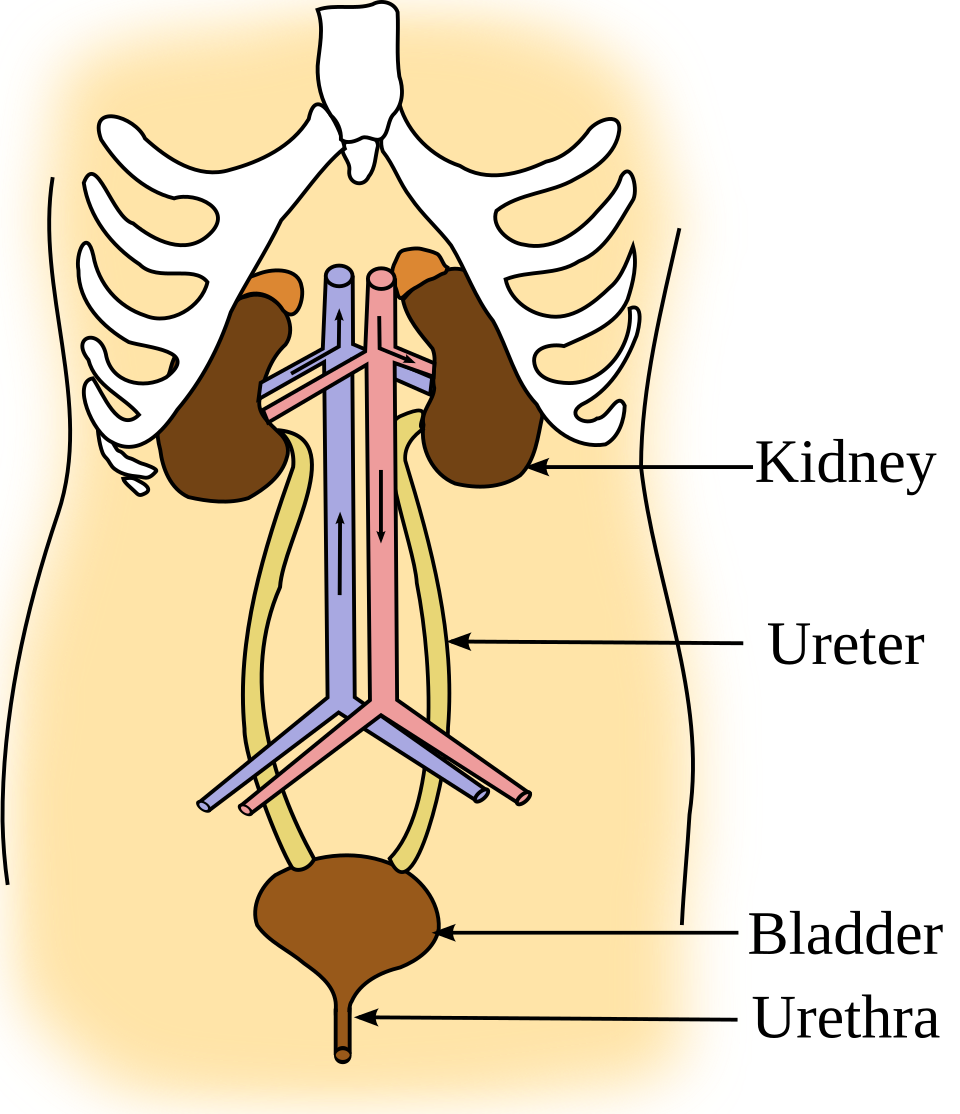
The urinary tract is the system that makes, stores and removes urine: two kidneys, two ureters (the tubes that carry urine down), the bladder and the urethra (the tube that carries urine out of the body). A urinary tract infection happens when germs, nearly always bacteria, get into this normally sterile system and multiply. Doctors name the infection after the part that is affected.
Source: Cleveland Clinic, NHS
- Cystitis is infection of the bladder. It is the most common type of UTI.
- Urethritis is infection of the urethra.
- Pyelonephritis is infection of one or both kidneys. It is less common than a bladder infection but more serious, because untreated it can lead to sepsis or permanent kidney damage.
Source: Cleveland Clinic, CDC, NIDDK
A urinary tract infection is among the most frequent bacterial infections in the world. A widely cited review in Nature Reviews Microbiology estimates that UTIs affect about 150 million people each year worldwide, and Cleveland Clinic notes that healthcare providers in the United States treat 8 to 10 million people for them every year. MedlinePlus states that about four times as many women as men get UTIs, and Cleveland Clinic puts the figure for children at 1% to 2%.
Source: Nature Reviews Microbiology, Cleveland Clinic, MedlinePlus
What causes a urinary tract infection, and who is at risk
Most urinary tract infections start when bacteria that normally live in the gut and on the skin around the anus travel to the opening of the urethra, climb up into the bladder and multiply. Cleveland Clinic reports that Escherichia coli (E. coli) causes more than 90% of bladder infections. Other bacteria, such as Klebsiella and Proteus, cause a smaller share.
Source: Cleveland Clinic, Nature Reviews Microbiology, MedlinePlus
Anatomy is the main reason women get urinary tract infections more often: the female urethra is short and sits close to the anus, so bacteria have a short distance to travel. A urinary tract infection is not a sexually transmitted infection, but sexual activity can push bacteria toward the urethra, which is why infections often follow sex. Recognized risk factors include:
- Being sexually active, using a diaphragm, or using spermicide (including spermicidal condoms)
- Menopause, which changes the vaginal tissues and their normal bacteria
- Pregnancy
- A previous UTI
- Trouble emptying the bladder fully, for example because of an enlarged prostate in men or constipation in children
- Blockages such as kidney stones, or structural problems of the urinary tract such as vesicoureteral reflux (urine flowing back toward the kidneys)
- A current or recent urinary catheter, or recent urinary tract surgery
- Diabetes and other conditions that weaken the immune system, such as chemotherapy
- Older age, immobility, dementia and not drinking enough fluids
Source: NIDDK, NHS, MedlinePlus, CDC
Diabetes, often undiagnosed, is a recognized risk factor for urinary tract infections. Frequent infections together with thirst, frequent urination and tiredness are a reason to check blood sugar; our guide to early diabetes symptoms explains what to look for, and the reference page on type 2 diabetes covers diagnosis and treatment.
Source: NHS, MedlinePlus, MedlinePlus
Urinary tract infection symptoms
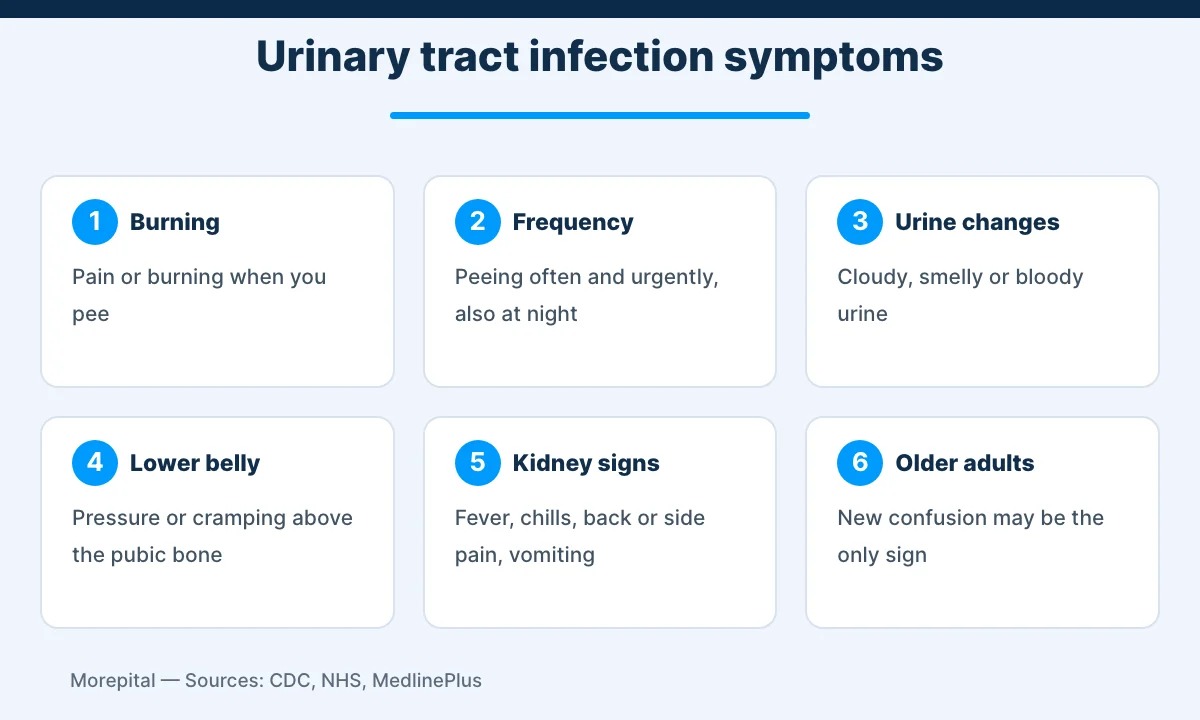
Symptoms depend on which part of the urinary tract is infected and on the person’s age. A bladder infection, the most common form, typically causes:
- Pain or burning when urinating (dysuria)
- Needing to urinate more often, including at night, and feeling a sudden urge even when the bladder is nearly empty
- Pressure, cramping or pain in the lower abdomen or groin
- Cloudy, strong-smelling or bloody urine (it may look pink, red or dark brown)
- Sometimes a low-grade fever or tiredness
Source: CDC, MedlinePlus, NHS
Signs of a kidney infection
When infection spreads up to the kidneys, the illness is usually more obvious and more serious. Warning signs include fever above 101°F (38.3°C), chills or shivering, pain in the back or side just below the ribs, nausea and vomiting, and flu-like aching. NHS also flags a temperature below 36°C (96.8°F) as a sign of possible serious infection. Kidney infection symptoms can take a week or longer to settle even with treatment.
Source: MedlinePlus, NHS, NHS
Symptoms in children
A urinary tract infection in young children is easy to miss. Fever is the most common sign of a UTI in infants and toddlers, although most children with fever do not have one. Babies may be irritable and feed poorly; older children may wet the bed or themselves, vomit or just look generally unwell. Children under 2 may have only a high temperature.
Symptoms in older adults
In older or frail people, a urinary tract infection may show up as new confusion or agitation (delirium), more urine leakage than usual, or new shivering. MedlinePlus notes that in older adults, confusion or another mental change may be the only sign.
Source: NHS, MedlinePlus
Blood in the urine is common in a urinary tract infection, but it can also come from kidney stones, an enlarged prostate or, less often, cancer of the bladder, kidney or prostate. If blood persists after the infection has been treated, or appears without other urinary symptoms, it needs further investigation; our article on prostate cancer symptoms explains why men with urinary changes should not ignore them.
Source: NHS, Cleveland Clinic
When to see a doctor or seek urgent care
CDC advises seeing a healthcare professional if you have one or more urinary tract infection symptoms. In the UK, NHS guidance says that women and girls aged 16 to 64 who are not pregnant or breastfeeding can start with a pharmacist, who can supply the same UTI medicines as a GP. Other groups should get an urgent appointment with a doctor (or call NHS 111 in the UK) if they have urinary symptoms and any of the following:
- Aged 65 or older, or a child aged 15 or younger
- Male, or trans or non-binary and assigned male at birth
- Pregnant, diabetic, immunosuppressed or using a catheter
- A very high or very low temperature, or shivering
- Pain in the lower abdomen or back, or blood in the urine
- Symptoms that get worse quickly or do not improve within 48 hours of starting treatment
- Repeated infections: 2 within 6 months or 3 within 12 months
Source: NHS
Call emergency services (911 in the US, 999 in the UK) if someone with a urinary tract infection becomes confused, drowsy or has difficulty speaking; these can be signs of sepsis. CDC also says to talk to a healthcare professional right away about any baby under 3 months with a fever of 100.4°F (38°C) or higher.
How a urinary tract infection is diagnosed
For a typical bladder infection in a healthy young woman, the diagnosis is often made from symptoms, and NHS notes that a urine test is not always necessary. In other situations, a doctor will take a history and examine you, then test a clean-catch (midstream) urine sample.
Source: NHS, Cleveland Clinic, MedlinePlus
- Urine dipstick and urinalysis: look for white blood cells, red blood cells, bacteria and chemicals such as nitrites and leukocyte esterase, which point to infection.
- Urine culture: grows the bacteria in the lab, identifies them and shows which antibiotics will work.
- Blood tests: a complete blood count and blood cultures may be done when a kidney infection or sepsis is suspected.
- Imaging and cystoscopy: ultrasound, CT or a bladder camera test may look for stones or blockages when infections are severe, recurrent or do not respond.
Source: Cleveland Clinic, MedlinePlus
One important point: bacteria found in urine without any symptoms (“asymptomatic bacteriuria”) is usually not an infection that needs treating. CDC states that most people with asymptomatic bacteriuria do not need antibiotics, with exceptions such as pregnancy and before certain urologic procedures. The US Preventive Services Task Force (2019) recommends against screening non-pregnant adults for it, but does recommend a screening urine culture in pregnancy.
Urinary tract infection treatment: antibiotics and self-care
Antibiotics are the main treatment for a urinary tract infection. Commonly used options include nitrofurantoin, trimethoprim/sulfamethoxazole, fosfomycin, cephalexin and amoxicillin. For healthy, non-pregnant women with uncomplicated cystitis, CDC lists nitrofurantoin, trimethoprim/sulfamethoxazole (where local resistance is below 20%) and fosfomycin as appropriate first-line choices, and advises reserving fluoroquinolones such as ciprofloxacin for when other agents are not suitable.
Source: Cleveland Clinic, CDC
How long treatment lasts
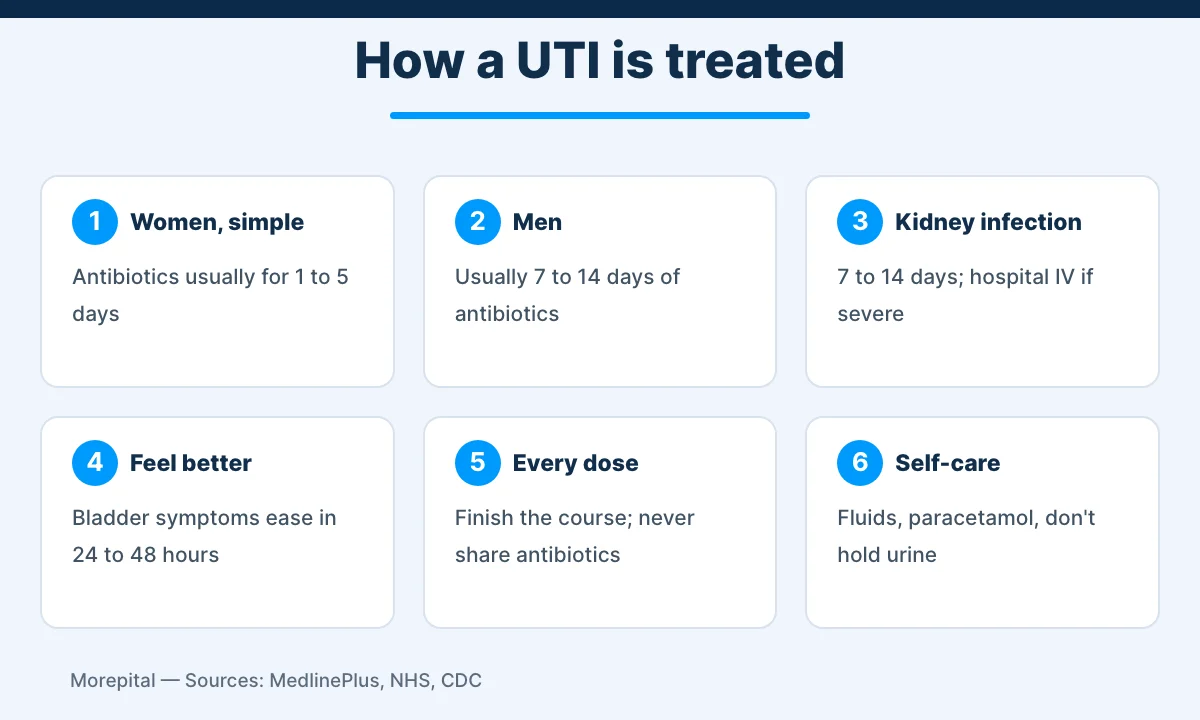
MedlinePlus gives typical course lengths of 1 to 5 days for a simple bladder infection in women and 7 to 14 days in men, whose infections may involve the prostate. Infections in pregnancy or diabetes, and mild kidney infections, are usually treated for 7 to 14 days. NHS states that kidney infections are generally treated with antibiotic tablets for 7 to 14 days, and that people who are pregnant or have long-term conditions may need intravenous antibiotics in hospital, usually going home after 3 to 7 days.
Source: MedlinePlus, NIDDK, NHS
Bladder infection symptoms usually improve within 24 to 48 hours of starting the right antibiotic, while kidney infections take longer; NHS says most people with a kidney infection feel better after about 2 weeks. Take every dose as prescribed even if you feel better, do not share antibiotics or save them for later, and contact a doctor if you are not improving or are getting worse, because the bacteria may be resistant.
Source: MedlinePlus, NHS, CDC
Does every UTI need antibiotics?
Not every urinary tract infection needs antibiotics. NHS notes that a GP may suggest waiting 48 hours to see whether mild symptoms clear on their own, and Cleveland Clinic says minor UTIs sometimes resolve without treatment. However, antibiotics are essential when there is fever, chills, nausea or vomiting, and anyone in a higher-risk group should be treated promptly. Antibiotics have real downsides: CDC lists rashes, allergic reactions, drug-resistant infections and C. diff diarrhea among their side effects. CDC therefore advises using antibiotics only when needed.
Source: NHS, Cleveland Clinic, CDC
Self-care while you recover
- Drink enough fluids to pass pale urine regularly; NIDDK says this can speed recovery and ease symptoms.
- Take paracetamol (acetaminophen) for pain and fever. NIDDK also mentions ibuprofen for bladder infections, but NHS advises avoiding ibuprofen with a kidney infection unless a doctor recommends it.
- Avoid drinks that can irritate the bladder, such as coffee, alcohol and fruit juice, and do not hold in urine.
| Type of UTI | Typical signs | Usual care | Typical antibiotic course |
|---|---|---|---|
| Uncomplicated bladder infection (women) | Burning, frequency, urgency, cloudy urine | Pharmacist or doctor; self-care | 1 to 5 days |
| Bladder infection in men | Same, sometimes penile pain | Doctor, urine culture | 7 to 14 days |
| Pregnancy or diabetes | Bladder symptoms, sometimes none | Urgent doctor review | 7 to 14 days |
| Kidney infection | Fever, chills, flank pain, vomiting | Urgent care; hospital if severe | 7 to 14 days (IV if needed) |
| Asymptomatic bacteriuria | No symptoms | Usually no treatment (except pregnancy) | None in most people |
Source: MedlinePlus, NHS, CDC, Cleveland Clinic
Men, pregnancy, children and catheters
Men
NIDDK notes that men under 50 rarely get bladder infections, so a urinary tract infection in a man is taken more seriously. The infection may involve the prostate, which is why courses are longer, and an underlying cause such as an enlarged prostate, a narrowed urethra or a kidney stone should be considered. NHS directs men with UTI symptoms to an urgent GP appointment rather than a pharmacy.
Source: NIDDK, NIDDK, MedlinePlus, NHS
Pregnancy
Bladder infections during pregnancy are more likely to spread to the kidneys, according to NIDDK, so urine is checked for bacteria during pregnancy and treated even without symptoms. USPSTF recommends a urine culture at the first prenatal visit or at 12 to 16 weeks, whichever comes first. Tell the prescriber if you could be pregnant, as this affects the choice of antibiotic.
Source: NIDDK, USPSTF, MedlinePlus
Children
A UTI in a child, especially with fever, should always be assessed by a doctor, because young children cannot describe symptoms well and urinary tract abnormalities such as vesicoureteral reflux raise the risk. When potty training girls, CDC recommends teaching them to wipe from front to back.
Urinary catheters
Catheters give bacteria a direct route into the bladder; in the US, 70% to 80% of complicated urinary tract infections are attributed to them. For people with a catheter, fever, new confusion or new shivering should prompt a same-day medical review, because symptoms are often atypical.
Source: Nature Reviews Microbiology, NHS
Recurrent urinary tract infection: why it comes back
About a quarter of women who have a urinary tract infection of the bladder go on to have repeat infections, and a previous UTI is itself a risk factor. NHS defines recurrent UTIs as 2 infections within 6 months or 3 within 12 months. A doctor may look for a reason such as incomplete bladder emptying or stones.
Source: NIDDK, NHS, Cleveland Clinic
Options a doctor may discuss include:
- Changing contraception: diaphragms, unlubricated condoms and spermicides may raise the risk.
- Vaginal estrogen: low-dose cream, gel, tablet, pessary or ring for women in or after menopause.
- Preventive antibiotics: a single dose after sex, a low daily dose (NHS mentions up to 6 months), or a “standby” course kept at home to start when symptoms appear. Because of resistance and side effects, this is a considered decision.
- Non-antibiotic tablets: methenamine hippurate is one option to prevent infection.
- Specialist referral: to a specialist, such as a urologist, particularly if symptoms persist after treatment.
Source: NIDDK, NHS, Cleveland Clinic, MedlinePlus
NHS also describes “chronic UTIs”: symptoms persist although standard urine tests do not clearly show infection, possibly because bacteria hide in the bladder lining. A specialist referral is advised.
Source: NHS
How to prevent a urinary tract infection
Simple habits lower the risk of a urinary tract infection:
- Drink plenty of fluids, especially water, so that you urinate regularly.
- Urinate when you feel the urge, take your time and empty the bladder fully.
- Urinate soon after sex, and wash the genital area before and after.
- Wipe from front to back after using the toilet.
- Prefer showers to baths, and avoid douches, sprays, powders and scented soaps in the genital area.
- Use non-spermicidal, water-based lubricant and avoid spermicides.
- Wear cotton underwear and loose clothing, and change menstrual products, nappies and incontinence pads promptly.
Source: NHS, CDC, Cleveland Clinic, NIDDK
Cranberry and D-mannose
The 2023 Cochrane review of 50 randomized trials with 8,857 participants found that cranberry products probably reduce the risk of symptomatic, culture-confirmed UTIs in women with recurrent infections, in children, and in people having bladder procedures. It found little or no benefit in older people living in care homes, pregnant women or adults with nerve-related bladder emptying problems. Cleveland Clinic notes that ordinary supermarket cranberry juice does not prevent UTIs, and NHS says some evidence supports daily D-mannose or cranberry products for recurrent cystitis. These products can be high in sugar, and people taking warfarin should avoid cranberry.
Source: Cochrane, Cleveland Clinic, NHS
Complications and outlook
With prompt diagnosis and the right treatment, most bladder infections cause no complications and the outlook is good. The main risks come from infection that spreads or is not treated: kidney infection, kidney scarring or permanent damage, and sepsis, a life-threatening reaction to infection. Young children, very old adults and people with weakened immune systems have the highest risk of sepsis.
Source: NIDDK, MedlinePlus, Cleveland Clinic
Antibiotic resistance is a growing complication of its own. WHO notes that drug-resistant E. coli is a leading cause of serious bloodstream infections and estimates that bacterial antimicrobial resistance was associated with more than 4.7 million deaths globally in 2021, which is a key reason to treat a urinary tract infection with the right drug for the right length of time.
Source: Cleveland Clinic, WHO, MedlinePlus
Urinary tract infection: frequently asked questions
Can a urinary tract infection go away on its own?
A mild bladder infection sometimes clears without antibiotics, and a doctor may suggest waiting 48 hours in healthy women. Fever, back pain, vomiting, or being in a higher-risk group means you need treatment.
Source: NHS, Cleveland Clinic
How long does a urinary tract infection last with antibiotics?
Bladder infection symptoms usually improve within 24 to 48 hours of starting treatment. Kidney infections take longer; most people feel better after about 2 weeks.
Source: MedlinePlus, NHS
Is a urinary tract infection contagious or sexually transmitted?
No. A UTI is not a sexually transmitted infection, although sex can move bacteria toward the urethra and trigger one.
Source: CDC
Does cranberry juice cure a urinary tract infection?
No. Cranberry has no proven effect once an infection has started. Cranberry products may help prevent recurrences in some groups, but supermarket juice is not effective.
Source: NHS, Cochrane, Cleveland Clinic
Can men get a urinary tract infection?
Yes, though less often than women. Men usually need a urine culture and a longer antibiotic course, and the cause, such as an enlarged prostate, should be checked.
Source: NIDDK, MedlinePlus
Why do I keep getting urinary tract infections?
Common reasons include sexual activity, spermicides, menopause, incomplete bladder emptying, stones and diabetes. Two infections in 6 months or three in 12 months warrant a doctor’s review.
When is a urinary tract infection an emergency?
Seek emergency care for confusion, drowsiness or difficulty speaking, and urgent care for high fever, shivering, back pain or vomiting, which may mean a kidney infection or sepsis.
Disclaimer: this article is for general health education and does not replace advice from a qualified doctor who can assess your individual case. Last updated: October 2026.