
Erectile dysfunction treatment usually starts with lifestyle changes and tablets called PDE5 inhibitors, such as sildenafil or tadalafil, which help most men get and keep an erection. If tablets do not work or are unsuitable, doctors can offer penile injections, urethral pellets, vacuum pumps, shockwave therapy or, as a long-term solution, a penile implant. Because erection problems can be an early warning sign of heart disease, a medical check-up is part of good care.
Source: NHS, EAU Guidelines, American College of Cardiology
Source: EAU Guidelines
Contents
- Erectile dysfunction treatment starts with finding the cause
- Lifestyle changes that improve erections
- PDE5 tablets: first-line erectile dysfunction treatment
- Injections, urethral pellets and vacuum pumps
- Shockwave therapy, testosterone and counseling
- Penile implant: erectile dysfunction treatment when others fail
- Erectile dysfunction treatment options compared
- Side effects, fake pills and urgent warning signs
- Erectile dysfunction treatment abroad and in Turkey
- Erectile dysfunction treatment: frequently asked questions
Erectile dysfunction treatment starts with finding the cause

Erectile dysfunction (ED) is very common, particularly in men over 40, and occasional episodes are usually linked to stress, tiredness or too much alcohol. When it keeps happening, it may be caused by high blood pressure, high cholesterol, diabetes, hormone problems, depression, anxiety or a medicine. Cleveland Clinic notes that ED affects more than half of men aged 40 to 70. Our erectile dysfunction reference page covers symptoms and causes in detail.
Source: NHS, Cleveland Clinic
Doctors look for a cause before prescribing because ED is often the first sign of something more serious. The American College of Cardiology says erection problems appear roughly two to five years before cardiovascular symptoms and that vasculogenic ED should be regarded as a warning sign of silent or future heart disease. Seeking erectile dysfunction treatment can therefore also protect your heart.
Source: American College of Cardiology
What happens at the first appointment
A GP or sexual health clinic will ask about your lifestyle and relationships, check basic measurements such as blood pressure and examine your genitals for an obvious physical cause; with urinary symptoms, they may also examine your prostate. Your clinician may review the medicines you take and suggest a different dose or drug, but never stop a prescribed medicine on your own. Treating high blood pressure, high cholesterol, hormone problems or poorly controlled type 2 diabetes is part of erectile dysfunction treatment too.
Lifestyle changes that improve erections
Lifestyle changes can sometimes help on their own and make every erectile dysfunction treatment work better. The NHS suggests losing weight if you are overweight, stopping smoking, eating a healthy diet, exercising daily, reducing stress, keeping alcohol to no more than 14 units a week and cycling less if you ride more than 3 hours a week.
Arabic-speaking readers: a detailed, source-referenced Arabic overview of this topic is available in the Alphateb medical encyclopedia — ضعف الانتصاب.
Source: NHS
The US National Institute of Diabetes and Digestive and Kidney Diseases (NIDDK) adds stopping recreational drugs and aiming for at least 150 minutes of moderate activity, such as brisk walking, each week. Cleveland Clinic states that vigorous cardiovascular exercise for at least 45 minutes, three times a week, may reverse some mild ED, and that quitting smoking can improve mild ED after several months.
Source: NIDDK, Cleveland Clinic
The EAU agrees that aerobic exercise, weight loss (including bariatric surgery for obesity) and treating cardiovascular risk factors may improve sexual function. Because these changes take months, most men combine them with another erectile dysfunction treatment.
Source: EAU Guidelines
PDE5 tablets: first-line erectile dysfunction treatment
The main medicines are PDE5 inhibitors: sildenafil (Viagra), tadalafil (Cialis), vardenafil (Levitra) and avanafil (Spedra in the UK, Stendra in the US). They improve blood flow to the penis but only work with sexual stimulation. As an erectile dysfunction treatment they are taken by mouth, either shortly before sex or, in the case of tadalafil, once a day.
Source: NHS, NIDDK, MedlinePlus
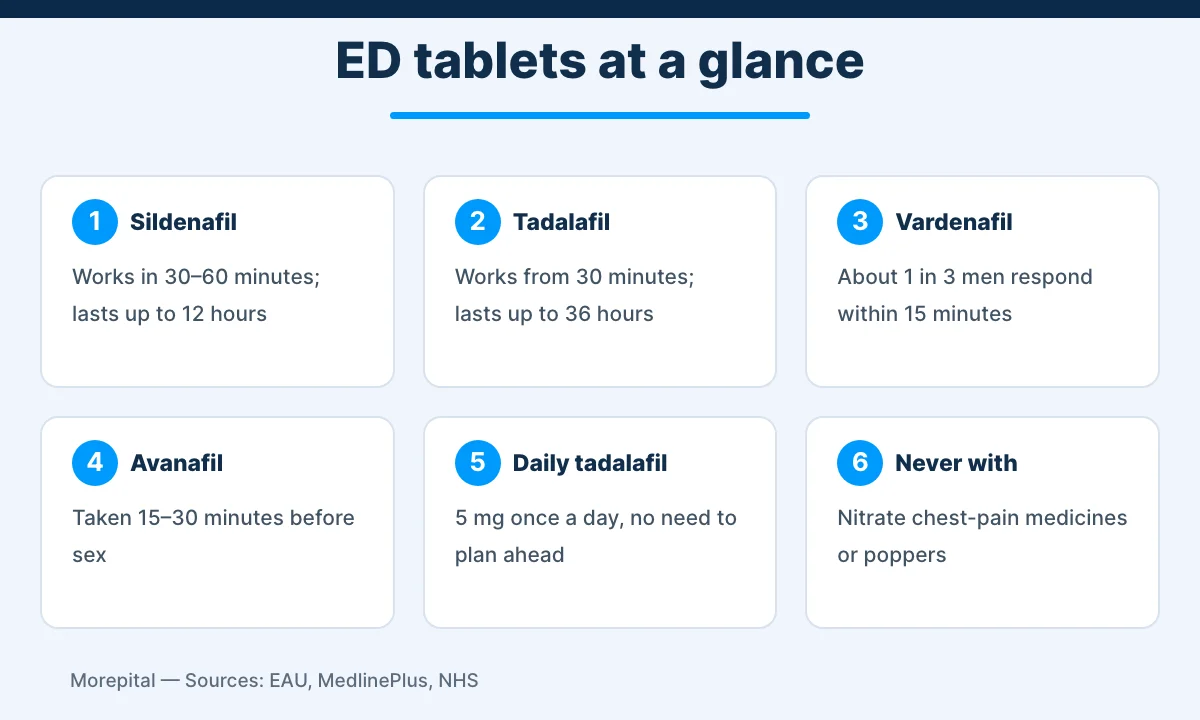
How quickly each tablet works
- Sildenafil: works 30 to 60 minutes after a dose and lasts up to 12 hours; take it about 1 hour before sex (30 minutes to 4 hours) and no more than once in 24 hours.
- Tadalafil: works from about 30 minutes, peaks at around 2 hours and lasts up to 36 hours; no more than 1 tablet a day.
- Vardenafil: works from 30 minutes; about 1 in 3 men get a satisfactory erection within 15 minutes.
- Avanafil: taken 15 to 30 minutes before sex.
Source: EAU Guidelines, MedlinePlus, NHS
How well the tablets work
In trials summarized by the EAU, improved erections were reported by 56%, 77% and 84% of men on sildenafil 25, 50 and 100 mg, versus 25% on placebo. With tadalafil 10 and 20 mg the figures were 67% and 81% (35% on placebo), and with vardenafil 20 mg, 80% (30% on placebo). The guideline suggests sildenafil 50 mg when effectiveness is the priority and tadalafil 10 mg when tolerability matters most.
Source: EAU Guidelines
Daily low-dose tadalafil
Some men take tadalafil 5 mg once a day at the same time, which removes the need to plan sex. The EAU found no clinically significant difference compared with on-demand tadalafil. If you miss a daily dose, take it when you remember unless the next is nearly due, and never take two doses together.
Source: EAU Guidelines, NHS
Getting the tablets
In the UK, sildenafil can be prescribed or bought from a pharmacy, while the other three need a prescription. Seeing a doctor first is still safest, because these medicines do not suit everyone. If one tablet fails, the dose can be changed or another PDE5 inhibitor tried. Our partner clinic compares the best-known options in its guide to Viagra vs Cialis.
Source: NHS
Injections, urethral pellets and vacuum pumps
When tablets fail or cannot be used, the EAU treats penile injections as an alternative first-line or second-line erectile dysfunction treatment. Alprostadil, papaverine and phentolamine, alone or combined, cause a quick erection by increasing blood flow, usually within 10 minutes. You are taught to inject yourself at the clinic.
Source: EAU Guidelines, Cleveland Clinic, NIDDK
Alprostadil injections work in more than 70% of men, with satisfaction of 87% to 93.5% in patients and 86% to 90.3% in partners, yet 41% to 68% of men eventually stop using them. Prolonged erection (priapism) occurs in about 1% and scar tissue (fibrosis) in about 2%.
Source: EAU Guidelines
Urethral alprostadil
Alprostadil also comes as a small pellet inserted into the urethra. It avoids needles but is less reliable: erections sufficient for intercourse occur in 30% to 65.9% of men, local pain in 29% to 41%, and only about 30% keep using it long term.
Source: EAU Guidelines, NIDDK
Vacuum erection devices
A vacuum device uses a plastic tube over the penis, a pump that draws blood in and an elastic ring at the base to keep the erection. The NHS says pumps work for most men, though they are not always available on the NHS. The EAU reports efficacy up to 90% but satisfaction from 27% to 94%, and the ring must come off within 30 minutes. Bruising is usually painless, and ejaculation may weaken without affecting the pleasure of orgasm.
Source: NIDDK, NHS, EAU Guidelines
Shockwave therapy, testosterone and counseling
Low-intensity shockwave therapy
Low-intensity shockwave therapy (Li-SWT) uses sound waves to improve blood flow to the penis. It is noninvasive, but the EAU gives it only a weak recommendation, for mild vasculogenic ED, men who cannot take tablets and poor responders to them. Satisfactory improvement is reported in 40% to 80%, typically 1 to 3 months after treatment, and it may fade over time. See this guide to shockwave therapy for erectile dysfunction for the procedure.
Source: Cleveland Clinic, EAU Guidelines
Testosterone
Testosterone is not an erectile dysfunction treatment for men with normal hormone levels. It is considered for men with low or low-normal testosterone and problems with desire or erections, usually alongside PDE5 tablets; men with low testosterone who do not respond to tablets may respond better after starting it. It comes as gels, patches, injections or pellets and starts working within about four weeks.
Source: EAU Guidelines, NIDDK, Cleveland Clinic
Psychosexual therapy
Anxiety, stress, depression and relationship problems can cause or worsen ED. The EAU strongly recommends cognitive behavioral therapy, individually, as a couple or online, ideally combined with medical erectile dysfunction treatment, and partners may join sessions. Men who also ejaculate too quickly may find our page on premature ejaculation useful.
Source: EAU Guidelines, NIDDK
Penile implant: erectile dysfunction treatment when others fail
Most men with ED never need surgery. A penile prosthesis is considered when other options have not helped, and the EAU strongly recommends it in that situation. The device sits entirely inside the penis: an inflatable type with a pump in the scrotum, or a bendable rod. Cleveland Clinic notes that an implant does not affect sensation, urination or orgasm. Our penile implant reference page explains the types.
Source: NIDDK, EAU Guidelines, Cleveland Clinic
Satisfaction is the highest of any erectile dysfunction treatment: 92% to 100% of patients and 91% to 95% of partners. About 87.2% of devices still work at 5 years and 76.8% at 10 years, and mechanical failure affects fewer than 5% at 5 years.
Source: EAU Guidelines
Risks of implant surgery
Infection is the most serious complication, occurring in 2% to 3% with standard antibiotics and 1% to 2% with antibiotic-impregnated or coated devices. Erosion occurs in 1% to 6%. When an infected implant must be replaced, salvage surgery succeeds in more than 80%. These figures are why a surgeon’s experience matters.
Source: EAU Guidelines
Erectile dysfunction treatment options compared
This summary uses the figures above. Results vary between men, so treat it as a starting point for a talk with your doctor about the right erectile dysfunction treatment, not a ranking.
| Treatment | How it is used | Onset | Key figure |
|---|---|---|---|
| PDE5 tablets | Before sex or daily tadalafil | 15–60 minutes | Up to 84% improved |
| Penile injections | Self-injection | About 10 minutes | Over 70% effective |
| Urethral alprostadil | Pellet in the urethra | Before sex | 30–65.9% effective |
| Vacuum device | Pump plus ring | Almost immediate | Up to 90% effective |
| Shockwave therapy | Clinic sessions | 1–3 months | 40–80% improved |
| Penile implant | Surgery | After healing | 92–100% satisfied |
Source: EAU Guidelines, Cleveland Clinic
Side effects, fake pills and urgent warning signs
Common side effects of PDE5 tablets include headache, flushing, indigestion or heartburn, a blocked nose, nosebleeds, muscle and back aches and diarrhea. If a tablet makes you dizzy, do not drive until it passes.
Source: MedlinePlus, NHS
Who should not take ED tablets
PDE5 inhibitors must not be combined with nitrate medicines for chest pain, such as nitroglycerin (GTN), or with nitrate “poppers.” Alcohol raises the risk of low blood pressure and dizziness, and grapefruit juice should be avoided with tadalafil. Tell your doctor about every medicine and supplement before starting any erectile dysfunction treatment.
Source: MedlinePlus, NHS, NIDDK

Fake medicines online
The NHS warns that many websites sell fake ED medicines with ingredients that vary between packs. In the UK, check that an online pharmacy is registered with the GPhC, the online doctor service with the CQC and the doctors with the GMC. The NIDDK also advises against ordering ED medicine online without talking to a clinician.
When to get urgent help
Get medical care right away for an erection lasting longer than 4 hours or for sudden vision or hearing loss after an ED tablet. Chest pain, fainting, palpitations or shortness of breath after a dose also need urgent attention.
Source: NIDDK, MedlinePlus, NHS
Erectile dysfunction treatment abroad and in Turkey
Tablets are available almost everywhere, so men who travel for erectile dysfunction treatment usually seek specialist care such as shockwave therapy or a penile implant. The CDC says the risk of a medical trip depends on the destination, the facility and your health, with infections, counterfeit medicines, lower-quality devices and language barriers as the main concerns.
Source: CDC
One option for men considering erectile dysfunction treatment in Istanbul is Male Hospital, a men’s sexual health center whose erectile dysfunction treatment page lists tablets, injections, shockwave therapy and implants. Wherever you go, apply the same checks.
How to choose a clinic and surgeon
- Verify the clinician’s qualifications and the facility’s accreditation (for example Joint Commission International); accreditation does not guarantee a good result.
- See your own doctor at least 4 to 6 weeks before the trip and confirm follow-up care at home.
- Bring your records and medicine list, and take translated copies of the clinic’s records home.
- Get travel health insurance and budget for treating complications at home.
Source: CDC
Questions to ask before booking
Ask which tests confirmed the cause of your ED and whether your heart risk was checked. For an implant, ask which type suits you, how many implants the surgeon performs and how infection is prevented. Ask who manages complications after you fly home, and when it is safe to fly: the CDC advises delaying air travel for 10 to 14 days after major surgery because of blood clot risk.
Source: EAU Guidelines, CDC
Considering erectile dysfunction treatment? Contact us for a free consultation and a treatment plan tailored to you.
Erectile dysfunction treatment: frequently asked questions
What is the most effective erectile dysfunction treatment?
PDE5 tablets work well for most men. When they fail, alprostadil injections work in more than 70%, and 92% to 100% of men with an implant are satisfied.
Source: EAU Guidelines
How long does it take for ED tablets to work?
Usually about 30 minutes; vardenafil works within 15 minutes in some men, and avanafil is taken 15 to 30 minutes before sex.
Source: EAU Guidelines
Can erectile dysfunction be treated without medication?
Sometimes. Aerobic exercise and stopping smoking may reverse mild ED, and counseling helps when the cause is psychological.
Source: Cleveland Clinic, NIDDK
Is erectile dysfunction treatment safe if I have heart disease?
Ask your doctor first. PDE5 tablets must never be combined with nitrates, and because ED can signal heart disease, your cardiovascular risk should be checked.
Source: MedlinePlus, American College of Cardiology
Does shockwave therapy work for ED?
Evidence is limited; the EAU gives it a weak recommendation, with improvement in 40% to 80% that may fade.
Source: EAU Guidelines
Is a penile implant permanent?
It stays in the body; about 76.8% still work at 10 years, so some men need a replacement.
Source: EAU Guidelines
When should I see a doctor about ED?
See a GP or sexual health clinic if erection problems keep happening, as they may signal a treatable condition.
Source: NHS
Disclaimer: this article is for general health education and does not replace advice from a qualified doctor who can assess your individual case. Last updated: October 2026.