
Varicocele is an enlargement of the veins inside the scrotum, along the spermatic cord that carries blood to and from each testicle, and it affects roughly 15–20% of males. Most cause no symptoms and need no treatment, but some lead to a dull scrotal ache, a smaller testicle, lower sperm quality or reduced testosterone. When it causes pain, testicular shrinkage or fertility problems, it can be fixed with microsurgery or a catheter-based procedure called embolization, usually as a day case.
Source: Cleveland Clinic, MedlinePlus (NIH)
Source: EAU Paediatric Urology Guidelines, Shridharani et al., Asian Journal of Andrology (PMC), nidirect (NHS content)
Contents
- What is a varicocele?
- Causes and why the left side
- Varicocele symptoms and grades
- Fertility, testosterone and testicle size
- How a varicocele is diagnosed
- Who needs treatment?
- Varicocele treatment: surgery vs embolization
- Recovery, risks and results after repair
- Varicocele in teenagers
- Choosing a specialist and treatment in Turkey
- Frequently asked questions
What is a varicocele?
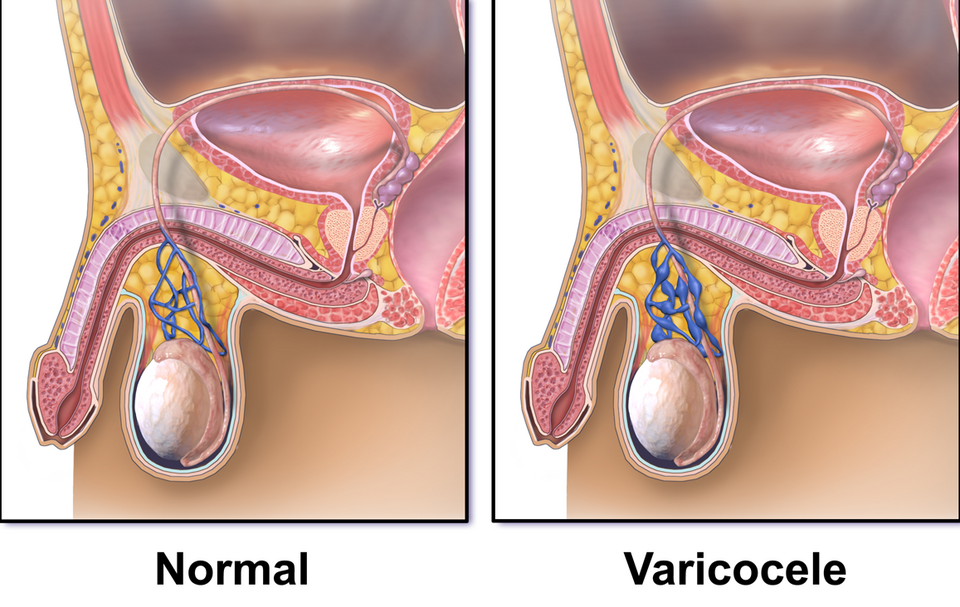
Each testicle drains through a web of small veins called the pampiniform plexus, which runs up the spermatic cord. When blood pools in these veins instead of flowing back toward the heart, they widen and twist, much like varicose veins in the legs. The result is a soft scrotal swelling that some men can feel above the testicle, especially when standing.
Source: nidirect (NHS content), MedlinePlus (NIH)
The condition is common. Cleveland Clinic estimates that 15–20% of males in the US have one, which is about 1 in 5, and a review in the Asian Journal of Andrology puts the figure at about 15% of the general male population. Many are thought to be present from birth and are first noticed in the teenage years; MedlinePlus notes they are most common between ages 15 and 25. A varicocele is not cancer and is not life-threatening, but it can matter a great deal to men who are trying to have children.
Source: Cleveland Clinic, Shridharani et al., Asian Journal of Andrology (PMC), MedlinePlus (NIH)
Causes and why the left side is affected
The exact cause is not fully understood. The leading explanation is that the one-way valves inside the spermatic cord veins do not close properly, so blood flows backward and collects around the testicle. The surge in blood flow to the genitals during puberty may also play a part, which helps explain why the problem usually appears in adolescence.
Source: Cleveland Clinic, MedlinePlus (NIH)
Anatomy explains the strong left-sided pattern. The left testicular vein drains into the left kidney vein at a sharp, roughly 90° angle, while the right testicular vein empties directly into the large inferior vena cava. The longer, steeper path on the left raises pressure in the veins, and European pediatric urology guidelines report that 78–93% of cases are left-sided. A right-sided swelling on its own is unusual.
Source: Therapeutic Advances in Urology (PMC), EAU Paediatric Urology Guidelines
When a varicocele can signal something else
Rarely, swollen scrotal veins are caused by pressure from something blocking venous drainage higher up in the abdomen. MedlinePlus warns that a varicocele that appears suddenly in an older man may be caused by a kidney tumor, and the European guidelines recommend an abdominal ultrasound for every prepubertal boy and every isolated right-sided case to rule out a mass behind the abdominal cavity. This is why a new swelling should always be examined rather than self-diagnosed.
Source: MedlinePlus (NIH), EAU Paediatric Urology Guidelines
Varicocele symptoms and grades
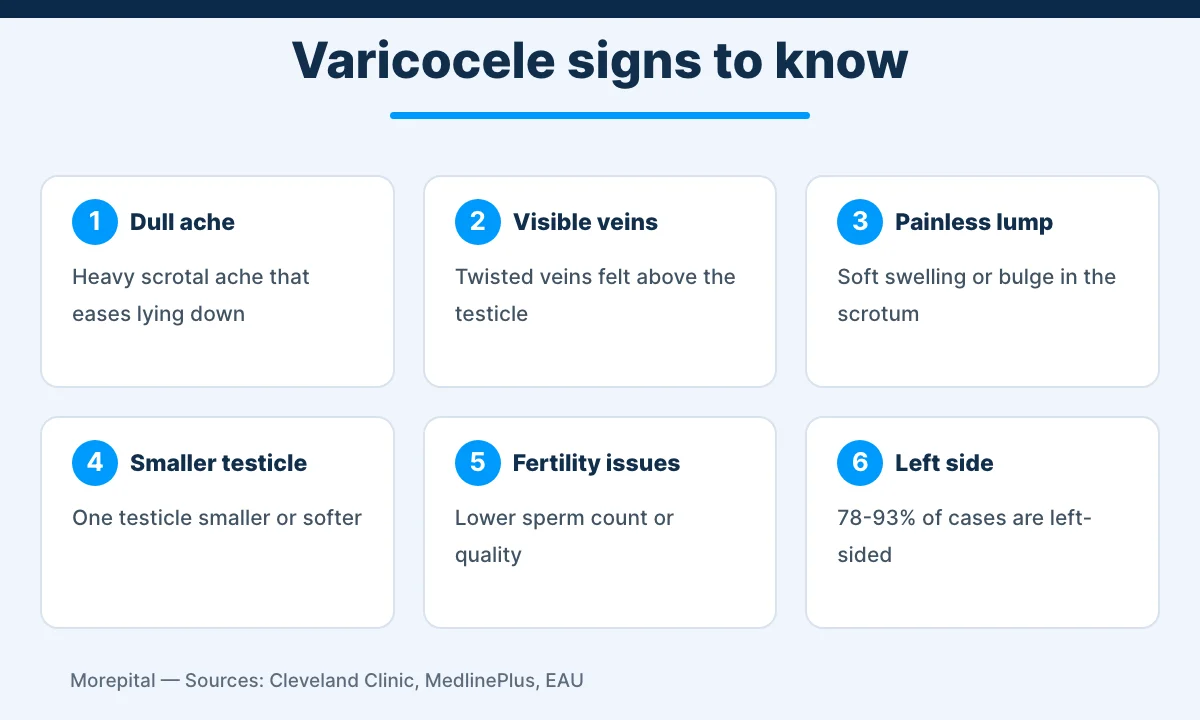
Most men have no symptoms at all, and the problem is often found during a routine exam or a fertility workup. When symptoms do occur, they include:
- A dull ache or heavy feeling in the scrotum that often eases when lying down
- Enlarged, twisted veins that can be seen or felt above the testicle
- A painless lump, bulge or swelling in the scrotum
- One testicle that is smaller or softer than the other (atrophy)
- Difficulty conceiving or a lower sperm count on testing
Source: Cleveland Clinic, MedlinePlus (NIH)
Because blood drains away when you lie flat, the swelling may not be detectable lying down, so doctors examine men standing up. Experts grade the size of the swelling, and the grade influences treatment decisions:
- Grade 0 (subclinical): seen only on ultrasound, not felt on exam.
- Grade I: felt only while bearing down (the Valsalva maneuver).
- Grade II: felt without straining but not visible.
- Grade III: large enough to be seen through the scrotal skin.
Source: Cleveland Clinic, MedlinePlus (NIH)
Fertility, testosterone and testicle size
Infertility means not achieving a pregnancy after 12 months or more of regular unprotected sex, and the World Health Organization estimates that about 1 in 6 people of reproductive age experience it during their lifetime. The WHO lists swollen scrotal veins among the causes of the testicles failing to produce sperm. Cleveland Clinic states they contribute to about 40% of male infertility cases, and the Asian Journal of Andrology review reports them in 35–50% of men with primary infertility and 69–81% of men with secondary infertility (trouble conceiving after a previous pregnancy).
Source: WHO, Cleveland Clinic, Shridharani et al., Asian Journal of Andrology (PMC)
Even so, most affected men father children without difficulty. A review in Therapeutic Advances in Urology estimates that 80–85% of men with the condition have no fertility problems. Researchers think the damage, when it happens, is caused by several factors together: higher venous pressure transmitted to the testicle, a rise in testicular temperature, backflow of adrenal gland metabolites, and excess oxidative stress (reactive oxygen species) that harms sperm.
Source: Therapeutic Advances in Urology (PMC), Shridharani et al., Asian Journal of Andrology (PMC)
Larger swellings are linked to low testosterone (male hypogonadism) and, in some men, to azoospermia, the complete absence of sperm in semen. A possible link with erectile problems has been suggested but not confirmed. Cleveland Clinic warns that untreated higher-grade cases can permanently damage the testicles. If low energy, low libido or reduced muscle mass are part of the picture, our guide to low testosterone symptoms explains the other causes and tests, and couples facing a wider workup can read our overview of male infertility.
Source: Cleveland Clinic
How a varicocele is diagnosed
Diagnosis starts with a history and a physical exam of the groin, scrotum and testicles, done standing up. The doctor asks you to take a deep breath, hold it and bear down (the Valsalva maneuver) to make the veins fill. Further tests depend on your symptoms and goals:
- Scrotal Doppler ultrasound: the most common imaging test; it confirms backward blood flow and measures both testicles.
- Kidney or abdominal ultrasound: when the swelling is right-sided only, appears suddenly in later life, or occurs before puberty.
- Semen analysis: if fertility is a concern; it is the main test that guides treatment decisions in adults.
- Blood tests: FSH and testosterone levels to look at hormone production.
Source: Cleveland Clinic, MedlinePlus (NIH), EAU Paediatric Urology Guidelines
Ultrasound is especially useful when the exam is difficult, such as in men with obesity, a high-riding testicle, previous groin surgery, or a suspected recurrence after treatment. Not every testicular lump is a swollen vein: cysts, fluid collections (hydroceles), hernias and, occasionally, testicular cancer can feel similar. Our article on testicular cancer symptoms explains which warning signs need prompt checking.
Source: Shridharani et al., Asian Journal of Andrology (PMC), nidirect (NHS content)
Who needs treatment?
Not every varicocele needs repair. A small, painless swelling that is not affecting testicle size or fertility usually needs only monitoring. For mild discomfort, Cleveland Clinic suggests supportive underwear or an athletic supporter, an ice pack wrapped in a towel for no more than 15 minutes at a time, and over-the-counter anti-inflammatory painkillers such as ibuprofen or naproxen after checking with a doctor or pharmacist.
Source: Cleveland Clinic, MedlinePlus (NIH)
Repair is generally considered in four situations:
- Infertility with abnormal semen: American (ASRM) and European (EAU) guidance supports repair when the swelling can be felt on exam, the couple has known infertility, the female partner has normal fertility or a treatable cause, and semen parameters are abnormal.
- Pain: persistent aching that affects daily life despite simple measures.
- A shrinking testicle: especially in adolescents, where it may affect future fertility.
- Low testosterone: in some men with large swellings and symptomatic testosterone deficiency, after discussion with a specialist.
Source: Shridharani et al., Asian Journal of Andrology (PMC), Cleveland Clinic (varicocelectomy)
Guidelines advise against repair when semen quality is normal, when the only abnormality is sperm shape (isolated teratozoospermia), or when the swelling is subclinical and seen only on ultrasound. For men with non-obstructive azoospermia, repair has returned sperm to the ejaculate in 10–55% of cases in published series. The European guidance stresses that couples should have a full discussion of the uncertainties before treatment.
Source: Shridharani et al., Asian Journal of Andrology (PMC)
Varicocele treatment: surgery vs embolization
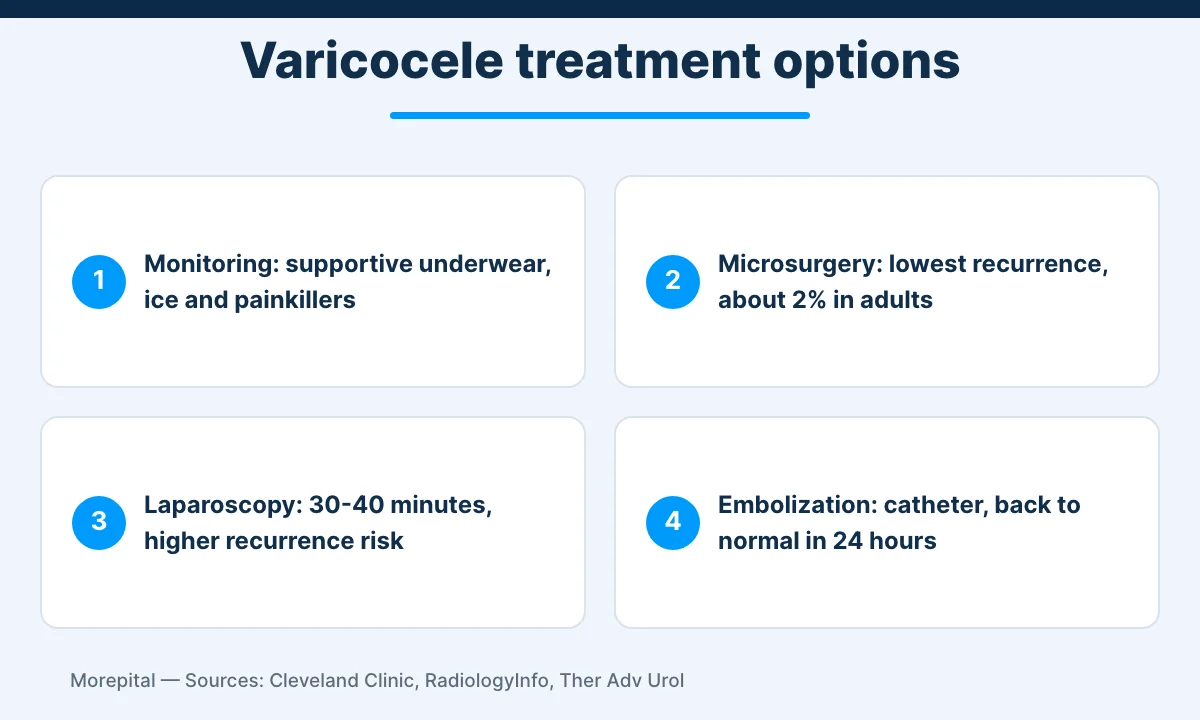
There are two main approaches: surgical ligation (varicocelectomy), in which the faulty veins are tied off, and percutaneous embolization, in which they are blocked from inside. Both are usually same-day procedures.
Source: MedlinePlus (NIH), Cleveland Clinic (varicocelectomy)
Microsurgical varicocelectomy
This is the most common surgical method. Through one or a few small incisions in the groin, the surgeon uses an operating microscope to identify and tie off the dilated veins while protecting the testicular artery and lymphatic vessels. It is performed under general anesthesia and takes about one to three hours, roughly double for both sides. European guidance suggests the microsurgical subinguinal approach has the lowest recurrence rate and possibly the fewest complications; in adult series reviewed in Therapeutic Advances in Urology, recurrence was about 2% and hydrocele about 0.75%.
Source: Cleveland Clinic (varicocelectomy), Shridharani et al., Asian Journal of Andrology (PMC), Therapeutic Advances in Urology (PMC)
Laparoscopic and open repair
Laparoscopic repair uses small incisions in the lower abdomen and a camera and takes about 30–40 minutes, but Cleveland Clinic notes it is now less common because of higher rates of recurrence and injury. Open inguinal or retroperitoneal ligation without a microscope is also still used. In a multicenter pediatric series, retreatment was needed in 1.5% after open repair and 3.4% after laparoscopy, with hydroceles in 4.9% and 8.1% respectively.
Source: Cleveland Clinic (varicocelectomy), Therapeutic Advances in Urology (PMC)
Varicocele embolization
An interventional radiologist threads a thin catheter from a vein in the groin or neck to the testicular vein under X-ray guidance, then blocks it with a coil or another embolic agent. It is usually done under moderate sedation and completed within an hour, needs only a small skin nick without stitches, and most people resume normal activities within 24 hours. RadiologyInfo reports about 90% success, similar to surgery, with recurrence in roughly 5–10%.
Source: RadiologyInfo (RSNA/ACR), MedlinePlus (NIH)
Sources disagree on how embolization compares. The Asian Journal of Andrology review found similar semen and pregnancy outcomes in experienced hands but a higher recurrence risk, and reports that the vein cannot be reached in about 20% of attempts; RadiologyInfo puts that technical failure rate below 5%. The procedure also involves a small amount of radiation. The best choice depends on anatomy, local expertise and whether the condition has come back after a previous repair.
Source: Shridharani et al., Asian Journal of Andrology (PMC), RadiologyInfo (RSNA/ACR)
| Option | How it is done | Typical time | Back to normal | Main drawbacks |
|---|---|---|---|---|
| Watch and support | Supportive underwear, ice, painkillers | — | — | Does not fix the veins |
| Microsurgical repair | Groin incision, microscope, general anesthesia | 1–3 hours | Work in a few days; full recovery within about 6 weeks | Longer operation; needs microsurgical skill |
| Laparoscopic repair | Small abdominal incisions, camera | 30–40 minutes | A few days | Higher recurrence and hydrocele rates |
| Embolization | Catheter via groin or neck vein, sedation | Under 1 hour | About 24 hours | Radiation; vein sometimes cannot be reached |
Source: Cleveland Clinic, Cleveland Clinic (varicocelectomy), RadiologyInfo (RSNA/ACR), Shridharani et al., Asian Journal of Andrology (PMC)
Recovery, risks and results after repair
After surgery most people go home a few hours later and need someone to drive them. Cleveland Clinic’s typical recovery timeline is:
- First day or two: rest, with help at home if possible; ice packs wrapped in a towel ease swelling.
- A few days: most people return to work or school.
- At least 1 week: avoid sex and masturbation.
- At least 2 weeks: avoid strenuous exercise and lifting anything heavier than 10 lb (4.5 kg); showers are fine, but avoid baths and swimming.
- 3–4 weeks: bruising in the groin and scrotum usually fades.
- Up to 6–8 weeks: swelling and groin tenderness settle; most people are fully recovered within six weeks.
Source: Cleveland Clinic (varicocelectomy)
After embolization, scrotal discomfort can last up to a week as the blocked vein clots. Possible risks of surgery include infection, a collection of blood (hematoma), fluid around the testicle (hydrocele), injury to the testicular artery and, rarely, loss of testicular function or recurrence. Embolization carries risks of bruising or bleeding at the puncture site, coil migration, back pain, inflammation of the epididymis or vein, and infection needing antibiotics in fewer than 1 in 1,000 cases.
Source: RadiologyInfo (RSNA/ACR), Cleveland Clinic (varicocelectomy), MedlinePlus (NIH)
What results can you expect?
Cleveland Clinic reports that about 8 in 10 people have less pain after repair and that results are usually permanent. For fertility, a meta-analysis of 17 studies found average gains of 9.7 million sperm per milliliter in concentration, 9.9% in motility and 3.1% in normal shape. In a randomized trial of 145 men, natural conception occurred in 32.9% of couples after repair versus 13.9% without it. A follow-up semen analysis is usually arranged to check the response.
Source: Cleveland Clinic (varicocelectomy), Shridharani et al., Asian Journal of Andrology (PMC)
Varicocele in teenagers
European pediatric guidelines report the condition in 14–20% of adolescents; it is unusual before age 10, and about 20% of affected adolescents later develop fertility problems. The key measurement is testicle size: a testicle is considered too small when it is more than 2 mL or 20% smaller than the other. Surgery is recommended when that difference persists on two visits six months apart, and may be considered case by case for pain, swellings on both sides, or abnormal semen in older teenagers.
Source: EAU Paediatric Urology Guidelines
Watchful waiting is reasonable for many boys with a varicocele. In one study cited in Therapeutic Advances in Urology, 85% of adolescents with more than 15% size difference caught up to less than 15% without surgery over a median of 39 months. When surgery is done, guidelines recommend magnification and lymphatic-sparing technique, because cutting the lymphatics can cause a hydrocele in up to 40% of cases. Pain resolved in more than 90% of treated cases, and the affected testicle showed an average catch-up growth of 76.4%.
Source: Therapeutic Advances in Urology (PMC), EAU Paediatric Urology Guidelines
Choosing a specialist and treatment in Turkey
Varicocele repair is usually performed by a urologist or andrologist trained in microsurgery, or by an interventional radiologist for embolization. Some international patients choose to have men’s health procedures in Turkey, often in Istanbul. Wherever you are treated, the same checks apply: confirm the diagnosis with an exam and ultrasound, make sure a semen analysis is done first if fertility is the goal, and agree on a plan for follow-up tests at home. One option is Male Hospital, a specialised men’s health center in Istanbul; its guide to male infertility covers related tests.
Questions worth asking any surgeon or clinic:
- Which technique do you recommend for my grade and anatomy, and why?
- Do you use an operating microscope and spare the artery and lymphatics?
- How many of these procedures do you perform, and what are your recurrence and hydrocele rates?
- Would embolization suit me, especially if this is a recurrence?
- When should I repeat the semen analysis, and who will review it?
- How long should I stay before flying home, and who do I contact if a complication occurs?
Source: Cleveland Clinic (varicocelectomy), Shridharani et al., Asian Journal of Andrology (PMC), EAU Paediatric Urology Guidelines
Because recovery from microsurgery or embolization is short, travel plans are usually simple, but discuss timing with your surgeon, particularly if you have other health conditions. Men also exploring treatment for erection problems can read our guide to erectile dysfunction treatment and the reference page on erectile dysfunction.
Source: Cleveland Clinic (varicocelectomy), RadiologyInfo (RSNA/ACR)
Considering varicocele treatment? Contact us for a free consultation and a treatment plan tailored to you.
Varicocele: frequently asked questions
Is a varicocele dangerous?
Usually not. It is not cancer, is not life-threatening and often needs no treatment. It matters mainly when it causes pain, a shrinking testicle, low testosterone or fertility problems.
Source: Cleveland Clinic, nidirect (NHS content)
Can a varicocele go away on its own?
The veins do not usually return to normal by themselves, but symptoms can be managed with supportive underwear and pain relief. In teenagers, a smaller testicle often catches up in size without surgery, which is why doctors often monitor first.
Source: Cleveland Clinic, Therapeutic Advances in Urology (PMC)
Does a varicocele cause infertility?
It can reduce sperm production and quality, and it is found in 35–50% of men with primary infertility. However, 80–85% of men with the condition have no fertility problems.
Source: Shridharani et al., Asian Journal of Andrology (PMC), Therapeutic Advances in Urology (PMC)
Is varicocele surgery or embolization better?
Both have similar success in experienced hands. Microsurgery has the lowest recurrence rates in many series, while embolization avoids an incision and allows a return to normal activity within about 24 hours. The right choice depends on your anatomy and local expertise.
Source: Shridharani et al., Asian Journal of Andrology (PMC), RadiologyInfo (RSNA/ACR)
How long does recovery take after varicocele repair?
Most people return to work within a few days, avoid sex for one week and heavy lifting for two weeks, and are fully recovered within about six weeks after surgery.
Source: Cleveland Clinic (varicocelectomy)
Can a varicocele come back after treatment?
Yes. Recurrence is about 2% after adult microsurgical repair and about 5–10% after embolization, depending on the technique and the study.
Source: Therapeutic Advances in Urology (PMC), RadiologyInfo (RSNA/ACR)
When should I see a doctor?
See a doctor for any new lump, swelling, change in shape, or ache that does not go away. Go to an emergency department for sudden, severe testicle pain, which may be testicular torsion.
Source: nidirect (NHS content), NHS 111 Wales
Disclaimer: this article is for general health education and does not replace advice from a qualified doctor who can assess your individual case. Last updated: October 2026.