
Male infertility means a man’s reproductive system makes it hard to get a partner pregnant, usually diagnosed after a year of regular unprotected sex without a pregnancy. A male factor is involved in about half of couples who struggle to conceive, most often because of low sperm numbers, poorly moving sperm or abnormally shaped sperm. A semen analysis is the first test, and many causes can be treated or bypassed with assisted reproduction.
Source: NHS, Cleveland Clinic, EAU Guidelines
Source: WHO, EAU Guidelines, NHS
Contents
- What is male infertility?
- Male infertility signs and when to see a doctor
- Male infertility causes and risk factors
- How male infertility is diagnosed
- Understanding your semen analysis
- Male infertility treatment options
- Azoospermia and sperm retrieval
- Lifestyle changes for sperm health
- Treatment abroad and in Turkey
- Male infertility: frequently asked questions
What is male infertility?

The World Health Organization defines infertility as a disease of the reproductive system in which pregnancy does not happen after 12 months or more of regular unprotected sex, and estimates that around 1 in 6 people of reproductive age experience it. Male infertility is the part that comes from the man: his sperm production, sperm transport, hormones or ability to ejaculate.
Source: WHO
Men are involved more often than many couples expect. European Association of Urology (EAU) guidelines report a male factor in about 50% of infertile couples, and in about 20% it is the only factor found. Cleveland Clinic notes that male infertility affects an estimated 10% to 15% of US men trying to conceive. Because both partners often contribute, the woman’s fertility should be assessed at the same time.
Source: EAU Guidelines, Cleveland Clinic
More than 8 in 10 couples in which the woman is under 40 conceive naturally within a year with regular sex every 2 to 3 days, so infertility is not the same as sterility. As many as 1 in 5 couples with infertility eventually conceive without treatment.
Source: NHS, MedlinePlus
Male infertility signs and when to see a doctor
The main sign of male infertility is simply not getting a partner pregnant. Semen that looks normal can still contain few or poorly moving sperm, so a semen analysis is the only reliable check. Some men have clues to an underlying cause:
- Low sex drive, erection problems or tiredness, which can reflect low testosterone (see our guide to low testosterone symptoms).
- Little or no semen when ejaculating.
- Pain, swelling or a lump in a testicle.
- Past undescended testicles, testicular injury or surgery, mumps affecting the testicles, a sexually transmitted infection, chemotherapy or radiotherapy.
Source: Cleveland Clinic, NHS, MedlinePlus
The NHS advises seeing a GP after more than a year of regular unprotected sex without a pregnancy, or after 6 months if your partner is 36 or older, and sooner if you know of a possible problem. A testicular lump always needs prompt checking. If male infertility is affecting your mood or relationship, talking to a therapist can help.
Source: NHS, NHS, Cleveland Clinic
Male infertility causes and risk factors
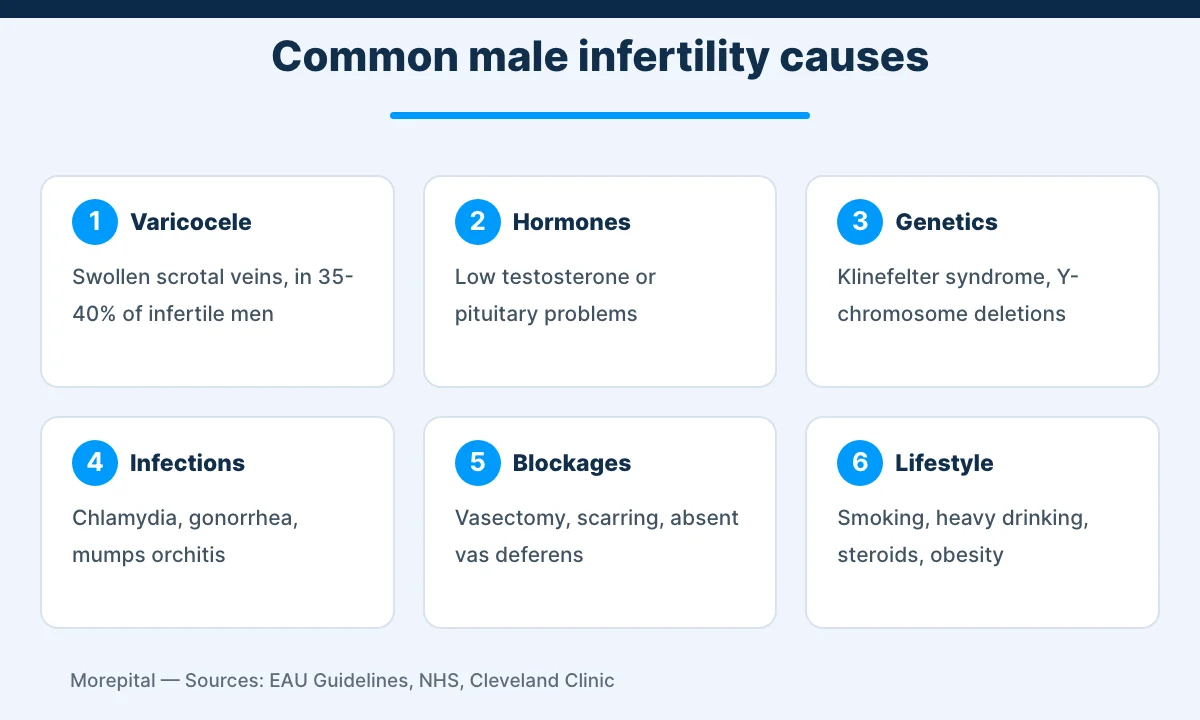
Most male infertility comes down to poor semen quality: a low or absent sperm count, sperm that swim poorly, or abnormally shaped sperm. Many cases are unexplained. When a cause is found, it usually falls into one of ten groups.
1. Varicocele
A varicocele is a swelling of the veins in the scrotum, found in about 15% of all men and 35% to 40% of infertile men, according to EAU guidelines. Not every varicocele harms fertility. The Male Hospital guide to varicocele explains how it is assessed.
Source: EAU Guidelines
2. Hormone disorders
Sperm production depends on signals from the brain’s pituitary gland and on testosterone. Low testosterone (hypogonadism) can be caused by a pituitary tumor, drug use or Klinefelter syndrome; uncontrolled diabetes can also contribute.
Source: NHS, MedlinePlus
3. Genetic conditions
Klinefelter syndrome, missing sections of the Y chromosome and cystic fibrosis gene changes are recognized causes. Klinefelter syndrome accounted for 13.7% of men with no sperm in an EAU dataset of nearly 13,000 men.
Source: EAU Guidelines, Cleveland Clinic
4. Infections
Epididymitis, orchitis (including from mumps), chlamydia and gonorrhea can damage or scar the reproductive tract.
Source: Cleveland Clinic, MedlinePlus
5. Blockages
Sperm may be made normally but blocked by a vasectomy, scarring, or being born without the vas deferens.
Source: NHS, MedlinePlus
6. Ejaculation problems
In retrograde ejaculation semen goes backward into the bladder; in anejaculation none is released. Erection problems can also make regular sex difficult; see our guide to erectile dysfunction treatment.
7. Testicular damage
Injury, testicular cancer, surgery, a congenital defect or undescended testicles can reduce semen quality.
Source: NHS
8. Cancer treatment
Chemotherapy and radiotherapy can severely reduce sperm production, so men should consider sperm banking first.
Source: NHS, Cleveland Clinic
9. Steroids, testosterone and medicines
Anabolic steroids and testosterone suppress sperm production. Sulfasalazine can temporarily lower sperm numbers, and spironolactone, flutamide and bicalutamide are also listed as risk factors.
Source: NHS, Cleveland Clinic, EAU Guidelines
10. Lifestyle, environment and age
Smoking, heavy drinking, marijuana, cocaine, a BMI above 25, frequent heat to the testicles and exposure to pesticides, lead or mercury are linked to poorer sperm. Being 40 or older is a risk factor for male infertility too.
Source: Cleveland Clinic, NHS, EAU Guidelines
How male infertility is diagnosed
A GP may refer you to a urologist, andrologist or fertility clinic. The doctor asks about how long you have been trying, past illnesses, infections, medicines, steroids, alcohol and smoking, then examines the testicles for size, lumps or a varicocele and checks the penis.
Source: Cleveland Clinic, NHS
The core tests for male infertility are:
- Semen analysis – repeated, usually about 3 months later, if abnormal.
- Urine test – for chlamydia and diabetes.
- Hormone blood tests – EAU guidelines recommend testosterone, FSH and LH in every man with a low count or no sperm.
- Scrotal ultrasound – to look at the testicles and veins.
- Genetic tests – a karyotype for men with no sperm or a low count, and Y-chromosome microdeletion testing at 1 million sperm/mL or less.
- Testicular biopsy – rarely, to see whether sperm are made.
Source: NHS, EAU Guidelines, MedlinePlus
Sperm DNA fragmentation testing is recommended for recurrent miscarriage, failed assisted reproduction or unexplained infertility, not routinely.
Source: EAU Guidelines
Understanding your semen analysis
You collect the whole ejaculate in a sample pot without lubricant, after 2 to 7 days without ejaculating. Results vary between samples, so one abnormal result is not a diagnosis of male infertility.
Source: East Kent NHS, NHS
The WHO manual (6th edition, 2021) lists the lower 5th centiles of men whose partners conceived within a year. They do not draw a clear line between fertile and infertile men.
Source: PMC review, Manchester NHS
| Semen measure | WHO 2021 lower value | Term if below |
|---|---|---|
| Volume | 1.4 mL | Hypospermia |
| Concentration | 16 million/mL | Oligospermia (low count) |
| Total sperm number | 39 million | Oligospermia (low count) |
| Progressive motility | 30% | Asthenospermia (poor movement) |
| Normal shape | 4% | Teratospermia |
| Live sperm | 54% | Low vitality |
| Any sperm seen | Yes | Azoospermia (none) |
Source: Manchester NHS, Cleveland Clinic
Your doctor reads the whole picture, including both partners’ ages, how long you have been trying and your hormone results, rather than any single number. A low count with normal hormones points in a different direction from no sperm with a high FSH level, a hormone that EAU guidelines associate with lower sperm counts.
Source: EAU Guidelines
Male infertility treatment options
Male infertility rarely resolves on its own. Treatment depends on the cause and both partners’ ages, and aims to improve sperm production, remove a barrier, or bypass the problem.
Source: Cleveland Clinic
Treating the cause
- Stopping steroids and testosterone – EAU guidelines strongly advise against testosterone for male infertility; some prescription drugs may be switched.
- Hormone injections – men whose pituitary sends too few signals can often start making sperm with hCG, adding FSH if needed.
- Antibiotics – for chlamydia and other infections.
- Varicocele repair – recommended for a varicocele you can feel when semen is abnormal and no other cause is found, if the partner has good ovarian reserve. A 2021 Cochrane review found it may improve pregnancy rates. It is not advised when semen is normal.
- Reversing a blockage – microsurgery can reconnect tubes after a vasectomy or bypass an epididymal blockage.
Source: EAU Guidelines, NHS, Cleveland Clinic
Clomiphene-type pills are sometimes offered, but EAU guidelines rate the evidence as low quality and do not recommend them routinely for unexplained male infertility.
Source: EAU Guidelines
Assisted reproduction
- IUI – washed, fast-moving sperm are placed in the womb.
- IVF – eggs are fertilized with sperm in a laboratory.
- ICSI – a single sperm is injected into each egg, for very low counts, poor movement or shape, or surgically collected sperm.
- Donor sperm – where no usable sperm is found and the law allows.
The UK regulator HFEA says ICSI’s success rates are similar to IVF and it offers no benefit when the problem is not sperm-related. Sons may inherit a genetic cause of male infertility, so genetic counseling is worth considering.
Source: HFEA
The outlook for male infertility depends on the cause, the man’s age and his partner’s age. A diagnosis does not mean you will never have a biological child, and many couples succeed after treatment.
Source: Cleveland Clinic, MedlinePlus
Azoospermia and sperm retrieval
Azoospermia, no sperm in the semen, is either obstructive (sperm are made but blocked) or non-obstructive (the testicles make very little). Obstruction explains 20% to 40% of cases.
Source: EAU Guidelines
- PESA and TESA – a fine needle takes sperm from the epididymis or testicle, usually under local anesthetic.
- MESA – microsurgical sampling of the epididymis under general anesthetic.
- TESE – a small piece of testicular tissue is removed.
- Micro-TESE – a microscope is used to find tubules most likely to contain sperm; many experts consider it best for non-obstructive azoospermia.
Source: HFEA
In non-obstructive cases, one meta-analysis cited by EAU found retrieval rates of 35% for conventional TESE and 52% for micro-TESE, while a later one found 46% for both. In Klinefelter syndrome sperm can be recovered in up to 50% of cases. Men with complete AZFa or AZFb deletions should not have surgery, because sperm are essentially never found.
Source: EAU Guidelines
Obstructive azoospermia often has better odds. After a vasectomy, microsurgical reversal reopens the tubes in 90% to 97% of men, with pregnancy rates of 52% to 73% reported in EAU guidelines; bypassing an epididymal blockage reopens the tubes in 63% to 85%. When reconstruction is unsuitable, sperm can be collected directly.
Source: EAU Guidelines
Retrieved sperm is used with ICSI. Bleeding, infection and a fall in testosterone are uncommon side effects, and finding sperm does not guarantee pregnancy.
Source: HFEA
Lifestyle changes for sperm health

EAU guidelines strongly recommend lifestyle improvement for male infertility. Sperm take about three months to develop, so changes show up in a semen test roughly 90 days later.
Source: EAU Guidelines, Healthy Male
- Stop smoking – linked to poorer sperm in data from 20 studies.
- Limit alcohol – no more than 14 units a week over 3 or more days; heavy drinking harms semen.
- Lose excess weight – see our page on obesity.
- Stay active – regular exercise is linked to better semen results.
- Avoid steroids and drugs, and limit workplace chemicals.
- Keep the testicles cool – loose underwear and fewer saunas, though benefit is uncertain.
- Have sex every 2 to 3 days to cover the fertile window.
Source: EAU Guidelines, NHS, NHS
Randomized trials have not confirmed that antioxidant supplements help, and some lubricants can affect sperm. Men with fertility problems are slightly more likely to develop testicular cancer, so regular self-checks are advised. For urinary symptoms later in life, see our guide to an enlarged prostate.
Source: EAU Guidelines, MedlinePlus, HFEA
Treatment abroad and in Turkey
Many couples travel for male infertility care because of waiting lists or cost; WHO notes assisted reproduction is unaffordable in many countries. The HFEA advises checking that treatment is regulated where you go, asking for a costed plan, and checking how success rates are calculated.
Questions to ask a clinic:
- Is the surgeon a urologist or andrologist experienced in varicocele repair and micro-TESE?
- Will my home semen and hormone results be accepted?
- Is the embryology lab on site, and can sperm be frozen?
- How many embryos do you transfer? Twins and triplets are the biggest risk to mothers and babies.
- How many trips are needed, and who provides aftercare at home?
- Does the price include medicines, tests and freezing?
Source: HFEA
Turkey is a popular destination, but 2010 regulations allow spouses to use only each other’s eggs and sperm, so donor sperm is not available; check current rules before planning. Keep copies of your records, as the HFEA cannot handle complaints about treatment abroad. Male Hospital, a men’s sexual health center in Istanbul, also has a patient guide to male infertility.
Considering male infertility treatment? Contact us for a free consultation and a treatment plan tailored to you.
Male infertility: frequently asked questions
Can male infertility be cured?
Sometimes. Hormone problems, infections, blockages and some varicoceles can be treated; otherwise ICSI with ejaculated or retrieved sperm may still allow a biological child.
Source: Cleveland Clinic, HFEA
Can you have a normal sperm count and still have male infertility?
Yes. Movement, shape and DNA quality matter, and the partner’s fertility plays a large role, so both should be assessed.
Source: EAU Guidelines
How long does it take to improve sperm quality?
About three months, the time sperm take to develop.
Source: Healthy Male
Does testosterone therapy cause male infertility?
It can, because it suppresses sperm production. Men with low testosterone who want children need a different plan.
Source: EAU Guidelines, NHS
Is male infertility linked to erectile dysfunction?
They are separate, but low testosterone can cause both, and erection problems make conception harder. Read more about erectile dysfunction.
Source: Cleveland Clinic
Does age affect male infertility?
Yes, more gradually than in women. Being 40 or older is a risk factor, and sperm DNA damage rises with age.
Source: Cleveland Clinic, EAU Guidelines
Can a man with no sperm in his semen become a father?
Often, yes. Sperm can frequently be retrieved surgically and used with ICSI, especially when the cause is a blockage. If none is found, donor sperm or adoption are alternatives.
Should I freeze sperm before cancer treatment?
Yes, ask about sperm banking before chemotherapy or radiotherapy starts.
Source: Cleveland Clinic
Disclaimer: this article is for general health education and does not replace advice from a qualified doctor who can assess your individual case. Last updated: October 2026.