
Stomach cancer symptoms most often include indigestion or heartburn that does not go away, feeling full after only a small meal, pain or discomfort in the upper belly, loss of appetite, weight loss without trying, nausea or vomiting, trouble swallowing and dark or black stools. Early stomach cancer usually causes no symptoms at all, and each of these signs has far more common causes, so the key is to get symptoms checked when they are new, persistent or getting worse.
Source: NHS, American Cancer Society, National Cancer Institute
Contents
- Stomach cancer symptoms: why early signs are easy to miss
- The 10 most common stomach cancer symptoms
- Early vs advanced stomach cancer symptoms
- Indigestion, reflux, ulcer or cancer?
- Hidden bleeding and anemia
- Who is at higher risk of stomach cancer
- When to see a doctor about stomach cancer symptoms
- How doctors investigate stomach cancer symptoms
- Why early diagnosis matters: survival, screening and treatment
- Stomach cancer symptoms: frequently asked questions
Stomach cancer symptoms: why early signs are easy to miss
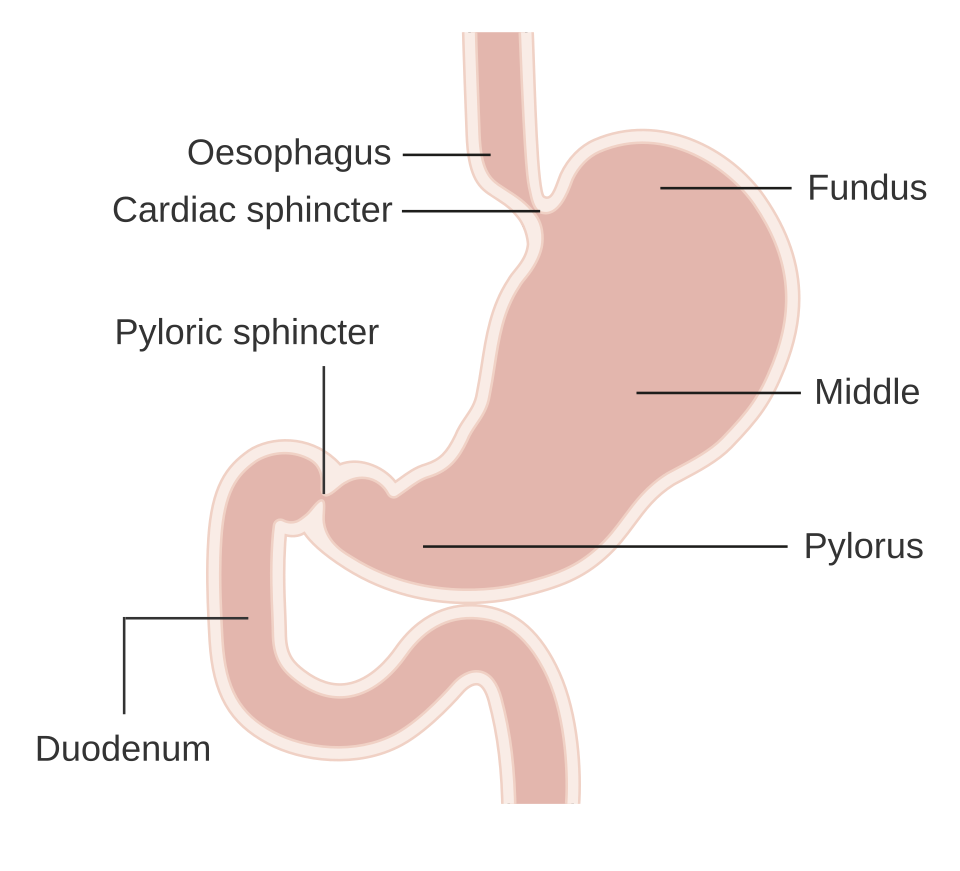
Stomach cancer begins when cells in the stomach grow out of control. More than 9 out of 10 stomach cancers are adenocarcinomas, which form in the gland cells of the inner lining (mucosa); rarer types include GISTs, lymphomas and neuroendocrine tumors. Precancerous changes can develop over several years and rarely cause symptoms, so they often go unnoticed.
Source: American Cancer Society, Cleveland Clinic
Doctors also divide adenocarcinomas by location: cardia cancers start just below the junction with the food pipe (esophagus), and non-cardia cancers start in the main body of the stomach. The two groups have different risk factors. In the US most cases arise near the gastroesophageal junction, while elsewhere they more often form in the main part of the stomach.
Source: American Cancer Society, Cleveland Clinic
The second reason stomach cancer symptoms are missed is that they are vague. The National Cancer Institute (NCI) states that early stomach cancer usually has no symptoms, which makes it hard to detect, and that symptoms usually begin after the cancer has spread. Early stomach cancer symptoms, when present, are things almost everyone has felt, and MedlinePlus notes that diagnosis is often delayed because they resemble less serious conditions such as heartburn or gas.
Source: National Cancer Institute, MedlinePlus
Stomach cancer is not very common in the UK, but the World Cancer Research Fund reports it was the 5th most common cancer worldwide in 2022, with about 969,000 new cases, and the highest rates in Mongolia, Japan and South Korea. In the US, NCI SEER puts the median age at diagnosis at 68.
Source: World Cancer Research Fund, NCI SEER, NHS
The 10 most common stomach cancer symptoms
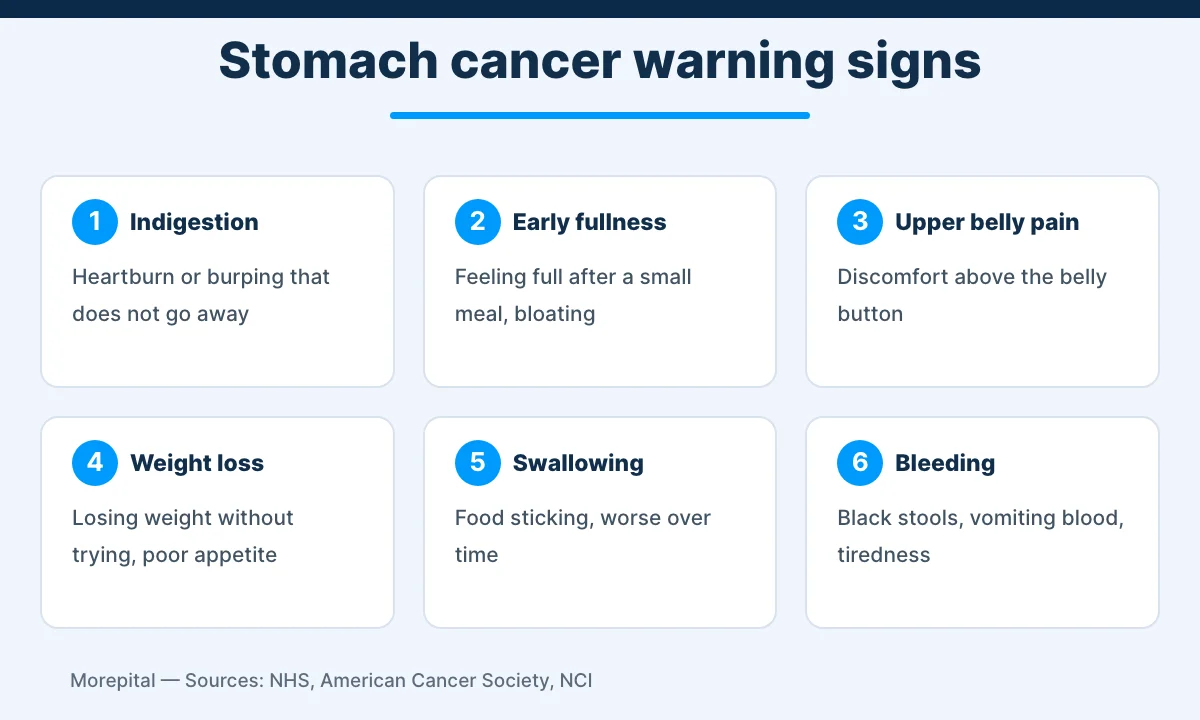
The NHS, Cancer Research UK, the American Cancer Society and the NCI describe a very similar list of 10 stomach cancer symptoms:
- Indigestion that does not go away – often with a lot of burping, or heartburn and acid reflux.
- Feeling full very quickly – feeling full after eating only a small amount, or bloated after meals.
- Pain or discomfort in the upper tummy – often a vague discomfort above the navel (belly button).
- Loss of appetite – not wanting to eat, or going off food.
- Losing weight without trying – weight loss that is not explained by changes to diet or exercise.
- Feeling or being sick – nausea, or vomiting with or without blood.
- Difficulty swallowing (dysphagia) – food feels as if it sticks; MedlinePlus describes trouble swallowing that worsens over time.
- Dark or black stools – a sign of bleeding in the stomach.
- Tiredness and weakness – often from a low red blood cell count (anemia).
- A lump or swelling in the tummy – a lump at the top of the abdomen, or swelling from fluid build-up (ascites).
Source: NHS, Cancer Research UK, American Cancer Society, National Cancer Institute, MedlinePlus
Most people with these stomach cancer symptoms do not have cancer; the American Cancer Society says they are more likely to be caused by something else. What matters is the pattern: stomach cancer symptoms that are new, persistent or worsening, or that come with weight loss or bleeding. Cancer Research UK advises seeing your doctor if you have unexplained weight loss or symptoms that are unusual for you or will not go away.
Source: American Cancer Society, Cancer Research UK
The table summarizes the main stomach cancer symptoms and how quickly to act.
| Symptom | What you may notice | How urgent |
|---|---|---|
| Indigestion, heartburn, burping | New or different, not settling with usual remedies | See a GP if no better after 3 weeks |
| Early fullness, poor appetite | Full after a few bites, going off food | See a GP if persistent or worsening |
| Difficulty swallowing | Food sticking, getting worse over time | See a GP |
| Unexplained weight loss | Losing weight without dieting | See a GP |
| Lump in the tummy | A firm area at the top of the abdomen | See a GP |
| Vomiting | Being sick for more than 2 days | Get urgent advice (NHS 111 in the UK) |
| Blood in vomit or black stools | Vomit with blood; dark brown or black stools | Seek medical help promptly |
Source: NHS, American Cancer Society, MedlinePlus
Early vs advanced stomach cancer symptoms
The NCI separates stomach cancer symptoms into two groups. Early-stage signs, when they occur at all, are indigestion and stomach discomfort, a bloated feeling after eating, mild nausea, loss of appetite and heartburn. Advanced-stage cancer can cause all of these plus blood in the stool, vomiting, weight loss for no known reason, stomach pain, trouble swallowing, yellowing of the skin and eyes (jaundice) and fluid build-up in the abdomen (ascites).
Source: National Cancer Institute
Some later stomach cancer symptoms reflect spread: the American Cancer Society notes that jaundice can occur if the cancer reaches the liver. Cancer Research UK adds that early and advanced tumors can bleed into the stomach and can block it, which explains vomiting and feeling full quickly.
Source: American Cancer Society, Cancer Research UK
Cleveland Clinic points out that unexplained weight loss and stomach pain usually appear later, so waiting for these stomach cancer symptoms before seeking help can mean the disease is already more advanced.
Source: Cleveland Clinic
Indigestion, reflux, ulcer or cancer?
Heartburn and indigestion are very common and usually harmless. Acid reflux, gastritis, ulcers and Helicobacter pylori (H. pylori) infection can all feel like early stomach cancer symptoms. If heartburn is your main problem, our guide to acid reflux and how to treat it explains the common causes and self-care steps.
Source: National Cancer Institute, MedlinePlus, NHS
The difference is usually in how the symptom behaves. The NHS advises seeing a GP if digestive symptoms are not getting better after 3 weeks of your usual treatments, or if other stomach cancer symptoms get worse or do not improve after 3 weeks. Indigestion is more worrying when it comes with food sticking, weight loss, vomiting, black stools or tiredness (see when to see a doctor).
Source: NHS, American Cancer Society
Reflux, gastritis, H. pylori and past ulcers are also risk factors for stomach cancer, according to Cleveland Clinic, so persistent indigestion should not be accepted as normal. If stomach cancer symptoms remain after your usual treatments, book an appointment rather than keep self-treating.
Source: Cleveland Clinic, NHS
Hidden bleeding and anemia
Stomach tumors can bleed slowly into the stomach. Blood that has been digested makes stools look dark brown or black and sticky, and larger bleeds can cause vomiting of blood. The American Cancer Society lists both as stomach cancer symptoms, alongside tiredness or weakness caused by having too few red blood cells (anemia).
Source: American Cancer Society, Cancer Research UK
Slow bleeding often causes no pain. Cancer Research UK notes that some people do not have any symptoms of their anemia, and that it may be picked up on a blood test done for another reason. Doctors take unexplained anemia seriously, because slow bleeding from a tumor is one possible cause; our article on anemia symptoms explains the other signs and causes of a low red blood cell count.
Source: Cancer Research UK, American Cancer Society
Dark or bloody stools can also come from the bowel; if you notice a change in bowel habit, read our guide to colon cancer symptoms. A blood count and a stool test for blood are among the first checks when stomach cancer symptoms are suspected.
Source: American Cancer Society, MedlinePlus
Who is at higher risk of stomach cancer
Risk rises with age, and most people diagnosed are in their 60s, 70s or 80s. The NHS lists these main risk factors: being over 50, being a man, past H. pylori infection, long-term severe acid reflux, gastritis or pernicious anemia, and a parent, brother or sister with stomach cancer.
Source: NHS, American Cancer Society
H. pylori infection
H. pylori is a stomach bacterium that the International Agency for Research on Cancer classified as a human carcinogen in 1994. Chronic infection is linked to cancer in the main (non-cardia) part of the stomach and to rare gastric MALT lymphoma. About two-thirds of the world’s population carries it, and most never develop cancer. In a trial in Shandong, China, 2 weeks of antibiotics cut gastric cancer incidence by nearly 50% over 22 years. Our article on H. pylori infection explains testing and treatment.
Source: National Cancer Institute, American Cancer Society
Lifestyle, diet and work
Smoking nearly doubles the risk of stomach cancer, especially in the upper stomach, and heavy drinking (3 or more drinks a day) probably raises it too. Salt-preserved foods, pickled vegetables and processed or charbroiled meats raise risk, while fresh fruit appears to lower it. Excess body weight is linked to cancers of the cardia; see our reference page on obesity. Coal, metal and rubber workers also appear to be at higher risk.
Source: American Cancer Society, Cleveland Clinic
Medical history and genes
Past partial stomach removal for ulcers, adenomatous polyps, pernicious anemia, common variable immune deficiency and Epstein-Barr virus infection are linked to higher risk. A small share of cases come from inherited syndromes, mainly CDH1 mutations (diffuse gastric and lobular breast carcinoma syndrome), Lynch syndrome, familial adenomatous polyposis, Li-Fraumeni and Peutz-Jeghers syndromes. Blood type A is also associated with higher risk.
Source: American Cancer Society, Cleveland Clinic
To lower your risk, the NHS recommends stopping smoking, losing weight if you are overweight, cutting down on salt, not drinking more than 14 units of alcohol a week, eating at least 5 portions of fruit and vegetables a day, and wearing protective equipment if you work with harmful chemicals.
Source: NHS
When to see a doctor about stomach cancer symptoms
The NHS gives clear thresholds. See a GP (family doctor) if you have:
- problems swallowing;
- a lump in your tummy;
- weight loss that is not caused by changes to your diet or exercise;
- other stomach cancer symptoms that get worse or do not get better after 3 weeks;
- a digestive condition whose symptoms are not improving after 3 weeks of your usual treatments.
Source: NHS
Get urgent advice the same day (in the UK, from NHS 111) if you have been vomiting for more than 2 days. Vomiting blood or passing black stools can be signs of bleeding and should be checked by a doctor promptly. Outside the UK, contact your doctor or local urgent care service.
Source: NHS, American Cancer Society
Before your appointment, note when your stomach cancer symptoms began and how often they occur, since the NCI says doctors will ask about both. It also warns that ignoring symptoms can delay treatment and make it less effective.
Source: National Cancer Institute
How doctors investigate stomach cancer symptoms
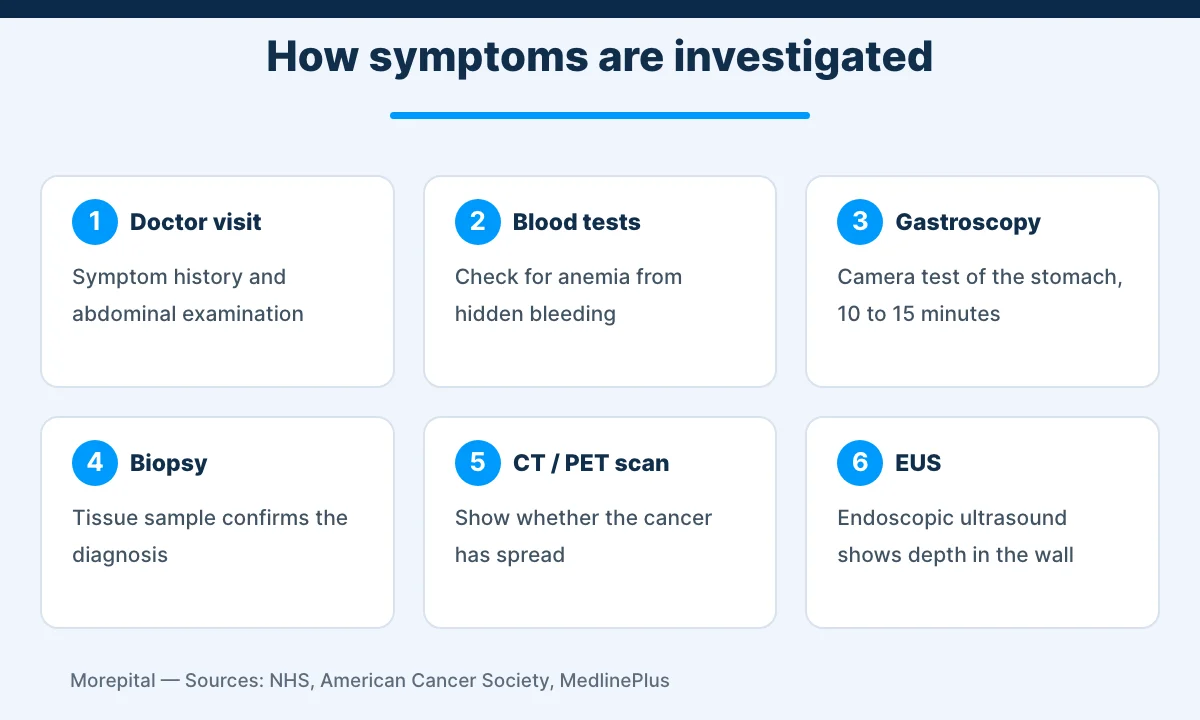
Your doctor will take a history and feel your abdomen for a lump. Blood tests check for anemia and a stool test may look for hidden blood. If stomach cancer symptoms need further checks, you will usually be referred for a gastroscopy.
Source: American Cancer Society, MedlinePlus
Gastroscopy (upper endoscopy) and biopsy
A gastroscopy (upper endoscopy or EGD) is the most common test when stomach cancer is suspected. A thin, flexible tube with a camera is passed through the mouth to view the esophagus, stomach and first part of the small intestine. The NHS says it takes around 10 to 15 minutes and may be uncomfortable but should not be painful; a throat spray or sedation may be offered. Biopsies are taken during the test, and results usually come within 2 weeks.
Source: NHS, American Cancer Society
Staging tests
If cancer is found, further tests show how far it has spread. A CT scan shows the tumor and whether it has reached the liver or lymph nodes. Endoscopic ultrasound (EUS) shows how deeply the cancer has grown into the stomach wall. PET scans, MRI and laparoscopy (keyhole surgery to look inside the abdomen) may also be used. The biopsy is also tested for markers such as HER2 and PD-L1, which help decide whether targeted drugs or immunotherapy could work.
Source: American Cancer Society, NHS, Cleveland Clinic
Why early diagnosis matters: survival, screening and treatment
Stage at diagnosis makes a large difference. In US SEER data (2016–2022), 5-year relative survival is 78.1% for stomach cancer still confined to the stomach (localized), 39.0% when it has spread to nearby lymph nodes and 8.1% when it has spread to distant organs. Only about 32% of cases are diagnosed at the localized stage, while 35% are found after distant spread, which reflects how quiet early stomach cancer symptoms are.
Source: NCI SEER
The American Cancer Society says no major medical organizations recommend routine screening for people at average risk in the US, although mass screening in some East Asian countries has found many stomach cancers at an early stage. People with inherited risk, such as CDH1 mutations or Lynch syndrome, may be offered regular upper endoscopies.
Source: American Cancer Society, Cleveland Clinic
Treatment depends on the stage, your general health and your preferences. Early cancers can sometimes be removed through an endoscope; larger tumors need partial or total gastrectomy. Chemotherapy, sometimes with radiation, may be given before or after surgery, and targeted therapy and immunotherapy are used mainly for advanced disease.
Source: Cleveland Clinic
Weight loss, poor appetite and jaundice also occur in other upper-abdominal cancers; our guide to pancreatic cancer symptoms explains how that disease presents.
Source: National Cancer Institute, National Cancer Institute
Stomach cancer symptoms: frequently asked questions
What are the first stomach cancer symptoms?
Early stomach cancer often causes none. When early signs appear, they are usually indigestion, heartburn, a bloated feeling after eating, mild nausea and loss of appetite.
Source: National Cancer Institute, American Cancer Society
Can stomach cancer symptoms come and go?
Yes. Indigestion and bloating can fluctuate, which is why they are easy to dismiss. The NHS advises seeing a GP if digestive symptoms do not improve after 3 weeks of your usual treatments.
Source: NHS
Where is stomach cancer pain felt?
Usually at the top of the tummy, often as a vague discomfort above the belly button rather than a sharp pain. Pain tends to be a later symptom.
Source: American Cancer Society, NHS, Cleveland Clinic
Do stomach cancer symptoms show up in blood tests?
There is no blood test that diagnoses stomach cancer. Blood tests can show anemia from slow bleeding, which may prompt further checks; the diagnosis needs an endoscopy and biopsy.
Source: American Cancer Society, Cancer Research UK
Does H. pylori mean I will get stomach cancer?
No. H. pylori raises the risk, but most people who carry it never develop stomach cancer. Treating the infection can lower the risk.
Source: American Cancer Society, National Cancer Institute
Can young people have stomach cancer symptoms?
It is uncommon, as most people diagnosed are over 60, but younger people can be affected, particularly those with inherited syndromes such as Li-Fraumeni syndrome or CDH1 mutations.
Source: American Cancer Society
Disclaimer: this article is for general health education and does not replace advice from a qualified doctor who can assess your individual case. Last updated: October 2026.