

Peyronie’s disease is a condition in which scar tissue (plaque) forms inside the penis and makes it curve, shorten or narrow during an erection, sometimes with pain. Mild cases may need no treatment, while bothersome curves can be managed with traction devices, injections or, once the condition has stabilized, surgery. A urologist can tell you which option fits the phase you are in.
Source: NHS, NIDDK, Cleveland Clinic
Source: EAU Guidelines, Cleveland Clinic
Contents
- What Peyronie’s disease is and how common it is
- Peyronie’s disease symptoms and complications
- Causes and risk factors
- The two phases of Peyronie’s disease
- How doctors diagnose and measure the curve
- Non-surgical Peyronie’s disease treatment
- Surgery for Peyronie’s disease: plication, grafting or implant
- Treatment options compared
- Treatment abroad and in Turkey: choosing a surgeon
- Peyronie’s disease: frequently asked questions
What Peyronie’s disease is and how common it is
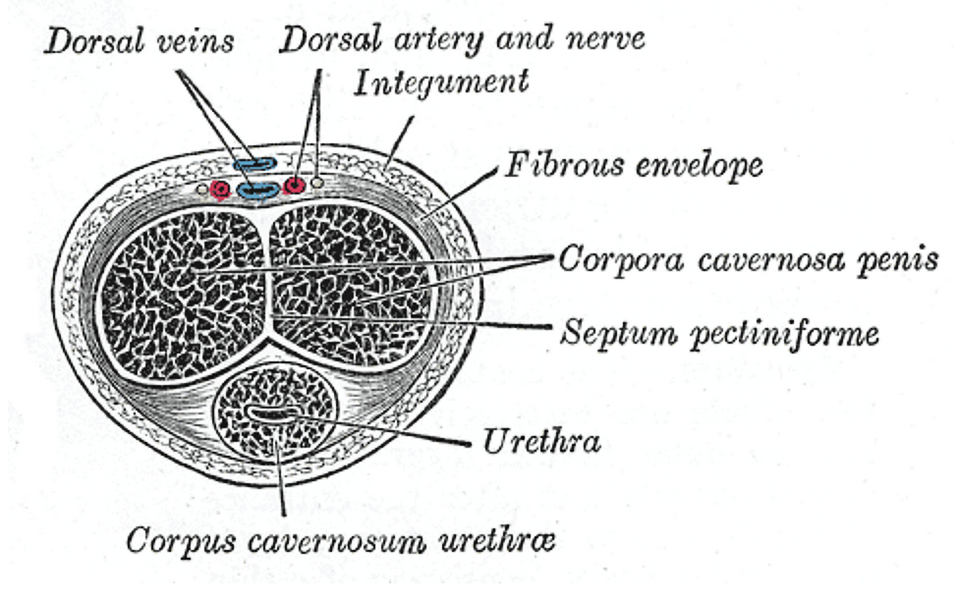
The penis has two spongy erection chambers wrapped in a tough sheath, the tunica albuginea. In Peyronie’s disease, fibrous scar tissue forms in this sheath; because the scar cannot stretch, the penis bends toward it during an erection. MedlinePlus describes Peyronie’s disease as the most common cause of an abnormal bend in the erect penis in adults.
Source: MedlinePlus, NHS
Some natural curvature is normal. Peyronie’s disease is a new curve or shape change, usually with a lump you can feel; the NHS says it mainly affects men over 40, though younger men can get it too.
Source: NHS
How many men have it?
Many men never mention it to a doctor, so figures vary. According to the US National Institute of Diabetes and Digestive and Kidney Diseases (NIDDK), about 1 in 100 American men over 18 have been diagnosed with Peyronie’s disease, but more than 1 in 10 may actually have it. The European Association of Urology (EAU) guideline gives a typical age of onset of 50 to 60 years.
Source: NIDDK, EAU Guidelines
Peyronie’s disease symptoms and complications
The most common signs of Peyronie’s disease are:
- a hard lump or band of tissue under the skin of the shaft;
- a curve when erect: upward if the plaque is on top, downward if it is underneath, and sideways if it is on one side;
- pain during erections or intercourse;
- shortening, narrowing or an “hourglass” dent in the middle of the shaft;
- softer erections or erectile dysfunction.
Source: NHS, Cleveland Clinic, NIDDK
Cleveland Clinic notes that about 1 in 3 people have calcium in the scar, and that a bend greater than 30 degrees can make sex painful or impossible. In severe cases, the penis may lose about 0.5 to 1.5 cm (0.2 to 0.6 in) of length.
Source: Cleveland Clinic
Complications beyond the curve
Erectile dysfunction is the main physical complication, reported in 30% to 70.6% of patients in the EAU guideline. If you are dealing with both problems, our erectile dysfunction reference page explains the causes and tests involved.
Source: EAU Guidelines, Cleveland Clinic
The emotional impact of Peyronie’s disease is often underestimated. In some reports cited by Di Maida and colleagues, nearly 80% of men with Peyronie’s disease had clinically meaningful depression, and more than half described relationship difficulties. NIDDK also lists anxiety and difficulty fathering a child when intercourse is not possible. Cleveland Clinic stresses that the condition itself does not cause infertility, cancer or urinary problems.
Source: Di Maida et al. (PMC), NIDDK, Cleveland Clinic
When to see a doctor
See a GP or urologist if you notice a lump on the penis, a new curve, painful erections, or erection problems that make sex difficult; the NHS advises not to feel embarrassed. Seek help urgently if you feel a sudden sharp pain during sex followed by swelling and bruising, which MedlinePlus lists as a reason to contact a provider and can be a sign of penile fracture.
Source: NHS, MedlinePlus
Causes and risk factors
The exact cause of Peyronie’s disease is not fully understood. The leading theory is abnormal wound healing after small injuries to the erect penis, for example from bending during sex. Cleveland Clinic points out that up to 80% of people do not remember a specific injury, so unnoticed micro-injuries may be enough in men prone to excess scarring. It is not a sexually transmitted infection and cannot be passed to a partner.
Source: Cleveland Clinic, NIDDK
Factors linked to a higher risk include:
- Age, with risk rising over time;
- Family history, such as a father or brother with the condition;
- Connective tissue and autoimmune disorders, including Dupuytren’s contracture of the hand, plantar fasciitis, scleroderma and lupus;
- Diabetes with erectile dysfunction, which NIDDK says raises the chance about 4 to 5 times;
- Prostate cancer surgery or radiation, and a previous penile fracture;
- Cardiovascular risk factors such as high blood pressure, high cholesterol and coronary heart disease, and some medicines including beta blockers and antidepressants, according to the NHS.
Source: NIDDK, NHS, MedlinePlus
NIDDK notes there is no proven way to prevent Peyronie’s disease, and diet has not been shown to play a role. Cleveland Clinic suggests reducing injury risk by treating erectile dysfunction, using lubricant and guiding the penis during penetration.
Source: Cleveland Clinic, NIDDK
The two phases of Peyronie’s disease
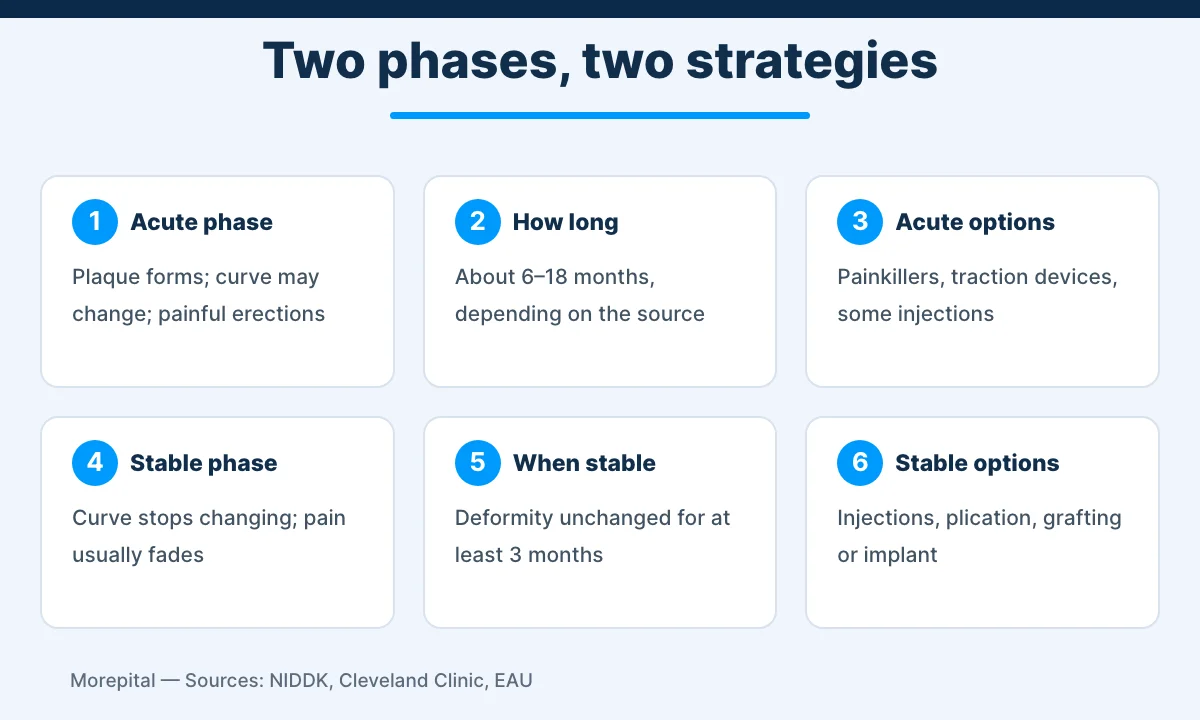
The phase you are in decides which treatments make sense. In the acute (active) phase, the plaque forms, the curve may change and erections are often painful. In the chronic (stable) phase, the scar stops growing, the curve no longer worsens and pain usually fades, although erectile dysfunction may appear or get worse.
Source: Cleveland Clinic, NIDDK
Cleveland Clinic says the acute phase lasts about 6 to 12 months; NIDDK says it can last up to 18 months, with the chronic phase usually starting 12 to 18 months after symptoms first appear. The Di Maida review explains that the chronic phase is generally defined as a deformity that has been stable for at least 3 months, and that some men reach it within 5 to 7 months of onset.
Source: Cleveland Clinic, NIDDK, Di Maida et al. (PMC)
Does it go away on its own?
Pain affects roughly 20% to 70% of men at onset and generally settles within 12 to 18 months. The curve is different: the same review found low rates of spontaneous healing. NIDDK says the condition goes away without treatment only in very few cases, while Cleveland Clinic notes that mild cases may improve but severe curves and plaques rarely resolve by themselves.
Source: Di Maida et al. (PMC), NIDDK, Cleveland Clinic
How doctors diagnose and measure the curve
Peyronie’s disease is usually diagnosed from your history and a physical examination. The EAU guideline recommends recording how long you have had symptoms, pain on erection, the type of deformity, difficulty with penetration and any erectile dysfunction. The doctor will feel for plaques, measure stretched penile length and look for related conditions such as Dupuytren’s contracture.
Source: EAU Guidelines, NIDDK
Measuring the curve
Your urologist may ask for photos of your erect penis taken at home, or give an injection in the clinic to produce an erection and measure the angle directly; the EAU guideline considers the injection method more accurate. Repeated measurements show whether the disease is still active.
Source: EAU Guidelines, NIDDK
Is an ultrasound needed?
Not always. A penile Doppler ultrasound shows the plaque, calcium and blood flow. The EAU guideline says ultrasound plaque measurements are operator-dependent, but recommends Doppler testing before surgery; CT and MRI are not needed routinely.
Source: EAU Guidelines, Cleveland Clinic
Non-surgical Peyronie’s disease treatment
A small, painless curve that does not interfere with sex may need no treatment. The NHS says Peyronie’s disease treatment is considered when symptoms are severe or cause pain during sex, depression or low self-esteem. Non-surgical options are mainly used in the active phase or for men who do not want surgery.
Source: NHS, EAU Guidelines
Pain relief and tablets
The EAU guideline strongly recommends anti-inflammatory painkillers (NSAIDs) for pain in the acute phase, and PDE5 tablets such as tadalafil when erectile dysfunction is also present; our guide to erectile dysfunction treatment compares these tablets. However, NIDDK states that no oral medicine effectively treats the curve itself, and Cleveland Clinic says there are no reliable studies showing tablets such as vitamin E, colchicine or potassium aminobenzoate reduce curvature.
Source: EAU Guidelines, NIDDK, Cleveland Clinic
Traction and vacuum devices
Traction devices gently stretch the penis each day, and vacuum devices draw blood into it. The EAU guideline suggests offering them to reduce deformity, while noting that outcome data are limited. In a 3-month randomized trial summarized by Reddy and colleagues, men using a traction device gained 0.5 cm in length and saw an average curve reduction of 11.7 degrees, compared with 1.3 degrees in the control group. Devices must be used daily for several months, and the NHS notes they are not usually available on the NHS.
Source: EAU Guidelines, Reddy et al., Res Rep Urol (PMC), NHS
Injections into the plaque
Collagenase clostridium histolyticum (brand name Xiaflex) is an enzyme that breaks down collagen in the plaque. NIDDK describes it as the only FDA-approved treatment for Peyronie’s disease, approved for curves greater than 30 degrees, and the EAU guideline strongly recommends it for dorsal or lateral curves over 30 degrees in men who want a non-surgical option. In the pivotal IMPRESS trials, the average curve improved by 34% with collagenase versus 18% with placebo. Availability differs by country: the EAU notes that the manufacturer has withdrawn it from the European market.
Source: NIDDK, EAU Guidelines, Reddy et al. (PMC)
Verapamil injections for Peyronie’s disease are still used in some clinics, but later randomized trials found no significant curve improvement compared with saline, and the EAU guideline makes no recommendation for them. Interferon alpha-2b is not recommended by the EAU, which notes it was withdrawn from the European and US markets in 2021.
Source: Reddy et al. (PMC), EAU Guidelines
Shockwave therapy and newer options
Shockwave therapy may ease acute-phase pain, but the EAU guideline strongly advises against using it to straighten the penis, and says data on platelet-rich plasma (PRP) injections are still limited.
Source: EAU Guidelines, Reddy et al. (PMC)
Surgery for Peyronie’s disease: plication, grafting or implant
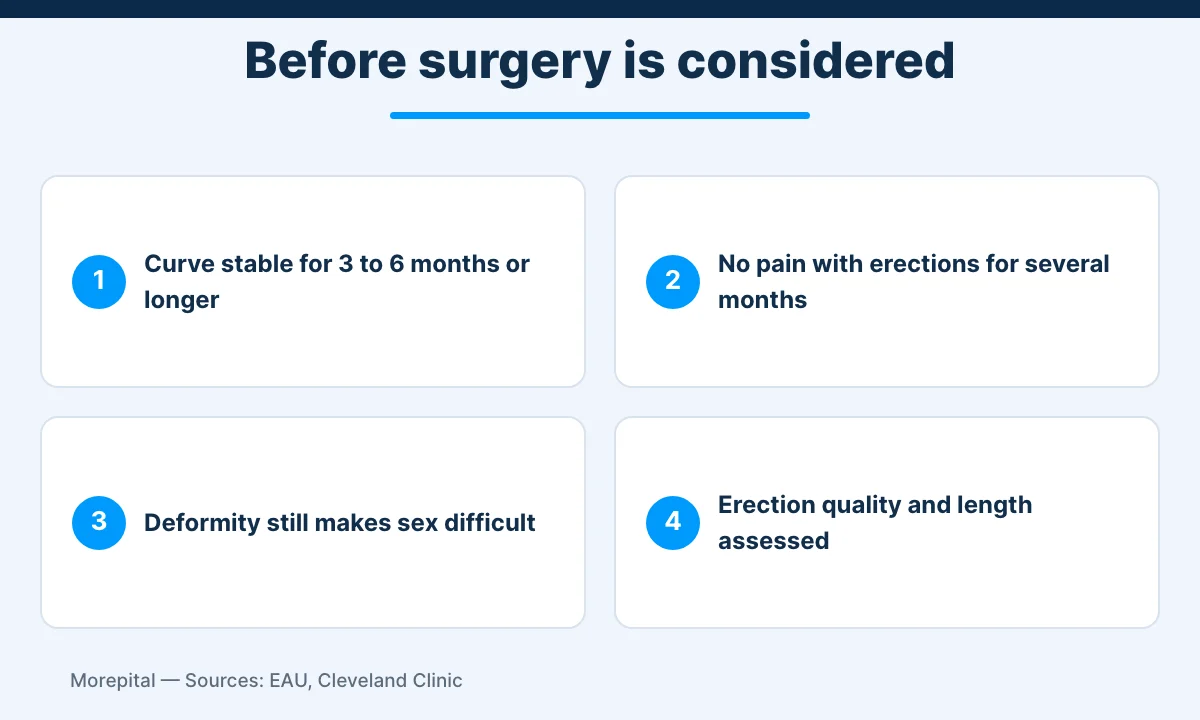
Surgery is the most reliable way to straighten a significant curve, but timing matters. The EAU guideline says to operate only when Peyronie’s disease is stable and the deformity compromises intercourse, which in practice means a stable curve for 3 to 6 months (or more than 9 to 12 months after onset). Cleveland Clinic adds that you should have had no pain for 6 to 12 months. The NHS cautions that it is not usually possible to make the penis exactly as it was before.
Source: EAU Guidelines, Cleveland Clinic, NHS
Plication (shortening the longer side)
Stitches are placed, or a small piece of tissue removed, on the side opposite the plaque. The EAU guideline suggests it as the first option for men with good erections, adequate length, a less severe curve and no complex deformity such as an hourglass. NIDDK notes it causes less numbness and erectile dysfunction than grafting, but it cannot restore length or girth, and some length is usually lost.
Source: EAU Guidelines, NIDDK, Cleveland Clinic
Plaque incision and grafting (lengthening the shorter side)
The plaque is cut or partly removed and the gap covered with a graft. The EAU guideline suggests it for men with normal erections who have a severe curve, a complex deformity or not enough length for plication. It may restore some length, but NIDDK warns that numbness and erectile dysfunction can follow. The EAU strongly advises against the so-called sliding technique because of the risk of life-changing complications.
Source: EAU Guidelines, NIDDK
Penile implant (when erections are also affected)
For men who have both Peyronie’s disease and erectile dysfunction that does not respond to tablets, the EAU guideline strongly recommends a penile prosthesis, with extra straightening steps during the same operation if needed. Cleveland Clinic calls an inflatable implant the best option here. Read more in our penile implant guide.
Source: EAU Guidelines, Cleveland Clinic
Treatment options compared
| Option | Best suited to | Main limitation |
|---|---|---|
| Watchful monitoring | Small, painless curve that does not affect sex | Severe curves rarely resolve alone |
| NSAID painkillers | Painful erections in the acute phase | Do not straighten the penis |
| Traction or vacuum device | Men wanting to limit curve and length loss | Daily use for months; limited data |
| Collagenase injections | Dorsal or lateral curve over 30 degrees | Not available in every country |
| Plication | Stable, simpler curve with good erections and length | Some length loss |
| Incision and grafting | Severe or complex curve with good erections | Higher risk of numbness and ED |
| Penile implant | Curve plus ED not helped by tablets | Permanent; replaces natural erections |
Source: EAU Guidelines, NIDDK, Cleveland Clinic
Treatment abroad and in Turkey: choosing a surgeon
Many men travel abroad for Peyronie’s disease surgery or implants, and Turkey is a common destination. Wherever you go, the US Centers for Disease Control and Prevention (CDC) advises checking the qualifications of the surgeon and the credentials of the facility, while remembering that accreditation does not guarantee a good result. It also advises seeing your own doctor 4 to 6 weeks before travel and arranging follow-up care at home.
Source: CDC
After major surgery, the CDC suggests waiting 10 to 14 days before flying to reduce the risk of blood clots. Ask for copies of your operation notes, ideally in English. In Istanbul, Male Hospital is a clinic focused on men’s health and urology that publishes an overview of its penile curvature correction options, which you can compare with the guidance above.
Source: CDC
Questions to ask before you decide
- Is my Peyronie’s disease stable, and how was that confirmed?
- How large is my curve, measured on an erection, and is there an hourglass or indentation?
- Which procedure do you recommend for me, and why not the alternatives?
- How much length might I lose or gain, and what is the risk of numbness or erectile dysfunction?
Source: EAU Guidelines, NIDDK, CDC
Softer erections and low libido can also have other causes, such as those in our article on low testosterone symptoms, and couples worried about conception can read our guide to male infertility.
Considering Peyronie’s disease treatment? Contact us for a free consultation and a treatment plan tailored to you.
Peyronie’s disease: frequently asked questions
Can Peyronie’s disease go away without treatment?
Occasionally, in mild cases, but it is uncommon. Pain usually settles within 12 to 18 months, while the curve tends to stay the same or worsen. NIDDK says the condition disappears without treatment only in very few cases.
Source: NIDDK, Di Maida et al. (PMC)
Is Peyronie’s disease cancer or an STI?
No. Peyronie’s disease is a benign scarring condition. It is not cancer, not a sexually transmitted infection and not contagious, and it does not affect the rest of the body.
Source: Cleveland Clinic, NIDDK
How much curve is too much?
There is no single cut-off for Peyronie’s disease. Treatment is considered when the curve causes pain, distress or problems with sex. Cleveland Clinic notes that a bend of more than 30 degrees can make intercourse painful or impossible, and 30 degrees is also the threshold for collagenase injections.
Source: Cleveland Clinic, NHS
Can tablets or vitamin E cure Peyronie’s disease?
No oral medicine has been shown to reliably reduce the curve. Tablets may help with pain or erections, but not with the bend itself.
Source: NIDDK, Cleveland Clinic
When can I have surgery for Peyronie’s disease?
Only once the curve has been stable for 3 to 6 months and the deformity still makes sex difficult.
Source: EAU Guidelines
Will surgery make my penis shorter?
Plication usually causes some length loss; grafting may restore some length but carries a higher risk of numbness and erectile problems.
Source: NIDDK, Cleveland Clinic
Disclaimer: this article is for general health education and does not replace advice from a qualified doctor who can assess your individual case. Last updated: October 2026.