
Testicular cancer symptoms most often start with a painless lump or swelling in one testicle, a testicle that gets bigger, or a scrotum that feels heavy, firm or hard. Some men also notice a dull ache in the testicle, scrotum, lower belly or groin, while back pain, a cough, breathlessness or tender breasts can mean the tumor is making hormones or has spread. Most testicular lumps are not cancer, but any new change should be checked by a doctor, because this cancer is highly treatable when found early.
Source: NHS, American Cancer Society, Cancer Research UK
Contents
- What are testicular cancer symptoms?
- The main testicular cancer symptoms in the testicle
- Does testicular cancer hurt?
- Breast changes and other hormone-related signs
- Testicular cancer symptoms when it has spread
- Testicular cancer symptoms or something harmless?
- How to check your testicles
- Who is most at risk?
- Tests, treatment and outlook
- When to see a doctor about testicular cancer symptoms
- Testicular cancer symptoms: frequently asked questions
What are testicular cancer symptoms?
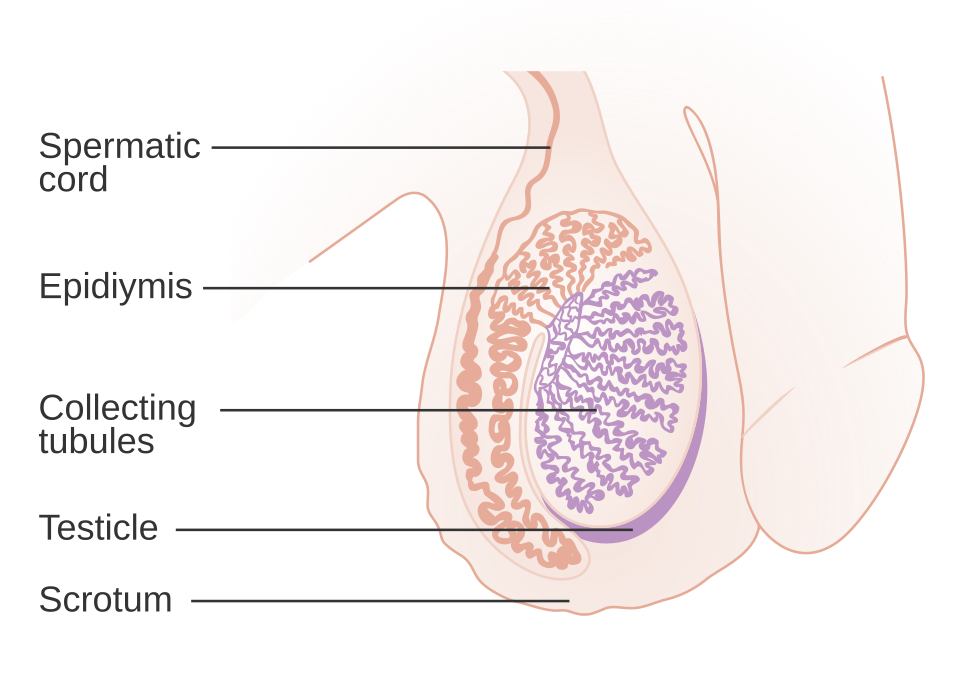
The testicles (testes) are two oval glands that hang in the scrotum, the pouch of skin below the penis. They make sperm and the hormone testosterone. Behind each testicle sits the epididymis, a coiled tube that stores and carries sperm, and above it runs the spermatic cord, which holds the blood vessels and the tube that carries sperm away.
Source: Cleveland Clinic, American Cancer Society
Testicular cancer starts in the testicles and usually affects one side, although it can affect both. Nearly all cases (about 95%) are germ cell tumors, which grow from the cells that make sperm. These fall into two main groups: seminomas, which tend to grow slowly, and nonseminomas, which tend to grow faster and include embryonal carcinoma, yolk sac tumor, choriocarcinoma and teratoma.
Source: NHS, Cleveland Clinic, MedlinePlus
The American Cancer Society estimates about 9,810 new cases and about 630 deaths in the United States in 2026, with an average age at diagnosis of about 33. Roughly 1 in 250 males will develop it during their lifetime, while the lifetime risk of dying from it is only about 1 in 5,000.
Source: American Cancer Society
Because the testicles are easy to feel, most testicular cancer symptoms are physical changes a man can notice himself. The American Cancer Society notes that most testicular cancers are found at an early stage, usually because of a lump, which is often the first of the testicular cancer symptoms a man notices.
Source: American Cancer Society
The main testicular cancer symptoms in the testicle
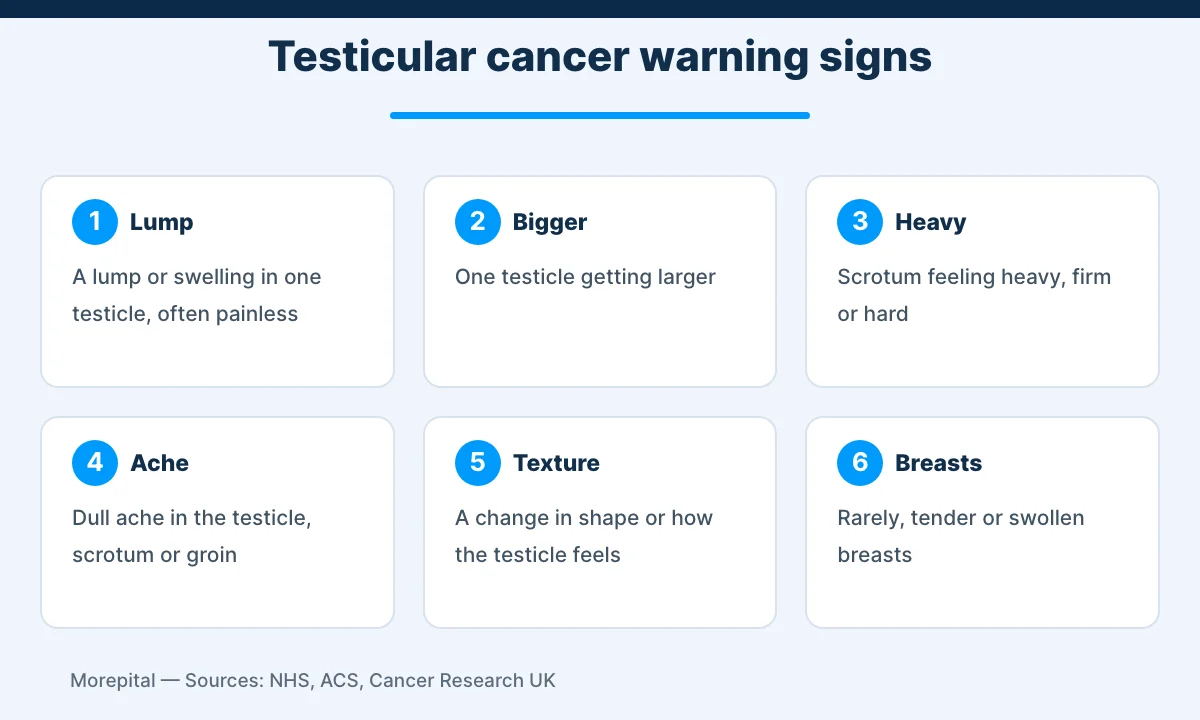
The NHS lists four main testicular cancer symptoms, and Cancer Research UK and the American Cancer Society agree:
- A lump or swelling in a testicle. This is the most common of all testicular cancer symptoms. It is often a hard mass and usually does not hurt.
- A testicle that gets bigger. One side may swell or grow larger over weeks.
- A heavy, firm or hard scrotum. Some men describe a dragging feeling or pressure.
- An ache or pain in the testicle or scrotum. This is less common than a painless lump.
Source: NHS, Cancer Research UK, American Cancer Society
Cancer Research UK adds that the shape or texture of the testicle may change, and the National Cancer Institute mentions a change in how the testicle feels, a dull ache in the lower abdomen or groin, and a sudden buildup of fluid in the scrotum. Testicular cancer symptoms like these can come from other conditions, so they are reasons to get checked, not proof of cancer.
Source: Cancer Research UK, National Cancer Institute
One testicle is often slightly larger than the other or hangs lower, and that alone is not one of the testicular cancer symptoms. What matters is a change from what is usual for you, which is why getting to know how your own testicles look and feel is the most useful habit.
Source: American Cancer Society, NHS
Does testicular cancer hurt?
Usually not at first. The American Cancer Society says some testicular tumors cause pain, but most of the time they do not. Cancer Research UK makes the same point and adds that for some men a sharp pain is the first of their testicular cancer symptoms. Cleveland Clinic describes possible heaviness, pressure or a dull ache, with sharp, stabbing pain being rare.
Source: American Cancer Society, Cancer Research UK, Cleveland Clinic
A painless, hard lump in the body of the testicle is the textbook presentation of testicular cancer, while painful, tender swelling is more typical of infection or inflammation. Neither feeling rules cancer in or out, so the rule for testicular cancer symptoms is simple: any persistent change should be examined, painful or not.
Source: Cleveland Clinic, American Cancer Society
Sudden, severe pain is a separate emergency
Sudden, severe pain in one testicle, often with swelling, a testicle sitting higher than normal, or nausea and vomiting, can be testicular torsion: the spermatic cord twists and cuts off the testicle’s blood supply. Torsion is most common in the first year of life and at the start of puberty, but it can happen in older men. MedlinePlus notes that if surgery is done within 6 hours, most of the testicle can usually be saved. Go to an emergency department straight away; do not wait to see whether it settles.
Source: MedlinePlus, nidirect (NHS Northern Ireland)
Breast changes and other hormone-related signs
Some testicular tumors make hormones, and these can cause testicular cancer symptoms far from the scrotum. In rare cases, germ cell tumors make the breasts grow or become sore, because they release human chorionic gonadotropin (hCG), a hormone that stimulates breast development. Cancer Research UK describes this as tender or swollen breasts, and the NHS lists a sore or swollen chest among other possible testicular cancer symptoms.
Source: American Cancer Society, Cancer Research UK, NHS
Breast tissue enlargement in males, called gynecomastia, has many common causes and also happens normally in teenage boys, as MedlinePlus points out. So breast swelling on its own is rarely due to testicular cancer, but if it appears together with any testicle change, mention both to your doctor.
Source: MedlinePlus
Some Leydig cell tumors make estrogens, which can cause breast growth or loss of sexual desire. Others make androgens (male hormones), which in boys can trigger signs of puberty at an unusually early age, such as a deepening voice and growth of facial and body hair. In adult men these androgen-producing tumors may cause no testicular cancer symptoms at all. Changes in sex drive have many other causes; see our guide to low testosterone symptoms.
Source: American Cancer Society
Testicular cancer symptoms when it has spread
Testicular cancer usually spreads first to the lymph nodes at the back of the abdomen (the retroperitoneal nodes), and beyond them most often to the lungs and liver; it can also reach the brain. Testicular cancer symptoms then depend on where it has gone:
- Lymph nodes in the abdomen: low back pain or a dull ache in the lower belly.
- Lungs or chest: shortness of breath, chest pain, a cough (sometimes coughing up blood), difficulty swallowing or swelling in the chest.
- Other lymph nodes: lumps around the collarbone or in the neck.
- Liver or abdomen: belly pain from enlarged nodes or liver spread.
- Brain: headaches or confusion.
- General: losing weight without trying.
Source: American Cancer Society, Cancer Research UK, NHS, Cleveland Clinic
The American Cancer Society notes that many men have no spread-related testicular cancer symptoms even when the cancer has spread, so their absence does not mean a lump is harmless. Cancer Research UK also stresses that testicular cancer can usually be cured even if it has spread by the time it is diagnosed.
Source: American Cancer Society, Cancer Research UK
Testicular cancer symptoms or something harmless?
Cancer Research UK notes that most testicular lumps are benign, and nidirect, the NHS information service for Northern Ireland, says most causes are harmless. These are the conditions that most often mimic testicular cancer symptoms:
Source: Cancer Research UK, nidirect (NHS Northern Ireland)
| Condition | What it is | Typical feel or clue |
|---|---|---|
| Testicular cancer | Tumor in the testicle itself | Often a hard, painless lump or enlargement; scrotum may feel heavy |
| Epididymal cyst | Fluid-filled sac in the epididymis | Small, separate from the testicle; often needs no treatment |
| Varicocele | Swollen veins in the spermatic cord | Usually harmless; can cause aching or affect fertility |
| Hydrocele | Fluid around the testicle | Common in newborns; in men may follow inflammation or injury |
| Epididymitis or orchitis | Infection or inflammation (orchitis is often linked to mumps) | Painful, tender swelling; bacterial cases need antibiotics |
| Inguinal hernia | A hernia in the groin | Groin or scrotal swelling that often appears when lifting and goes when lying down |
| Testicular torsion | Twisted spermatic cord | Sudden, severe pain and swelling: an emergency |
Source: nidirect (NHS Northern Ireland), American Cancer Society, MedlinePlus
You cannot reliably tell these apart by touch alone. A scrotal ultrasound shows whether a lump is solid tissue inside the testicle or a fluid-filled cyst outside it. Some of these benign conditions, such as a varicocele, can affect sperm production; our article on male infertility covers that link.
Source: Cancer Research UK, nidirect (NHS Northern Ireland)
How to check your testicles
Experts disagree on whether men without testicular cancer symptoms should do a formal monthly self-exam. Cleveland Clinic recommends a monthly check. The American Cancer Society says some doctors recommend monthly exams after puberty, but it makes no recommendation for all men because self-exams have not been studied enough to show they lower the death rate. It does advise every man to be aware of testicular cancer and to see a doctor right away about a lump, and it says men with risk factors should seriously consider monthly self-exams. The NHS advises checking regularly to learn what is normal for you.
Source: Cleveland Clinic, American Cancer Society, NHS
If you choose to check, the American Cancer Society describes a simple method:
- Examine yourself during or after a warm bath or shower, when the scrotal skin is relaxed.
- Hold the penis out of the way and check one testicle at a time.
- Roll each testicle gently between the thumbs and fingers of both hands.
- Feel for hard lumps or nodules, or any change in size, shape or consistency.
Source: American Cancer Society
Remember that the epididymis, the soft, rope-like structure at the back and top of each testicle, can feel like a bump and is often mistaken for an abnormal lump. A doctor can show you what is normal.
Source: American Cancer Society
Who is most at risk?
The exact cause of testicular cancer is often unclear, and most men who get it have no obvious risk factor. Known risk factors include:
- An undescended testicle (cryptorchidism): about 3% of boys are born with one, and it makes testicular cancer many times more likely. Roughly 1 in 4 of these cancers develop in the normally descended testicle.
- Family history: a father or brother (Cleveland Clinic also lists a son) with testicular cancer.
- Previous testicular cancer: about 3% to 4% of men cured of cancer in one testicle later develop it in the other.
- Age: about half of cases occur between ages 20 and 45, but it can happen at any age.
- Ethnicity: white men have a higher risk than Black and Asian men; the NHS lists a white British background.
- Other conditions: HIV infection, Klinefelter syndrome, hypospadias, carcinoma in situ of the testicle, and low fertility or infertility.
Source: American Cancer Society, NHS, Cleveland Clinic
The American Cancer Society says injury to the testicle and repeated activities such as horseback riding are not linked to testicular cancer, and most studies have not found that strenuous exercise raises the risk. MedlinePlus states there is no link between vasectomy and testicular cancer. Testicular cancer is a different disease from prostate cancer, which mainly affects older men; read about prostate cancer symptoms if urinary changes are your concern.
Source: American Cancer Society, MedlinePlus
Tests, treatment and outlook
What happens at the appointment
A GP or primary care doctor will ask about your testicular cancer symptoms and general health, then examine your testicles and the lymph nodes at the top of your legs. If cancer is possible, you will be referred urgently for tests or to a specialist, usually a urologist. An urgent referral does not mean you definitely have cancer.
Source: NHS, Cancer Research UK
Main tests
- Scrotal ultrasound: a painless scan that shows whether a lump is solid or a fluid-filled cyst.
- Blood tests for tumor markers: alpha-fetoprotein (AFP), human chorionic gonadotropin (hCG) and lactate dehydrogenase (LDH). Raised levels can point to testicular cancer, but not every tumor raises them and other conditions can, so they cannot diagnose cancer alone.
- CT or MRI scans: of the chest, abdomen and pelvis, to see whether the cancer has spread (staging).
Source: Cancer Research UK, NHS, National Cancer Institute
Unlike many cancers, testicular cancer is not usually confirmed with a needle biopsy through the scrotum. The National Cancer Institute explains that cutting through the scrotum could spread cancer, so the whole testicle is removed through a cut in the groin (inguinal orchiectomy) and examined under a microscope. This operation is both the diagnosis and the main treatment.
Source: National Cancer Institute, NHS
Treatment
Surgery to remove the affected testicle may be the only treatment needed. Depending on the type and stage, it may be followed by close surveillance, chemotherapy, radiotherapy (mainly for seminomas) or surgery to remove lymph nodes in the abdomen. Men are usually offered an artificial testicle (prosthesis) at the time of surgery.
Source: NHS, National Cancer Institute, Cleveland Clinic
Removing one testicle does not usually affect fertility, but chemotherapy can, and some treatments may cause permanent infertility. Men are offered the chance to store sperm before treatment starts. If sexual problems such as erection difficulties appear after cancer treatment, see our guide to erectile dysfunction.
Source: NHS, National Cancer Institute
Outlook
Testicular cancer is among the most treatable and curable cancers. Based on people diagnosed in 2015 to 2021, the American Cancer Society reports 5-year relative survival rates of 99% when the cancer is localized, 96% when it has spread to nearby lymph nodes or structures, and 72% when it has spread to distant organs. Cleveland Clinic notes that most recurrences happen within the first two to three years.
Source: MedlinePlus, American Cancer Society, Cleveland Clinic
When to see a doctor about testicular cancer symptoms
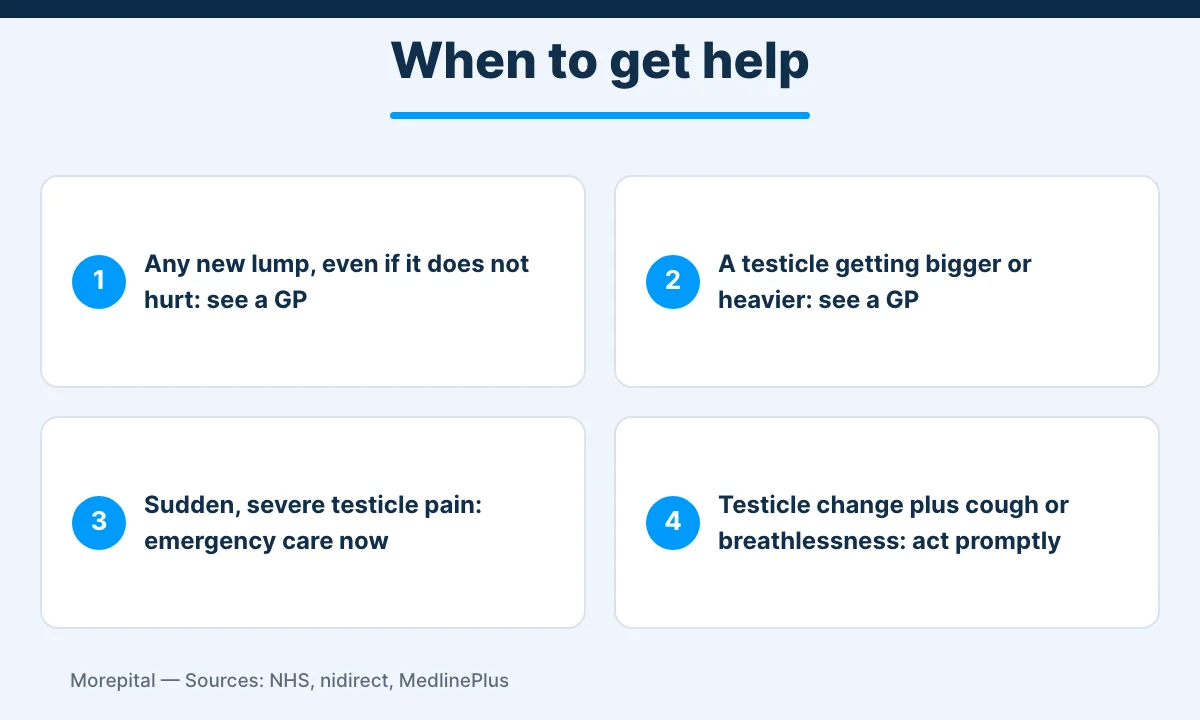
Book an appointment with a GP or primary care doctor if you notice any of the following, even if it does not hurt:
- a lump or swelling on one or both testicles
- one or both testicles getting bigger
- a heavy, firm or hard scrotum
- an ache or pain in the scrotum or testicles
- any change in your testicles that is unusual for you
Source: NHS
Cancer Research UK advises seeing a doctor about testicular cancer symptoms that are unusual for you or that do not go away or improve. Do not wait for testicular cancer symptoms to grow or start hurting first. Testicular examination is a routine part of a physical exam, and an ultrasound is an easy, painless test.
Source: Cancer Research UK, American Cancer Society
Go to an emergency department straight away for sudden, severe pain in a testicle or in the lower belly, because this may be torsion. Seek prompt care, too, if testicle changes come with coughing up blood, breathlessness or confusion. If you have already been treated for testicular cancer, report new testicular cancer symptoms without waiting for your next follow-up appointment, and keep checking the remaining testicle.
Source: nidirect (NHS Northern Ireland), American Cancer Society, NHS, National Cancer Institute
Testicular cancer symptoms: frequently asked questions
What is usually the first of the testicular cancer symptoms?
A lump or swelling in one testicle, often painless, is the most common of the early testicular cancer symptoms. Some men first notice that a testicle has grown or that the scrotum feels heavy.
Source: Cancer Research UK, American Cancer Society
Are painless testicular cancer symptoms more worrying than painful ones?
A painless, hard lump is the typical presentation of testicular cancer, while painful swelling is more often due to infection or inflammation. Either way, any lump that persists needs a doctor’s examination.
Source: American Cancer Society, Cleveland Clinic
Are most testicular lumps cancer?
No. Most lumps and swellings in the scrotum are benign, such as cysts, varicoceles or hydroceles. Only an examination and usually an ultrasound can tell the difference.
Source: Cancer Research UK, nidirect (NHS Northern Ireland)
At what age do testicular cancer symptoms usually appear?
Most cases occur between about 15 and 49, and the average age at diagnosis in the United States is about 33. Around 6% of cases occur in children and teens and about 8% in men over 55.
Source: NHS, American Cancer Society
Can testicular cancer symptoms affect the breasts?
Yes, rarely. Some tumors release hCG or estrogens, which can make the breasts swell or feel tender. Breast swelling in men has many other causes, so it should be checked alongside any testicle change.
Source: American Cancer Society, Cancer Research UK
Can a testicle injury cause testicular cancer?
No. The American Cancer Society says testicular injury is not linked to testicular cancer, and MedlinePlus says vasectomy is not linked either.
Source: American Cancer Society, MedlinePlus
Can you have children after testicular cancer?
Often, yes. Removing one testicle does not usually affect fertility, but chemotherapy can. Ask about sperm banking before treatment starts.
Source: NHS, National Cancer Institute
Is testicular cancer curable once symptoms appear?
Usually. It is among the most curable cancers, with a 5-year relative survival rate of about 99% when found before it spreads, and many men are cured even when it has spread.
Source: American Cancer Society, Cancer Research UK
Disclaimer: this article is for general health education and does not replace advice from a qualified doctor who can assess your individual case. Last updated: October 2026.