
Pancreatic cancer symptoms most often include yellowing of the skin or eyes (jaundice), pain in the upper belly that can spread to the back, unexplained weight loss, loss of appetite, pale or greasy stools, nausea and constant tiredness. Early pancreatic cancer usually causes no symptoms, and each of these signs has more common causes, so get symptoms checked when they are new, persistent or unusual for you. Jaundice should be seen by a doctor the same day.
Source: NHS, American Cancer Society, National Cancer Institute
Source: American Cancer Society, National Cancer Institute, NCI SEER, Pancreatic Cancer UK
Contents
- Pancreatic cancer symptoms: why they are easy to miss
- The 9 most common pancreatic cancer symptoms
- Jaundice: often the first of the pancreatic cancer symptoms
- Belly and back pain: what pancreatic cancer pain feels like
- New-onset diabetes and blood clots as early clues
- Who is at higher risk of pancreatic cancer
- When to see a doctor about pancreatic cancer symptoms
- How doctors investigate pancreatic cancer symptoms
- Why early diagnosis matters: survival and screening
- Pancreatic cancer symptoms: frequently asked questions
Pancreatic cancer symptoms: why they are easy to miss
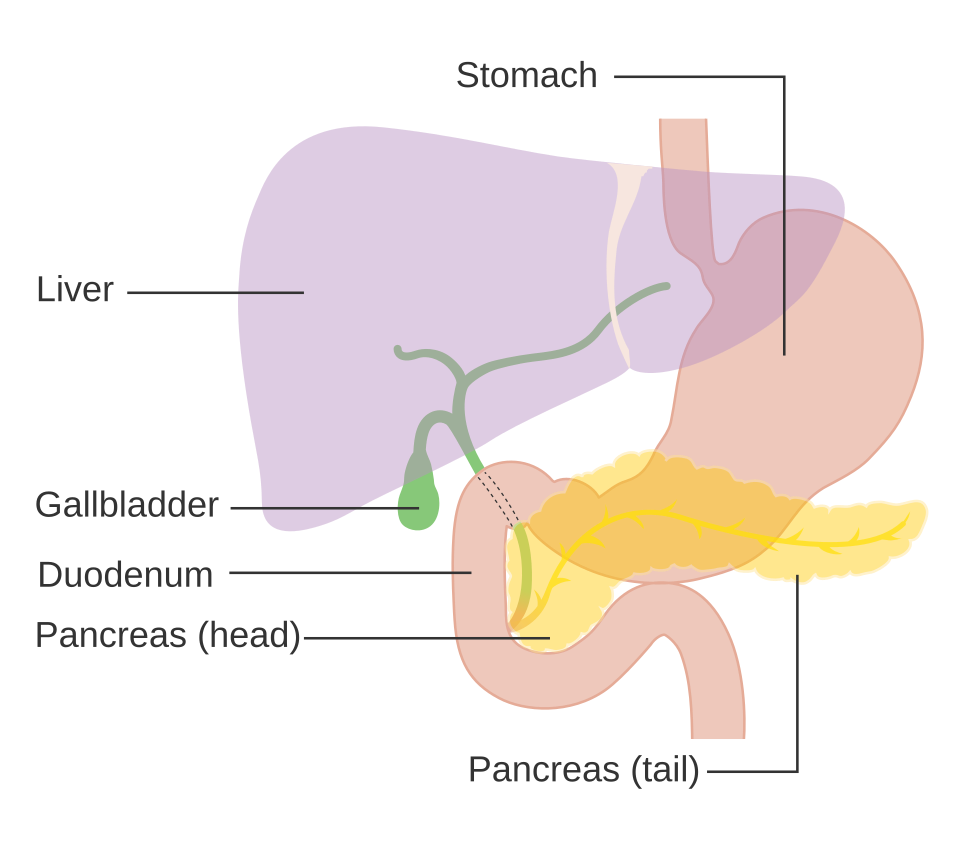
The pancreas is an organ about 15 cm (6 inches) long that sits behind the stomach. Most of its cells make digestive enzymes that travel through ducts to the small intestine; a smaller share release hormones such as insulin and glucagon that control blood sugar. Because the gland lies so deep, a small tumor rarely causes noticeable problems. The American Cancer Society and the US National Cancer Institute both state that early pancreatic cancer generally has no signs or symptoms, and that by the time pancreatic cancer symptoms appear, the tumor has often grown large or spread.
Source: American Cancer Society, American Cancer Society, National Cancer Institute
The second problem is that pancreatic cancer symptoms look like everyday digestive complaints. Bloating, indigestion, poor appetite, diarrhea, constipation and tiredness are very common, and the NHS stresses that they are usually caused by other conditions. What should raise concern is the pattern: symptoms that are new, keep going, cluster together or come with weight loss.
Source: NHS
Adenocarcinoma and neuroendocrine tumors
“Pancreatic cancer” usually means adenocarcinoma, which starts in the exocrine (enzyme-making) part of the gland; Cleveland Clinic notes that more than 9 out of 10 pancreatic tumors are this type. Pancreatic neuroendocrine tumors (PNETs) are rare, can be cancerous or benign, and are usually less aggressive. This article focuses on adenocarcinoma.
Source: Cleveland Clinic
The 9 most common pancreatic cancer symptoms
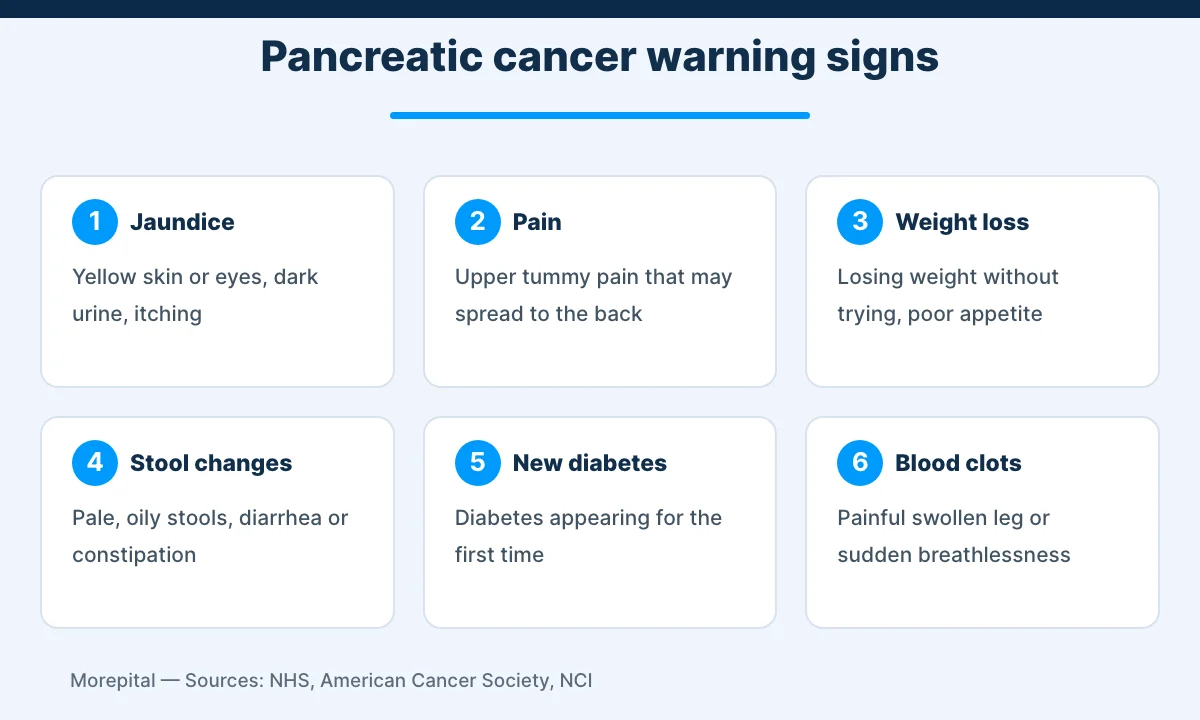
Major health organizations list a consistent set of warning signs. No single sign proves you have cancer, but these are the pancreatic cancer symptoms doctors look for:
- Jaundice: yellow skin or whites of the eyes, often with itching, dark urine and pale stools.
- Upper abdominal and back pain: pain at the top of the tummy that may spread to the back.
- Unexplained weight loss: losing weight without trying, often with little appetite.
- Stool and bowel changes: diarrhea, constipation, or pale, oily stools that are hard to flush.
- Indigestion, gas and bloating: a burning feeling in the upper tummy or feeling full and swollen.
- Nausea and vomiting: especially if the tumor partly blocks the outlet of the stomach.
- New-onset diabetes: diabetes appearing for the first time, sometimes with thirst and frequent urination.
- Blood clots: a painful, swollen leg, or breathlessness from a clot in the lungs.
- Fatigue: tiredness or weakness not explained by activity; the NHS also lists fever or feeling hot, cold or shivery.
Source: NHS, American Cancer Society, National Cancer Institute, Pancreatic Cancer UK
Beyond the pancreatic cancer symptoms you can feel, doctors may also find signs you cannot notice yourself. A blocked bile duct can make the gallbladder swell so it can be felt as a lump under the right ribs, and cancer that has spread to the liver can enlarge it, which may be felt on examination or seen on a scan.
Source: American Cancer Society
Jaundice: often the first of the pancreatic cancer symptoms
For most people with the disease, jaundice is one of the first pancreatic cancer symptoms, according to the American Cancer Society. It happens when a tumor blocks the bile duct, so a yellow pigment called bilirubin builds up in the body. Typical changes are:
- Dark urine: often the first thing people notice.
- Yellow skin and eyes: a yellow tint to the skin and the whites of the eyes.
- Pale, gray or greasy stools: without bile, fats are not broken down properly and stools may float.
- Itchy skin: bilirubin deposited in the skin can cause itching.
Source: American Cancer Society, NHS
Gallstones and hepatitis are far more common causes of jaundice than cancer, but the cause always needs to be found. The NHS lists yellowing of the eyes or skin as a reason for an urgent GP appointment or a call to NHS 111, and Pancreatic Cancer UK advises going to your GP or the emergency department straight away.
Source: American Cancer Society, NHS, Pancreatic Cancer UK
Head versus body and tail tumors
The head of the pancreas lies on the right side of the abdomen, the body behind the stomach and the tail on the left next to the spleen. Tumors in the head can block the bile duct while still small, so jaundice may appear relatively early. Tumors in the body or tail usually do not block the duct until they have spread, so they tend to show up later with pain, weight loss and general pancreatic cancer symptoms instead.
Source: American Cancer Society, American Cancer Society
Pale, oily stools (steatorrhea)
Stool changes are among the most overlooked pancreatic cancer symptoms. When fat in food is not digested properly, it passes through the gut. Pancreatic Cancer UK describes the result as stools that are pale and oily, smell worse than normal and are difficult to flush. The NHS also lists diarrhea and constipation, and advises urgent advice for diarrhea lasting more than 7 days.
Source: Pancreatic Cancer UK, NHS
Belly and back pain: what pancreatic cancer pain feels like
The NHS describes pain at the top part of the tummy and the back that may feel worse when you eat or lie down and better when you lean forward. Cleveland Clinic lists pain in the upper abdomen, mid-back or side. The American Cancer Society explains that tumors in the body or tail can press on nearby organs, and that cancer spreading to the nerves around the pancreas often causes back pain.
Source: NHS, Cleveland Clinic, American Cancer Society
On their own, back pain and upper tummy pain are very common and are usually not pancreatic cancer symptoms; they generally have other causes. Burning discomfort after meals is far more often due to acid reflux. Get checked if pain follows the pattern above, does not improve after 2 weeks, or comes with weight loss, jaundice or a change in your stools.
Source: NHS
Indigestion, nausea and vomiting
Pancreatic Cancer UK describes the indigestion as a painful, burning feeling in the chest, upper tummy or throat, sometimes with a bitter taste, and advises seeing a GP if you get it a lot, especially alongside other symptoms. If a tumor presses on the far end of the stomach, food struggles to pass, causing nausea, vomiting and pain that is often worse after eating. The NHS advises urgent advice for vomiting that lasts more than 2 days.
Source: Pancreatic Cancer UK, American Cancer Society, NHS
New-onset diabetes and blood clots as early clues
The National Cancer Institute highlights two less obvious pancreatic cancer symptoms that can sometimes point to the disease before other signs appear: new-onset diabetes and unexplained blood clots.
Source: National Cancer Institute
New diabetes, especially with weight loss
A tumor can destroy the insulin-producing cells of the pancreas. Sometimes this causes classic diabetes symptoms such as thirst, hunger and frequent urination, but more often it only causes small blood sugar changes seen on blood tests. The National Cancer Institute singles out new diabetes in someone without the usual risk factors, such as a family history or obesity, as a possible clue.
Source: American Cancer Society, National Cancer Institute
Keep this in proportion: most people who develop type 2 diabetes do not have cancer. A population study published in Gastroenterology in 2005 found that about 1% of people aged 50 or older with new diabetes were diagnosed with pancreatic cancer within 3 years. Pancreatic Cancer UK advises speaking to a GP if you were diagnosed with diabetes in the last 6 to 12 months and have other symptoms, and says the GP should arrange an urgent scan if you have also lost weight.
Source: Chari et al., Gastroenterology (PMC), Pancreatic Cancer UK
Blood clots without an obvious cause
Sometimes the first of the pancreatic cancer symptoms is a clot in a large leg vein (deep vein thrombosis), causing pain, swelling, redness and warmth. A clot that travels to the lungs (pulmonary embolism) can cause breathing trouble or chest pain, which needs emergency care. The National Cancer Institute notes that a new clot, especially with other symptoms, should prompt more testing.
Source: American Cancer Society, National Cancer Institute
Who is at higher risk of pancreatic cancer
Your risk does not change which pancreatic cancer symptoms matter, but it helps your doctor judge them. The main risk factors are:
- Age: almost all patients are older than 45 and about two-thirds are at least 65; the US median age at diagnosis is 71.
- Smoking: roughly doubles the risk; about 25% of cases are thought to be caused by cigarette smoking.
- Excess weight: people with obesity are about 20% more likely to develop it.
- Diabetes and chronic pancreatitis: most diabetes-related risk is seen in type 2 diabetes; long-term pancreatitis, including hereditary forms, also raises risk.
- Inherited genes: may cause up to 10% of cases, including BRCA1, BRCA2, PALB2, ATM, CDKN2A, Lynch syndrome and Peutz-Jeghers syndrome.
- Other factors: Cleveland Clinic lists male sex, Black or Ashkenazi Jewish ancestry, and exposure to pesticides and some petroleum-derived chemicals.
Source: American Cancer Society, Cleveland Clinic, NCI SEER
Most people who get pancreatic cancer have no family history of it, so having no affected relatives does not rule it out. Stopping smoking and keeping a healthy weight are the main risks you can change.
Source: American Cancer Society
When to see a doctor about pancreatic cancer symptoms
The NHS separates pancreatic cancer symptoms that need urgent advice from those that need a routine appointment, and Pancreatic Cancer UK gives similar timeframes. Outside the UK, the same thresholds are a sensible guide for contacting your own doctor.
Source: NHS, Pancreatic Cancer UK
| Symptom | Common explanations | How fast to act |
|---|---|---|
| Yellow skin or eyes, dark urine, pale stools, itching | Gallstones, hepatitis, or a tumor blocking the bile duct | Urgent: same day |
| Vomiting for more than 2 days | Many causes, including a partly blocked stomach | Urgent advice |
| Diarrhea for more than 7 days | Many causes, including poor fat digestion | Urgent advice |
| Painful, swollen leg; sudden breathlessness or chest pain | Possible blood clot | Same day; emergency for breathing trouble |
| Noticeable weight loss without trying | Many conditions | Book a doctor’s appointment |
| Tummy or back pain, bloating, indigestion, bowel changes | Usually common digestive problems | See a doctor if not better after 2 weeks |
| Diabetes diagnosed in the last 6 to 12 months plus other symptoms | Usually type 2 diabetes | See your doctor; urgent scan if weight loss |
Source: NHS, Pancreatic Cancer UK, American Cancer Society
If you already have a digestive condition such as irritable bowel syndrome, the NHS advises seeing a GP if your symptoms change, get worse or feel unusual, or if treatment stops working after 2 weeks. Bowel changes and weight loss also overlap with colon cancer symptoms, another reason not to self-diagnose possible pancreatic cancer symptoms. Noting when each symptom started and any weight change makes the appointment more useful.
Source: NHS
How doctors investigate pancreatic cancer symptoms
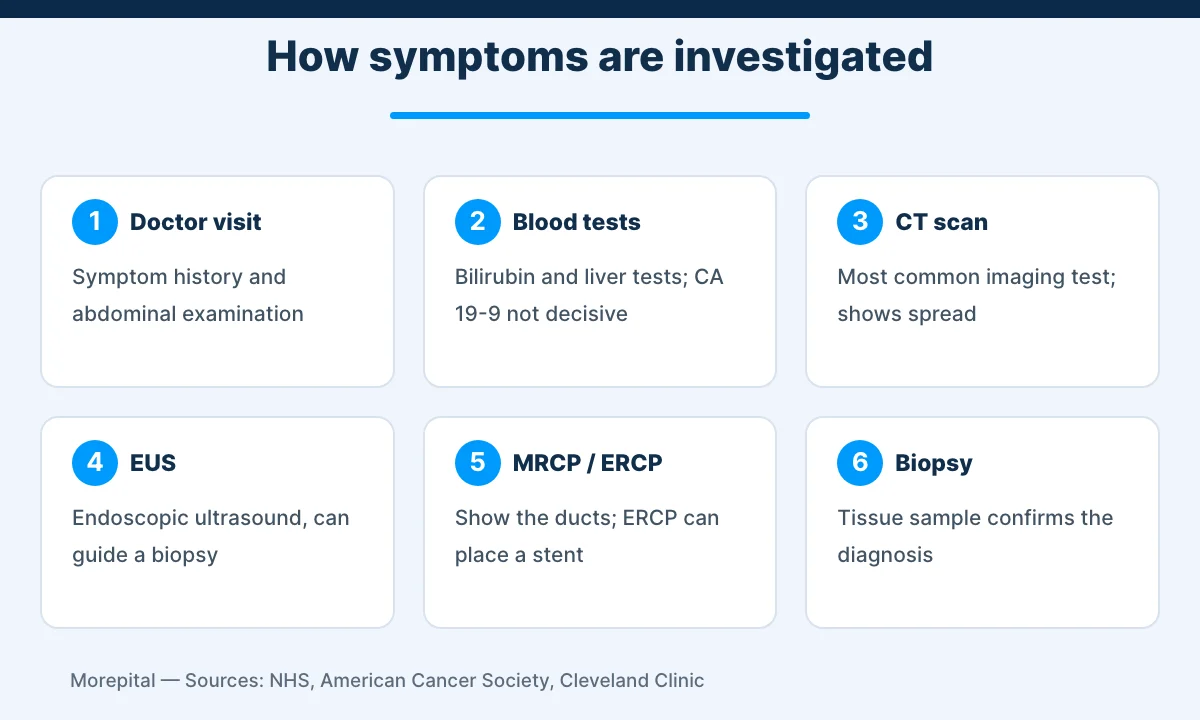
A doctor will ask about your pancreatic cancer symptoms, examine your abdomen and may arrange urine and blood tests, referring you urgently to a specialist if needed. Bilirubin and liver function tests help show whether jaundice comes from liver disease or a blocked bile flow, such as a gallstone or tumor. An abdominal ultrasound or CT scan is usually the first step in finding the cause.
Source: NHS, American Cancer Society, National Cancer Institute
- CT scan: the most common imaging test; a multiphase “pancreatic protocol” CT shows spread and helps decide whether surgery is possible.
- Endoscopic ultrasound (EUS): a probe on an endoscope; more accurate than ordinary ultrasound and can guide a biopsy needle.
- MRI and MRCP: MRCP images the bile and pancreatic ducts without an invasive procedure.
- ERCP: an endoscope plus X-rays; it can take cells and place a stent to reopen a blocked bile duct.
- PET scan and laparoscopy: used to check how far the cancer has spread.
- Biopsy: a tissue sample, often taken during EUS, confirms the diagnosis.
Source: Cleveland Clinic, American Cancer Society, NHS
The CA 19-9 blood test is often measured, but the American Cancer Society states that neither CA 19-9 nor CEA is accurate enough to confirm pancreatic cancer: levels can be normal in people with the disease and raised in people without it. They are more useful for tracking treatment. Cleveland Clinic recommends hereditary genetic testing for everyone diagnosed.
Source: American Cancer Society, Cleveland Clinic
Why early diagnosis matters: survival and screening
Acting on pancreatic cancer symptoms quickly matters because this is a serious cancer. NCI SEER data estimate 67,530 new cases and 52,740 deaths in the United States in 2026: 3.2% of new cancers but 8.4% of cancer deaths. Overall 5-year relative survival is 13.7%, and stage at diagnosis makes a large difference:
- Localized (confined to the pancreas): 15% of cases, 43.6% 5-year survival.
- Regional (spread to nearby lymph nodes): 28% of cases, 17.0%.
- Distant (spread to other organs): 51% of cases, 3.4%.
Source: NCI SEER
Surgery, such as the Whipple procedure or distal pancreatectomy, is the only cure, and only when all the cancer can be removed. Chemotherapy is the most common treatment, sometimes with radiation; targeted drugs and clinical trials suit some patients. When cure is not possible, an endoscopic stent for a blocked bile duct, palliative surgery and palliative care can relieve symptoms.
Source: Cleveland Clinic, National Cancer Institute
There is no routine screening for the general population. The US Preventive Services Task Force recommends against screening adults without symptoms who are not at high risk (grade D, 2019). This does not cover people with inherited syndromes or familial pancreatic cancer, for whom the American College of Gastroenterology conditionally recommends surveillance, so ask your doctor if several close relatives were affected or you carry a gene change such as BRCA2. For everyone else, recognizing pancreatic cancer symptoms early and acting on them is the main route to an earlier diagnosis.
Source: USPSTF
Pancreatic cancer symptoms: frequently asked questions
What are the first pancreatic cancer symptoms?
Early disease usually has none. When signs appear, jaundice (often starting with dark urine) is one of the first for many people, especially with tumors in the head of the pancreas; others first notice upper abdominal or back pain, weight loss or poor appetite.
Source: American Cancer Society, National Cancer Institute
Can pancreatic cancer symptoms come and go?
Digestive symptoms such as bloating and bowel changes can fluctuate, which is why they are often dismissed. See a doctor if they do not improve after 2 weeks or feel unusual for you.
Source: NHS
Where is pancreatic cancer pain felt?
Usually at the top of the abdomen, often spreading to the back. It may be worse after eating or lying down and ease when leaning forward.
Source: NHS, Cleveland Clinic
Do pancreatic cancer symptoms show up in blood tests?
Not reliably. Blood tests may show raised bilirubin, abnormal liver tests or a raised CA 19-9, but none can confirm or rule out the disease. Diagnosis relies on scans and a biopsy.
Source: American Cancer Society
Is new diabetes one of the pancreatic cancer symptoms?
Occasionally. In one population study, about 1% of people aged 50 or older with new diabetes were diagnosed with pancreatic cancer within 3 years. Discuss new diabetes with weight loss or other symptoms with your doctor.
Source: Chari et al., Gastroenterology (PMC), Pancreatic Cancer UK
Are pancreatic cancer symptoms different in women and men?
No. The main warning signs are the same in both sexes, although Cleveland Clinic lists male sex as a risk factor.
Source: Cleveland Clinic, NHS
What should I do if I have jaundice?
Seek medical advice the same day. Gallstones and hepatitis cause jaundice far more often than cancer, but it always needs prompt tests.
Source: NHS, American Cancer Society, Pancreatic Cancer UK
Disclaimer: this article is for general health education and does not replace advice from a qualified doctor who can assess your individual case. Last updated: October 2026.