
Cervical cancer symptoms most often start with vaginal bleeding that is unusual for you: bleeding during or after sex, between periods, after menopause, or periods that are heavier or longer than normal. Other signs include a change in vaginal discharge (watery, bloody or foul-smelling), pain during sex, and pain in the pelvis or lower back. Early cervical cancer often causes no symptoms at all, so regular screening matters, and any of these changes should be checked by a doctor.
Source: NHS, National Cancer Institute, CDC
Source: WHO, National Cancer Institute, Cancer Research UK
Contents
- What cervical cancer symptoms are and why early disease is silent
- The 7 most common cervical cancer symptoms
- Abnormal vaginal bleeding: the key warning sign
- Advanced cervical cancer symptoms
- Other conditions that cause similar symptoms
- HPV and other risk factors
- Pap smear and HPV screening: who, when and how often
- The HPV vaccine: who should get it
- Cervical cancer symptoms checked: diagnosis, stages and treatment
- Frequently asked questions
What cervical cancer symptoms are and why early disease is silent
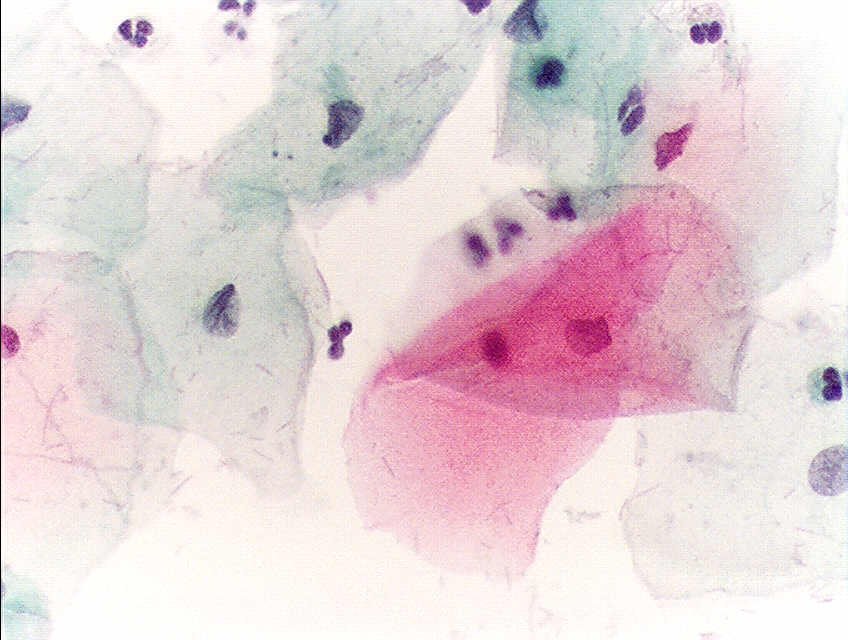
The cervix is the lower, narrow end of the womb (uterus) that opens into the vagina. Cervical cancer develops when cells on the surface of the cervix change slowly over many years. These early changes, called precancerous changes or cervical intraepithelial neoplasia (CIN), do not cause pain, bleeding or any other sign you can notice. That is why most cervical cancers in countries with screening programs are found through a routine test rather than because of cervical cancer symptoms.
Source: National Cancer Institute, Cancer Research UK, Cleveland Clinic
According to the WHO, it usually takes 15 to 20 years for a persistent HPV infection to turn into cancer in a person with a normal immune system, and 5 to 10 years in someone with a weakened immune system, such as in some people living with HIV. Either way, there is a long window in which screening can find and treat abnormal cells before cancer forms.
Source: WHO
When cervical cancer symptoms do appear, they usually mean the cancer has started to grow into nearby tissue. The U.S. National Cancer Institute (NCI) notes that symptoms usually begin after the cancer has spread, and that ignoring them can delay treatment and make it less effective. Most cervical cancer symptoms are also common in conditions that are not cancer, so the goal is not to panic but to get a prompt check.
Source: National Cancer Institute
There are two main types. Squamous cell carcinoma starts in the flat cells that cover the outer surface of the cervix and makes up roughly 8 to 9 in 10 cases. Adenocarcinoma starts in the mucus-producing gland cells lining the cervical canal and accounts for up to about 1 in 5 cases. Cervical cancer symptoms are much the same for both types.
Source: Cleveland Clinic
The 7 most common cervical cancer symptoms
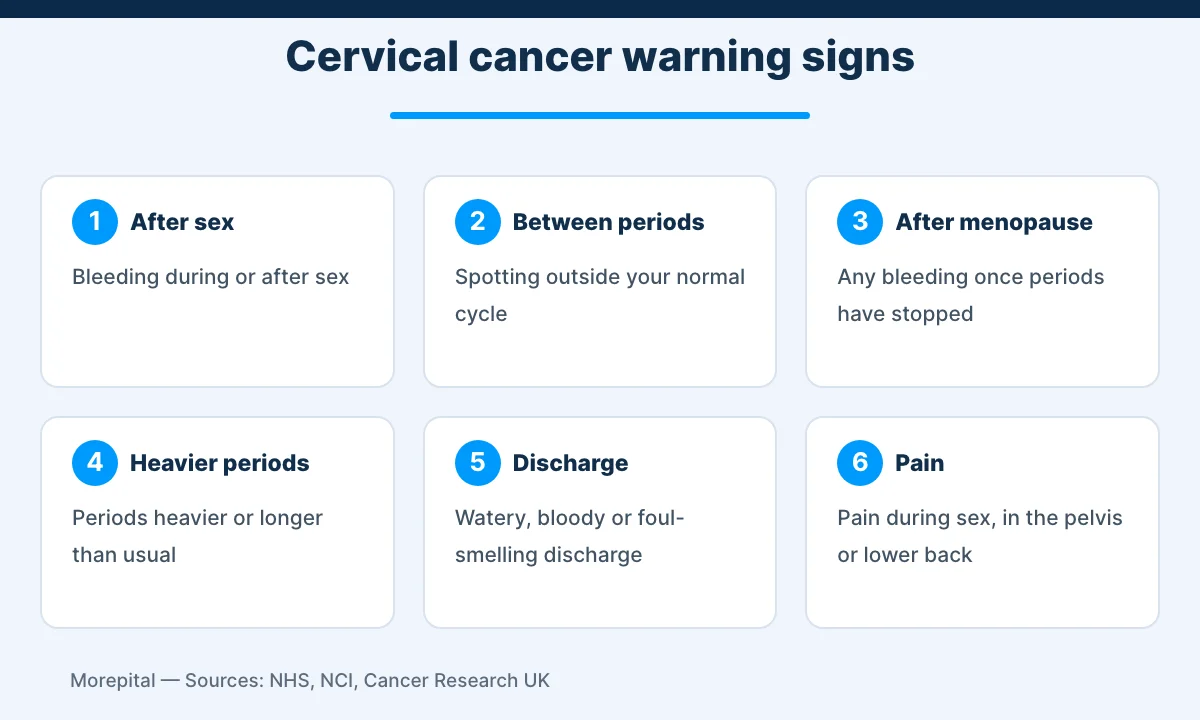
Health services such as the NHS, the NCI and Cancer Research UK list very similar warning signs. Taken together, the seven most common cervical cancer symptoms are:
- Bleeding during or after sex. Any spotting or bleeding after vaginal intercourse that you cannot explain.
- Bleeding between periods. Bleeding or spotting outside your normal menstrual cycle.
- Heavier or longer periods than usual. A change from your normal pattern rather than periods that have always been heavy.
- Bleeding after menopause. Any vaginal bleeding once your periods have stopped for good.
- A change in vaginal discharge. Discharge that is watery, contains blood, increases in amount or has a strong or unpleasant smell.
- Pain during sex. Discomfort or pain on penetration (dyspareunia).
- Pelvic or lower back pain. Pain in the lower tummy, between the hip bones, or in the lower back.
Source: NHS, National Cancer Institute, Cancer Research UK
None of these cervical cancer symptoms on its own proves that you have cancer. The NHS stresses that these symptoms are very common and can have many different causes. What matters is change: a symptom that is new, persistent, getting worse or simply not normal for you. The NHS advises booking an appointment with a GP if you have any cervical cancer symptoms, because finding it early makes treatment more likely to work.
Source: NHS
Abnormal vaginal bleeding: the key warning sign
Among cervical cancer symptoms, unusual vaginal bleeding is the one most closely linked to the disease, and the CDC advises seeing a doctor right away if you have bleeding that is not normal for you.
Source: CDC
Bleeding after sex (postcoital bleeding)
Bleeding after sex is one of the best-known cervical cancer symptoms, but it has a common harmless cause as well. Cancer Research UK explains that it is often due to cervical ectropion (also called cervical erosion), where cells from inside the cervical canal sit on the outer surface. Ectropion is common in young women, during pregnancy and in people taking the contraceptive pill. It is not cancer and often settles on its own or after a change of contraception. Only an examination can tell the two apart, so bleeding after sex should still be checked.
Source: Cancer Research UK
Bleeding between periods or heavier periods
Spotting between periods and heavier or longer periods are cervical cancer symptoms listed by both the NHS and the NCI. The NHS points out that fibroids and endometriosis can cause similar symptoms, so a change in your bleeding pattern needs a check rather than a guess.
Source: NHS, National Cancer Institute
Bleeding after menopause
Any vaginal bleeding after menopause is not normal and should always be checked by a doctor. Cancer Research UK lists bleeding at any time after menopause as a possible sign of cervical cancer, and the WHO includes it among the main symptoms. Like other cervical cancer symptoms, postmenopausal bleeding has other causes too, but it should never be ignored.
Source: Cancer Research UK, WHO
Advanced cervical cancer symptoms
When cervical cancer spreads beyond the cervix to nearby organs such as the bladder, bowel or pelvic wall, new cervical cancer symptoms can appear in addition to the early ones. The NCI and Cleveland Clinic describe the following advanced cervical cancer symptoms:
- Difficult or painful urination, or blood in the urine
- Difficult or painful bowel movements, or bleeding from the rectum
- A dull backache or pain in the pelvis or abdomen
- Swelling of one or both legs
- Feeling tired, losing your appetite and losing weight without trying
Source: National Cancer Institute, Cleveland Clinic, WHO
Weight loss and tiredness are not specific cervical cancer symptoms; they can come with many advanced cancers, including colon cancer symptoms and lung cancer symptoms, so on their own they do not point to the cervix. Together with abnormal bleeding or discharge, however, they need urgent assessment.
Source: National Cancer Institute, Cleveland Clinic
Other conditions that cause similar symptoms
Most people who have cervical cancer symptoms turn out to have a different, often treatable, cause, as Cancer Research UK notes. Common look-alikes include:
- Cervical ectropion: a harmless change that can cause bleeding after sex, as described above.
- Fibroids and endometriosis: the NHS names both as causes of heavy or irregular bleeding and pelvic pain that can resemble cervical cancer symptoms.
- Pain during sex and urinary symptoms: Cancer Research UK notes that pain during sex has many possible causes, and painful urination is often due to a urinary tract infection rather than cancer.
- Bowel conditions: rectal bleeding is often due to problems such as hemorrhoids, although new rectal bleeding should still be checked.
Source: Cancer Research UK, NHS, National Cancer Institute
Because the overlap is so large, the NCI states that only a health professional can determine the cause. Do not wait for a screening invitation if you have cervical cancer symptoms; screening is designed for people without symptoms, and the NHS advises seeing a GP if your symptoms change, get worse or no longer feel normal for you.
Source: National Cancer Institute, NHS
HPV and other risk factors
Almost all cervical cancers are caused by a persistent infection with high-risk HPV types. HPV spreads through skin-to-skin genital contact, vaginal, anal or oral sex, and sharing sex toys. The NCI says nearly all sexually active people are infected with HPV at some point, and most infections clear within a year or two as the immune system controls them. Short-term infections do not cause cancer; the danger comes from a high-risk infection that persists for years.
Source: NHS, National Cancer Institute, CDC
Two types, HPV 16 and HPV 18, cause most cases: about 70% according to the NCI and about 76% according to the WHO, a small difference that reflects different data sets. Other high-risk types cause the rest.
Source: National Cancer Institute, WHO
Factors that raise the risk
- A weakened immune system, including HIV, immune-suppressing medicines and cancer treatment. The WHO says women living with HIV are about six times more likely to develop cervical cancer.
- Smoking, including secondhand smoke; the risk rises with the amount of exposure.
- Starting sex before age 18 or having many sexual partners, which raises the chance of a high-risk HPV infection.
- Long-term use of the contraceptive pill (more than 5 years slightly raises the risk, according to the NHS, which notes that for many people the benefits outweigh this).
- Having several children, or having children at a young age (under 17).
- Exposure to diethylstilbestrol (DES) before birth, a rare risk factor for clear cell adenocarcinoma.
Source: National Cancer Institute, NHS, WHO
The NHS adds that cervical cancer is most common in women aged 30 to 35 but can occur at any age, while U.S. data show a median age at diagnosis of 50. The NCI also notes that obesity can make screening technically harder, which may lower the detection of precancers (read more about obesity).
Source: NHS, NCI SEER, National Cancer Institute
Pap smear and HPV screening: who, when and how often
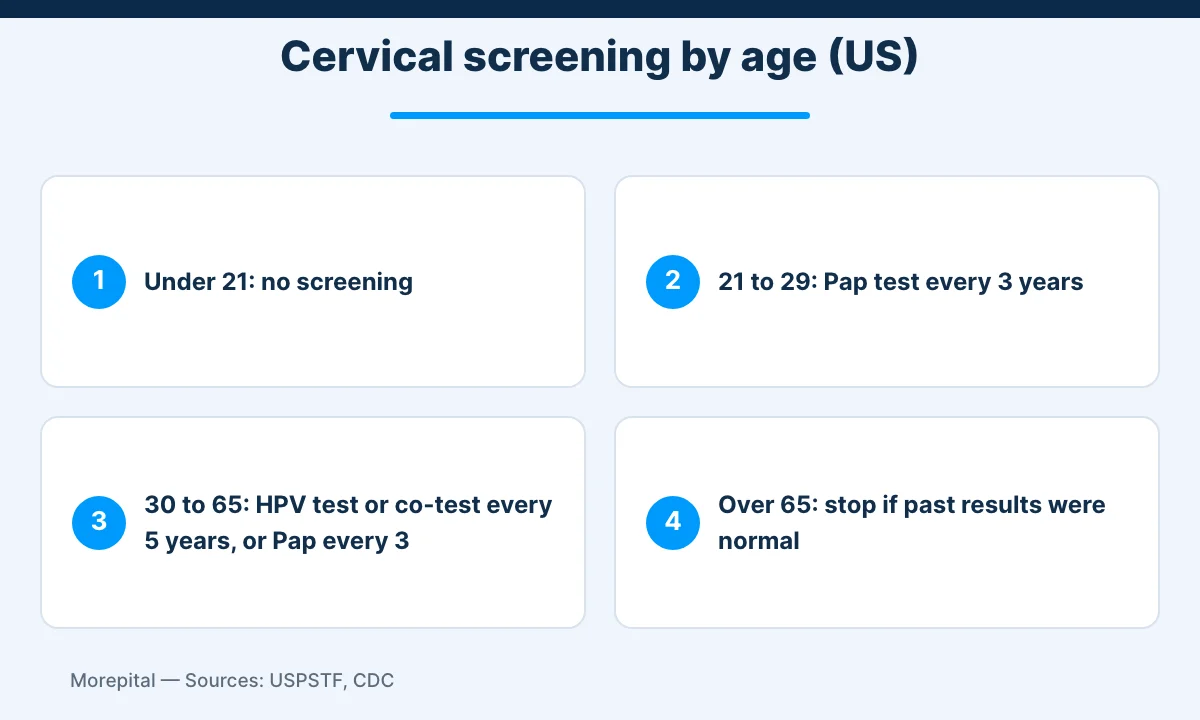
Cervical screening is not a test for cervical cancer symptoms; it is a check for HPV and abnormal cells in people who feel well. There are two main tests. The Pap test (smear test) looks at cervical cells for precancerous changes, and the HPV test checks the cells for the high-risk virus that causes those changes. Screening can be done during your period, and no preparation is needed for an HPV test; before a Pap test, the CDC advises avoiding sex, douching, vaginal medicines and spermicide for two days.
Source: CDC
Screening in the United States
The U.S. Preventive Services Task Force (USPSTF) recommendation, published in 2018 and currently being updated, advises:
- Under 21: no screening.
- Ages 21 to 29: a Pap test (cytology) every 3 years.
- Ages 30 to 65: a Pap test every 3 years, a high-risk HPV test alone every 5 years, or both together (co-testing) every 5 years.
- Over 65: stop if you have had adequate previous screening with normal results and are not otherwise at high risk.
- After a hysterectomy with removal of the cervix: no screening, unless you have had high-grade precancer or cervical cancer.
Screening in the UK and worldwide
The NHS invites women and people with a cervix aged 25 to 64 for cervical screening every 5 years. The sample is tested for HPV first. If no HPV is found, the risk of cervical cancer is very low and you are invited again in 5 years. If HPV is found without abnormal cells, you are invited back in 1 year; if HPV is found with abnormal cells, or persists for 2 years, you are referred for a colposcopy.
The WHO recommends that the general population start screening at age 30 with a high-performance test (such as an HPV test) every 5 to 10 years, and that women living with HIV start at 25 and screen every 3 to 5 years. The WHO also considers HPV samples that women collect themselves to be as reliable as samples taken by a health worker.
Source: WHO
What happens at the appointment
A nurse or doctor uses a speculum and a soft brush to collect cells from the cervix. The appointment takes about 10 minutes, it may feel uncomfortable, and you can ask to stop at any time. A positive HPV result means a high-risk virus is present, not that you have cancer.
The HPV vaccine: who should get it
The HPV vaccine prevents infection with the virus types that cause most cervical cancers, which makes cervical cancer one of the most preventable cancers. It works best when given before a person becomes sexually active, and it does not treat an infection that is already present.
Source: National Cancer Institute, Cleveland Clinic
- WHO: girls aged 9 to 14 are the main target group, with one or two doses depending on the national schedule; people with weakened immune systems should ideally receive two or three doses.
- United States (CDC): routine vaccination at age 11 to 12 (it can start at 9), with 2 doses if started before age 15 and 3 doses if started at 15 to 26 or for people with weakened immunity. Catch-up is recommended through age 26; adults aged 27 to 45 may choose to be vaccinated after talking with a doctor.
- United Kingdom (NHS): offered to all children aged 12 to 13, with catch-up until the 25th birthday for eligible young people, and to men who have sex with men up to age 45. Most people under 25 now need just 1 dose.
Gardasil 9, the vaccine used in the United States, protects against seven cancer-causing HPV types (16, 18, 31, 33, 45, 52 and 58) and two types that cause genital warts. Most side effects are mild, such as a sore arm, headache, fever or tiredness. Because the vaccine does not cover every cancer-causing type, vaccinated people still need regular cervical screening.
Source: National Cancer Institute, CDC, NHS
Condoms reduce the spread of HPV but do not fully prevent it, because they do not cover all genital skin. Quitting smoking also lowers the risk.
Source: NHS, National Cancer Institute
Cervical cancer symptoms checked: diagnosis, stages and treatment
If you have cervical cancer symptoms, start with your GP or gynecologist. If an examination or a screening test suggests abnormal cells, or if your symptoms could be due to cervical cancer, you will usually be referred for a colposcopy.
Source: NHS
Colposcopy and biopsy
During a colposcopy, a specialist looks at the cervix through a magnifying instrument with a light, may apply a liquid to highlight abnormal areas, and takes a small tissue sample (biopsy). It takes about 15 to 30 minutes, may be uncomfortable but should not be painful, and can cause light bleeding or cramping afterwards. Results can take several weeks. If cancer is confirmed, blood tests and scans (CT, MRI, PET or chest X-ray) show its size and spread, called the stage.
Source: NHS
Stages and outlook
The table summarizes U.S. survival data, which show why early detection matters. These figures describe groups of patients and cannot predict an individual outcome.
Source: Cleveland Clinic, NCI SEER
| Stage at diagnosis (SEER) | Typical cervical cancer symptoms | Share of U.S. cases | 5-year relative survival |
|---|---|---|---|
| Precancer (CIN) | None; found by screening | Not counted as cancer | Treatable before cancer forms |
| Localized (cervix only) | Often none, or bleeding and discharge | 41% | 91.8% |
| Regional (nearby tissue or lymph nodes) | Bleeding, pelvic pain, pain during sex | 37% | 64.0% |
| Distant (spread to other organs) | Plus back pain, leg swelling, urinary or bowel changes, weight loss | 16% | 20.5% |
Source: NCI SEER, National Cancer Institute, WHO
Treatment
Precancerous changes can be removed with thermal ablation, cryotherapy, a loop excision (LEEP/LLETZ) or a cone biopsy, sometimes in the same visit as screening. Invasive cancer is treated with surgery, radiotherapy, chemotherapy or a combination, depending on its size, type and spread and on your general health. For very small cancers, surgery can remove part of the cervix or the cervix alone while keeping the womb, so pregnancy may still be possible; larger cancers may need a hysterectomy or chemoradiotherapy. Targeted medicines and immunotherapy are used for advanced or recurrent disease. The WHO notes that cervical cancer can be cured if diagnosed and treated at an early stage.
Cervical cancer symptoms differ from those of other women’s cancers; for lumps or skin changes in the breast, see our guide to breast cancer symptoms.
Source: WHO
Cervical cancer symptoms: frequently asked questions
What is usually the first of the cervical cancer symptoms?
Abnormal vaginal bleeding, especially after sex, between periods or after menopause, is the most common first sign. Many early cancers cause no cervical cancer symptoms at all.
Source: CDC, National Cancer Institute
Can you have cervical cancer with no symptoms?
Yes. Early cervical cancer and precancerous changes usually cause no symptoms, which is why regular screening is recommended even if you have no cervical cancer symptoms.
Source: Cancer Research UK, CDC
Do cervical cancer symptoms come and go?
Bleeding or discharge may not be constant, so an episode that stops does not rule out a problem. See a doctor if a symptom is new, keeps coming back or is not normal for you.
Source: NHS
Does a positive HPV test mean I have cancer?
No. It means a high-risk HPV type is present. Most infections clear on their own, and follow-up tests decide whether you need a colposcopy.
Source: CDC, National Cancer Institute
I had the HPV vaccine. Do I still need screening?
Yes. The vaccine does not protect against every cancer-causing HPV type, so the NHS and NCI advise attending cervical screening when invited.
Source: NHS, National Cancer Institute
Can cervical cancer symptoms be caused by something else?
Yes, very often. Cervical ectropion, infections, fibroids and endometriosis can all cause bleeding, discharge or pain. Only an examination can find the cause.
Source: Cancer Research UK, NHS
Is cervical cancer curable?
Often, yes, if it is found early, ideally through screening before cervical cancer symptoms appear. U.S. data show a 5-year relative survival of about 92% when the cancer is still confined to the cervix.
Disclaimer: this article is for general health education and does not replace advice from a qualified doctor who can assess your individual case. Last updated: October 2026.