
Cellulite is the dimpled, lumpy “orange-peel” texture that fat pushing against fibrous bands under the skin creates, most often on the thighs, buttocks, hips and stomach. It affects an estimated 80% to 90% of women after puberty and fewer than 1 in 10 men, it is harmless and painless, and no treatment removes it completely. Several clinic procedures, mainly those that release the fibrous bands, can make dimples less visible for months to years.
Source: Cleveland Clinic, Aesthetic Surgery Journal Open Forum (2023 review)
Contents
- What is cellulite?
- What causes cellulite and who gets it
- How severity is graded
- Cellulite, lipoedema or cellulitis?
- Weight, exercise and diet
- Creams, massage and supplements
- Cellulite treatments in the clinic: what the evidence shows
- Why liposuction does not fix cellulite
- Choosing a clinic at home or abroad
- Frequently asked questions
What is cellulite?

Under the skin of the thighs and buttocks sits a layer of fat divided into compartments by vertical strands of connective tissue called fibrous septae. These strands tether the skin to the deeper muscle layer. When fat lobules bulge upward while the septae pull the skin down, the surface takes on a pattern of small hills and hollows. That pattern is cellulite, and it becomes more obvious when you sit, squeeze the skin or stand under overhead light.
Source: Cleveland Clinic, Aesthetic Surgery Journal Open Forum (2023 review)
Cellulite is cosmetic. It does not hurt, it is not contagious and it does not damage your overall physical health. Even so, the 2023 review in Aesthetic Surgery Journal Open Forum notes that cellulite is linked to body dissatisfaction, anxiety and reduced quality of life in some people, which is why so many treatments are marketed for it. DermNet describes it as causing no physical harm but potential embarrassment.
Source: Cleveland Clinic, Aesthetic Surgery Journal Open Forum (2023 review), DermNet
What causes cellulite and who gets it
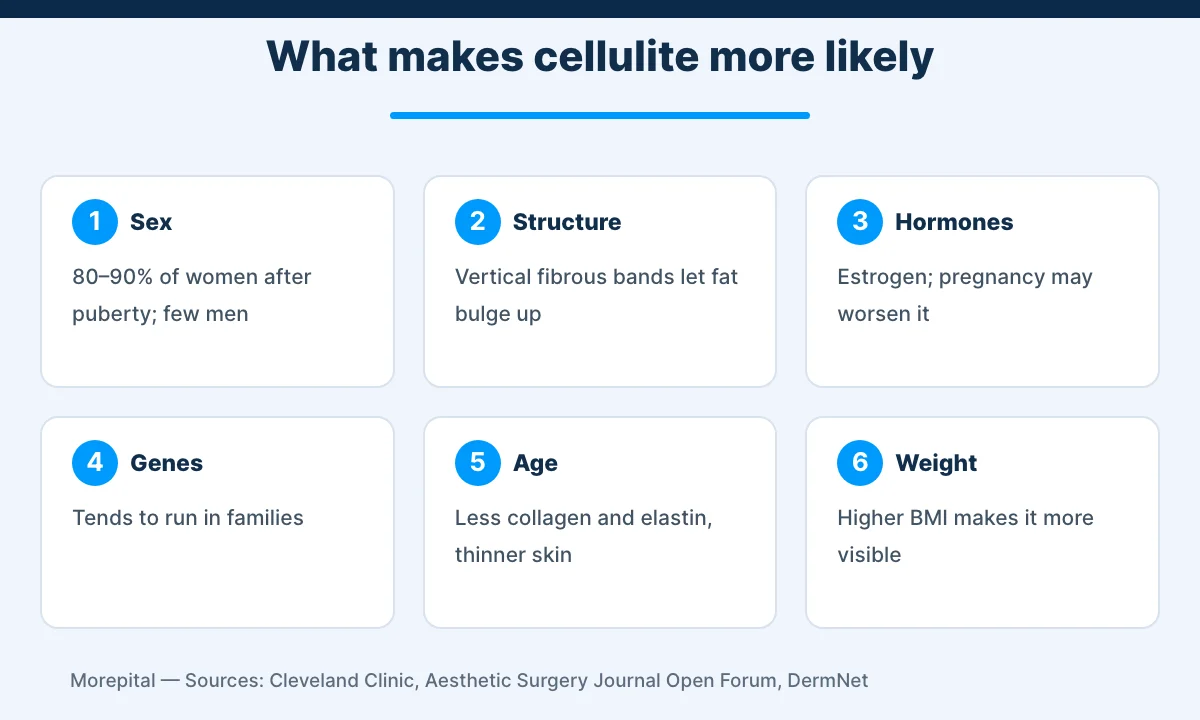
Nobody knows the exact cause. The leading explanation is architectural: the uneven tug of the fibrous bands combined with fat pushing upward. A 2020 review of the biology concluded there is compelling clinical evidence that the septae play a central role, partly because treatments aimed only at the fat or the outer skin give results that do not last.
Source: Cleveland Clinic, Dermatologic Surgery (2020 review)
Why women are far more affected
In women the septae tend to run vertically, in parallel, which lets fat lobules bulge up between them. In men they tend to crisscross at an angle, forming a tighter mesh. This difference is the main proposed reason why cellulite appears in most women but is rare in men, in whom it is often associated with low levels of male hormones.
Source: Cleveland Clinic, Aesthetic Surgery Journal Open Forum (2023 review)
Hormones, genes and age
Estrogen probably plays a central role. Researchers point out that cellulite usually appears after puberty and can worsen during pregnancy, with oral contraceptives or with hormone replacement. Other contributing factors listed in reviews and clinical references include:
- Genetics: cellulite tends to run in families, and it is reported to be more common in white women than in Asian women.
- Age: collagen and elastin in the skin decline, so the skin thins and sags and the bumps show through more.
- Body fat and weight change: a higher BMI makes it more pronounced, and weight gain can accentuate it, but lean people get it too.
- Skin thickness: thinner skin hides the underlying structure less well.
- Lifestyle: a sedentary routine, prolonged sitting or standing, and a diet high in carbohydrates, fats and salt have been suggested as contributors, though evidence is weaker.
Source: Aesthetic Surgery Journal Open Forum (2023 review), Cleveland Clinic, DermNet
How severity is graded
Doctors use simple scales to describe how visible cellulite is. Cleveland Clinic uses a common four-step version:
- Grade 0: no visible cellulite.
- Grade 1: smooth when standing, mild dimpling when sitting.
- Grade 2: moderate dimples when standing or sitting.
- Grade 3: severe dimples when standing or sitting, with deep peaks and valleys.
Source: Cleveland Clinic
This older Nürnberger–Müller-style scale is easy to use but has never been validated. For clinical trials, researchers now prefer the Cellulite Severity Scale (CSS), which scores five features from 0 to 3, giving a total where 1 to 5 is mild, 6 to 10 moderate and 11 to 15 severe. It has only been validated for the buttocks and thighs. When a device company quotes “a one-point improvement,” it usually refers to a scale like this.
Source: Aesthetic Surgery Journal Open Forum (2023 review)
The grade matters because it steers treatment. The 2023 review’s authors reserve subcision for severe cellulite, meaning dimples visible at rest, while mild grades are more often managed with lifestyle measures, topical products or energy-based devices.
Source: Aesthetic Surgery Journal Open Forum (2023 review)
Cellulite, lipoedema or cellulitis?
Three conditions with similar names or appearances are easy to confuse, and two of them need medical care.
Lipoedema
Lipoedema is an abnormal build-up of fat in the legs and sometimes the arms, mainly in women. The bottom, thighs and lower legs can look out of proportion to a narrower waist and upper body, usually on both sides equally, while the hands and feet are typically spared. The skin may look dimpled and feel soft and cool, but unlike cellulite it can cause pain, tenderness, heaviness and easy bruising. It is not caused by being overweight. If you recognize these features, the NHS advises seeing a GP; treatment includes compression, exercise, skin care and, in severe cases, liposuction.
Source: NHS (lipoedema), Cleveland Clinic
Cellulitis
Despite the similar name, cellulitis is a bacterial skin infection, usually entering through a cut, bite or cracked skin. The area becomes painful, hot and swollen, often red (less obvious on brown or black skin), and you may feel feverish. It needs antibiotics. Get an urgent appointment if your skin is painful, hot and swollen, and seek emergency care if you also have a very high temperature, a fast heartbeat, confusion or purple patches on the skin.
Source: NHS (cellulitis)
A simple rule: dimpling without pain, heat or swelling is almost always cellulite. Pain, heat, sudden swelling or legs that grow out of proportion deserve a medical review before any beauty treatment.
Source: Cleveland Clinic, NHS (lipoedema), NHS (cellulitis)
Weight, exercise and diet
Lifestyle changes cannot erase cellulite, but they can change how it looks. The American Academy of Dermatology (AAD) says that for some people, reaching and staying at a healthy weight reduces cellulite. It also warns that loose skin after weight loss can make it more noticeable, and DermNet adds that losing weight may improve or worsen the appearance. If you are carrying excess weight for health reasons, read our guide to obesity and its treatment; for loose skin after big weight loss, see skin laxity.
Source: American Academy of Dermatology, DermNet
Exercise helps for a different reason. More muscle under the skin can make the surface look smoother and firmer, and replacing fat with muscle may make cellulite less visible. Cleveland Clinic suggests running, cycling and resistance training, adding that it may take two to three months before you notice a difference. Strength work for the glutes and thighs targets the areas where cellulite is most common.
Source: American Academy of Dermatology, Cleveland Clinic
On diet, the evidence is indirect. Cleveland Clinic and DermNet both suggest limiting processed, high-carbohydrate, high-fat and salty foods, and DermNet advises avoiding long periods of sitting or standing. The 2023 review also lists avoiding smoking and excess alcohol among the lifestyle steps worth combining with any treatment. These habits help your heart anyway, so they are a low-risk start against cellulite.
Source: Cleveland Clinic, DermNet, Aesthetic Surgery Journal Open Forum (2023 review)
Creams, massage and supplements
Topical products
Cellulite creams sell well because they are cheap and painless, but results are modest. The AAD places them in its “may work” group:
- Caffeine: may dehydrate fat cells and make cellulite less visible, but you must apply it daily to keep the effect.
- Retinol 0.3%: may thicken the skin slightly so it hides the bumps better; expect to wait six months or longer.
- Aminophylline: can cause anxiety, a racing heart or breathing problems; people who use an asthma inhaler should avoid it.
Source: American Academy of Dermatology, DermNet
The AAD recommends patch-testing any new product on a small area and waiting 48 hours before wider use. DermNet adds that some herbal ingredients can cause allergic contact dermatitis. None of these creams is approved by the US Food and Drug Administration (FDA) as a cellulite treatment, and the 2023 review found the trials behind them small and short.
Source: American Academy of Dermatology, DermNet, Aesthetic Surgery Journal Open Forum (2023 review)
Massage, rollers and dry brushing
Mechanical massage devices such as endermologie are cleared by the FDA as low-risk, but the FDA has not stated that they work. Studies are mixed: some show a temporary reduction, others none, sessions last about 45 minutes, many are needed, and the effect tends to fade within a month of stopping. Cleveland Clinic notes there is no proof that dry brushing or rollers give a lasting benefit, and evidence for cupping is limited.
Source: American Academy of Dermatology, Cleveland Clinic
Supplements
The AAD says there is no evidence that any supplement reduces cellulite and lists supplements under “not recommended.” One placebo-controlled study of oral collagen reported improvement over six months in moderate cases, but no supplement is approved for the purpose, and evidence for ginkgo biloba or grape-seed extract is limited.
Source: American Academy of Dermatology, Aesthetic Surgery Journal Open Forum (2023 review), Cleveland Clinic
Cellulite treatments in the clinic: what the evidence shows

Clinic cellulite procedures fall into two groups: energy-based devices that heat or vibrate the tissue, and procedures that cut or release the fibrous bands. Because the bands are thought to be central to cellulite, the second group generally lasts longer, though it is more invasive.
Source: Dermatologic Surgery (2020 review), Aesthetic Surgery Journal Open Forum (2023 review)
Subcision: releasing the bands
Subcision uses a needle or small blade under the skin to cut the septae that pull cellulite dimples down. Results may show as soon as one month after the first treatment. Several FDA-cleared systems exist:
- Cellfina (vacuum-assisted): the AAD cites a 232-patient study in which 99% were satisfied, with results lasting two years or longer; the 2023 review reports 93% improved by at least one CSS point at one year and durability beyond three years.
- Avéli (manual, device-guided): cleared for buttocks and thighs; 95% reached at least a one-point CSS improvement at six months. Bruising, soreness and swelling occurred but resolved.
- Cellulaze (laser-assisted, 1440 nm): sustained improvement for at least a year in 90% of treated sites in the reported study; the AAD says more research is needed.
- Acoustic subcision (RESONIC): a single session using rapid acoustic pulses reduced CSS scores by about 30% at 12 weeks, with improvement seen up to 12 months.
Source: American Academy of Dermatology, Aesthetic Surgery Journal Open Forum (2023 review), Cleveland Clinic
An injectable enzyme (collagenase, sold as Qwo) was FDA-approved in 2020 to dissolve the bands chemically, but its maker discontinued production and sale in December 2022, so it is no longer an option. Clinic marketing that still mentions it is out of date.
Source: Aesthetic Surgery Journal Open Forum (2023 review)
Acoustic wave therapy
Acoustic (shock) wave therapy delivers pressure waves through the skin. The AAD lists it among the options with the best research support. It usually needs six to eight sessions; Cleveland Clinic says treatment may run over about six weeks with results lasting two to six months, and the review found no durability data beyond one year.
Source: American Academy of Dermatology, Cleveland Clinic, Aesthetic Surgery Journal Open Forum (2023 review)
Radiofrequency, lasers and light
Radiofrequency devices heat the deeper skin. Studies suggest a small improvement, but it is short-lived, several sessions are needed and bruising is common. Other lasers can reduce cellulite for six months or more before it usually returns; evidence for intense pulsed light is inconclusive. They suit mild cellulite in people who accept repeat visits.
Source: American Academy of Dermatology, Aesthetic Surgery Journal Open Forum (2023 review), DermNet
Treatments the evidence does not support
The AAD does not recommend mesotherapy (injections of drug mixtures), citing few supportive studies and side effects such as tender lumps, infection and allergic reactions; DermNet adds that it can cause abscesses and scarring and may even worsen dimpling. Cryolipolysis (fat freezing) can reduce small fat pockets but does not remove cellulite. Carboxytherapy, which injects carbon dioxide gas, has only small early studies.
Source: American Academy of Dermatology, DermNet
The table below summarizes the evidence for nine common approaches.
| Treatment | Evidence verdict | Typical durability |
|---|---|---|
| Vacuum-assisted subcision (Cellfina) | Best supported | 2–3+ years |
| Manual subcision (Avéli) | Good early data | Reported at 6 months |
| Laser-assisted subcision (Cellulaze) | Promising; more research needed | 1 year or longer |
| Acoustic wave therapy | Supported; 6–8 sessions | Months; no data past 1 year |
| Radiofrequency | Small effect | Short-lived |
| Caffeine or 0.3% retinol cream | May help a little | Only with ongoing use |
| Mechanical massage (endermologie) | Mixed results | Fades within about a month |
| Mesotherapy or supplements | Not recommended | No reliable benefit |
| Liposuction or cryolipolysis | Not recommended for dimpling | Removes fat, not dimples |
Source: American Academy of Dermatology, Aesthetic Surgery Journal Open Forum (2023 review), Cleveland Clinic, DermNet
Why liposuction does not fix cellulite
It seems logical that removing fat would remove dimples, but the AAD notes that treatments that remove fat effectively often have no effect on cellulite. Liposuction takes out deeper fat, not the superficial fat lobules and tethering bands that shape the surface, and the AAD warns that liposuction alone can make cellulite more obvious. DermNet likewise advises against it for this purpose because of poor cosmetic results.
Source: American Academy of Dermatology, Cleveland Clinic, DermNet
Liposuction still has a role when your goal is to reduce stubborn fat volume rather than cellulite. A tummy tuck, for example, removes loose abdominal skin, which can improve the overall look of the area even though it is not a dimpling treatment. If you are weighing body-contouring surgery abroad, our guide to a tummy tuck in Turkey covers candidacy, recovery and surgeon checks. Be clear with any surgeon whether your concern is volume, loose skin or cellulite.
Source: American Academy of Dermatology, Aesthetic Surgery Journal Open Forum (2023 review)
Choosing a clinic at home or abroad
The AAD stresses that results depend heavily on the skill and experience of the person performing the treatment, and recommends seeing a doctor who understands and treats the condition, such as a board-certified dermatologist or plastic surgeon, before any cosmetic procedure. A good practitioner will grade your cellulite, look for lipoedema or loose skin, and explain which option fits your grade rather than selling a fixed package.
Source: American Academy of Dermatology, Aesthetic Surgery Journal Open Forum (2023 review)
Questions to ask before you book
- Which grade is my cellulite, and which treatment does the evidence support for that grade?
- Is the device FDA-cleared or CE-marked for this use, and how many sessions will I need?
- How many of these procedures have you performed, and can I see your own before-and-after photos?
- What side effects should I expect, and how long do results usually last?
- What happens if I am unhappy with the result or develop a complication?
Source: American Academy of Dermatology, NHS (cosmetic surgery abroad), Aesthetic Surgery Journal Open Forum (2023 review)
If you are traveling for treatment
Many people combine body-contouring procedures with travel, often to Turkey. The NHS advises checking the practitioner’s training, qualifications, professional memberships and experience, finding out how clinics are regulated in that country, and making sure the doctor speaks a language you understand. It recommends two consultations before surgery with a cooling-off period between them, and warns that travel insurance usually does not cover complications from cosmetic procedures.
Source: NHS (cosmetic surgery abroad)
Plan aftercare before you go: ask where follow-up will happen and what it costs if something goes wrong. Flying raises the risk of blood clots, so the NHS advises not flying for 5 to 7 days after liposuction and 7 to 10 days after a tummy tuck. Minimally invasive cellulite procedures usually involve less downtime, but bruising and soreness are common after subcision, so avoid booking sightseeing or swimming straight after treatment.
Source: NHS (cosmetic surgery abroad), Aesthetic Surgery Journal Open Forum (2023 review)
Considering cellulite treatment? Contact us for a free consultation and a treatment plan tailored to you.
Cellulite: frequently asked questions
Can cellulite be removed permanently?
No. Every reputable source agrees no treatment eliminates cellulite completely. Subcision procedures have the longest-lasting results, reported at two to three years or more.
Source: Cleveland Clinic, American Academy of Dermatology, Aesthetic Surgery Journal Open Forum (2023 review)
Why do thin people get cellulite?
Because the dimpling comes mainly from how the fibrous bands and fat compartments are arranged, along with hormones, genes and skin thickness. A higher BMI makes it more pronounced, but lean people have it too.
Source: Cleveland Clinic, Aesthetic Surgery Journal Open Forum (2023 review)
Do cellulite creams work?
Some may help a little. Caffeine needs daily use, and 0.3% retinol takes six months or more. Patch-test first and avoid aminophylline if you use an asthma inhaler.
Source: American Academy of Dermatology
Does exercise get rid of it?
Exercise will not remove it, but building muscle can make skin look smoother and firmer. Allow two to three months of regular training to see a difference.
Source: American Academy of Dermatology, Cleveland Clinic
Is cellulite harmful?
No. It is painless and does not affect your physical health. See a doctor if the area is painful, hot or swollen, or if your legs are enlarging out of proportion, which may point to cellulitis or lipoedema.
Source: Cleveland Clinic, NHS (lipoedema), NHS (cellulitis)
Do men get cellulite?
Rarely. Estimates range from about 2% to under 10% of men, often linked to low male hormone levels, partly because the connective tissue in men forms a tighter crisscross mesh.
Source: Cleveland Clinic, Aesthetic Surgery Journal Open Forum (2023 review)
Which cellulite treatment lasts longest?
In published studies, vacuum-assisted subcision (Cellfina) has shown results lasting beyond three years, and the Cellulaze laser at least a year. Energy-based devices and massage usually need repeat sessions.
Source: Aesthetic Surgery Journal Open Forum (2023 review), American Academy of Dermatology
Disclaimer: this article is for general health education and does not replace advice from a qualified doctor who can assess your individual case. Last updated: October 2026.