
Skin laxity
Sagging skin, loose skin
Skin laxity is loose, sagging skin that has lost its ability to spring back because collagen and elastin fibers weaken with age, sun exposure, smoking and major weight loss. It is usually harmless, and while creams help little, energy-based devices can tighten mild sagging and surgical lifts remove larger amounts of excess skin.
Source: MedlinePlus, AAD, Cleveland Clinic
- What is skin laxity?
- Signs and symptoms
- Causes and risk factors
- Types of skin laxity
- Diagnosis
- Treatment options
- Complications
- Prevention and living with skin laxity
- When to see a doctor
- FAQ
- Sources
What is skin laxity?

Skin laxity is the medical term for skin that has become loose, slack or saggy because it no longer springs back the way it used to. Healthy skin owes its firmness to two kinds of fibers in the dermis: collagen, which gives support and strength, and elastin, which lets skin stretch and recoil. When these fibers thin out, break into fragments or are replaced by abnormal material, the skin gradually loses its elasticity and begins to droop.
Source: MedlinePlus, Cochrane protocol (PMC)
Skin laxity is not a disease in the usual sense. For most people it is a normal part of aging, sped up by sun exposure, smoking and large changes in body weight. It shows up most often on the face (cheeks, jowls and jawline), the neck, the upper eyelids, the upper arms, the abdomen and the thighs. Loose skin is rarely harmful to health, but it can affect how people feel about their appearance and, when large folds form after major weight loss, it can cause rashes, hygiene problems and difficulty with exercise.
Source: Cleveland Clinic, Cleveland Clinic, Cleveland Clinic
Facial skin laxity is more than a skin problem. Research on facial aging shows that the deeper layers also change: fat pads shrink and slide downward, the ligaments that anchor soft tissue to bone weaken, and the facial skeleton slowly remodels. Loose skin and folds are the visible result of all of these changes together, which is why the most effective treatments often address more than the skin surface.
Source: PMC review (2013)
Signs and symptoms
The signs of skin laxity depend on the body area and the cause. Common features of skin laxity include:
- Face: sagging cheeks, deeper folds between the nose and the corners of the mouth, and jowls along the jawline.
- Neck: loose skin and fat under the chin, sometimes called a double chin or “turkey neck,” and vertical bands from the platysma muscle.
- Eyelids: hooding of the upper lids and bags under the eyes.
- Body: hanging skin on the upper arms, breasts, abdomen, buttocks and thighs, especially after major weight loss.
- Skin texture: thin, dry, translucent or leathery skin, often with wrinkles and age spots on sun-exposed areas.
Source: ASPS, Cleveland Clinic, ASPS, MedlinePlus
After massive weight loss, severe skin laxity can leave an apron of skin and fat called a pannus can hang from the lower abdomen over the hips, genitals or thighs. Where folds of skin rub together, moisture and friction can lead to rashes, sores, and fungal or bacterial infections. Large folds can also limit walking and bending and may contribute to lower back pain.
Source: Cleveland Clinic
Causes and risk factors
Natural (intrinsic) aging
Intrinsic aging, the baseline cause of skin laxity, is driven by genetics and the passage of time. The outer layer of skin thins, the fat layer beneath the skin shrinks, and the connective tissue loses strength and elasticity. Enzymes called matrix metalloproteinases, which break down collagen and elastin, become more active with age. Hormones play a role too: lower estrogen after menopause is an important contributor to skin aging in women.
Source: MedlinePlus, Cochrane protocol (PMC)
Sun damage (photoaging)
Ultraviolet (UV) light is the single biggest factor in skin changes and the most important one people can control. Years of sun exposure fragment collagen and cause solar elastosis, a build-up of abnormal elastic material that gives skin a leathery, weathered look. Fair-skinned people tend to show more of these changes than people with darker natural pigment. Tanning beds and other indoor tanning devices emit the same harmful UV rays.
Source: MedlinePlus, Cochrane protocol (PMC), AAD
Smoking and lifestyle
Smoking is linked to facial wrinkling in both men and women and is thought to reduce blood flow to the skin and damage connective tissue. Dermatologists also point to heavy alcohol use, which dehydrates the skin, and a diet high in sugar or refined carbohydrates as factors that may speed up skin aging.
Source: Cochrane protocol (PMC), AAD
Weight loss and pregnancy
When skin has been stretched for a long time by weight gain, it can lose its elasticity and often fails to shrink back after significant weight loss, leaving excess skin on the abdomen, arms, legs, breasts and face. Speed matters: rapid weight loss, whether from bariatric surgery, very strict lifestyle changes or weight-loss medicines such as semaglutide, strips fat from under the facial skin and can cause hollowing and sagging, a look popularly called “Ozempic face.” Older adults, who have less facial fat to begin with, are more likely to notice it.
Source: Cleveland Clinic, Cleveland Clinic
Genetics and rare conditions
Inherited bone structure and anatomy influence how the neck and jawline age. Rarely, loose skin is caused by cutis laxa, a connective tissue disorder in which elastin fibers do not work properly. Inherited forms usually appear in infancy or childhood, while about 20 percent of cases are acquired later in life, often after an illness, inflammation, autoimmune disease or a reaction to a medicine. Cutis laxa is rare, with more than 450 affected families reported worldwide.
Source: Cleveland Clinic, MedlinePlus Genetics, Cleveland Clinic
Types of skin laxity
There is no single official classification, but doctors usually think about skin laxity in terms of cause, location and severity, because these guide the choice of treatment:
- Age-related and sun-related laxity: the most common type, developing slowly on the face, neck, eyelids and hands.
- Laxity after major weight loss: large folds of excess skin on the abdomen, arms, thighs, buttocks, breasts and face.
- Laxity after pregnancy: loose abdominal skin, sometimes with separated abdominal muscles.
- Cutis laxa: a rare inherited or acquired disorder in which skin is loose and inelastic, sometimes with involvement of the heart, blood vessels, lungs or intestines.
Source: Cleveland Clinic, ASPS, Cleveland Clinic
When judging skin laxity, severity matters most. Dermatologists note that nonsurgical skin tightening works best for people with a small amount of sagging and may not help when there is a lot of loose skin. People with marked excess skin usually need surgery to remove it.
Source: AAD, PMC systematic review (2023)
Diagnosis
Ordinary skin laxity is diagnosed by looking at and feeling the skin. A dermatologist or plastic surgeon will ask about your age, sun habits, smoking, weight history and pregnancies, examine how much loose skin there is and how well it recoils, and check the deeper structures such as fat, muscle and bone. This assessment helps decide whether creams, an energy-based device or surgery is the most realistic option.
Source: AAD, PMC review (2013), Cleveland Clinic
Before body contouring for skin laxity after major weight loss, surgeons also review general health. They check chronic conditions such as diabetes and high blood pressure and screen for nutritional problems such as anemia and vitamin deficiencies, which are common after bariatric surgery.
Source: Cleveland Clinic
If cutis laxa is suspected, for example in a child with loose skin or an adult whose skin loosens suddenly after an illness, a doctor may order a skin biopsy to examine the elastin fibers under a microscope and genetic testing. Imaging and lung function tests may be added when internal organs could be involved.
Source: Cleveland Clinic
Treatment options
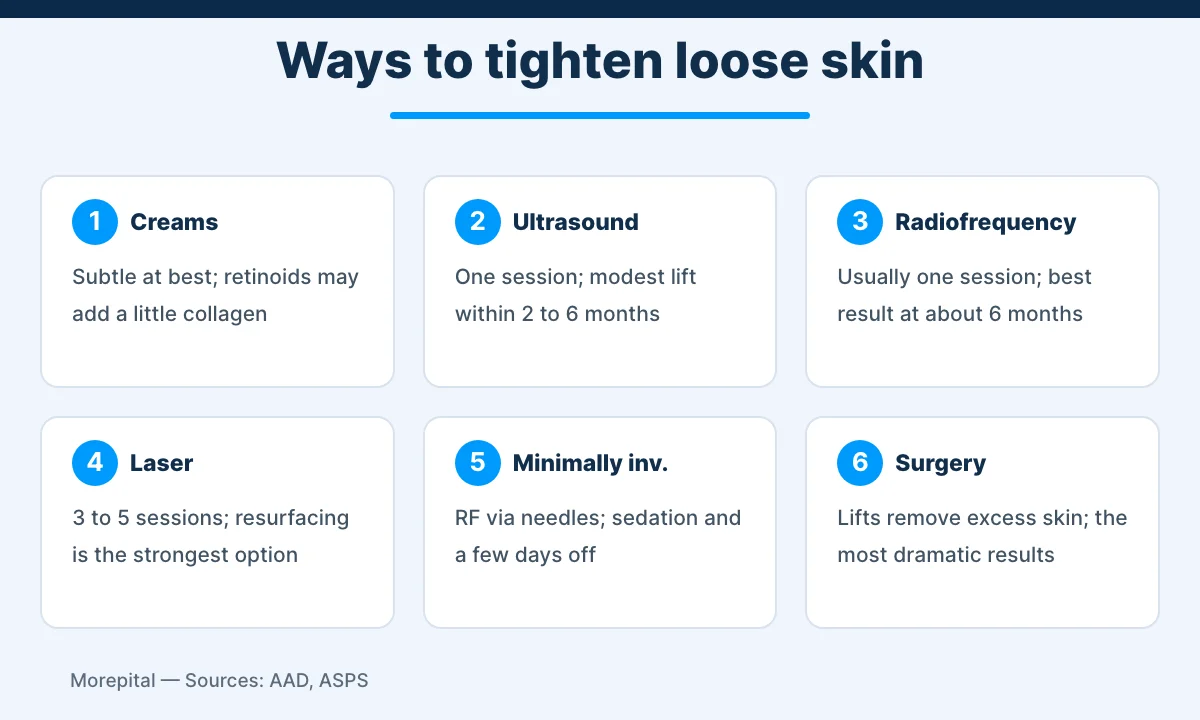
Skin laxity cannot be reversed by any single product, but several treatments can tighten skin or remove the excess. They range from creams to energy-based devices to surgery, and the results become stronger, but also riskier, as you move up the ladder.
Source: AAD
Creams and topical treatments
Skin creams cannot lift sagging skin because they do not penetrate deeply enough. A retinoid such as retinol may produce a small improvement by helping the body make more collagen, and any immediate firming effect is usually temporary moisturizing. Retinoids are typically applied once a day at bedtime and can cause redness, scaling and dryness, and they make skin more sensitive to the sun.
Source: AAD, Cochrane protocol (PMC)
Nonsurgical skin tightening
For mild to moderate skin laxity, energy-based devices heat the deeper layers of skin to stimulate new collagen while leaving the surface intact. Most sessions take an hour or less, the usual side effects are redness and swelling, and results appear gradually:
- Ultrasound: one treatment typically gives a modest lift within 2 to 6 months.
- Radiofrequency: most people have one treatment; best results appear in about 6 months.
- Non-ablative laser: typically 3 to 5 treatments, often used on the belly and upper arms.
- Minimally invasive radiofrequency: heat is delivered through a thin tube or needles, often on the neck or upper arms; it needs sedation and a few days of downtime.
- Laser resurfacing: the most effective nonsurgical option for tightening, but it requires 5 to 7 days at home and carries a greater risk of side effects, including scarring.
Source: AAD
Evidence supports these devices for mild to moderate skin laxity. A 2023 systematic review of microfocused ultrasound for the face found that most patients improved according to investigators, but patient-rated improvement was milder, objective changes were small, and people with marked laxity or a BMI above 30 generally had weaker results. Other options used for loose facial and neck skin include microneedling, radiofrequency microneedling and chemical peels, while dermal fillers and fat grafting restore lost volume rather than tighten skin.
Source: PMC systematic review (2023), Cleveland Clinic, Cleveland Clinic, PMC review (2013)
Surgery
For more advanced skin laxity, surgery removes excess skin and repositions deeper tissue, and it gives the most dramatic results. No nonsurgical option can match it. Common procedures include:
- Facelift for sagging cheeks, deep nasolabial folds and jowls, often combined with a neck lift, brow lift or blepharoplasty (eyelid surgery).
- Neck lift for loose skin and muscle under the chin.
- Tummy tuck or panniculectomy for hanging abdominal skin.
- Arm lift (brachioplasty), thigh lift and breast lift for sagging limbs and breasts.
- Lower or upper body lift after massive weight loss, sometimes done in stages.
Source: AAD, ASPS, Cleveland Clinic, ASPS, Cleveland Clinic
A facelift is usually done under general anesthesia, takes about 2 to 3 hours, and most people stay in hospital overnight. Full recovery takes about 2 to 4 weeks, and the final result is visible after 6 to 9 months. A facelift does not stop the aging process. After major weight loss, surgeons generally want your weight to have been stable for about a year, and you must stop smoking at least six weeks before surgery. Most people return to work two to four weeks after body contouring.
Source: NHS, ASPS, Cleveland Clinic
Complications
Mild skin laxity is a cosmetic issue and does not harm health. Large folds of loose skin, however, can trap moisture and cause skin breakdown, rashes and fungal or bacterial infections, and they can make walking, bending and exercise harder.
Source: Cleveland Clinic
Treatments for skin laxity carry their own risks. Energy-based devices commonly cause temporary redness and swelling; in the 2023 review of facial ultrasound, other side effects such as numbness, bruising and small burns occurred in about 2 percent of patients. Surgery carries the general risks of bleeding, infection, blood clots and anesthesia, plus procedure-specific risks such as nerve injury, asymmetry, visible scars and hair loss around scars after a facelift. After body contouring, poor wound healing, fluid collections, persistent swelling and recurrence of skin looseness are possible, and revision surgery may be needed.
Source: AAD, PMC systematic review (2023), NHS, Cleveland Clinic
In cutis laxa, the main concern is not the skin but the internal organs. Depending on the type, it can cause hernias, pouches in the intestines or bladder, emphysema and problems with the heart and arteries such as aortic aneurysm. When only the skin is affected, life expectancy is normal.
Source: Cleveland Clinic, MedlinePlus Genetics
Prevention and living with skin laxity
You cannot stop natural aging, but much of the skin laxity caused by extrinsic aging can be partly prevented. Dermatologists recommend these steps to slow skin laxity:
- Protect your skin every day with shade, sun-protective clothing and a broad-spectrum, water-resistant sunscreen with SPF 30 or higher.
- Use a self-tanner instead of tanning in the sun or a tanning bed.
- Quit smoking and drink less alcohol.
- Eat a balanced diet with plenty of fruits and vegetables, and exercise most days.
- Cleanse gently, moisturize daily and stop products that sting or burn.
Source: AAD, Cochrane protocol (PMC), MedlinePlus
If you are losing weight, a slower pace helps. Cleveland Clinic suggests aiming for about 1 to 2 pounds (roughly 0.5 to 1 kg) a week, eating enough protein, staying hydrated and keeping up daily sunscreen and skin care. Weight-related facial changes do not fade on their own while the weight loss is maintained, and they need no treatment unless you want it.
Source: Cleveland Clinic
Keeping a stable, healthy weight also helps any skin laxity procedure last. Dermatologists say the best candidates for skin laxity treatment keep a healthy weight, do not smoke, protect their skin from the sun and have only a small amount of sagging. Neck exercises may strengthen muscles, but there is no good evidence that they tighten loose skin.
Source: AAD, Cleveland Clinic
When to see a doctor
See a board-certified dermatologist or plastic surgeon if skin laxity bothers you and you want to discuss treatment, or if folds of skin cause repeated rashes, sores or infections. A doctor can also tell you whether any spots or growths on aging skin are worrisome, since normal age-related changes can be hard to tell apart from skin disease. See a doctor promptly if skin suddenly becomes loose after an illness, inflammation or a new medicine, or if a child has unusually loose skin, because these can be signs of cutis laxa.
Source: AAD, Cleveland Clinic, MedlinePlus, Cleveland Clinic
- after skin-tightening or lifting surgery you have chest pain, shortness of breath, or a painful, swollen leg (possible blood clot)
- you develop a fever, spreading redness or unusual drainage from an incision (possible infection)
- one side of the face or neck swells rapidly and painfully after a facelift or neck lift (possible bleeding)
Source: Cleveland Clinic, Cleveland Clinic, NHS
Related treatments
Related conditions
Skin laxity: frequently asked questions
Can skin laxity improve on its own?
Mild skin laxity may improve a little, especially in younger people with elastic skin, but skin that has been stretched for a long time often does not shrink back after major weight loss, and facial sagging from rapid weight loss does not fade with time.
Source: Cleveland Clinic, Cleveland Clinic, Cleveland Clinic
Do skin-firming creams work?
Only slightly. Creams cannot lift sagging skin because they do not penetrate deeply enough. A retinoid may give a small improvement by boosting collagen; most instant firming is temporary moisturizing.
Source: AAD
What is the best nonsurgical treatment for skin laxity?
Dermatologists consider laser resurfacing the most effective nonsurgical option, though it needs about a week of downtime. Ultrasound and radiofrequency give modest lifting over 2 to 6 months with little downtime.
Source: AAD
How long do skin laxity treatments last?
When should I have skin removal surgery after weight loss?
Surgeons generally want your weight to be stable for at least a year with no further loss expected, you must be in good health, and you must stop smoking at least six weeks before surgery.
Source: Cleveland Clinic, ASPS
Does rapid weight loss cause sagging skin?
Yes. The faster you lose weight, the more likely you are to lose facial fat and develop hollowing and sagging. Losing about 1 to 2 pounds a week may limit the effect.
Source: Cleveland Clinic
Can I prevent skin laxity?
You can slow it. Daily broad-spectrum SPF 30+ sunscreen, avoiding tanning, not smoking, limiting alcohol and a balanced diet all reduce premature skin aging.
Source: AAD
Is a facelift better than nonsurgical treatments for jowls?
Is skin laxity ever a sign of a disease?
Rarely. Cutis laxa, an inherited or acquired connective tissue disorder, causes loose, inelastic skin and can affect the heart, lungs and intestines, so sudden or unusual loose skin should be checked by a doctor.
Source: Cleveland Clinic, MedlinePlus Genetics
Ask about skin tightening or lift surgery
Sources
- AAD — Many ways to firm sagging skin
- AAD — 11 ways to reduce premature skin aging
- MedlinePlus — Aging changes in skin
- MedlinePlus Genetics — Cutis laxa
- Cleveland Clinic — Cutis Laxa
- Cleveland Clinic — Surgery After Significant Weight Loss
- Cleveland Clinic — Panniculectomy: What It Is, Surgery, Recovery & Results
- Cleveland Clinic — 'Ozempic Face': What It Is and How To Avoid It
- Cleveland Clinic — How To Get Rid of 'Turkey Neck'
- Cleveland Clinic — Neck Lift
- ASPS — Facelift
- ASPS — Body Contouring
- ASPS — Body contouring candidates
- NHS — Facelift
- PMC (Plast Reconstr Surg Glob Open, 2013) — The Science and Theory behind Facial Aging
- PMC (Cochrane Database Syst Rev, 2021) — Topical treatments and skin-resurfacing techniques for skin ageing (protocol)
- PMC (Int J Environ Res Public Health, 2023) — A Systematic Review of the Efficacy of Microfocused Ultrasound for Facial Skin Tightening
This page is part of the Morepital medical reference. It is for general health education and does not replace a consultation with a qualified doctor. Last reviewed: October 2026.