
Blepharoplasty
Eyelid surgery (eyelid lift)
Blepharoplasty (eyelid surgery) is an operation that removes or repositions excess skin and fat from the upper or lower eyelids to correct hooded lids, drooping skin that blocks vision, or bags under the eyes. It usually takes 45 minutes to 2.5 hours under local or general anesthesia, most people go home the same day and return to work after about 2 weeks, and results typically last for many years.
Source: NHS, Cleveland Clinic, MedlinePlus
- What is blepharoplasty?
- Who is a good candidate for blepharoplasty?
- How to prepare for eyelid surgery
- How blepharoplasty is done: step by step
- Blepharoplasty recovery timeline
- Results and how long they last
- Risks and complications of blepharoplasty
- Alternatives to blepharoplasty
- Choosing a surgeon and having blepharoplasty abroad
- When to call your doctor
- FAQ
- Sources
What is blepharoplasty?
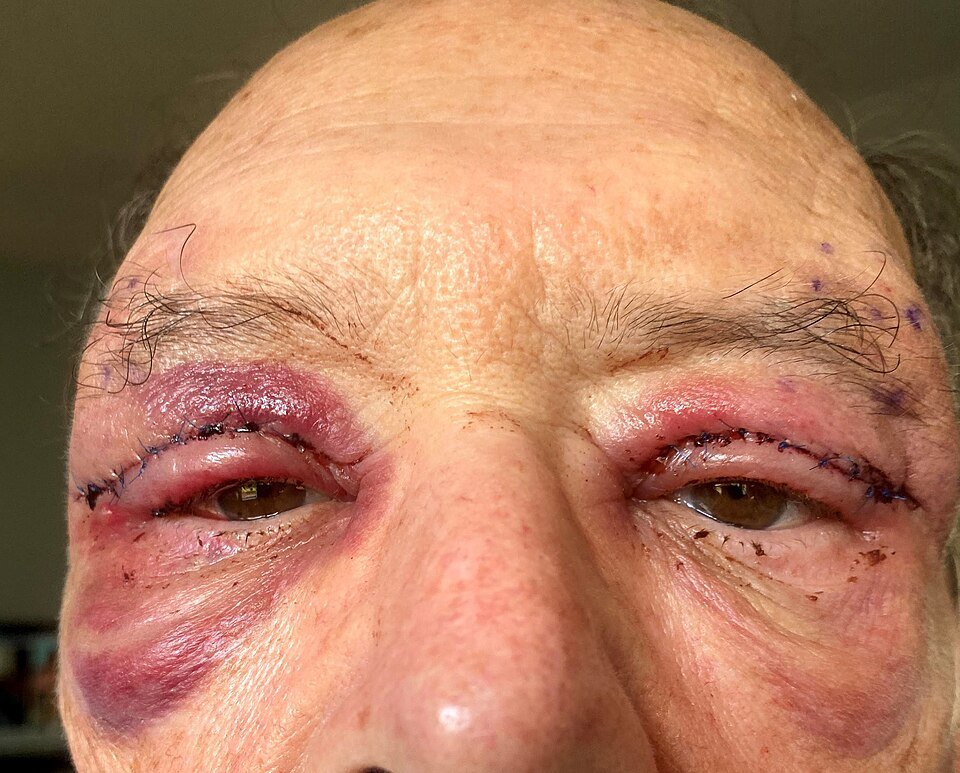
Blepharoplasty, often called eyelid surgery or an eyelid lift, is an operation that removes or repositions excess skin, fat and sometimes a little muscle from the upper eyelids, the lower eyelids or both. It is used to improve hooded or drooping upper lids and puffy bags under the eyes, so the eye area looks less tired.
Source: NHS, Cleveland Clinic, ASPS
The procedure can be cosmetic or functional. When loose upper-lid skin hangs low enough to block part of your field of vision, blepharoplasty is considered medically necessary; when it is done only to change appearance, it is cosmetic surgery. In the United States, insurance does not pay for elective cosmetic eyelid surgery, but it may cover upper-lid surgery when a visual field test documents that the extra skin seriously interferes with sight.
Source: MedlinePlus, Cleveland Clinic
What blepharoplasty can and cannot fix
- Can improve: loose or sagging upper-lid skin that forms folds, puffiness from fat in the eyelids, bags under the eyes, a lower lid that droops and shows white below the iris, and excess skin and fine wrinkles on the lower lid.
- Cannot fix on its own: wrinkles around the eyes such as crow’s feet, sagging eyebrows, or dark circles under the eyes.
Source: ASPS, MedlinePlus
Types of eyelid surgery
- Upper blepharoplasty – an incision in the natural eyelid crease lets the surgeon remove extra skin and bulging fat.
- Lower blepharoplasty (transcutaneous) – an incision just below the lower lash line allows skin removal and removal or repositioning of fat.
- Lower blepharoplasty (transconjunctival) – an incision inside the lower lid treats fat without removing skin and leaves no visible scar.
- Canthopexy or canthoplasty – tightening of a loose lower lid, often added to lower-lid surgery.
- Combined procedures – upper and lower surgery together, sometimes with a brow lift when low eyebrows add to upper-lid heaviness.
Source: Cleveland Clinic, ASPS
Who is a good candidate for blepharoplasty?
According to the American Society of Plastic Surgeons (ASPS), good candidates are healthy adults with no medical conditions that impair healing, non-smokers, people with a positive outlook and realistic goals, and people without serious eye conditions. Cleveland Clinic adds that you should not expect the surgery to change your look drastically.
Source: ASPS, Cleveland Clinic
Some conditions raise the risk of problems and must be discussed with your surgeon first: dry eye or low tear production, glaucoma, a detached retina, thyroid problems such as Graves disease, diabetes, high blood pressure, heart disease and other circulatory disorders.
Source: MedlinePlus, Cleveland Clinic
When blepharoplasty is not the right operation
Not every heavy upper lid is caused by extra skin. A low brow can push skin down onto the lid, and true eyelid ptosis, where the muscle that lifts the lid has stretched, needs a different surgical repair. Surgeons therefore check brow position, look for ptosis (which can be corrected in the same operation) and assess dryness before planning blepharoplasty. People who have had LASIK are especially prone to dry eye after eyelid surgery, so tear testing is advised for them.
Source: ASPS, Semin Plast Surg (PMC)
For the lower lids, a loose lid that fails a “snap-back” test, a prominent eye with a recessed cheekbone (a so-called negative vector), thyroid eye disease or previous lower-lid surgery all increase the chance that the lid will be pulled down afterwards. These do not always rule out surgery, but they change the plan.
Source: Semin Plast Surg (PMC)
How to prepare for eyelid surgery
Preparation starts with a consultation in which the surgeon takes a detailed medical and eye history, examines you and reviews your medicines, smoking history and previous surgery. The NHS recommends talking to your GP before you decide, as a medical condition or other reason may make the operation unsuitable.
Source: Cleveland Clinic, NHS
- Eye check. You may be asked to have your vision tested by an eye doctor. Surgeons typically examine vision, eye movement, lid and brow position, lid laxity and tear production (for example with a Schirmer test).
- Blood thinners. Tell the surgeon about aspirin, warfarin, apixaban and similar drugs. A review advises stopping aspirin, anticoagulants, anti-inflammatory painkillers, vitamin E, ginkgo and other herbal products up to 3 weeks before surgery where this is safe; never stop a prescribed blood thinner without your doctor’s agreement.
- Smoking. Non-smokers heal better and are preferred candidates.
- Practical plans. Arrange for an adult to drive you home and, ideally, to stay with you on the first night.
Source: MedlinePlus, Plast Surg Int (PMC), NHS, ASPS, Cleveland Clinic
Photographs are usually taken before surgery. Small differences between the two eyes are very common: in one study of 204 patients, 90.2% had some lower-lid asymmetry before any surgery, so it helps to know your starting point.
Source: Semin Plast Surg (PMC), Semin Plast Surg (PMC)
How blepharoplasty is done: step by step
Blepharoplasty usually takes about 45 minutes to 2.5 hours. Cleveland Clinic estimates 45 minutes to an hour for upper lids alone and about 2 hours for upper and lower lids together. It is normally an outpatient operation done in a surgeon’s office or a surgery center.
Source: NHS, Cleveland Clinic, MedlinePlus
- Anesthesia. Most upper-lid surgery is done under local anesthesia injected around the eye, often with sedation (“twilight sleep”), so you may be awake. General anesthesia is another option, especially for combined surgery.
- Marking. The surgeon marks the natural crease of the upper lid and the amount of skin to remove, leaving enough skin for the eye to close fully.
- Upper-lid incision. An incision is made in the crease; excess skin, protruding fat and sometimes a strip of muscle are removed, or fat is repositioned. A drooping lid muscle can be tightened at the same time if ptosis repair is needed.
- Lower-lid incision. Either just below the lashes, to remove some skin and remove or reposition fat, or on the inner surface of the lid (transconjunctival) to treat fat only. A loose lid may be tightened at its outer corner.
- Closure. Incisions are closed with fine stitches, skin glue or suture strips. Non-dissolving stitches are usually removed within about a week.
Source: MedlinePlus, Cleveland Clinic, ASPS, NHS, Semin Plast Surg (PMC)
A surgeon may also suggest a laser treatment or chemical peel to improve discoloration of the lower-lid skin. Most patients go home the same day.
Blepharoplasty recovery timeline
Right after surgery your eyes may be covered with ointment and light gauze. Tightness, soreness, swelling, bruising, dry or irritated eyes and watering are common at first and are usually controlled with simple painkillers such as paracetamol, cold packs and lubricating ointment or drops.
Source: MedlinePlus, ASPS, NHS
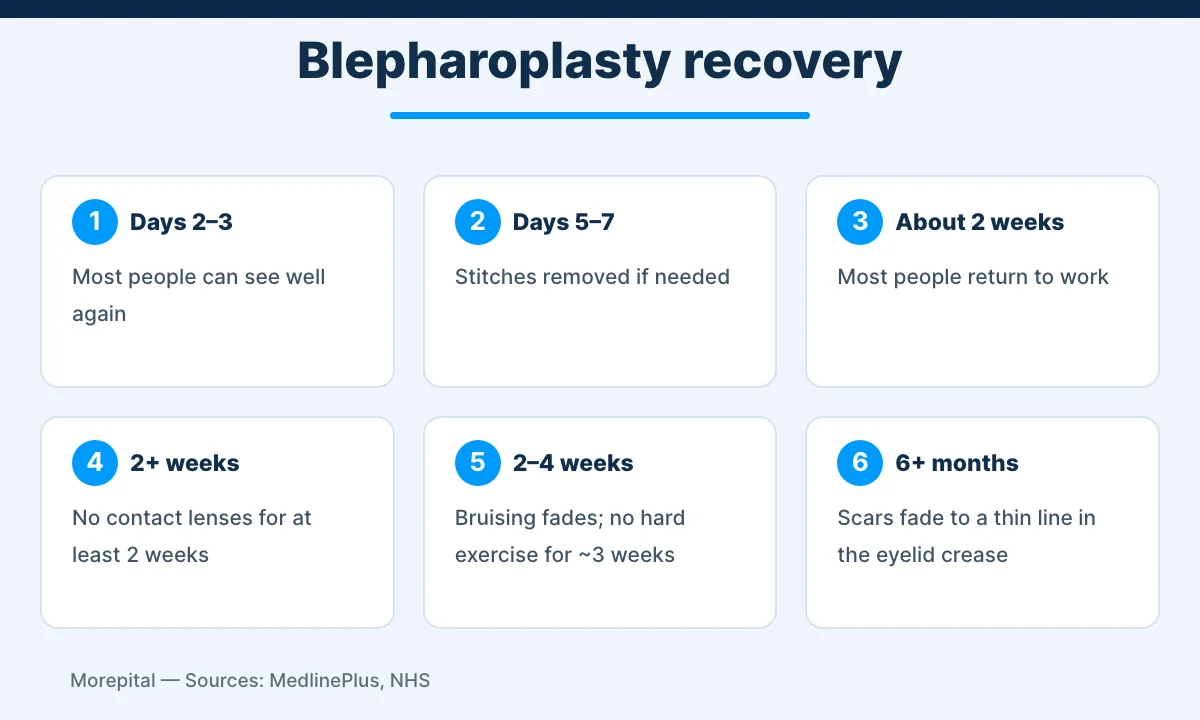
| Time after surgery | What to expect |
|---|---|
| First few days | Keep your head raised, use cold packs wrapped in a towel, keep activity to a minimum for 3–5 days; no driving for several days |
| Days 2–3 | Most people can see well again |
| Days 5–7 | Stitches are removed if needed |
| 10–14 days | Most people feel comfortable going out in public; many return to work after about 2 weeks |
| At least 2 weeks | No contact lenses |
| 2–4 weeks | Bruising fades; avoid heavy lifting, bending and hard exercise for about 3 weeks |
| First few weeks | Watering, sensitivity to light and wind, and blurred or double vision may occur |
| 3–6 months | Scars may feel tight and stay pink for 6 months or more before fading to a thin white line |
Source: MedlinePlus, NHS, ASPS
Aftercare tips
- Do not rub your eyes, smoke, or swim for a few days.
- Use the ointment or eye drops you are given, which may include antibiotic or lubricating drops.
- Wear dark sunglasses and protect the skin from the sun until healing is complete.
- Do not plan a holiday straight after surgery; rest and avoid alcohol, sun and sightseeing.
Source: NHS, MedlinePlus, ASPS, NHS
Results and how long they last
Results appear gradually over several weeks as swelling and bruising settle, with final healing taking a few months. The goal is smoother, better-defined eyelids and a more alert look, not a different face.
Source: Cleveland Clinic, ASPS
Blepharoplasty results are long-lasting. MedlinePlus notes that the more alert, youthful look usually lasts for years and is permanent for some people, and Cleveland Clinic says upper-lid results can last many years to a lifetime, while lower-lid surgery rarely needs to be repeated. Surgery does not stop aging, however, and lifelong sun protection helps maintain the result.
Source: MedlinePlus, Cleveland Clinic, ASPS
Results cannot be guaranteed. Occasionally the desired effect is not achieved and a second operation is needed; in a systematic review of lower blepharoplasty, reoperation rates ranged from 0% to 9%, with most studies below 3%.
Source: NHS, PRS Global Open (PMC)
Risks and complications of blepharoplasty
Like any operation, eyelid surgery carries general risks such as bleeding, infection, blood clots and reactions to the anesthetic. Temporary effects that most people notice include puffy, numb or hard-to-close eyelids, watery or light-sensitive eyes, bruising and visible scars that fade with time.
Source: NHS, MedlinePlus
Specific complications
- Dry eye. Reported in 0% to 26.5% of patients. In one study of 892 patients the rate was 12.9% after upper-lid surgery, 21.4% after lower-lid surgery and 31.3% after both; most cases are temporary, and in one study 95% recovered within 8 weeks.
- Difficulty closing the eyes (lagophthalmos), usually temporary and rarely permanent.
- Lower-lid malposition. The lid can be pulled down or turn outwards (ectropion). A systematic review of 36 studies found lower-lid malposition in 0% to 12% of patients; without lid support, the transcutaneous approach has been linked to malposition in up to 20%.
- Asymmetry, scarring and skin discoloration, including uneven eyelids or noticeable scars.
- Blurred or double vision, usually short-lived.
- Orbital (retrobulbar) hemorrhage – bleeding behind the eye that can threaten sight. It is rare, estimated at between 1 in 2,000 and 1 in 25,000 operations, and is more likely with high blood pressure or blood-thinning medicines.
- Vision loss – extremely rare, but the most serious risk.
Source: Int J Ophthalmol (PMC), MedlinePlus, PRS Global Open (PMC), Semin Plast Surg (PMC), Plast Surg Int (PMC), ASPS, Cleveland Clinic, NHS
Overall, the systematic review concluded that lower blepharoplasty has a low complication profile, reported no blindness in the studies it included, and found that most functional or cosmetic problems settled with conservative care or revision surgery. Choosing an experienced surgeon and following aftercare closely reduce the risks.
Source: PRS Global Open (PMC), Plast Surg Int (PMC)
Alternatives to blepharoplasty
The right treatment depends on what is causing the problem, so a surgeon will look at the brow, lid muscle and skin together.
Source: Semin Plast Surg (PMC)
- Brow lift. If sagging eyebrows push skin onto the upper lids, a brow lift raises the brows and can be combined with blepharoplasty.
- Ptosis repair. A lid that droops because the lifting muscle has stretched needs ptosis surgery rather than skin removal.
- Dermal fillers. Fillers can reduce the shadow of the lower lids, but they are temporary and need repeat treatments.
- Skin treatments. A laser treatment or a chemical peel can improve lower-lid discoloration and are sometimes used alongside surgery.
- Facelift. Eyelid surgery may be done alone or together with a facelift or brow lift for wider facial aging.
Source: ASPS, ASPS, ASPS, ASPS, MedlinePlus
Choosing a surgeon and having blepharoplasty abroad
Choose a surgeon with significant experience in eyelid surgery and ask about their credentials, training and how many procedures they have done. In the UK, the NHS advises checking that the clinic is registered with the Care Quality Commission and the surgeon or ophthalmologist with the General Medical Council, and asking how many operations they have performed with complications and what follow-up you will get if something goes wrong. In the UK, blepharoplasty costs about £2,000 to £6,000, and consultations, follow-up care and further surgery may cost extra.
Source: Cleveland Clinic, NHS
If you are traveling for surgery
- Check the surgeon’s qualifications, experience with the procedure and registration with the local regulator.
- Meet the surgeon yourself, ideally at two consultations with time to think in between, and make sure you share a language.
- Be wary of holiday packages that bundle surgery and travel, and do not pay for a surgeon or hospital you have not seen.
- Ask what happens if complications arise, where follow-up will take place and how you would return for further surgery.
- Check the clinic’s insurance; travel insurance usually does not cover complications of surgery.
- Plan to avoid flying for 7 to 10 days after facial procedures because of the risk of blood clots.
Source: NHS
When to call your doctor
Some discomfort, swelling and bruising are expected, but certain symptoms need urgent attention. Bleeding behind the eye is rare but can threaten sight, and treatment delayed by more than a few hours after vision is lost is unlikely to help, so you should have a way to reach your surgical team at any time.
Source: Plast Surg Int (PMC)
- You have severe, worsening or one-sided pain around the eye
- Your vision gets worse (check each eye separately)
- The eye bulges forward, feels tense or is hard to move
- You develop sudden, severe swelling or tightness around the eye
Source: Plast Surg Int (PMC), NHS
Contact your surgeon promptly if you notice signs of infection, double vision that does not settle, eyes that will not close or stay very dry after the first weeks, or a lower lid that pulls away from the eye. Dry-eye symptoms that last more than 2 weeks should be examined.
Source: MedlinePlus, Int J Ophthalmol (PMC), ASPS
Related treatments
Related conditions
Further reading
Blepharoplasty: frequently asked questions
How long does blepharoplasty recovery take?
Most people see well within 2–3 days, have stitches out at 5–7 days and return to work after about 2 weeks. Bruising fades over 2–4 weeks, and scars keep maturing for several months.
Source: MedlinePlus, NHS
Is blepharoplasty painful?
It is done under local anesthesia with sedation or under general anesthesia, so you should not feel pain during surgery. Afterwards, tightness and soreness are common and usually controlled with over-the-counter painkillers and cold packs.
Source: MedlinePlus, Cleveland Clinic
How long do blepharoplasty results last?
Results are long-lasting: usually many years, and permanent for some people. Upper-lid results can last many years to a lifetime and lower-lid surgery rarely needs repeating, but natural aging continues.
Source: MedlinePlus, Cleveland Clinic, ASPS
Will blepharoplasty leave a scar?
Upper-lid scars sit in the natural eyelid crease. They may stay pink for 6 months or more, then usually fade to a thin, nearly invisible line. Transconjunctival lower-lid surgery leaves no visible scar.
Source: MedlinePlus, Cleveland Clinic
Does insurance cover eyelid surgery?
Not when it is purely cosmetic. Upper-lid surgery may be covered when excess skin seriously blocks vision, as documented by a visual field test.
Source: Cleveland Clinic, MedlinePlus
Can blepharoplasty remove crow's feet or dark circles?
No. Eyelid surgery does not remove wrinkles around the eyes, lift sagging eyebrows or remove dark circles. Other treatments, such as a brow lift or skin treatments, may be needed.
Source: MedlinePlus, ASPS
What is the difference between blepharoplasty and ptosis surgery?
Blepharoplasty removes excess skin and fat. Ptosis is a drooping lid caused by a stretched lifting muscle and needs a different repair, though both can be done in the same operation.
Source: ASPS, Semin Plast Surg (PMC)
How much does blepharoplasty cost?
In the UK the NHS gives a range of about £2,000 to £6,000, plus possible extra costs for consultations, follow-up care or further surgery. Prices differ widely between countries and clinics.
Source: NHS
When can I fly after blepharoplasty abroad?
The NHS advises avoiding flying for 7 to 10 days after facial cosmetic procedures because of the risk of blood clots.
Source: NHS
Is blepharoplasty safe?
It is generally safe, and reviews report low complication rates. Temporary dry eye, swelling and bruising are common; serious problems such as bleeding behind the eye or vision loss are rare.
Source: PRS Global Open (PMC), Plast Surg Int (PMC), Int J Ophthalmol (PMC)
Considering blepharoplasty? Contact us for a free consultation and an honest assessment of your eyelids, brows and eye health.
Sources
- NHS — Eyelid surgery
- Cleveland Clinic — Eyelid Surgery: Plastic Surgery
- ASPS — Eyelid Surgery
- MedlinePlus — Eyelid lift
- ASPS — Eyelid Surgery Procedure Steps
- ASPS — Eyelid Surgery Candidates
- Semin Plast Surg (PMC) — Upper Eyelid Blepharoplasty: Evaluation, Treatment, and Complication Minimization
- Semin Plast Surg (PMC) — Eyelid Malposition after Blepharoplasty: An Ounce of Prevention
- Plast Surg Int (PMC) — Complications of Blepharoplasty: Prevention and Management
- ASPS — Eyelid Surgery Recovery
- ASPS — Eyelid Surgery Results
- NHS — Cosmetic surgery abroad
- PRS Global Open (PMC) — Safety and Complications in Lower Eyelid Blepharoplasty: A Systematic Review
- Int J Ophthalmol (PMC) — Cosmetic blepharoplasty and dry eye disease: a review of the incidence, clinical manifestations, mechanisms and prevention
- ASPS — Eyelid Surgery Risks and Safety
- ASPS — Brow Lift
- ASPS — Dermal Fillers
This page is part of the Morepital medical reference. It is for general health education and does not replace a consultation with a qualified doctor. Last reviewed: October 2026.