
Kidney stones are hard, pebble-like lumps of minerals and salts that form inside the kidneys when urine holds more of certain substances, such as calcium, oxalate or uric acid, than it can keep dissolved. Small stones often pass out in the urine with little or no trouble, but a stone that moves into the tube draining the kidney can cause severe pain in the side or back that spreads to the groin, along with nausea and blood in the urine. Most stones are managed at home with fluids and pain relief; larger or blocking stones need treatment such as shock wave lithotripsy, ureteroscopy or keyhole surgery.
Source: NHS, NIDDK, Cleveland Clinic
Source: Cleveland Clinic, National Kidney Foundation, NHS
Contents
- What are kidney stones?
- Types of kidney stones
- Kidney stones symptoms
- Causes and risk factors
- How kidney stones are diagnosed
- Passing a stone at home: sizes and timelines
- Procedures to remove or break up a stone
- Complications and when to get urgent help
- How to prevent kidney stones from coming back
- Kidney stones: frequently asked questions
What are kidney stones?
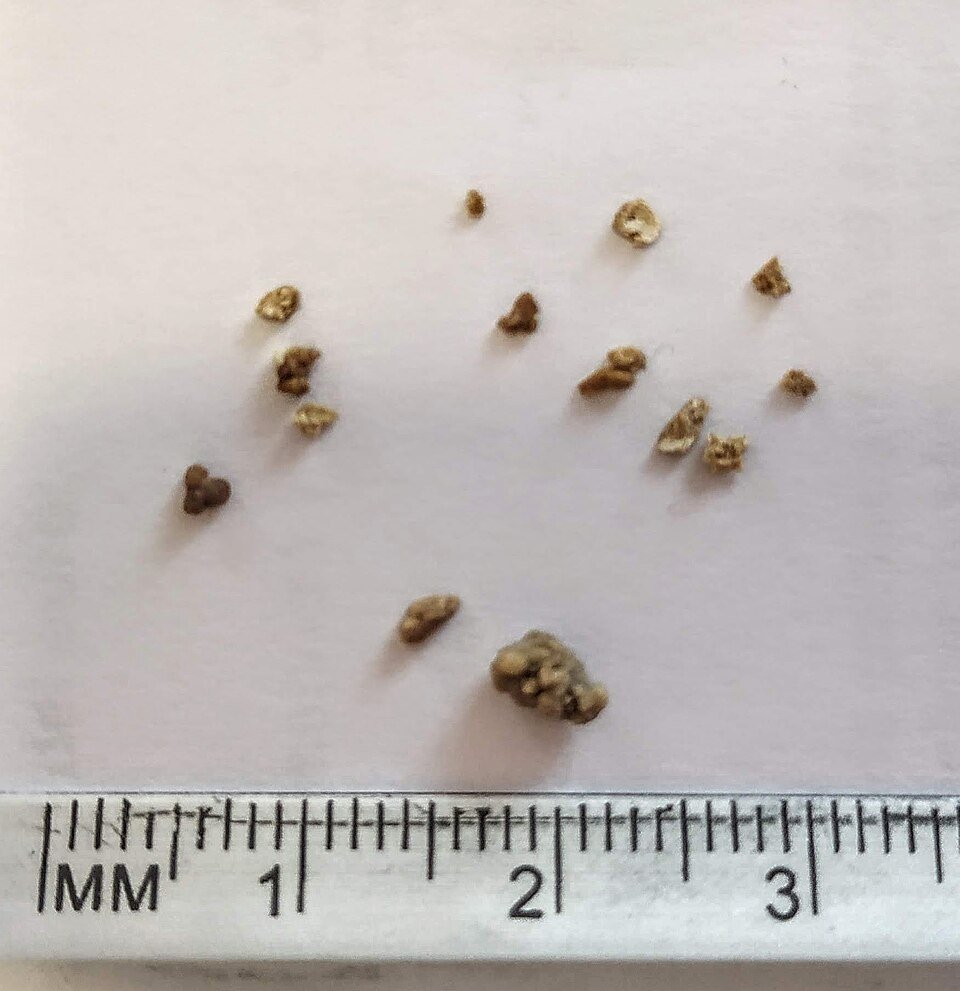
Urine normally contains minerals such as calcium, oxalate and phosphorus, and at low levels they cause no problems. When their concentration rises, or when there is too little liquid to keep them dissolved, crystals can form and slowly clump together into a solid stone. MedlinePlus notes that this process often takes weeks or months.
Source: NIDDK, MedlinePlus
Stones vary widely in size. Most are somewhere between a grain of sand and a pea, and in rare cases they grow as large as a golf ball. Kidney stones usually cause trouble when one moves into the ureter, the narrow tube from the kidney to the bladder, and blocks the flow of urine.
Source: NIDDK, MedlinePlus
How common are kidney stones?
The National Kidney Foundation (NKF) estimates that about 1 in 10 people will develop kidney stones in their lifetime, up from about 4 in 100 in the late 1970s, and that more than 500,000 people in the United States go to an emergency room for kidney stones every year. The US NIDDK puts lifetime figures at about 11% of men and 6% of women. Cleveland Clinic says stones are most common in men in their 30s and 40s.
Source: National Kidney Foundation, NIDDK, Cleveland Clinic
Types of kidney stones
Knowing the type matters, because prevention advice and medicines differ for each kind of kidney stones. There are four main types:
- Calcium stones are by far the most common. Calcium usually combines with oxalate (calcium oxalate stones, the most frequent kind) or, less often, with phosphate.
- Uric acid stones can form when urine is too acidic. They are linked to gout, diets rich in animal protein, diabetes and some chemotherapy.
- Struvite stones form after urinary tract infections. They can grow large quickly, and repeated infections can produce a big branching “staghorn” stone that usually needs surgery.
- Cystine stones are caused by cystinuria, an inherited disorder that lets the amino acid cystine leak into the urine.
Source: NIDDK, Cleveland Clinic, National Kidney Foundation, MedlinePlus
Kidney stones symptoms
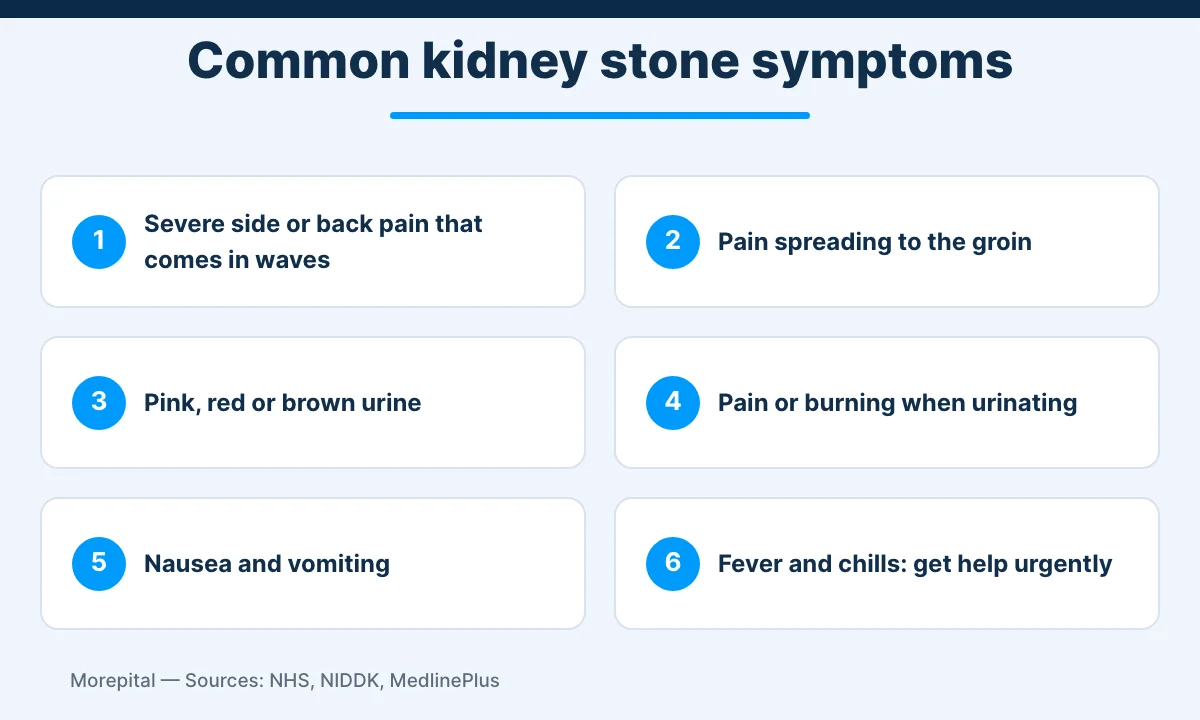
Small stones may cause no symptoms and pass unnoticed. Many people only find out they have kidney stones when one moves into the ureter and blocks the flow of urine.
Source: NHS, MedlinePlus
When symptoms do appear, the main one is pain. It usually starts in the side of the abdomen or the lower back (flank pain) and may spread down to the groin, the testicles in men or the area around the vaginal opening in women. The pain often comes in waves: it can start and stop suddenly, with severe spells followed by milder periods. Other common kidney stones symptoms include:
- Pink, red or brown urine (blood in the urine, called hematuria)
- Pain or burning while urinating
- A constant or frequent urge to urinate
- Passing only a small amount of urine, or being unable to urinate
- Cloudy or bad-smelling urine
- Nausea and vomiting
- Fever, chills, or feeling hot, cold and shivery, which can point to an infection
Source: NHS, NIDDK, Cleveland Clinic, MedlinePlus
NIDDK advises seeing a health professional right away for these symptoms, because they can also signal other serious conditions.
Source: NIDDK
Causes and risk factors
Kidney stones form when the balance between water and stone-forming substances in urine tips the wrong way. MedlinePlus calls not drinking enough fluid the biggest risk factor, and notes that making less than 1 liter (about 32 ounces) of urine a day raises the risk.
Source: MedlinePlus, NIDDK
Who is more likely to get kidney stones?
- Personal and family history: having had a stone before, or a close family member with stones
- Sex: men are affected more often than women
- Diet: a lot of sodium (salt), added sugar, meat, fish and seafood, with too little fruit, vegetables, calcium and water; the NHS also lists a high-protein, low-fiber diet
- Body weight and metabolism: obesity, metabolic syndrome and diabetes
- Other medical conditions: gout, hyperparathyroidism, inflammatory bowel disease and other small intestine diseases, gastric bypass surgery, polycystic kidney disease, urinary tract blockage and frequent urinary or kidney infections
- Inactivity: being inactive or bed-bound for long periods
Source: NIDDK, National Kidney Foundation, NHS, MedlinePlus
If you live with diabetes, it is worth knowing the early diabetes symptoms and keeping your condition well controlled, because the NKF lists diabetes among the conditions that raise stone risk and links it with uric acid stones. The NKF also notes that kidney stones are associated with a higher risk of high blood pressure, heart disease, osteopenia and chronic kidney disease.
Source: National Kidney Foundation
Medicines that can raise the risk
Some medicines make kidney stones more likely. NIDDK names long-term use of diuretics (“water pills”), calcium-based antacids, the HIV drug indinavir and the seizure and migraine medicine topiramate. The NHS also lists aspirin, antacids, diuretics and some antibiotics. If you rely on antacids for heartburn, for instance from acid reflux, mention it to your doctor. Never stop a prescribed medicine on your own. Cleveland Clinic adds that calcium supplements may increase risk, while eating calcium-rich foods is encouraged.
Source: NIDDK, NHS, Cleveland Clinic
How kidney stones are diagnosed
A doctor can often suspect kidney stones from your symptoms, medical history, medicines, diet and family history. Tests then confirm the diagnosis and look for complications:
- Urine tests look for blood, crystals and signs of infection.
- Blood tests check kidney function and levels of calcium, phosphorus, uric acid and electrolytes.
- Imaging shows the size and position of the stone. The NHS says adults with severe pain may be referred to hospital for a CT scan, while ultrasound is used during pregnancy and for children under 16. X-rays are also used.
- Stone analysis identifies the type of any stone you pass or that is removed.
Source: NHS, MedlinePlus, Cleveland Clinic
After a stone has passed or been removed, your doctor may order a 24-hour urine collection. You collect all your urine over a full day so a laboratory can measure its volume and mineral content, which helps explain why the stone formed. The NKF recommends that people who have had more than one stone do this test at least once a year.
Source: NIDDK, National Kidney Foundation
Passing a stone at home: sizes and timelines
Most kidney stones do not need surgery: Cleveland Clinic reports that around 80% pass on their own. Size is the strongest predictor: about 90% of stones smaller than 6 mm (about 1/4 inch) pass naturally, compared with about 60% of stones larger than 6 mm.
Source: Cleveland Clinic
Passing a stone can take time. According to Cleveland Clinic, stones under 4 mm may pass within one to two weeks, while larger ones may take two to three weeks. Once a stone reaches the bladder, it usually leaves the body within a few days. If a stone has not passed within four to six weeks, follow up with your provider.
Source: Cleveland Clinic, NHS
What home care involves
- Fluids: drinking plenty of liquids, mainly water, helps move the stone along.
- Pain relief: MedlinePlus says ibuprofen or naproxen can be effective, but Cleveland Clinic advises asking your provider before taking ibuprofen during an attack because it can raise the risk of kidney problems.
- Anti-sickness medicine: may be prescribed for nausea and vomiting.
- Catching the stone: you may be asked to strain your urine and save the stone for testing.
Source: NHS, MedlinePlus, Cleveland Clinic, NIDDK
Being pain-free does not prove a stone has passed. MedlinePlus advises confirming it by catching the stone in a strainer or with a follow-up X-ray.
Source: MedlinePlus
Medicines that help a stone pass
Doctors sometimes prescribe drugs that relax the ureter, such as tamsulosin (an alpha-blocker) or nifedipine. A 2017 meta-analysis of eight placebo-controlled trials, summarized in The Journal of Family Practice, found that tamsulosin helped pass stones of 5 to 10 mm in the lower ureter (about one extra stone passed for every five people treated) but not stones under 5 mm; its value above 10 mm is unclear.
Source: The Journal of Family Practice (PMC), Cleveland Clinic
Procedures to remove or break up a stone
Treatment of kidney stones depends on their size, position and type. A urologist usually recommends a procedure when a stone is too large to pass, keeps growing, blocks urine flow, causes uncontrolled pain, or comes with infection or fever. Vomiting with dehydration may require hospital care with IV fluids. The main options are:
Source: MedlinePlus, NIDDK
Shock wave lithotripsy (SWL or ESWL)
Shock waves are aimed at the stone from outside the body to break it into small pieces that then pass in the urine. NIDDK describes it as an outpatient procedure, sometimes done with anesthesia; the NHS says no anesthetic is needed. MedlinePlus notes that it is used for stones smaller than about 1.25 cm (half an inch).
Source: NIDDK, NHS, MedlinePlus
Ureteroscopy
A long, thin tube called a ureteroscope is passed up through the urethra and bladder into the ureter or kidney. The stone is removed or broken up, often with a laser. It is done in hospital under anesthesia, and most people go home the same day.
Source: NIDDK, NHS, MedlinePlus
Percutaneous nephrolithotomy (PCNL)
For larger stones, a surgeon passes a thin instrument (nephroscope) directly into the kidney through a small cut in the back, sometimes using a laser to break the stone. It is done under general anesthesia and may mean a hospital stay of several days.
Laparoscopic surgery is another option; open surgery is rare. After some procedures, a thin tube called a ureteral stent is left in place for a while to help urine drain. The table compares the main approaches.
Source: Cleveland Clinic, NIDDK, MedlinePlus
| Approach | How it works | Anesthesia and stay | Typically used for |
|---|---|---|---|
| Watchful waiting | Fluids, pain relief, sometimes tamsulosin | At home | Small stones likely to pass |
| Shock wave lithotripsy | Shock waves from outside the body | Outpatient; anesthesia not always needed | Stones under about 1.25 cm |
| Ureteroscopy | Scope through the urethra; laser | Anesthesia; usually home the same day | Stones in the ureter or kidney |
| Percutaneous nephrolithotomy | Instrument through a small cut in the back | General anesthesia; may stay several days | Larger stones |
Source: Cleveland Clinic, NIDDK, MedlinePlus, NHS
If calcium kidney stones are caused by hyperparathyroidism, removing the abnormal parathyroid gland can cure the condition and prevent new stones, though surgery carries risks such as infection.
Source: NIDDK
Complications and when to get urgent help
Kidney stones are painful but usually leave the body without lasting damage, and Cleveland Clinic notes that they do not cause death. Problems arise mainly when treatment is delayed. Possible complications include:
- Swelling of the kidney from trapped urine (hydronephrosis)
- Urinary tract infections, including kidney infection
- Acute kidney injury and, over time, loss of kidney function or scarring
- A higher risk of chronic kidney disease in people with past stones
Source: Cleveland Clinic, NIDDK, MedlinePlus
When to see a doctor
The NHS advises contacting your GP urgently or calling NHS 111 if you think you have kidney stones and you have severe pain, or a high temperature or feel hot, cold and shivery. MedlinePlus adds pain that will not go away, blood in the urine, vomiting, cloudy or foul-smelling urine, and burning when you urinate. Get medical help straight away if you cannot pass urine at all, or if fever and chills come with stone pain: MedlinePlus lists a blockage of urine flow with infection among the reasons a stone needs prompt procedures.
Source: NHS, MedlinePlus, NIDDK
How to prevent kidney stones from coming back
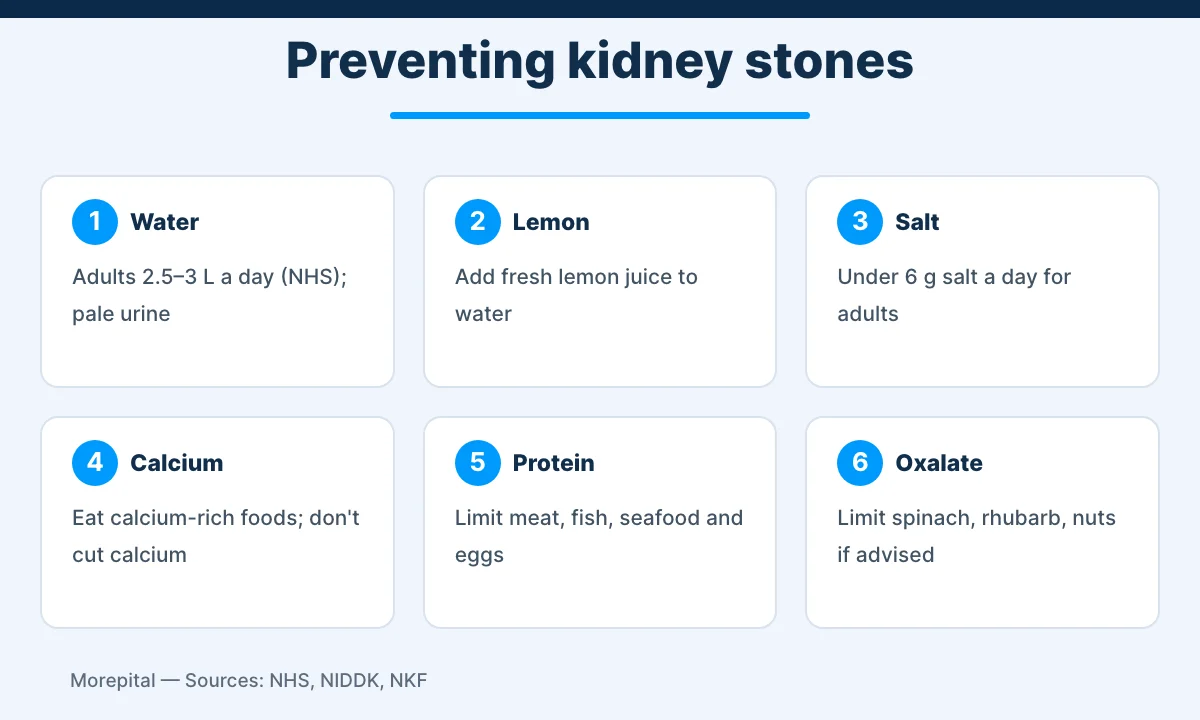
Once you have had kidney stones, you are likely to get more. The NKF estimates that at least half of people with a first stone will have another, and MedlinePlus notes that stones often recur when the underlying cause is not found and treated. Prevention is tailored to the type of stone you had, so talk to your doctor before big diet changes.
Source: National Kidney Foundation, MedlinePlus, NHS
Drink enough fluid, mostly water
Fluid is the most important step against kidney stones, though advice varies slightly by source. The NHS recommends that adults drink 2.5 to 3 liters (about 85 to 100 fluid ounces) of water a day and children 1 to 2 liters. NIDDK suggests six to eight 8-ounce glasses a day, mainly water, unless you have kidney failure, and more in hot weather, with exercise or if you have cystine stones. The NKF frames the goal as drinking enough to make 2.5 liters (85 ounces) of urine a day. Dark urine suggests you need to drink more. The NHS also suggests adding fresh lemon juice to water and limiting fizzy, caffeinated and alcoholic drinks.
Source: NHS, NIDDK, National Kidney Foundation
Cut down on salt
The NHS advises adults to eat less than 6 g of salt a day, and NIDDK recommends less than 2,300 mg of sodium a day, about the amount in one teaspoon of table salt (2,325 mg). NIDDK adds that studies link the DASH eating plan with a lower risk of kidney stones.
Get enough calcium from food
Cutting calcium does not prevent calcium kidney stones. In fact, the NKF says too little calcium can contribute to calcium oxalate stones. Aim for calcium-rich foods as part of meals. Cleveland Clinic notes that calcium supplements and calcium-containing antacids, unlike food, may increase risk, so ask your doctor before taking them.
Source: National Kidney Foundation, Cleveland Clinic, NHS
Limit animal protein, sugar and high-oxalate foods
- Limit animal protein from beef, chicken, pork (especially organ meats), eggs, fish and shellfish; beans, dried peas and lentils are useful plant alternatives.
- Limit added sugar and eat more fruit and vegetables.
- If you have had calcium oxalate stones, limit high-oxalate foods such as spinach, rhubarb, wheat bran, nuts and peanuts.
- Avoid vitamin C supplements and nutrition or herbal supplements unless your doctor approves; MedlinePlus notes that vitamin C supplements may increase oxalate-related stones.
- For uric acid stones, cut animal protein and lose weight if you are overweight.
Source: NIDDK, National Kidney Foundation, Cleveland Clinic, MedlinePlus
Keeping a healthy weight also helps, and if you have type 2 diabetes, ask your doctor how it affects your stone risk, since diabetes is one of the conditions linked to stones.
Source: Cleveland Clinic, National Kidney Foundation
Preventive medicines
If lifestyle changes are not enough to stop kidney stones, your doctor may prescribe a medicine based on the stone type and your 24-hour urine results:
- Calcium stones: potassium citrate, or thiazide-type diuretics such as chlorthalidone or indapamide, which lower urine calcium
- Uric acid stones: allopurinol and potassium citrate
- Struvite stones: antibiotics, sometimes with acetohydroxamic acid
- Cystine stones: mercaptopropionyl glycine and potassium citrate
Source: NIDDK, National Kidney Foundation
Kidney stones: frequently asked questions
How long does it take to pass kidney stones?
Stones under 4 mm may pass within one to two weeks and larger ones within two to three weeks, according to Cleveland Clinic. See your doctor if a stone has not passed after four to six weeks.
Source: Cleveland Clinic
What size of kidney stone needs surgery?
There is no single cut-off. About 90% of stones under 6 mm pass naturally, compared with about 60% of larger ones. Procedures are used when a stone is too big to pass, blocks urine, causes uncontrolled pain or comes with infection.
Source: Cleveland Clinic, MedlinePlus
Can kidney stones damage the kidneys?
Most do not cause lasting harm. A stone that blocks urine for a long time, or one linked to infection, can lead to kidney swelling, infection or loss of kidney function, so do not ignore symptoms.
Source: MedlinePlus, NIDDK
Should I stop eating calcium if I have had kidney stones?
No. Getting enough calcium from food lowers the risk of calcium oxalate stones. Only calcium supplements and calcium-based antacids may raise risk, so discuss them with your doctor.
Source: National Kidney Foundation, Cleveland Clinic
Do kidney stones come back?
Often, yes. At least half of people who have one stone will get another, according to the NKF. Drinking enough water, eating less salt and following type-specific advice lower the risk.
Source: National Kidney Foundation
Is lemon water good for kidney stones?
The NHS suggests adding fresh lemon juice to water, and NIDDK notes that citrus drinks may help prevent stones. This is prevention advice; if you have stone pain now, follow the home-care and treatment guidance above and see a doctor.
Disclaimer: this article is for general health education and does not replace advice from a qualified doctor who can assess your individual case. Last updated: October 2026.