
Breast cancer symptoms most often start with a new lump or thickening in the breast or armpit, which is frequently painless. Other warning signs are a change in breast size or shape, dimpled or “orange peel” skin, redness or a change in skin color, a nipple that turns inward, and nipple discharge (sometimes bloody) when you are not breastfeeding. Most breast lumps are not cancer, but any new or persistent change should be checked by a doctor promptly.
Source: WHO, American Cancer Society, NHS, NHS
Contents
- What breast cancer symptoms are and why they matter
- The 8 most common breast cancer symptoms
- Breast lumps: what a suspicious lump feels like
- Cancer without a lump: inflammatory breast cancer and Paget disease
- Breast cancer symptoms in men
- Benign conditions that mimic breast cancer
- Checking breast cancer symptoms: exam, imaging and biopsy
- Screening: finding cancer before symptoms appear
- When breast cancer symptoms need a doctor
- FAQ
What breast cancer symptoms are and why they matter
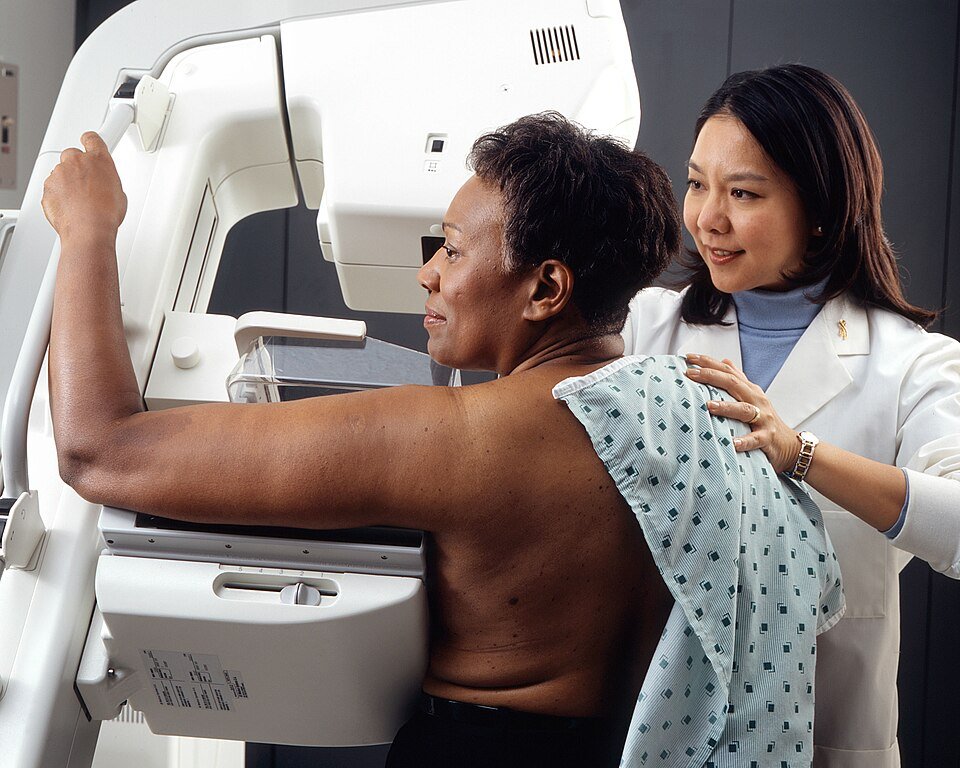
Breast cancer happens when cells in the breast grow out of control and form a tumor. According to the World Health Organization, an estimated 2.4 million women were diagnosed with breast cancer worldwide in 2024, and about 694,000 died of it. It was the most common cancer in women in 164 of 186 countries. Roughly 80% of cases occur in women with no specific risk factor other than being female and getting older, so knowing the breast cancer symptoms is useful for everyone, not only for people with a family history.
Source: WHO
Acting on breast cancer symptoms early matters because outcomes depend strongly on stage. In the United States, the five-year relative survival for female breast cancer is about 91.9% overall. It is close to 100% when the cancer is still confined to the breast (localized), about 87.5% when it has spread to nearby lymph nodes (regional), and about 33.8% once it has spread to distant organs. About 64% of cases are diagnosed at the localized stage, and the median age at diagnosis is 64.
Source: NCI SEER, Cleveland Clinic
Breast cancer symptoms are not proof of cancer, since lumps and nipple changes usually have harmless causes. Their absence is not proof of health either: some people have no signs, and the only clue may be a suspicious screening mammogram.
Source: CDC, Cleveland Clinic
The 8 most common breast cancer symptoms
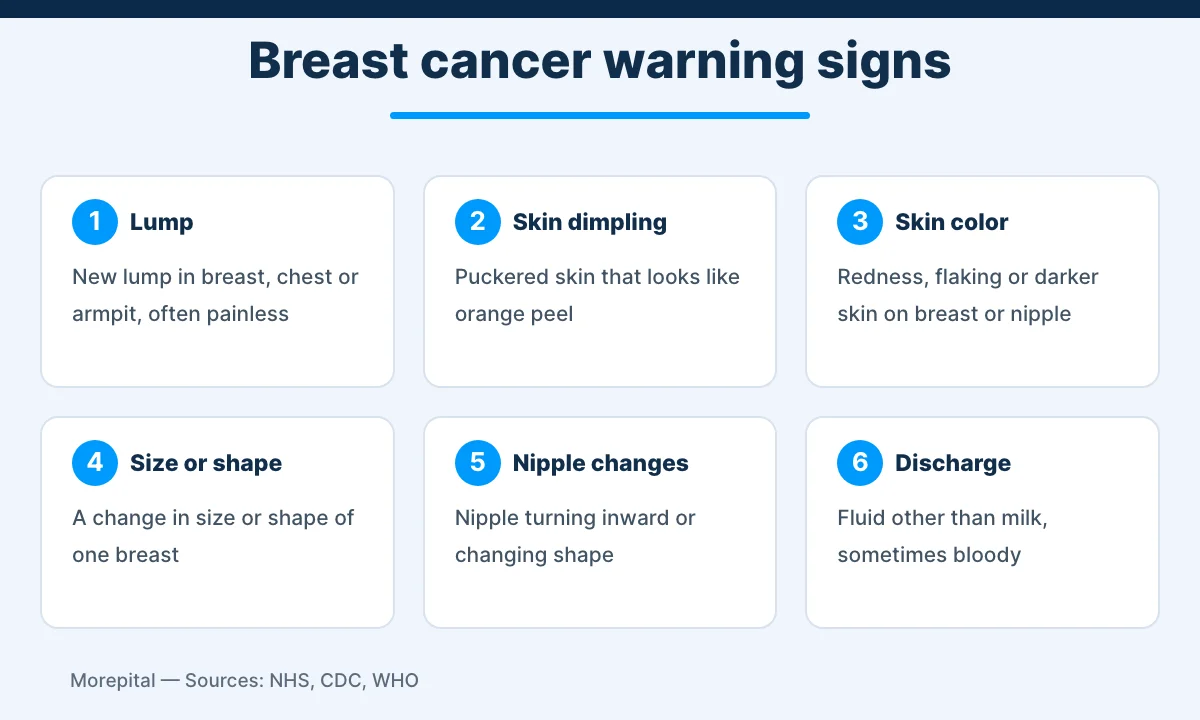
Health agencies list broadly the same warning signs. Breast cancer symptoms can appear alone or together; combinations are more typical of advanced disease. The most common breast cancer symptoms are:
- A new lump or swelling in the breast, chest or armpit. This is the most common sign.
- Thickening or swelling of part of the breast, even when no distinct lump can be felt.
- Skin dimpling or puckering, sometimes looking or feeling like orange peel.
- Redness, flaking or a change in skin color on the breast or nipple. On darker skin the area may look darker rather than red.
- A change in size or shape of one or both breasts.
- Nipple changes, such as a nipple that pulls inward (inversion) or changes in shape.
- Nipple discharge other than breast milk, which may contain blood.
- Swollen lymph nodes under the arm or near the collarbone.
Source: NHS, CDC, American Cancer Society, Cleveland Clinic
Pain in the breast or nipple appears on some symptom lists, but the NHS stresses that you can have all of these signs without any pain, and that breast pain by itself is not usually a symptom of breast cancer. Swollen lymph nodes deserve special attention: the American Cancer Society explains that they can signal spread even before the original tumor is large enough to be felt.
Source: NHS, American Cancer Society
Changes that last through your cycle
Breasts change with the menstrual cycle, so what matters is whether a change is new for you and persists. Watch for a lump or thickening that lasts through your cycle or any change that does not go away after a few days, and check your breasts regularly so you know what is normal for you.
Source: Cleveland Clinic, NHS
Breast lumps: what a suspicious lump feels like
A lump is the breast cancer symptom people worry about most, and the one doctors see most often. The American Cancer Society describes a painless, hard, fixed mass with irregular edges as more likely to be cancer. Cleveland Clinic notes that a cancerous lump can be as small as a pea and hard like a marble.
Source: American Cancer Society, Cleveland Clinic
Texture alone cannot rule cancer in or out: breast cancer can also be soft, round, tender or even painful. The WHO advises seeking care for any abnormal lump, even a painless one, while stressing that most breast lumps are not cancer. Only imaging and, when needed, a biopsy can tell the difference.
Source: American Cancer Society, WHO, CDC
Lumps in the armpit
The lymph nodes that drain the breast sit in the armpit and above the collarbone. The NHS lists armpit lumps or swelling among the main breast cancer symptoms in women and men; check them like a breast lump.
Source: NHS, NHS, American Cancer Society
Cancer without a lump: inflammatory breast cancer and Paget disease
Some forms do not start with a lump. Their breast cancer symptoms can be mistaken for an infection or a skin rash.
Inflammatory breast cancer
Inflammatory breast cancer (IBC) is rare, accounting for about 1% to 5% of all breast cancers. It often causes no lump and may not show up on a mammogram. Its signs usually develop over a few weeks to a few months and include:
- swelling of the breast skin and redness covering at least a third of the breast;
- pitted or thickened skin that may look like orange peel;
- one breast looking larger, or feeling warmer and heavier, than the other;
- a retracted or inverted nipple;
- tenderness, pain or itching, and swollen lymph nodes under the arm or near the collarbone.
Source: American Cancer Society
These breast cancer symptoms overlap with mastitis, which is far more common, so antibiotics are often tried first. Return if there is no improvement within about a week, or if things worsen or spread.
Source: American Cancer Society
Paget disease of the nipple
Paget disease of the breast affects the skin of the nipple and the darker area around it (areola). The skin may look crusted, scaly and red, and it is easily mistaken for eczema. It may burn or itch, the nipple may flatten or turn inward, and blood or yellow fluid may leak. It usually affects one breast and, in most cases, occurs together with ductal carcinoma in situ (DCIS) or invasive ductal cancer in the same breast, which can sometimes be felt as a lump. An eczema-like rash on one nipple that does not settle should always be examined.
Source: American Cancer Society, NHS
Breast cancer symptoms in men
Men have a small amount of breast tissue and can develop breast cancer, although it is uncommon. The WHO estimates that 0.5% to 1% of breast cancers occur in men. In the United States, the American Cancer Society estimates about 2,670 new cases of invasive breast cancer in men and about 530 deaths in 2026. The average age at diagnosis is between 60 and 70, and the lifetime risk for an average man is about 1 in 755, compared with about 1 in 8 for women.
Source: WHO, American Cancer Society
The NHS lists these breast cancer symptoms in men:
- a lump or swelling in the chest or armpit;
- liquid leaking from a nipple, which may contain blood;
- a change in the size or shape of one side of the chest;
- sores or ulcers on the chest skin;
- nipple changes, such as turning inward or an eczema-like rash.
Source: NHS
Because breast cancer is rare in men, these signs are easy to dismiss. The NHS advises seeing a GP about any lump or swelling in the chest or armpit, discharge from either nipple, or any chest or nipple change that is not normal for you. Reading about common diseases and their warning signs can help, but it never replaces an examination.
Source: NHS, American Cancer Society
Benign conditions that mimic breast cancer
Most breast changes are benign. These common non-cancerous conditions can cause breast cancer symptoms such as lumps, pain or discharge:
- Fibrocystic breast changes: swelling, tenderness, sensitive nipples or lumpiness, often before or during a period. As many as half of all women notice these changes.
- Breast cysts: usually fluid-filled lumps, most common before menopause, that can be painful just before a period.
- Fibroadenomas: firm, round, easily movable lumps that do not usually hurt, most common under age 30.
- Intraductal papilloma: a growth in a milk duct near the nipple that may cause clear or bloody discharge.
- Duct ectasia: widened ducts that can cause whitish, greenish or blackish discharge.
- Mastitis: breast infection with discharge, fever or flu-like symptoms.
Source: National Cancer Institute, CDC
Is breast pain a sign of breast cancer?
Breast pain is extremely common, and on its own it is not usually one of the breast cancer symptoms. Cyclical pain usually starts up to two weeks before a period and eases when the period ends; it is typically dull, affects both breasts and may spread to the armpit. Strains in the neck, shoulder or back, the contraceptive pill and some antidepressants, pregnancy and menopause can all cause it too. Simple painkillers and a well-fitted bra often help.
Source: NHS
The NHS advises an urgent appointment if pain comes with a high temperature, redness, heat or swelling of the breast, a hard lump that does not move, nipple discharge, a change in breast shape, dimpled skin, or a rash or sunken nipple. In other words, pain plus any of the classic breast cancer symptoms should be assessed quickly, as should persistent pain in someone with a family history of breast or ovarian cancer.
Checking breast cancer symptoms: exam, imaging and biopsy
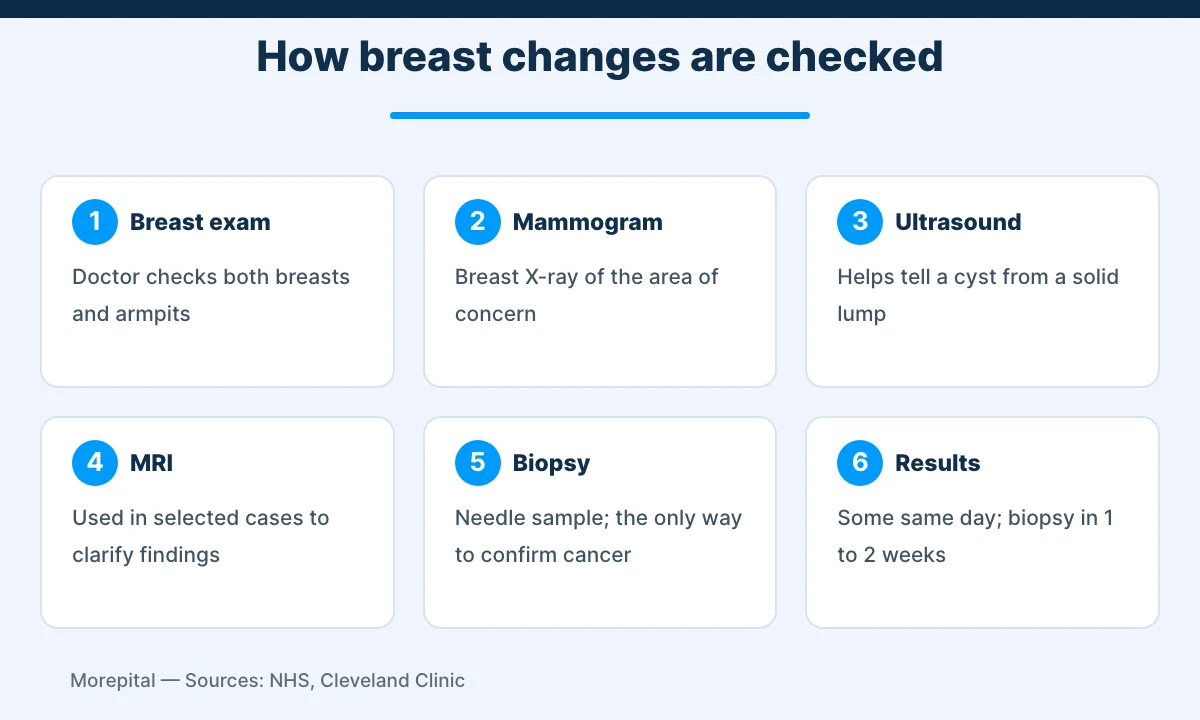
When you report breast cancer symptoms, your doctor will usually examine both breasts and armpits and, if needed, refer you to a specialist breast clinic. In the UK, the NHS explains that most people have all the tests they need in one visit. Typical steps are:
- Clinical breast exam: a doctor or nurse checks the breasts and armpits for abnormal tissue.
- Diagnostic mammogram: a breast X-ray focused on the area of concern.
- Breast ultrasound: often used to tell a fluid-filled cyst from a solid lump.
- MRI: used in selected cases to clarify findings.
- Biopsy: a small tissue sample, usually taken with a needle, which is the only way to confirm cancer. It also shows receptor status, which guides treatment.
Source: NHS, Cleveland Clinic
Some results come the same day; biopsy results can take one to two weeks. A needle biopsy does not make cancer spread. If cancer is confirmed, scans such as CT, MRI or PET show whether it has spread, and a specialist team plans care.
Source: NHS, Cleveland Clinic
If you have breast implants
Implants can hide part of the breast tissue on a mammogram, so after breast augmentation tell the clinic when booking and the technologist before imaging. Extra “implant displacement” views are usually taken, and mammograms very rarely rupture an implant. Implants do not change which breast cancer symptoms you should report.
Source: American Cancer Society
Screening: finding cancer before symptoms appear
Screening looks for cancer in people without breast cancer symptoms, when tumors are too small to see or feel. Advice differs by country:
| Organization | Who | How often |
|---|---|---|
| USPSTF (US, 2024) | Women aged 40 to 74 | Mammogram every 2 years |
| American Cancer Society | Average risk: option at 40 to 44; yearly 45 to 54; 55+ every 1 to 2 years | While healthy with 10+ years’ life expectancy |
| NHS (England) | Women aged 50 up to their 71st birthday | Every 3 years; self-referral after 71 |
| WHO | Usually women aged 50 to 69 | Organized mammography programs |
Source: USPSTF, American Cancer Society, NHS, WHO
Screening is not a substitute for acting on breast cancer symptoms. The NHS is clear: if you notice a change, see a GP even if you were screened recently, and do not wait for your next invitation. Mammograms do not find every breast cancer, and self-exams are not enough on their own to screen people at average risk. With dense breasts, discuss extra imaging with a clinician.
Source: NHS, American Cancer Society, American Cancer Society, USPSTF
When breast cancer symptoms need a doctor
The NHS advises seeing a GP if you have a lump or swelling in the breast, chest or armpit, any change in your breasts or nipples that is not normal for you, or breast or armpit pain with close relatives who had breast or ovarian cancer. Cleveland Clinic advises seeing a provider for any change that does not go away after a few days. Use this quick guide:
| What you notice | What to do |
|---|---|
| New lump in breast, chest or armpit | Book a doctor’s appointment, even if painless |
| Dimpled skin, inverted nipple, change in shape | See a doctor promptly |
| Nipple discharge (not breastfeeding), especially bloody | See a doctor promptly |
| Red, hot, swollen breast, with or without fever | Urgent appointment; return if no better in about a week |
| Scaly or eczema-like rash on one nipple | See a doctor; do not just self-treat |
| Cyclical pain in both breasts, no other change | Usually benign; see a GP if it persists or you have a family history |
Source: NHS, NHS, American Cancer Society, Cleveland Clinic
Risk factors that make checking more important
Risk factors do not cause breast cancer symptoms, but they help doctors decide how quickly to investigate. Being female and older are the strongest; most cases are diagnosed after 50. Others include BRCA1 or BRCA2 mutations, a family history of breast or ovarian cancer, dense breasts, chest radiation before 30, alcohol, combined hormone therapy, inactivity and obesity after menopause.
Before the appointment, note when you first noticed the change, whether it varies with your cycle, any medicines or hormone therapy you take, and your family history. If you are diagnosed, treatment is planned by a specialist team; you can browse an overview of medical treatments explained on Morepital to prepare questions for your doctor.
Breast cancer symptoms: frequently asked questions
What are the first breast cancer symptoms?
Often a painless lump or thickening in the breast or armpit. Some people instead first notice skin dimpling, a nipple change or discharge, and some have no symptoms, with cancer found on a screening mammogram.
Source: WHO, CDC, Cleveland Clinic
Can breast cancer symptoms come and go?
Lumpiness and tenderness that come and go with the menstrual cycle are usually fibrocystic changes. A lump or change that persists through a full cycle, or lasts more than a few days, should be checked.
Source: National Cancer Institute, Cleveland Clinic
Does a painful lump mean it is not cancer?
No. Painful lumps are more often benign, but breast cancer can be soft, round, tender or even painful, so any new lump needs assessment.
Source: American Cancer Society
Are breast cancer symptoms different in men?
They are similar: a lump or swelling in the chest or armpit, nipple discharge, nipple inversion or rash, sores on the chest skin, or a change in the shape of one side of the chest.
Source: NHS
Can you have breast cancer without a lump?
Yes. Inflammatory breast cancer often causes redness and swelling without a lump, and Paget disease shows as a scaly nipple rash. Swollen lymph nodes can also be the first sign.
Source: American Cancer Society, American Cancer Society, American Cancer Society
I had a normal mammogram recently. Should I still report a lump?
Yes. Mammograms do not find every cancer, and the NHS advises seeing a GP about symptoms even after recent screening.
Source: American Cancer Society, NHS
How quickly should I see a doctor about breast cancer symptoms?
Book an appointment as soon as you notice a new lump or persistent change. Seek urgent care for a red, hot, swollen breast, especially with fever.
Disclaimer: this article is for general health education and does not replace advice from a qualified doctor who can assess your individual case. Last updated: October 2026.