
All-on-4 dental implants replace a whole upper or lower arch of teeth with a fixed bridge screwed onto just four implants, two placed straight at the front of the jaw and two tilted at the back. They suit adults who have lost all or most teeth in a jaw, often give a fixed temporary bridge within a day of surgery, and need a final bridge a few months later, so the real decision is about candidacy, planning, aftercare and choosing the right team.
Source: Cleveland Clinic, Soto-Penaloza 2017 review
Contents
- How the All-on-4 concept works
- Are you a candidate for All-on-4 dental implants?
- The treatment step by step
- Recovery timeline and the first weeks
- Results, lifespan and risks
- All-on-4 dental implants vs other full-arch options
- How to choose a clinic for All-on-4 dental implants
- All-on-4 dental implants abroad and in Turkey
- Long-term care and when to call your dentist
- Frequently asked questions
How the All-on-4 concept works
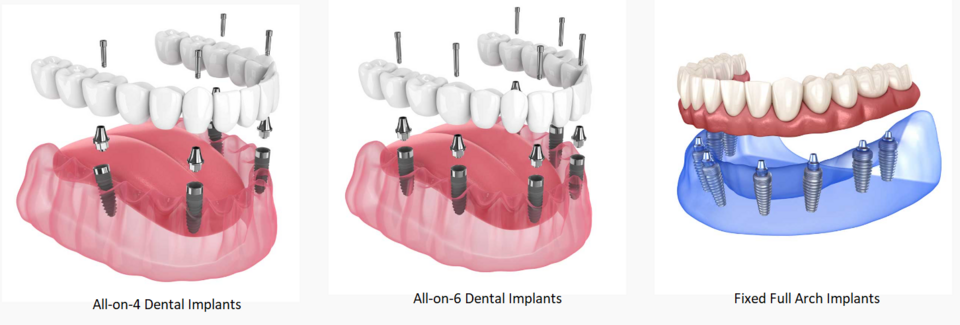
Cleveland Clinic describes All-on-4 as a specific type of fixed implant denture that replaces an entire arch of missing teeth using just four implants. Unlike a conventional denture, the bridge does not rest loosely on the gums and is not removed at night; only a dentist can take it off, usually for maintenance. Because All-on-4 is a trademarked name, some clinics describe the same idea as a full-arch fixed implant bridge or a fixed hybrid denture, so ask which system is offered.
Source: Cleveland Clinic
The key feature of All-on-4 dental implants is the angle of the back implants. In the studies reviewed, the two rear implants were most often tilted at about 30 degrees, and up to 45 degrees in some cases. Tilting lets the surgeon use longer implants in the bone that remains, avoid the sinuses in the upper jaw and the nerve in the lower jaw, and spread the support further back. For the clinical background, see our reference page on All-on-4 dental implants; for implants in general, see dental implants.
Source: Soto-Penaloza 2017 review, Gaonkar 2021 review
Patients usually compare All-on-4 dental implants with two familiar alternatives: a removable complete denture, which rests on the gums, and an implant-supported overdenture, which clips onto implants but is still taken out for cleaning. The fixed bridge sits between these, giving fixed teeth on a minimal number of implants.
Source: Cleveland Clinic, NHS
Are you a candidate for All-on-4 dental implants?
A 2017 consensus of implant specialists says the main indication for All-on-4 dental implants is a shrunken (atrophic) upper or lower jaw, with or without some teeth that cannot be saved, in patients who are healthy or have only mild, well-controlled systemic disease (ASA class I or II). The concept may also suit people who prefer to avoid bone-building procedures such as sinus lifts or grafts. If you have lost several teeth but not a whole arch, see our guide to tooth loss, because single implants or bridges may be more appropriate.
Source: Consensus 2017
Signs you may be a good candidate
- You are missing all or most teeth in one jaw, or your remaining teeth are failing.
- There is enough bone in the front part of the jaw for four implants, between the sinuses above or between the nerve exits below.
- Your general health is good, and any condition such as diabetes is well controlled.
- Gum disease has been treated, and you are able to clean a fixed bridge every day.
- You want fixed teeth rather than a denture you remove.
Source: Consensus 2017, Cleveland Clinic
Factors that make All-on-4 dental implants riskier
Cleveland Clinic lists factors that make implant treatment less suitable or riskier: untreated gum disease, extensive decay or poor oral hygiene, severe bone loss, unmanaged diabetes, some bone and autoimmune disorders, and smoking or vaping. Heavy grinding (bruxism) does not rule you out, but a 2021 review found that fractures of the acrylic bridge, wear of the opposing teeth and screw loosening were reported mainly in bruxers. If bone is too thin even for tilted implants, your team may suggest grafting first or zygomatic implants, which anchor in the cheekbone.
Source: Cleveland Clinic, Gaonkar 2021 review, Ramezanzade 2021 review
Only an in-person examination with X-rays and usually a 3D scan can confirm candidacy. Be cautious about any offer that promises All-on-4 dental implants from photos alone; the UK dental regulator says a qualified dentist should assess you and take your full medical history before you receive a treatment plan or cost.
Source: General Dental Council, Gaonkar 2021 review
The treatment step by step
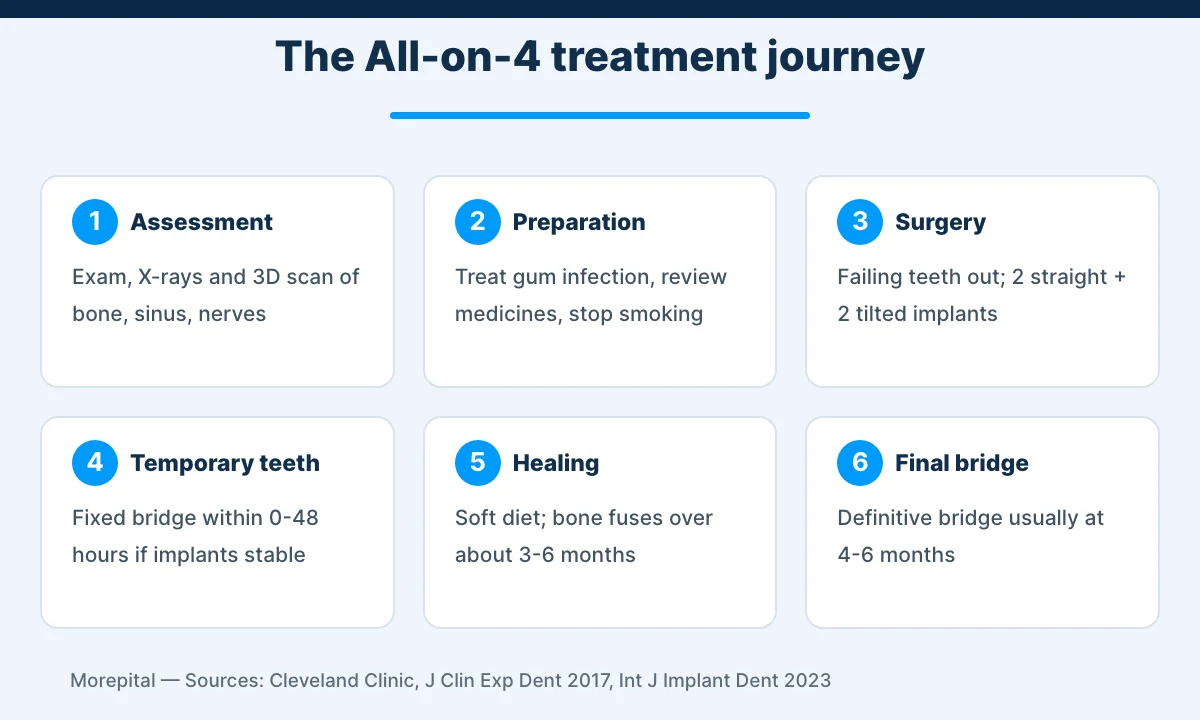
Protocols vary, but published studies describe a similar pathway for All-on-4 dental implants, which helps you judge whether a plan is realistic.
Source: Soto-Penaloza 2017 review
- Assessment and planning: examination of the gums, remaining teeth and bite, plus X-rays and a 3D scan to measure bone and locate the sinuses and nerves. Tilting the back implants is technically demanding, and reviewers note it generally calls for a computer-guided surgical stent.
- Preparation: any active gum infection is treated, medicines are reviewed and you are asked to stop smoking.
- Surgery day: usually under local anesthetic, with sedation available. Failing teeth are removed, and two straight and two tilted implants are placed in the same session.
- Stability check: for immediate loading, the consensus recommends that each implant is held with an insertion torque above 35 Ncm.
- Temporary bridge: a fixed, usually acrylic, provisional bridge is attached within 2 to 8 hours in some studies and at 24 or 48 hours in others.
- Final bridge: most studies fitted the definitive bridge 4 to 6 months after surgery, once the bone had fused with the implants.
Source: Soto-Penaloza 2017 review, Consensus 2017, Gaonkar 2021 review, Uesugi 2023 cohort
Same-day teeth with All-on-4 dental implants are not guaranteed
Fixed teeth on the day of surgery depend on how firmly the implants are anchored. If stability is not good enough, the team waits and you wear a healing denture that does not attach to the implants while they integrate, which Cleveland Clinic says typically takes about three to six months.
Source: Cleveland Clinic, Consensus 2017
What the bridge on All-on-4 dental implants is made of
The consensus recommends a rigid, fracture-resistant provisional bridge of high-density acrylic carrying 10 or 12 teeth. Final bridges may be metal-ceramic or acrylic on a metal framework with up to 12 teeth, designed so they can be cleaned. Because acrylic fracture is the most common prosthetic problem, the 2021 review recommends a cast metal framework for the definitive bridge.
Source: Consensus 2017, Gaonkar 2021 review
Recovery timeline and the first weeks
Cleveland Clinic says most people feel normal within about a week and can resume routine activities in two to three days, while strenuous exercise should be avoided for at least 48 hours. Full integration of the implants takes about three to six months, and longer after bone grafting.
Source: Cleveland Clinic
Practical tips from an NHS implant unit
- Take painkillers such as paracetamol or ibuprofen before the local anesthetic wears off and for the first 48 hours, as advised.
- Hold a wrapped ice pack on the face for 10 minutes each hour during the first 6 hours to limit swelling.
- If the wound bleeds, bite firmly on a rolled-up clean handkerchief for at least 30 minutes; go to an emergency department if bleeding does not stop.
- Avoid alcohol for 24 hours, and follow your team’s instructions on mouthwash and when to start brushing the surgical area.
- Expect a check and stitch removal about 7 to 14 days after surgery.
Source: Guy’s and St Thomas’ NHS
Diet after All-on-4 dental implants
The temporary bridge sits on implants that have not yet fused with the bone, so chewing forces must stay low. In a long-term Japanese cohort treated with All-on-4 dental implants, patients followed a soft-food diet for 2 to 3 months after surgery. Once the final bridge is fitted, Cleveland Clinic says you can generally return to eating your favorite foods.
Source: Uesugi 2023 cohort, Cleveland Clinic
Results, lifespan and risks of All-on-4 dental implants
The immediate result of All-on-4 dental implants is a full set of fixed teeth, often within a day. In one study included in a 2017 systematic review, 95.6% of patients rated their satisfaction as excellent. With good care the implants can last a lifetime, but the teeth on top wear; Cleveland Clinic suggests the denture part of an implant-supported denture is replaced every 15 to 20 years.
Source: Soto-Penaloza 2017 review, Cleveland Clinic
What the research reports
- A 2021 systematic review of 25 studies found cumulative implant survival of about 94% to 98% over 72 to 132 months, bridge survival of 99% to 100% at 12 months, and no significant difference between tilted and straight implants or between upper and lower jaws.
- A 2017 review of 24 studies covering 11,743 implants found that most failures (134) happened in the first year.
- A Japanese cohort of 561 patients and 2,364 implants followed for 3 to 17 years reported implant survival of 97.4% in the upper jaw and 98.9% in the lower jaw; the upper jaw was the strongest risk factor for failure.
Source: Gaonkar 2021 review, Soto-Penaloza 2017 review, Uesugi 2023 cohort
Read these figures with caution. The 2017 review judged 13 of its studies to be at high risk of bias, mainly because of incomplete follow-up, and the 2021 review included no randomized trials. An independent commentary from The Dental Elf, limiting the analysis to the two strongest studies, estimated five-year implant survival at between 86% and 97%, and noted undisclosed manufacturer links in several papers.
Source: Soto-Penaloza 2017 review, The Dental Elf, Gaonkar 2021 review
Main risks to discuss
- Surgical: infection, nerve damage, injury to the mouth and perforation of the sinus, which Cleveland Clinic describes as usually minimal.
- Implant failure: mostly in the first 12 months, mainly from lack of bone fusion or infection.
- Bridge problems: acrylic fracture, detached parts of the final bridge (23.2% of patients in two studies), screw loosening and wear of opposing teeth.
- Gum and bone problems: peri-implant mucositis and peri-implantitis, the second most frequent complication after two years in the 2017 review.
Source: Cleveland Clinic, Gaonkar 2021 review, Soto-Penaloza 2017 review
Because the whole bridge rests on four implants, losing one matters more than with designs using more implants. A published case report describes replacing failed back implants after seven years and making a new bridge, and its authors note that four implants give less support against biting forces, raising the risk of mechanical and biological problems. They advise regular bite adjustment and a night guard.
Source: Siadat 2018 case report
All-on-4 dental implants vs other full-arch options
All-on-4 dental implants are one of several ways to replace a full arch; the right choice depends on your bone, health, budget and whether you want fixed or removable teeth.
Source: Cleveland Clinic
| Option | Fixed or removable | Key points |
|---|---|---|
| Complete denture | Removable | No surgery; usually available on the NHS with a patient contribution; rests on the gums |
| Implant-supported overdenture | Removable | Snaps onto implants for stability; taken out daily to clean |
| All-on-4 dental implants | Fixed (dentist removes) | Four implants, two tilted; often avoids grafting; temporary teeth within 0–48 hours if stable |
| Fixed bridge on more implants | Fixed | More support per arch; may need bone grafting where bone is lacking |
| Zygomatic implants | Fixed | For a severely shrunken upper jaw; survival 95.2–100% in reviews; needs a very experienced surgeon |
Source: NHS, Cleveland Clinic, Ramezanzade 2021 review
If your concern is mainly the appearance of teeth you still have, rather than missing teeth, implants are usually not the first step; cosmetic options such as veneers or crowns are covered in our guide to a Hollywood smile in Turkey.
Source: Cleveland Clinic
How to choose a clinic for All-on-4 dental implants
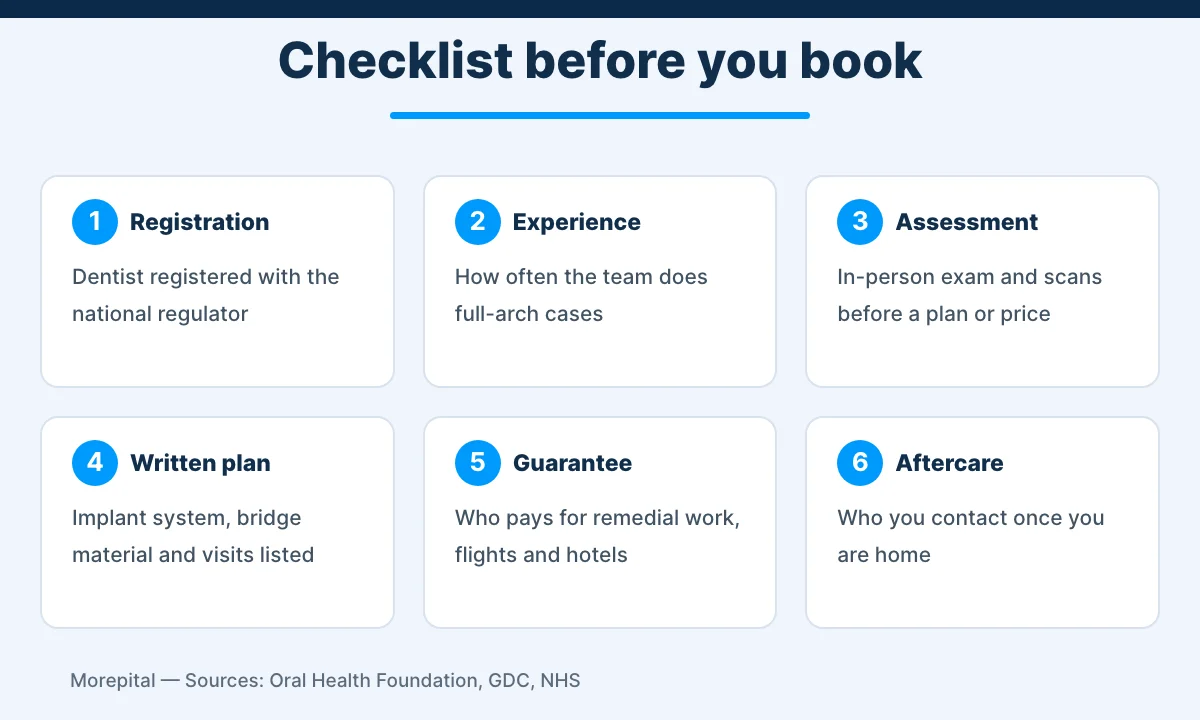
Reviewers stress that careful patient selection, thorough evaluation and the surgeon’s skill are key to predictable results with All-on-4 dental implants, and that tilted implants are technically demanding. Choose a team that regularly treats full-arch cases.
Source: Gaonkar 2021 review
Questions to ask before booking All-on-4 dental implants
- Who will place the implants and who will make the bridge, and what are their qualifications?
- Are they registered with the country’s dental regulator, and is registration compulsory there?
- How often do they perform this procedure, and what are their complication and infection rates?
- Which implant system, abutments and bridge material are included in the quote?
- Is the work guaranteed, for how long, and who pays for extra flights, hotels or remedial work?
- Do they carry insurance for the procedure, and do they have a complaints system you can see?
- What aftercare is provided, and who can you contact once you are home?
Source: Oral Health Foundation, General Dental Council
Warning signs
The NHS treatment-abroad checklist warns against a hard sell, pressure to decide quickly, or no discussion of complications or aftercare. The Oral Health Foundation adds that you do not have to commit on the day of a consultation, and that cheaper prices for lower standards are not worth the risk. A plan for All-on-4 dental implants should be written, itemized and based on your own scans.
Source: NHS, Oral Health Foundation
All-on-4 dental implants abroad and in Turkey
Dental care is among the most common reasons people travel for treatment, according to the US Centers for Disease Control and Prevention. In the UK, the NHS says implants are usually only available privately and are expensive, with NHS implants limited to people who cannot wear dentures for reasons such as mouth cancer or an accident, which is one reason many people look abroad for All-on-4 dental implants. The Turkish Dental Association has estimated that 150,000 to 250,000 foreign patients travel to Turkey for dental work each year.
Reporting on Turkey’s dental-tourism boom has also described problems, including botched implants, unnecessary crowns on healthy teeth, and repairs at home costing three to four times the original price, with slow legal redress. Our article on dental implants in Turkey covers the wider practical picture.
Source: Euronews
Planning trips for All-on-4 dental implants
- Two stages: with the final bridge usually fitted 4 to 6 months after surgery, expect at least two visits, plus years of maintenance.
- Time to recover: the NHS advises staying in the country of treatment long enough to recover before travelling home; ask your surgeon when flying is safe.
- Records: take your medical history, medicines list and allergy details, and bring home copies of all records, scans and implant details, translated if needed.
- Insurance: tell your travel insurer about the treatment, and budget for possible care back home.
- Local dentist: speak to your own dentist first so they know your plans in case of complications.
Source: Soto-Penaloza 2017 review, NHS, CDC, General Dental Council
Long-term care and when to call your dentist
A fixed bridge cannot be removed at home, so it is cleaned in the mouth. Brush it at least twice a day with a soft-bristled brush and non-abrasive toothpaste, and clean underneath and around each implant with floss threaders and interdental brushes. The American Academy of Periodontology notes that implants need home care and regular dental visits, much like natural teeth, to prevent peri-implant disease.
Source: Cleveland Clinic, American Academy of Periodontology
Specialists recommend X-rays at recall visits to confirm the bridge still fits, and a personal maintenance plan that accounts for risks such as smoking or diabetes. In the Japanese cohort, patients were recalled every 3 to 6 months after the final bridge; a case report suggests every three months in the first year, then every six months. If you grind your teeth, a night guard helps protect the bridge. Living with All-on-4 dental implants means long-term care with a dentist near home.
Source: Consensus 2017, Uesugi 2023 cohort, Siadat 2018 case report
Contact your dental team promptly if you notice
- Bleeding that does not stop after biting on a pad for 30 minutes (go to an emergency department).
- A fever, pus, swollen gums or swollen lymph nodes in the neck.
- A loose bridge, a wobbly implant, a chipped or broken part, or a sudden change in your bite.
Source: Guy’s and St Thomas’ NHS, Cleveland Clinic, Soto-Penaloza 2017 review
Considering All-on-4 dental implants? Contact us for a free consultation and a treatment plan tailored to you.
All-on-4 dental implants: frequently asked questions
How long do All-on-4 dental implants last?
Reviews report that about 94% to 98% of implants are still working after 6 to 11 years. The implants can last a lifetime with good care, but the teeth on top may need repair, and Cleveland Clinic suggests replacing that part every 15 to 20 years.
Source: Gaonkar 2021 review, Cleveland Clinic
Do you really get teeth in one day?
Often, yes. If the implants are firmly anchored, a fixed temporary bridge is attached the same day or within 48 hours. If not, you wear a healing denture until the implants integrate. The final bridge follows months later.
Source: Soto-Penaloza 2017 review, Cleveland Clinic
How many trips do All-on-4 dental implants need if I travel?
Usually at least two: one for assessment, surgery and the temporary bridge, and one for the final bridge, typically 4 to 6 months later. Regular maintenance visits follow, ideally with a dentist near home.
Source: Soto-Penaloza 2017 review, Uesugi 2023 cohort
Is surgery for All-on-4 dental implants painful?
It is usually done under local anesthetic, with sedation available. Afterwards, regular painkillers for the first 48 hours and cold packs help, and discomfort should only last up to about a week.
Source: Guy’s and St Thomas’ NHS, Uesugi 2023 cohort
Can smokers have All-on-4 dental implants?
Smoking and vaping can interfere with healing and make implant treatment riskier. In one large cohort, smokers had lower implant survival in simple comparison, although the difference was not significant after adjusting for other factors. Your team will advise stopping.
Source: Cleveland Clinic, Uesugi 2023 cohort
Are All-on-4 dental implants available on the NHS?
Rarely. The NHS says implants are usually only available privately, and NHS implants are reserved for people who cannot wear dentures for reasons such as mouth cancer or an accident. Complete dentures are usually available on the NHS.
Source: NHS
What if one of my All-on-4 dental implants fails?
Most failures happen in the first year. Because the bridge rests on four implants, a failed implant usually has to be replaced and the bridge adjusted or remade, so ask in advance how such repairs are handled and paid for.
Source: Gaonkar 2021 review, Siadat 2018 case report, Oral Health Foundation
Disclaimer: this article is for general health education and does not replace advice from a qualified doctor who can assess your individual case. Last updated: October 2026.