
All-on-4 dental implants
All-on-four full-arch fixed implant bridge (implant-supported fixed denture)
All-on-4 dental implants replace a full arch of upper or lower teeth with a fixed bridge screwed onto four implants: two straight at the front and two tilted at the back to use existing bone and often avoid grafting. A temporary bridge is usually fitted on the day of surgery or within 48 hours, and studies report that about 94-98% of implants still function after 6 to 11 years.
Source: Cleveland Clinic, J Clin Exp Dent (Soto-Penaloza et al., 2017), J Indian Prosthodont Soc (Gaonkar et al., 2021)
- What are All-on-4 dental implants?
- Who is a candidate for All-on-4 dental implants?
- Preparing for All-on-4 treatment
- How All-on-4 surgery is done
- Recovery timeline after All-on-4 dental implants
- Results and how long All-on-4 implants last
- Risks and complications of All-on-4 dental implants
- Living with an All-on-4 bridge
- Alternatives to All-on-4 dental implants
- Choosing a clinic and having All-on-4 treatment abroad
- When to call your dentist
- FAQ
- Sources
What are All-on-4 dental implants?
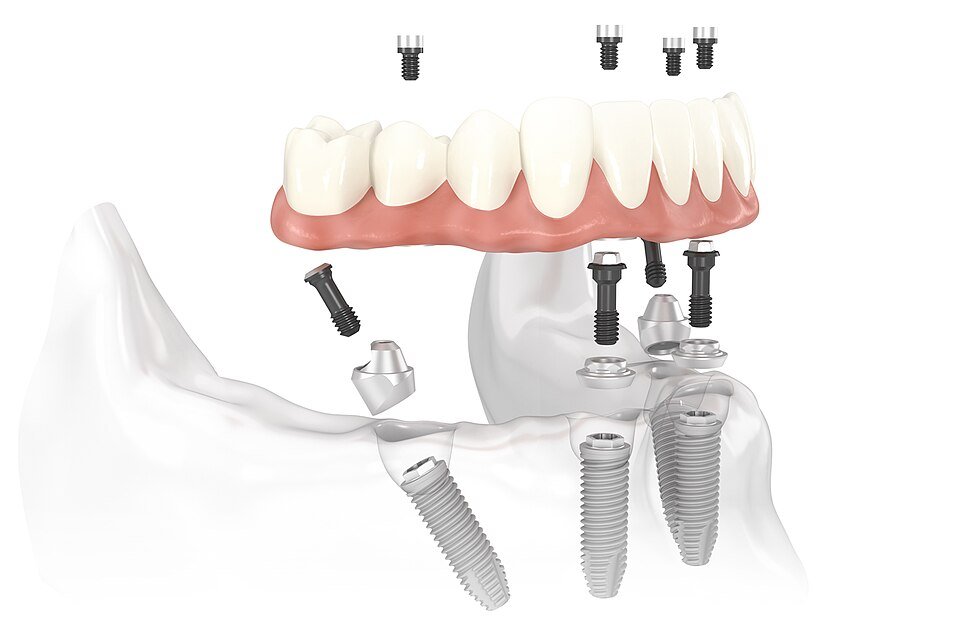
All-on-4 dental implants are a way of replacing a whole arch of teeth, upper or lower, with a fixed bridge that is screwed onto just four implants in the jawbone. Cleveland Clinic describes All-on-4 as a specific type of fixed implant denture: unlike a conventional denture, it does not rest on the gums and does not come out at night. Only a dentist can take it off, usually for maintenance. The name All-on-4 is a registered trademark, which is why some clinics call the same idea a full-arch fixed implant bridge or a fixed hybrid denture.
Source: Cleveland Clinic
The concept was introduced by the Portuguese dentist Paulo Malo in 2003. Its key feature is the position of the implants. The two front implants are placed straight (axially), while the two back implants are tilted toward the rear of the mouth, most often by about 30 degrees and in some cases up to 45 degrees. Tilting lets the surgeon use longer implants in the bone that is still there, avoid the sinuses in the upper jaw and the nerve canal in the lower jaw, and spread the implants further apart so the bridge needs a shorter unsupported extension at the back.
Source: J Indian Prosthodont Soc (Gaonkar et al., 2021), J Clin Exp Dent (Soto-Penaloza et al., 2017)
Because the tilted implants make use of existing bone, All-on-4 dental implants are often chosen to avoid bone grafting or sinus lifts in people whose jaw has shrunk after years of tooth loss. In many protocols a fixed temporary bridge is attached on the day of surgery or within 48 hours, an approach called immediate loading. A stronger final bridge follows a few months later, once the bone has fused to the implants.
Source: J Clin Exp Dent (Soto-Penaloza et al., 2017), J Clin Exp Dent (Penarrocha-Diago et al., 2017)
How it differs from other implant options
A single implant replaces one tooth, and conventional full-arch implant treatment often uses more implants per jaw. An implant-supported overdenture is a removable denture that clips onto implants and is taken out daily for cleaning. All-on-4 sits between these: it replaces every tooth in the arch with a fixed prosthesis, but on a minimal number of implants. For a general overview of the posts themselves, see our guide to dental implants, listed under related treatments.
Source: Cleveland Clinic, American Academy of Periodontology
Who is a candidate for All-on-4 dental implants?
All-on-4 dental implants are designed for adults who have lost all or most of the teeth in one jaw, or whose remaining teeth cannot be saved and need to be removed. A 2017 consensus of implant specialists says the main indication is an atrophic (shrunken) upper or lower jaw, with or without a few hopeless teeth, in patients who are in good general health. It also suits people who prefer not to have bone-regeneration procedures such as sinus lifts or grafts.
Source: J Clin Exp Dent (Penarrocha-Diago et al., 2017), J Clin Exp Dent (Soto-Penaloza et al., 2017)
Good candidates generally have:
- Missing or failing teeth across a whole arch.
- Enough bone in the front part of the jaw for four implants, between the sinuses in the upper jaw or between the two nerve exits (mental foramina) in the lower jaw.
- Good general health; most studies included only healthy patients or those with mild, well-controlled conditions (ASA class I or II).
- Healthy gums, or gum disease that has been treated, and the ability to clean the bridge every day.
Source: J Clin Exp Dent (Penarrocha-Diago et al., 2017), J Clin Exp Dent (Soto-Penaloza et al., 2017), American Academy of Periodontology
Who may not be suitable
Cleveland Clinic lists several factors that can make implant treatment less suitable or riskier: active or untreated gum disease, extensive decay or poor oral hygiene, severe jawbone loss, unmanaged diabetes, some bone disorders and autoimmune diseases, and smoking or vaping, which can interfere with healing. People who grind or clench their teeth (bruxism) can still be treated, but reviews report more fractures of the acrylic bridge and more screw loosening in this group, so a night guard and a reinforced final bridge are usually advised.
Source: Cleveland Clinic, J Indian Prosthodont Soc (Gaonkar et al., 2021), J Dent (Tehran) (Siadat et al., 2018)
If there is too little bone even for tilted implants, particularly in the upper jaw, the team may suggest bone grafting first or a different technique such as zygomatic implants, which anchor in the cheekbone.
Source: Cleveland Clinic, Maxillofac Plast Reconstr Surg (Ramezanzade et al., 2021)
Preparing for All-on-4 treatment
Planning for All-on-4 dental implants starts with a full examination of the mouth, the remaining teeth, the gums and the bite, together with X-rays and usually a 3D scan to measure bone height and width and to locate the sinuses and nerves. The consensus statement notes that a minimum amount of bone is needed in specific zones and that the space for the new teeth should be around 12 mm in height. Many teams use a computer-planned surgical guide to place the tilted implants precisely, and reviews describe the technique as technically sensitive.
Source: J Clin Exp Dent (Penarrocha-Diago et al., 2017), J Indian Prosthodont Soc (Gaonkar et al., 2021), Int J Implant Dent (Uesugi et al., 2023)
Before surgery your dental team will usually:
- Review your medical history and medicines, including conditions such as diabetes or autoimmune disease that affect healing.
- Treat any active gum infection.
- Plan which teeth will be removed; failing teeth are usually extracted during the same operation in All-on-4 protocols.
- Take impressions or scans so the temporary bridge can be prepared in advance.
- Ask you to stop smoking, ideally before treatment and for the long term.
Source: Cleveland Clinic, Int J Implant Dent (Uesugi et al., 2023), Guy’s and St Thomas’ NHS
It is also worth asking at this stage how many visits are needed, when the final bridge will be fitted, what material it will be made of, and what follow-up appointments are included, because the treatment is spread over several months.
Source: Oral Health Foundation, J Clin Exp Dent (Soto-Penaloza et al., 2017)
How All-on-4 surgery is done
Protocols differ between clinics, but a typical immediate-loading procedure for All-on-4 dental implants in one jaw follows these steps:
- Anesthesia: the operation is usually done under local anesthesia; sedation can be offered to help you relax.
- Extractions: any remaining teeth in the arch are removed.
- Access to the bone: the gum is opened (a flap) so the surgeon can see the jaw ridge.
- Implant placement: two implants are placed straight in the front of the jaw and two are angled at the back, often with the help of a surgical guide.
- Stability check: the surgeon measures how firmly each implant is held. For immediate loading, the consensus recommends an insertion torque above 35 Ncm; studies used values between about 25 and 50 Ncm.
- Abutments and stitches: angled connectors (multi-unit abutments) correct the tilt so the bridge can sit evenly, and the gum is stitched.
- Temporary bridge: a fixed provisional bridge, usually acrylic, is screwed onto the implants the same day (2 to 8 hours after surgery in several studies) or within 24 to 48 hours.
Source: Int J Implant Dent (Uesugi et al., 2023), J Clin Exp Dent (Soto-Penaloza et al., 2017), J Clin Exp Dent (Penarrocha-Diago et al., 2017), Cleveland Clinic
If the implants are not stable enough, the team may wait for healing before attaching fixed teeth; in that case you wear a healing denture while the implants fuse with the bone. The provisional bridge typically carries 10 to 12 teeth, depending on how far back the implants reach.
Source: Cleveland Clinic, J Clin Exp Dent (Penarrocha-Diago et al., 2017)
Fitting the final bridge
After the bone has bonded to the implants, the dentist takes new impressions and a laboratory makes the definitive bridge. In most studies this happened 4 to 6 months after surgery; one long-term Japanese cohort fitted it about 6 months after the temporary bridge. Final bridges may have a titanium or metal framework with acrylic or ceramic teeth, and reviews recommend a rigid, reinforced framework to reduce fractures.
Source: J Clin Exp Dent (Soto-Penaloza et al., 2017), Int J Implant Dent (Uesugi et al., 2023), J Indian Prosthodont Soc (Gaonkar et al., 2021)
Recovery timeline after All-on-4 dental implants
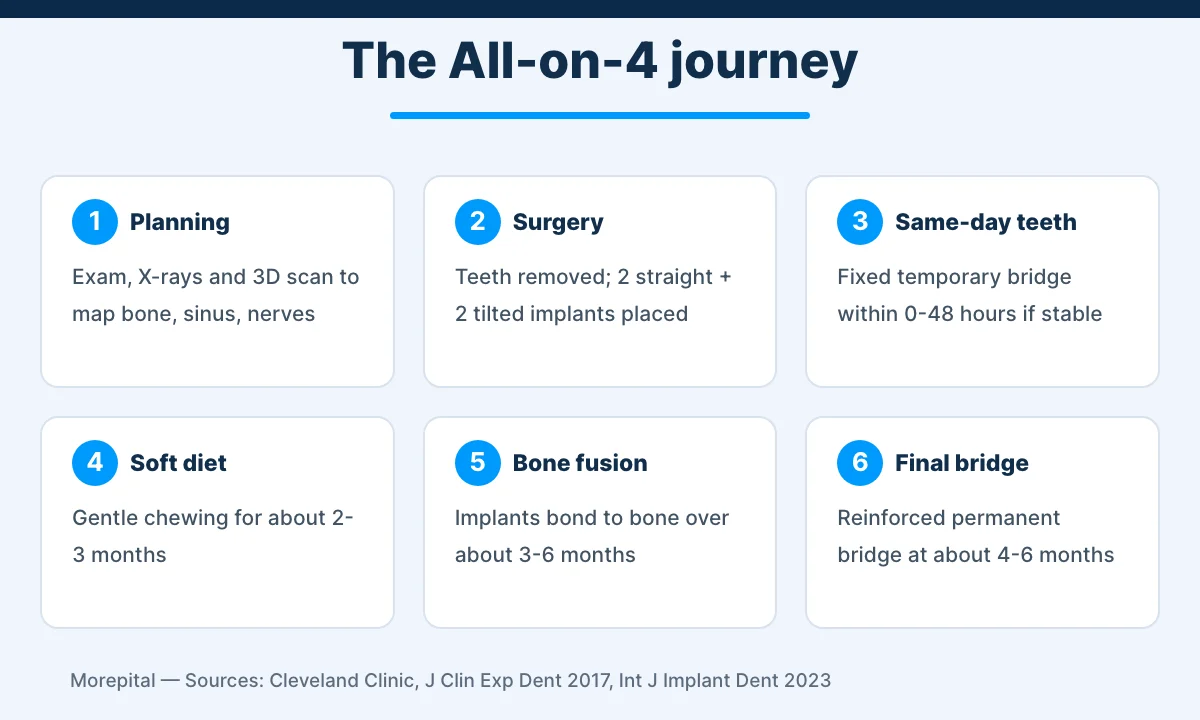
After All-on-4 dental implants, most people feel close to normal within about a week, and Cleveland Clinic says routine activities can typically be resumed in 2 to 3 days. The bigger adjustment is the diet: the temporary bridge sits on implants that have not yet fused with the bone, so chewing forces must be kept low for the first months.
Source: Cleveland Clinic, Cleveland Clinic
| Time after surgery | What to expect |
|---|---|
| Day of surgery | Fixed temporary bridge attached the same day or within 48 hours, if the implants are stable enough |
| First 48 hours | Take painkillers regularly, use cold packs, avoid strenuous exercise and avoid alcohol for 24 hours |
| First week | Soreness, swelling and bruising usually settle; follow the cleaning instructions given |
| 1 to 2 weeks | Stitches removed and healing checked |
| First 2 to 3 months | Soft diet while the implants integrate |
| 3 to 6 months | Bone fuses with the implants (osseointegration); longer if bone grafting was needed |
| About 4 to 6 months | Definitive bridge made and fitted |
| Long term | Check-ups every 3 to 6 months in some protocols, with X-rays at recall visits |
Source: J Clin Exp Dent (Soto-Penaloza et al., 2017), Guy’s and St Thomas’ NHS, Cleveland Clinic, Int J Implant Dent (Uesugi et al., 2023), J Clin Exp Dent (Penarrocha-Diago et al., 2017)
Practical tips for the first weeks
- Start painkillers such as paracetamol or ibuprofen before the local anesthetic wears off and keep taking them for the first 48 hours, following your dentist’s advice.
- Apply a cold pack wrapped in cloth for about 10 minutes every hour during the first 6 hours to limit swelling.
- For bleeding, bite firmly on a rolled-up clean handkerchief for at least 30 minutes.
- Use the mouthwash your team prescribes (chlorhexidine is common) and do not brush the surgical area until you are told to.
- Choose soft foods that need little chewing, and avoid biting into hard or sticky food with the temporary bridge.
Source: Guy’s and St Thomas’ NHS, Int J Implant Dent (Uesugi et al., 2023)
Results and how long All-on-4 implants last
The immediate result of All-on-4 dental implants is a full set of fixed teeth, often within a day of surgery, instead of weeks or months without teeth. Implant-supported dentures do not shift or slip when you chew or speak, help preserve the jawbone, and look like natural teeth. Patient satisfaction in the studies that measured it was high; in one study 95.6% of patients rated the outcome as excellent.
Source: Cleveland Clinic, J Clin Exp Dent (Soto-Penaloza et al., 2017)
What the research shows
- A 2021 systematic review of 25 studies found cumulative implant survival of 94% to 98% over 72 to 132 months (6 to 11 years), and bridge survival of 99% to 100% at 12 months. Tilted and straight implants performed similarly, as did upper and lower jaws.
- A 2017 systematic review of 24 studies and 11,743 implants reported 175 failures, most of them (134) in the first year. Its authors reported survival above 99% beyond two years, with the lowest figure being 94.8% at 10 years in one study.
- A Japanese cohort of 561 patients and 2,364 implants followed for 3 to 17 years reported overall implant survival of 97.4% in the upper jaw and 98.9% in the lower jaw. Implants in the upper jaw failed more often, especially early on.
Source: J Indian Prosthodont Soc (Gaonkar et al., 2021), J Clin Exp Dent (Soto-Penaloza et al., 2017), Int J Implant Dent (Uesugi et al., 2023)
These numbers should be read with caution. The reviews themselves note that almost all studies are observational, many have a high risk of bias, follow-up is incomplete, and there are few randomized trials. An independent commentary by The Dental Elf argued that the 99.8% survival figure looked too optimistic and, after restricting the analysis to the two strongest studies, estimated five-year implant survival at between 86% and 97%. Several included papers also had links to the manufacturer.
Source: J Clin Exp Dent (Soto-Penaloza et al., 2017), The Dental Elf, J Indian Prosthodont Soc (Gaonkar et al., 2021)
With good care the implants themselves can last a lifetime, but the bridge on top wears and may need repair or replacement; Cleveland Clinic suggests the denture part of an implant-supported denture is replaced every 15 to 20 years.
Source: Cleveland Clinic
Risks and complications of All-on-4 dental implants
Like any implant surgery, All-on-4 dental implants carry surgical risks, usually described as uncommon in experienced hands: infection, nerve damage that can cause numbness or tingling, injury to surrounding tissues, and perforation of the sinus membrane in the upper jaw.
Source: Cleveland Clinic, Cleveland Clinic
Implant failure
An implant can fail to fuse with the bone or become infected. Most failures happen in the first 12 months. Because the whole All-on-4 bridge rests on only four implants, losing one may require a new implant and adjustment or remaking of the bridge; a published case report describes replacing a failed back implant after seven years and making a new prosthesis. In the large Japanese cohort, the upper jaw was the strongest risk factor for failure, and smokers had lower implant survival in the simple comparison.
Source: J Indian Prosthodont Soc (Gaonkar et al., 2021), J Clin Exp Dent (Soto-Penaloza et al., 2017), J Dent (Tehran) (Siadat et al., 2018), Int J Implant Dent (Uesugi et al., 2023)
Bridge (mechanical) problems
- Fracture or chipping of the acrylic bridge: the most common prosthetic complication in reviews, seen especially in people who grind their teeth.
- Detached or broken parts of the final bridge: reported in 23.2% of patients in two studies; the consensus notes this did not seem to affect overall implant or bridge survival.
- Screw loosening and wear of the opposing teeth, again more often in bruxers.
Source: J Clin Exp Dent (Soto-Penaloza et al., 2017), J Clin Exp Dent (Penarrocha-Diago et al., 2017), J Indian Prosthodont Soc (Gaonkar et al., 2021)
Biological problems
Inflammation of the gum around implants (peri-implant mucositis) and peri-implantitis, which also destroys supporting bone, are reported in some patients after a few years. One commentary highlighted a study in which almost half of implants showed ongoing bone loss after three years, so regular X-ray checks and professional cleaning matter.
Source: J Clin Exp Dent (Soto-Penaloza et al., 2017), J Clin Exp Dent (Penarrocha-Diago et al., 2017), The Dental Elf
Specialists also point out that with fewer implants, there is less support to resist biting forces, which raises the risk of mechanical and biological complications compared with designs using more implants. Regular follow-up, bite adjustment and a night guard are recommended.
Source: J Dent (Tehran) (Siadat et al., 2018)
Living with an All-on-4 bridge
A fixed bridge cannot be taken out at home, so cleaning is done in the mouth. Brush it at least twice a day with a soft-bristled brush and non-abrasive toothpaste, and clean underneath it and around each implant with floss threaders and interdental (interproximal) brushes. Regular professional cleanings and examinations are essential.
Source: Cleveland Clinic, American Academy of Periodontology
Once the implants have healed and the final bridge is fitted, Cleveland Clinic says you can generally go back to eating your favorite foods. Long-term maintenance includes check-ups with X-rays to confirm that the bridge still fits well on the implants, and a personal maintenance plan that takes account of risk factors such as smoking or diabetes. If you grind your teeth, a night guard helps protect the bridge.
Source: Cleveland Clinic, J Clin Exp Dent (Penarrocha-Diago et al., 2017), J Dent (Tehran) (Siadat et al., 2018)
Alternatives to All-on-4 dental implants
- Complete dentures: removable false teeth that replace all teeth in a jaw. They are usually available on the NHS in the UK, take a few weeks to get used to, and may loosen as the gums and bone shrink over time.
- Implant-supported overdentures: a removable denture that snaps onto implants for more stability, taken out daily for cleaning.
- Conventional fixed full-arch implant bridges: fixed teeth on a larger number of implants, sometimes after bone grafting or sinus lifting where bone is lacking.
- Bone grafting and sinus augmentation: procedures that build up bone so standard implants can be placed later.
- Zygomatic implants: long implants anchored in the cheekbone for a severely shrunken upper jaw. An overview of reviews reported survival of 95.2% to 100%, with sinusitis as the most common complication, and stressed that they require a very experienced surgeon.
Source: NHS, NHS, Cleveland Clinic, American Academy of Periodontology, Maxillofac Plast Reconstr Surg (Ramezanzade et al., 2021)
Whether All-on-4 dental implants or another option is best depends on your bone, health, budget and whether you want fixed or removable teeth. Ask your dentist to explain the pros and cons of each for your situation.
Source: Cleveland Clinic
Choosing a clinic and having All-on-4 treatment abroad
Because the reviews stress that careful patient selection, thorough evaluation and surgical skill are key to predictable results, choose a team experienced in full-arch implant surgery and in making implant bridges. In the UK, the NHS says implants are usually only available privately and are expensive, and are offered on the NHS only in limited situations, such as for people who cannot wear dentures after mouth cancer or an accident. This is one reason many people look abroad.
Source: J Indian Prosthodont Soc (Gaonkar et al., 2021), NHS
If you are considering treatment in another country, the Oral Health Foundation advises:
- Check whether the country has a dental regulator and whether your dentist is registered with it.
- Have a proper assessment by a qualified dentist before accepting a treatment plan and price.
- Ask about the team’s qualifications, the language spoken, complication rates, guarantees and insurance, and who pays for travel and remedial work if something goes wrong.
- Find out what aftercare is provided and who you can contact once you are home.
- Take your time; you do not have to commit on the day.
Source: Oral Health Foundation
With All-on-4 dental implants the final bridge is usually fitted around 4 to 6 months after surgery, so most patients need at least two treatment stages, plus regular maintenance for years afterward. Plan these visits, and local follow-up care, before you book. Our article on dental implants in Turkey covers the practical side of treatment abroad.
Source: J Clin Exp Dent (Soto-Penaloza et al., 2017), Int J Implant Dent (Uesugi et al., 2023)
When to call your dentist
Some soreness and swelling are normal for a few days after All-on-4 dental implant surgery. Contact your dental team promptly if you notice any of the following:
- Bleeding that does not stop after biting firmly on a pad for 30 minutes (go to the nearest emergency department)
- A fever of 101°F (38.3°C) or higher
- Pain that does not improve with medicine
- Pus, worsening gum swelling, or swollen lymph nodes in the neck
Source: Guy’s and St Thomas’ NHS, Cleveland Clinic, Cleveland Clinic
Also book a visit if the bridge feels loose, an implant seems to wobble, a part of the bridge chips or breaks, or your bite suddenly feels different.
Source: Cleveland Clinic, J Clin Exp Dent (Soto-Penaloza et al., 2017)
Related treatments
Related conditions
Further reading
All-on-4 dental implants: frequently asked questions
How long do All-on-4 dental implants last?
Reviews report that about 94% to 98% of implants are still working after 6 to 11 years, and one large cohort followed patients for up to 17 years with high survival. The implants can last a lifetime with good care, but the bridge on top may need repairs or replacement after some years.
Source: J Indian Prosthodont Soc (Gaonkar et al., 2021), Int J Implant Dent (Uesugi et al., 2023), Cleveland Clinic
Do you really get teeth on the same day?
Often, yes. If the implants are firmly anchored at surgery, a fixed temporary bridge is attached the same day or within 24 to 48 hours. If stability is not good enough, the team waits for healing and you wear a healing denture first.
Source: J Clin Exp Dent (Soto-Penaloza et al., 2017), J Clin Exp Dent (Penarrocha-Diago et al., 2017), Cleveland Clinic
Is All-on-4 surgery painful?
The surgery is done under local anesthesia, with sedation available, so it should not hurt during the procedure. Soreness, swelling and bruising afterward are common and usually settle within about a week with regular painkillers.
Source: Cleveland Clinic, Guy's and St Thomas' NHS, Cleveland Clinic
What can I eat after All-on-4?
Stick to a soft diet while the implants fuse with the bone, typically for the first 2 to 3 months. Once the implants have healed and the final bridge is fitted, most people can eat their favorite foods again.
Source: Int J Implant Dent (Uesugi et al., 2023), Cleveland Clinic
Can I get All-on-4 if I have bone loss?
Often yes. Tilting the back implants is designed to use existing bone and avoid grafting, and it is mainly used for shrunken jaws. If bone is too limited, bone grafting or zygomatic implants may be needed.
Source: J Clin Exp Dent (Penarrocha-Diago et al., 2017), J Indian Prosthodont Soc (Gaonkar et al., 2021), Maxillofac Plast Reconstr Surg (Ramezanzade et al., 2021)
Is the All-on-4 bridge removable?
No. It is screwed onto the implants and only a dentist can remove it, usually for maintenance. You clean it in your mouth with a soft brush, floss threaders and interdental brushes.
Source: Cleveland Clinic
What is the most common problem with All-on-4?
In reviews, the most frequent problem is fracture or chipping of the acrylic bridge, especially in people who grind their teeth. Implant loss, mostly in the first year, and inflammation around the implants also occur.
Source: J Clin Exp Dent (Soto-Penaloza et al., 2017), J Indian Prosthodont Soc (Gaonkar et al., 2021), J Clin Exp Dent (Penarrocha-Diago et al., 2017)
Does smoking affect All-on-4 implants?
Yes. Smoking can disrupt healing, and in one long-term cohort smokers had lower implant survival in the simple comparison. Dental teams advise stopping smoking before treatment and for the long term.
Source: Cleveland Clinic, Int J Implant Dent (Uesugi et al., 2023), Guy's and St Thomas' NHS
Get a free All-on-4 treatment plan
Sources
- Cleveland Clinic — Implant-Supported Dentures
- Cleveland Clinic — Dental Implants
- J Clin Exp Dent (Soto-Penaloza et al., 2017) — The all-on-four treatment concept: Systematic review
- J Clin Exp Dent (Penarrocha-Diago et al., 2017) — Consensus statements and clinical recommendations on treatment indications, surgical procedures, prosthetic protocols and complications following All-On-4 standard treatment
- J Indian Prosthodont Soc (Gaonkar et al., 2021) — Survival rates of axial and tilted implants in the rehabilitation of edentulous jaws using the All-on-four concept: A systematic review
- Int J Implant Dent (Uesugi et al., 2023) — The All-on-four concept for fixed full-arch rehabilitation of the edentulous maxilla and mandible: a longitudinal study with 3-17-year follow-up
- J Dent (Tehran) (Siadat et al., 2018) — Full Arch All-on-4 Fixed Implant-Supported Prostheses with 8.5 Years of Follow-Up: A Case Report
- The Dental Elf — All-on-4 treatment concept: current evidence limited
- Maxillofac Plast Reconstr Surg (Ramezanzade et al., 2021) — Zygomatic implants placed in atrophic maxilla: an overview of current systematic reviews and meta-analysis
- American Academy of Periodontology — Dental Implant Procedures
- Guy's and St Thomas' NHS — After having a dental implant
- NHS — Dental treatments
- NHS — Dentures (false teeth)
- Oral Health Foundation — Dental tourism explained
This page is part of the Morepital medical reference. It is for general health education and does not replace a consultation with a qualified doctor. Last reviewed: October 2026.