
Hair loss in women is common: more than half of women notice it at some point, and the most frequent cause is hereditary female pattern hair loss, which thins the hair on the top of the head while usually sparing the front hairline. Other causes include shedding after childbirth, illness or stress, thyroid disease, iron deficiency, hormonal conditions such as PCOS and tight hairstyles. Many types are treatable, and treatment works best when it starts early, so a dermatologist should check the cause.
Source: Cleveland Clinic, AAD, AAD
Source: AAD, AAD, Fabbrocini 2018
Contents
- Hair loss in women: what counts as normal shedding?
- Signs and patterns of thinning hair
- Common causes of hair loss in women
- Female pattern hair loss: the most common type
- Telogen effluvium: shedding after childbirth, illness or stress
- How doctors diagnose hair loss in women
- Treatment options for hair loss in women
- Hair transplant for hair loss in women: who is a candidate?
- When to see a doctor about thinning hair
- Hair loss in women: frequently asked questions
Hair loss in women: what counts as normal shedding?

Everyone sheds hair every day. Losing between 50 and 100 hairs a day is normal and usually goes unnoticed, because new hairs grow in at the same time. Cleveland Clinic describes losing more than 125 hairs a day as hair loss. The medical word for hair loss is alopecia, and dermatologists separate two problems that can occur alone or together: excessive shedding, where more hairs than usual fall out, and true hair loss, where hair stops growing or grows back thinner.
Source: AAD, Cleveland Clinic, NHS
Each scalp hair follows a cycle: a growth phase (anagen) of about 2 to 8 years, which covers 85% to 90% of scalp hairs at any time, a transition phase (catagen) of 2 to 3 weeks and a resting phase (telogen) of 2 to 4 months, after which the hair falls out. Most hair loss in women happens when something shortens the growth phase, pushes many hairs into the resting phase at once, or damages the follicle itself.
Source: Cleveland Clinic
Hair loss in women is not usually dangerous, but it often affects self-esteem. The International Society of Hair Restoration Surgery (ISHRS) notes that it is often underestimated, even by doctors, and should never simply be dismissed as normal.
Source: ISHRS, Cleveland Clinic
Signs and patterns of thinning hair
The way hair loss in women develops gives important clues to the cause. Signs that Cleveland Clinic lists include:
- more hair than usual on your brush, pillow or in the shower drain
- a widening part on the top of the head
- scalp that shows through the hair, especially under bright light
- a ponytail that feels smaller than before
- hair that breaks off rather than falling out from the root
- patches of thinner or missing hair
Source: Cleveland Clinic
Unlike men, women rarely develop a receding hairline with a bald crown; hair loss in women is more often diffuse thinning over the top of the scalp. Round, smooth bald patches suggest a different condition, alopecia areata, while broken hairs, scaling or inflamed areas suggest hair damage or a scalp infection. Itching, burning, pain or scarring on the scalp are not typical of pattern hair loss and should be checked by a doctor.
Source: ISHRS, NIAMS, AAD, MedlinePlus
Common causes of hair loss in women
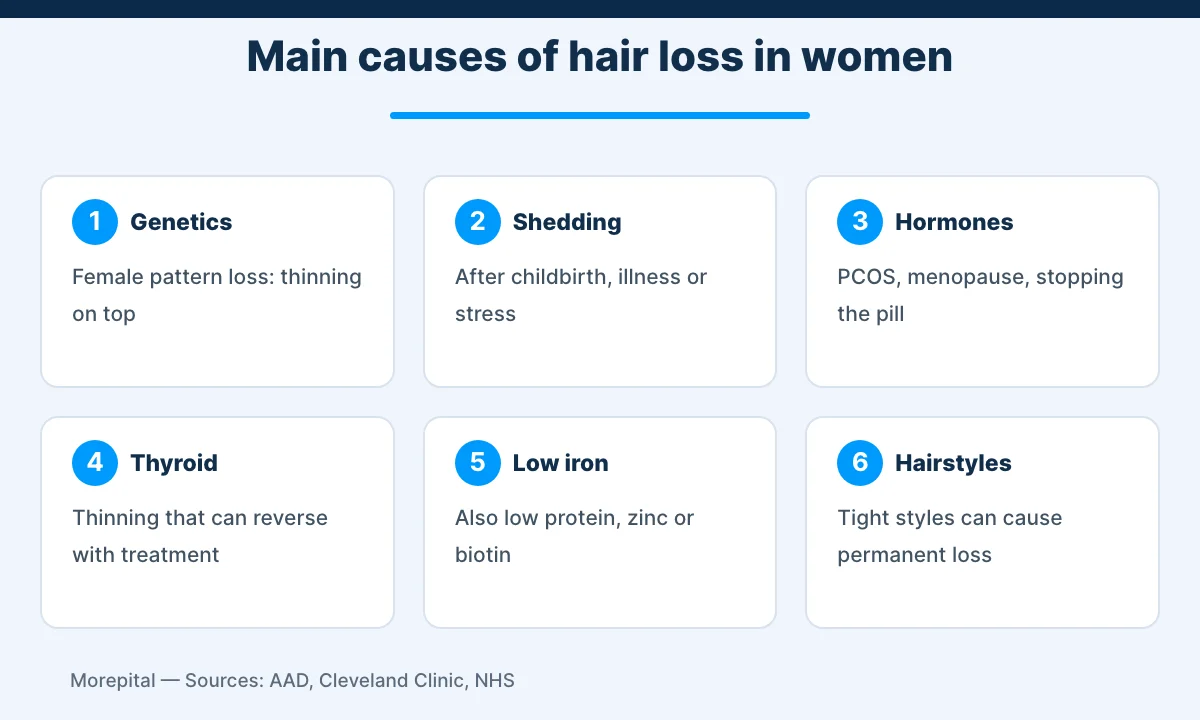
Hair loss in women often has more than one cause at the same time, which is why a full history matters. The American Academy of Dermatology (AAD) and Cleveland Clinic describe these as the main causes:
Hereditary and age-related thinning
Female pattern hair loss is inherited from either or both parents and is the most common cause. Hair growth also slows with age, and a woman’s hairline naturally starts to recede slightly over time.
Hormonal changes and PCOS
Pregnancy, childbirth, menopause and stopping some birth control pills can all shift hormone levels and trigger hair loss in women. Polycystic ovary syndrome (PCOS) is a common hormonal cause; the NHS lists both hair loss and excess hair growth on the face or body among its main symptoms, together with irregular periods, weight gain and oily skin or acne.
Source: AAD, Cleveland Clinic, NHS
Thyroid disease
Thyroid disease can thin the hair, sometimes with hair coming out in clumps. Treating the thyroid problem can reverse the loss. Other clues are covered in our guide to thyroid symptoms.
Source: AAD, Cleveland Clinic
Low iron and other nutrient gaps
Too little iron, protein, zinc or biotin in the diet can cause noticeable hair loss, and hair can regrow once the body gets enough of the missing nutrient. MedlinePlus also lists heavy menstrual blood loss among possible contributors to thinning, and anemia is one of the underlying conditions Cleveland Clinic links to hair loss; read more about anemia symptoms. Rapid weight loss and crash diets are another trigger.
Source: AAD, MedlinePlus, Cleveland Clinic, NHS
Hairstyles and hair care
Tight ponytails, braids, buns and extensions pull on the follicles and can cause traction alopecia, which can become permanent if the pulling continues. Repeated coloring, perming and relaxing can also damage follicles; damaged follicles cannot regrow hair.
Source: AAD, Cleveland Clinic
Alopecia areata, infections and scarring
Alopecia areata is an autoimmune disease that causes small, round, smooth patches about the size of a quarter (roughly 2.5 cm), sometimes with short “exclamation point” hairs at the edges and small pits in the nails. It has no cure, but the follicles survive, so hair often regrows, although episodes can recur; see our page on alopecia areata. A scalp infection causes scaly, sometimes inflamed areas and small black dots of broken hair and usually clears with treatment. Scarring alopecias are rarer but urgent: once inflammation destroys a follicle, it cannot regrow a hair.
Medicines and cancer treatment
Chemotherapy and radiation therapy can cause anagen effluvium, in which growing hairs are damaged and fall out. Certain blood pressure and gout medicines and high doses of vitamin A can also cause hair loss, and the ISHRS adds beta-blockers, warfarin (Coumadin) and some antidepressants. Hair loss in women caused by a medicine often improves once the drug is changed, but only under medical advice.
Source: Cleveland Clinic, ISHRS, AAD
Female pattern hair loss: the most common type
Female pattern hair loss (FPHL), also called androgenetic alopecia, is the form of hair loss in women that runs in families. It causes follicles to shrink gradually, a process called miniaturization. Each new hair grows back shorter and finer until some follicles stop producing visible hair. Because the follicles stay alive for a long time, regrowth with treatment may still be possible.
Source: MedlinePlus, Fabbrocini 2018
This form of hair loss in women affects about 30 million people in the United States, according to Cleveland Clinic. It becomes more common with age: a 2018 review cites data showing that about 12% of women have it by age 29, 25% by age 49, 41% by age 69 and more than half by age 79. The AAD says it usually begins in a woman’s 40s, 50s or 60s, though it can start earlier, and it is more common after menopause, so hormones may play a role.
Source: Cleveland Clinic, Fabbrocini 2018, AAD
What it looks like
Thinning is concentrated on the top and crown. It often starts with a widening of the center part, sometimes in a triangular “Christmas tree” pattern toward the front, while the front hairline is usually preserved. Doctors grade it with the Ludwig, Olsen or Sinclair scales. Total or near-total baldness is uncommon in women. Without treatment, FPHL tends to progress from a widening part to overall thinning.
Source: MedlinePlus, Fabbrocini 2018, AAD
The role of hormones
Androgens (male-type hormones present in all women) drive follicle shrinkage in genetically susceptible follicles, but most women with FPHL have normal hormone levels. PCOS is the most common hormonal condition linked to it, and features of metabolic syndrome such as obesity and insulin resistance are also associated. Signs of androgen excess, such as unwanted facial hair, irregular periods or new acne, should prompt hormone tests.
Source: Fabbrocini 2018, Ramos & Miot 2015, MedlinePlus
Telogen effluvium: shedding after childbirth, illness or stress
Telogen effluvium is the medical term for excessive shedding. A shock to the body pushes many hairs into the resting phase at the same time, and they fall out together a few months later. Our reference page on telogen effluvium covers it in more detail. Common triggers listed by the AAD include:
- losing 20 pounds (about 9 kg) or more
- giving birth
- high stress, such as caring for a sick relative, divorce or losing a job
- a high fever or recovery from an illness with a high fever
- surgery
- stopping birth control pills
Source: AAD
After childbirth, shedding can start about 2 months after delivery and typically peaks around 4 months. This type of hair loss in women is usually temporary: once the body readjusts, hair generally regains its normal fullness within 6 to 9 months. If the stress continues, shedding can last much longer. Shedding from a treatable cause, such as thyroid disease or low iron, usually settles once the underlying problem is corrected.
Telogen effluvium and pattern hair loss can occur together, and early pattern loss is easily confused with long-lasting shedding. One practical difference is the pull test: shedding across the whole scalp suggests telogen effluvium or diffuse alopecia areata, while pattern loss is limited to the thinning areas.
Source: Ramos & Miot 2015
How doctors diagnose hair loss in women
A dermatologist usually diagnoses hair loss in women. The visit starts with questions about when the loss began, family history, recent illness, pregnancy, stress, diet, medicines, hairstyles and hair pulling (trichotillomania). The doctor then examines the scalp, often using these tests:
- Pull test: gently tugging small groups of hairs to see how many come out
- Dermoscopy (trichoscopy): a magnified look at the scalp and hair shafts; variation in hair thickness with many fine hairs suggests pattern loss
- Blood tests: commonly thyroid function, iron stores and vitamins such as vitamin D and B vitamins, plus zinc
- Scalp biopsy: a small skin sample, used when the cause is unclear or scarring is suspected
Source: Cleveland Clinic, Ramos & Miot 2015, MedlinePlus
Lab tests for pattern hair loss in women are often unnecessary, because the history and examination are usually enough. Hormone tests, such as the free androgen index and prolactin, are added when there are signs of androgen excess; hormonal contraceptives may need to be stopped for at least 2 months before testing so the results are accurate. Experts disagree about ferritin (stored iron): some studies found lower ferritin in women with pattern hair loss, while a 2006 review found no evidence for checking it routinely.
Source: Fabbrocini 2018, Ramos & Miot 2015
Treatment options for hair loss in women
Treatment of hair loss in women depends entirely on the cause. Shedding after stress, illness or pregnancy often settles on its own, loss from a medical problem usually improves once it is treated, and styling damage calls for gentler hairstyles and fewer chemical treatments. For female pattern hair loss, the options below can slow thinning and help some women regrow hair, but no treatment is 100% effective and results are usually more modest than in men.
Source: Cleveland Clinic, NHS, Ramos & Miot 2015
Topical minoxidil
Minoxidil 2% or 5% is approved by the US Food and Drug Administration (FDA) for women, is sold without a prescription and is the most recommended treatment for pattern hair loss in women. It is applied to a dry scalp once or twice a day depending on the product. Shedding may increase for the first 2 to 8 weeks, and results take 6 to 12 months of continuous use; stopping it means losing the benefit. MedlinePlus says it helps about 1 in 4 or 5 women regrow hair and slows or stops loss in most. Side effects include scalp irritation and unwanted facial hair, and it should be avoided in pregnancy and breastfeeding. Our guide to minoxidil for hair loss explains how to use it.
Source: AAD, MedlinePlus, Cleveland Clinic
Prescription tablets
Spironolactone, an anti-androgen, is the most common prescription pill for FPHL and is used off-label, usually at 100 to 200 mg a day. Other off-label options include low-dose oral minoxidil, flutamide, dutasteride and finasteride. Results take 6 to 12 months, and if there is no growth within 12 months the drug is unlikely to work. Because they can cause birth defects, they are not for pregnancy, and premenopausal women should use birth control while taking them.
Source: AAD, Fabbrocini 2018
Sources differ on finasteride in women. The NHS states that women should not use it, and a 2018 review notes that a 1 mg dose did not help postmenopausal women in one trial, while the AAD lists it among off-label options some dermatologists prescribe. Our article on finasteride for hair loss explains why it is mainly a treatment for men.
Source: NHS, Fabbrocini 2018, AAD
Devices, PRP and supplements
At-home laser combs and caps are FDA-cleared and sold without a prescription; a few studies show benefit, but long-term safety and effectiveness are unclear. Platelet-rich plasma (PRP) injections and microneedling show promising early results but need more research. Biotin and folic acid showed no effect in most studies, and hair loss shampoos can make hair look fuller but cannot regrow hair.
Source: AAD, Fabbrocini 2018, Cleveland Clinic
Styling and support while treatment works
Changing your hair color or style, using volumizing sulfate-free shampoos, or wearing a hairpiece can make hair loss in women less visible while treatment takes effect. In the UK, some wigs are available on the NHS; synthetic wigs last about 6 to 9 months and real-hair wigs about 3 to 4 years. If hair loss in women causes distress, counselling and support groups such as those listed by Alopecia UK can help.
Source: Cleveland Clinic, MedlinePlus, NHS
| Cause | Typical sign | Main approach | Outlook |
|---|---|---|---|
| Female pattern hair loss | Widening part, thinning on top | Minoxidil, off-label pills, transplant in some | Progressive; treatment slows it |
| Telogen effluvium | Heavy diffuse shedding months after a trigger | Remove or treat the trigger | Fullness usually back in 6–9 months |
| Thyroid disease or low iron | Diffuse thinning, other symptoms | Treat the condition | Hair often regrows |
| Alopecia areata | Round, smooth bald patches | Dermatologist-led treatment | Unpredictable; may recur |
| Traction alopecia | Thinning where hair is pulled tight | Change hairstyle early | Can become permanent |
| Scarring alopecia | Patches with inflammation or scarring | Urgent specialist treatment | Lost hair does not regrow |
Hair transplant for hair loss in women: who is a candidate?
A hair transplant moves healthy follicles, usually from the back of the scalp, to thinning areas. It is an option for some cases of pattern hair loss in women, but it requires enough healthy donor hair. The AAD notes that women with sparse hair all over the scalp may not be candidates, and a 2015 review explains that diffuse thinning that also affects the donor area limits what surgery can achieve.
Source: AAD, Ramos & Miot 2015
According to a 2018 review, the best candidates for surgery for hair loss in women are generally over about 25, have hair loss that has stabilized, have not responded well enough to medical treatment and have dense donor hair at the back of the head. MedlinePlus adds that a transplant often needs more than one session, can be expensive and carries a risk of minor scarring and a slight risk of infection. Long-term medical treatment is usually still needed after surgery.
Source: Fabbrocini 2018, MedlinePlus, Ramos & Miot 2015
Before surgery for hair loss in women, ask any clinic whether a doctor has confirmed the cause, who performs each step, how much donor hair you have and how many sessions may be needed. The NHS advises seeing a GP before going to a commercial hair clinic. If you are considering surgery abroad, Hair Cultivate, a specialized hair-transplant center in Istanbul, publishes information on female hair transplant in Turkey and PRP hair treatment.
When to see a doctor about thinning hair
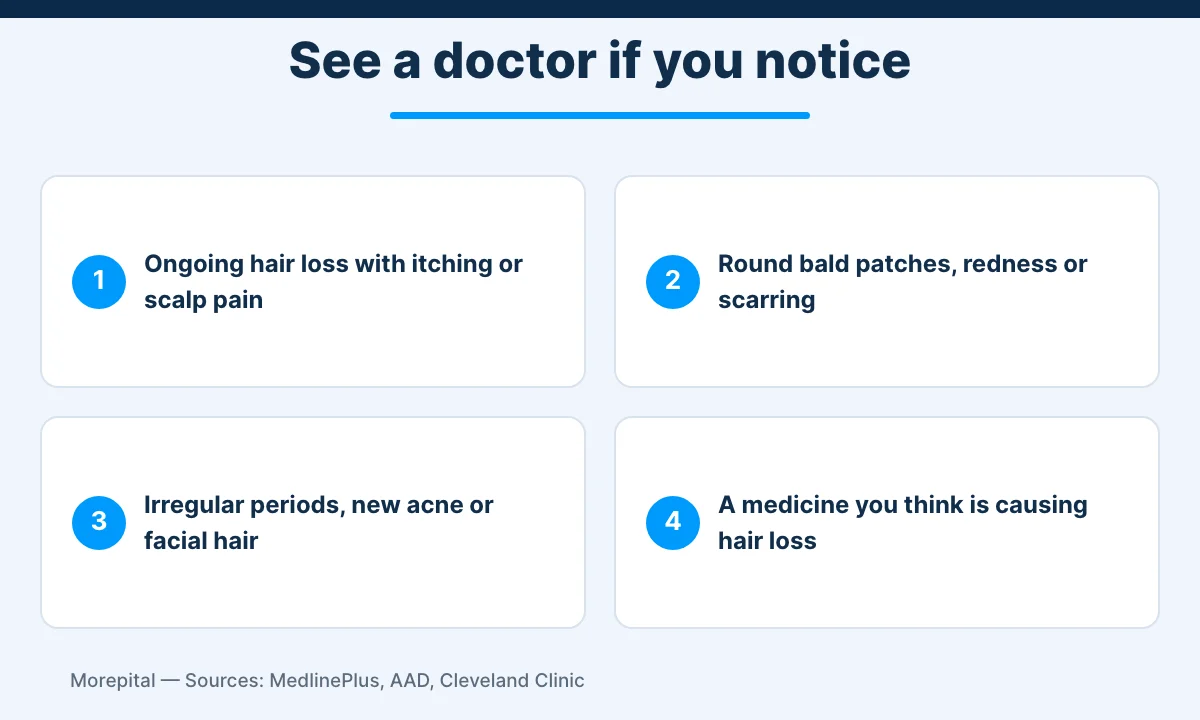
See a doctor or dermatologist whenever you are worried about how much hair you are losing. Cleveland Clinic advises seeing a dermatologist as soon as you notice hair loss, because earlier treatment is more effective. Sudden, patchy or painful hair loss in women should be checked promptly, especially if:
- hair loss continues, especially with itching, scalp irritation or pain
- you notice round bald patches, redness, scaling or scarring
- hair loss comes with irregular periods, new acne or unwanted facial hair
- you have other new symptoms, since thyroid disease, anemia and vitamin deficiencies can all cause hair loss
- you think a medicine is causing your hair loss
Source: Cleveland Clinic, MedlinePlus, AAD
If you suspect a medicine, do not stop it on your own; stopping some medicines suddenly can cause serious side effects, so talk to the doctor who prescribed it first.
Source: AAD
Considering treatment for hair loss in women? Contact us for a free consultation and a treatment plan tailored to you.
Hair loss in women: frequently asked questions
What is the most common cause of hair loss in women?
Hereditary female pattern hair loss, which causes gradual thinning on the top of the head and a widening part.
Source: AAD, Cleveland Clinic
How much hair loss in women is normal per day?
Shedding 50 to 100 hairs a day is normal. Noticeably more than that, or a visible change in density, is worth discussing with a doctor.
Does hair grow back after telogen effluvium?
Usually yes. Once the trigger has passed, most women see their hair regain normal fullness within 6 to 9 months, although ongoing stress can prolong shedding.
Source: AAD
Can low iron cause hair loss in women?
Yes. Too little iron can cause noticeable hair loss, and hair can regrow once iron levels are corrected, but experts disagree on whether to test ferritin routinely in pattern hair loss.
Source: AAD, Ramos & Miot 2015
Is female pattern hair loss permanent?
It is progressive and usually permanent without treatment, but minoxidil and other treatments can slow it and help some women regrow hair, especially when started early.
Source: MedlinePlus, AAD
Can a woman have a hair transplant?
Yes, if she has stable hair loss and enough dense donor hair. Women with thinning all over the scalp may not be suitable candidates.
Source: AAD, Fabbrocini 2018
Can stress cause hair loss in women?
Yes. A very stressful event, such as a divorce, job loss or caring for a sick relative, can trigger heavy shedding a few months later, which usually settles once the stress passes.
Source: AAD
Does menopause cause hair loss in women?
Hormone changes around menopause can make hair finer and thinner, and female pattern hair loss becomes more common after menopause.
Source: Cleveland Clinic, AAD
Disclaimer: this article is for general health education and does not replace advice from a qualified doctor who can assess your individual case. Last updated: October 2026.