
BBL in Turkey is a Brazilian butt lift performed by a surgeon in Turkey: fat is removed by liposuction from areas such as the abdomen, flanks or back, purified, and injected into the buttocks to add volume and shape. The safety question that matters most is not the country but where the fat goes: guidance from international and UK plastic surgery societies says fat must stay in the fat layer under the skin and never be injected into the buttock muscle, ideally with real-time ultrasound to confirm the plane. Before booking a BBL in Turkey, check the surgeon’s plastic surgery credentials, the hospital’s authorization and the aftercare plan for when you are back home.
Source: Cleveland Clinic, BAAPS (2022), Task Force (2018)
Contents
- What a Brazilian butt lift actually involves
- Fat embolism: the main safety issue
- How BBL safety guidance changed after 2018
- Who is a good candidate for BBL in Turkey?
- BBL in Turkey step by step
- Recovery timeline after BBL in Turkey
- Other risks and warning signs after surgery
- Choosing a surgeon and hospital for BBL in Turkey
- Questions to ask before you book BBL in Turkey
- Frequently asked questions
What a Brazilian butt lift actually involves
Despite the name, a Brazilian butt lift is not a lift in the way a facelift or breast lift is. It is a fat-grafting operation: the surgeon uses liposuction to take fat from places where you have spare fat, then injects it into the buttocks and hips to add volume and improve contour. It is also called gluteal fat grafting or lipofilling. Because no skin is removed, a BBL does not correct loose or sagging buttock skin.
Source: Cleveland Clinic, ASPS
According to the American Society of Plastic Surgeons, buttock augmentation can also be done with silicone implants or a combination of implants and fat, while a buttock lift removes sagging skin and fat without adding size. Decide which of these you need before you decide where to have it.
Source: ASPS
Clinically, a BBL in Turkey follows the same principles as in the UK, Europe or the US. What changes is the logistics: consultation, surgery and early recovery are compressed into a short stay, and a later complication may be handled by a different doctor at home. Because a BBL starts with liposuction, it helps to understand that operation too; our liposuction reference page explains how fat is removed and who it suits.
Source: NHS, Cleveland Clinic
Fat embolism: the main safety issue
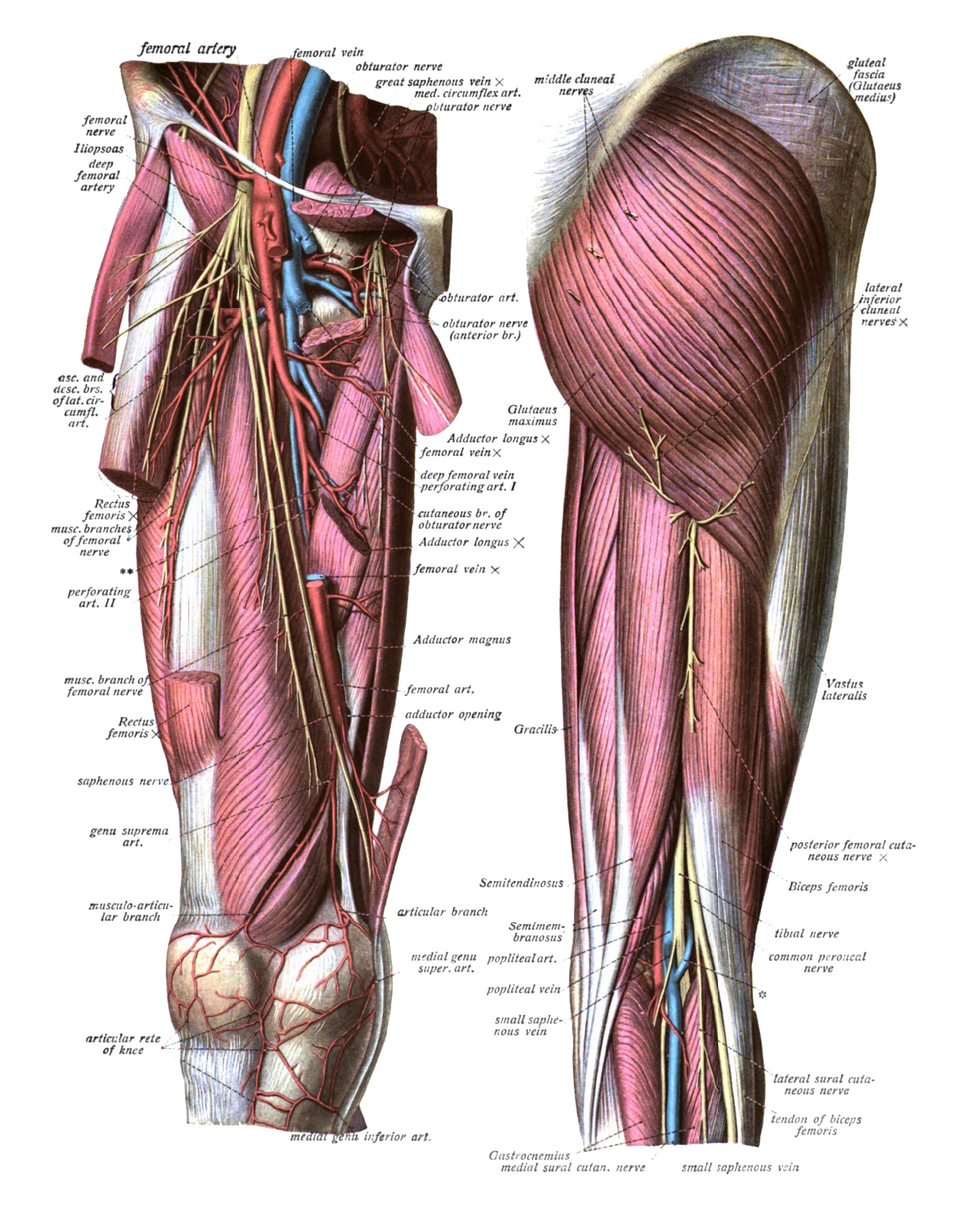
Anyone researching BBL in Turkey soon learns that the operation became known as one of the riskiest in cosmetic surgery because of pulmonary fat embolism. Beneath the buttock muscle lie large gluteal veins. If the injecting cannula enters or passes under the muscle and damages these veins, fat can be drawn into the bloodstream and travel to the heart and lungs, where it can block blood flow.
Autopsies explained why. A 2018 urgent advisory from the Multi-Society Task Force for Safety in Gluteal Fat Grafting (ASPS, ASAPS, ISAPS, IFATS and ISPRES) reported that in every patient who had died, fat was found within the gluteal muscle, and in no death was fat found only in the subcutaneous (under-the-skin) layer. The task force therefore concluded that fat should never be placed in the muscle and should be placed only in the subcutaneous tissue. It also warned that the muscle is easy to enter unintentionally, so technique matters whether you have a BBL in Turkey or elsewhere.
Source: Task Force (2018)
How high is the risk of death?
Estimates differ, and it is worth knowing why. A 2017 survey by the Aesthetic Surgery Education and Research Foundation (ASERF) task force collected reports of 32 fatal and 103 nonfatal fat emboli across 198,857 gluteal fat grafting procedures, which was extrapolated to a death risk as high as about 1 in 2,351; the 2018 advisory quoted a figure of up to 1 in 3,000, higher than any other cosmetic operation. In its 2022 review, BAAPS argued that the survey method was flawed and estimated the actual risk to be nearer 1 in 15,000, similar to the mortality risk of a tummy tuck. Both figures come from surgeon surveys, and neither is specific to BBL in Turkey.
Source: BAAPS (2022), Task Force (2018)
How quickly fat embolism shows itself
A 2023 review of published cases of pulmonary fat embolism after liposuction and fat grafting found that symptoms began within 24 hours of surgery in 76% of patients and that all deaths occurred within five days. Common signs were shortness of breath, low oxygen, low blood pressure, a fast heart rate, confusion and sometimes a pinpoint rash (petechiae). This shows why the first days after a BBL in Turkey should be spent close to the treating hospital.
Source: Healthcare (2023)
How BBL safety guidance changed after 2018
In October 2018, BAAPS advised its members not to perform the BBL at all until more data were available, and BAPRAS backed the pause, warning that safety standards for people having this surgery abroad vary widely. BAAPS notes that this decision came shortly after a 29-year-old British woman died following a BBL in Turkey, a case that drew wide media attention in the UK.
Source: BAPRAS, BAAPS (2022)
After reviewing the newer evidence, BAAPS published superficial gluteal lipofilling guidance and, in its 2022 safety review, set out technical recommendations for surgeons. These recommendations are guidelines rather than laws, but they give patients a clear checklist of what a careful team offering BBL in Turkey should be doing:
- Inject fat into the subcutaneous plane only, never into the muscle.
- Use intraoperative ultrasound to confirm the cannula is in the subcutaneous layer before fat is placed, and save the images.
- Use blunt, thick cannulas of 4 mm or more, which bend less, and avoid downward injection angles.
- Limit the volume to what the tissue can safely hold, and stage a second session rather than injecting deeper.
- Avoid surgeon fatigue, with a recommended maximum of three cases a day.
Source: BAAPS (2022), BAAPS
The task force adds: track the cannula tip with every stroke, inject only while the cannula is moving, and discuss the risk of death and alternatives such as implants with every patient. These documents turn a vague promise of “safe BBL” into specific questions you can ask.
Source: Task Force (2018), BAAPS (2022)
Who is a good candidate for BBL in Turkey?
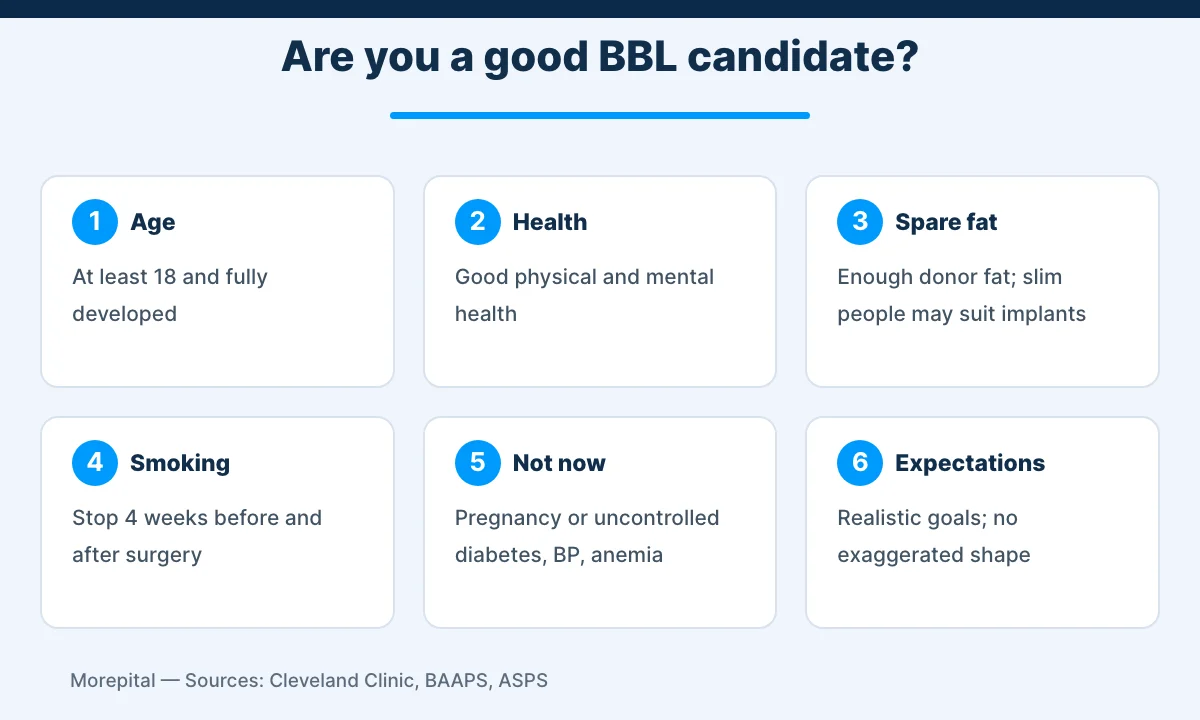
Cleveland Clinic says candidates for BBL in Turkey, as anywhere, must be at least 18, have finished physical development, be in good physical and mental health, have realistic expectations and have enough spare body fat to transfer. Very slim people may be better suited to implants.
Source: Cleveland Clinic, ASPS
BAAPS says gluteal fat grafting should not go ahead, or only with extreme caution, in pregnancy; with unstable or untreated diabetes, high blood pressure, anemia or clotting disorders; with significant heart, kidney or liver disease; with body dysmorphic disorder or unstable mental health; or with unrealistic expectations. If you smoke, BAAPS advises stopping for four weeks before and after BBL in Turkey or any gluteal fat grafting.
Source: BAAPS (2022)
Weight matters as well. Overweight and obesity raise the risk of blood clots, so if your weight is high or still changing, it is sensible to address that first; see our obesity reference page. If your main concern is loose skin on the abdomen rather than buttock volume, a different operation may suit you better, as explained in our guide to a tummy tuck in Turkey.
Source: NHS, Cleveland Clinic
BBL in Turkey step by step
Consultation and consent
BAAPS recommends written information, a second consultation and consent taken by the surgeon before the day of surgery, covering alternatives, life-threatening complications, possible fat loss or a repeat procedure, and the surgeon’s experience. The NHS similarly advises two consultations with the surgeon, not just a sales adviser, before any cosmetic surgery abroad, including BBL in Turkey.
Source: BAAPS (2022), NHS
The operation
A BBL in Turkey is usually done under general anesthesia, although small transfers may be done under local anesthesia. The surgeon performs liposuction through small incisions, purifies the fat, then injects it through three to five small incisions around the buttock into the subcutaneous tissue, placing most of it in the upper buttock. Cleveland Clinic says the amount is usually about 300 to 500 cc (roughly 1⅓ to 2¼ cups) on each side. The incisions are closed and a compression garment is applied.
Source: Cleveland Clinic
For a BBL in Turkey, BAAPS standards are a useful benchmark: an anesthetist familiar with the procedure, active warming to prevent hypothermia, clot prevention based on a risk assessment, and a sterile operating theatre rather than a clinic room.
Source: BAAPS (2022)
Discharge and the first days
After surgery you are monitored in a recovery area, and ASPS notes that some patients go home after a few hours. Cleveland Clinic says someone should drive you and stay with you for at least the first 24 hours. For a BBL in Turkey, that usually means a hotel or recovery facility near the hospital, a companion, and a clear number to call at any hour. Given that serious embolism symptoms usually start within the first day, do not plan to be far from the hospital in that period.
Source: ASPS, Cleveland Clinic, Healthcare (2023)
Recovery timeline after BBL in Turkey
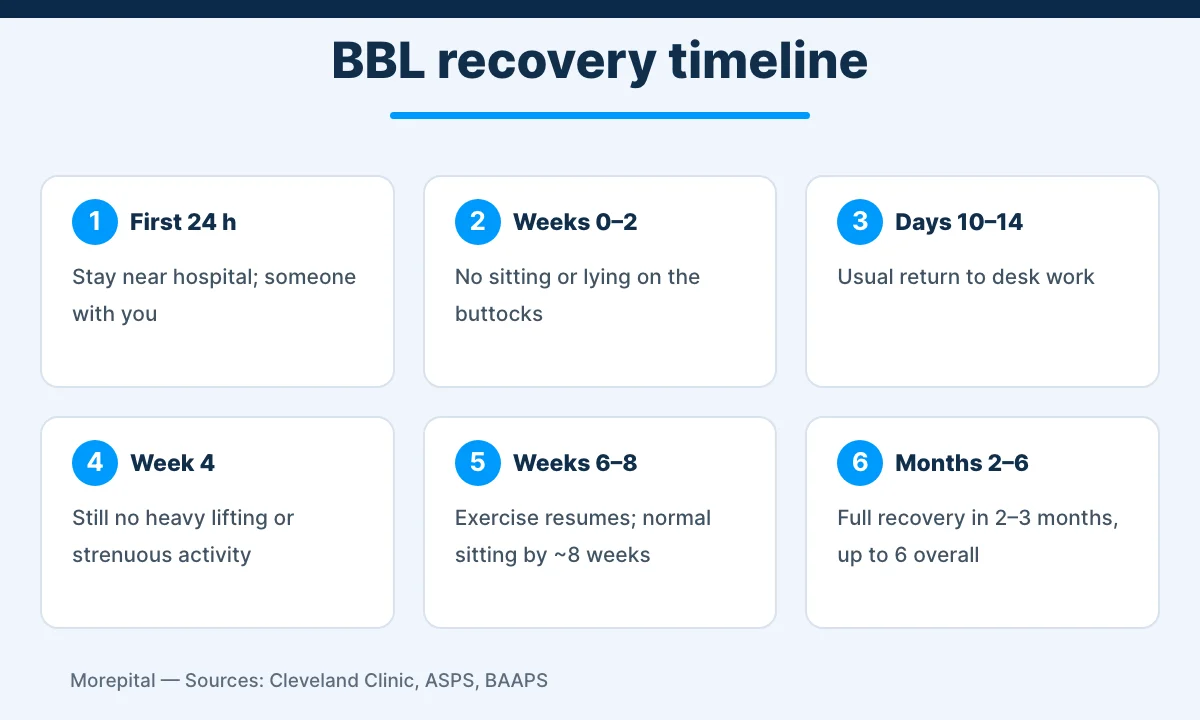
The first several days after BBL in Turkey are the most uncomfortable, with swelling, bruising, fluid and a little oozing from the incisions; a temporary drain may be used. For at least two weeks you should not sit or lie on your buttocks, so you sleep on your front or side and stand or lie face down for much of the day. ASPS describes avoiding prolonged sitting for about two weeks, notes that some surgeons prefer longer, and suggests a cushion behind the thighs to keep pressure off the grafts when you must sit. BAAPS also recommends keeping pressure off the grafted area for the first two weeks.
Source: Cleveland Clinic, ASPS, BAAPS (2022)
Stitches usually come out after one to two weeks, and pain should ease over the same period. Most people return to work after about 10 to 14 days, depending on the job; a standing desk helps if you normally sit. You can sit for short periods on a special pillow after several weeks, but sitting normally without it takes about eight weeks. Cleveland Clinic advises avoiding heavy lifting and strenuous activity for a month, while ASPS says exercise can generally resume after six to eight weeks. Full recovery takes two to three months, and up to six months for the whole body to settle.
Source: Cleveland Clinic, ASPS
Compression garments and massage
Most surgeons prescribe a compression garment worn day and night, and some recommend lymphatic drainage massage. BAAPS points out that there is little evidence on the safety and effectiveness of either and no agreement on how long they should be used, so follow your own surgeon’s plan rather than generic online advice.
Source: ASPS, BAAPS (2022)
Flying home
The NHS advises not flying for 5 to 7 days after liposuction, and a BBL includes liposuction plus fat transfer, so ask your surgeon for a specific date before you book flights for BBL in Turkey. Remember that sitting is restricted for about two weeks, which makes a long seated flight harder; plan an aisle seat, walking breaks and plenty of fluids. Journeys longer than four hours, recent surgery and dehydration all raise the risk of a blood clot.
How long results last
Some transferred fat does not survive, so a repeat procedure is possible. Cleveland Clinic describes the results as semi-permanent: they should last several years and may last more than a decade, and keeping a stable weight helps preserve them. Follow-up visits are typically at one to two weeks, four to six weeks and three months.
Source: Cleveland Clinic, BAAPS (2022)
Other risks and warning signs after surgery
Fat embolism is not the only serious risk of BBL in Turkey or anywhere else. BAAPS lists major complications including blood loss that may need a transfusion, deep vein thrombosis (DVT) and pulmonary embolism, sepsis and necrotizing fasciitis, sciatic nerve injury, and injuries from positioning during surgery. Less serious problems include infection, fluid collections, contour irregularities, numbness, fat necrosis and oil cysts. BAAPS adds that most BBL complications seen in the UK’s NHS are sepsis, fat necrosis and skin necrosis. ASPS adds asymmetry and the possible need for revision.
Source: BAAPS (2022), ASPS
When to get urgent help
Contact your surgeon or emergency services at once if you notice any of these after BBL in Turkey:
- Shortness of breath, chest pain or an unusual heartbeat: seek emergency care immediately.
- Confusion, unusual drowsiness or a new pinpoint rash in the first days after surgery.
- Throbbing pain, swelling or color change in one leg, a sign of DVT; with breathlessness or chest pain, call emergency services.
- Fever, spreading redness, foul-smelling discharge or severe pain at the incisions, which may signal infection.
Source: ASPS, NHS, Healthcare (2023)
BAAPS also warns that patients who have surgery abroad or in unregulated facilities are at higher risk of serious complications and of inadequate management afterwards. That is not a reason to rule out a BBL in Turkey, but it is a reason to choose a regulated hospital, stay long enough, and know who will treat you if a problem appears back home.
Source: BAAPS (2022), NHS
Choosing a surgeon and hospital for BBL in Turkey
In a 2023 joint statement, BAAPS and the Turkish Society of Plastic, Reconstructive and Aesthetic Surgeons (TSPRAS) gave patients a practical checklist for surgery in Türkiye. Confirm the surgeon is a TSPRAS member and ask to see Turkish board certification; European board (EBOPRAS) certification is desirable. The surgeon should have practiced plastic surgery for at least five years and worked with the clinic for at least three. Surgery should take place in a fully recognized hospital, which the statement suggests can be identified by having at least 30 beds. You should receive a comprehensive consent form before you travel and an aftercare plan, and you should know your surgeon’s name and how to reach them.
Source: BAAPS and TSPRAS
Turkey also regulates health tourism. Under a regulation published on 13 July 2017, facilities and intermediary agencies serving international patients must hold an International Health Tourism Authorization Certificate, and the Ministry of Health lists authorized providers on the HealthTürkiye website. The UK Foreign Office points to that list but stresses that it does not endorse any practitioner, and says it is aware of 7 British nationals who died in Turkey in 2025 after medical procedures. We applied the same checks in our guide to rhinoplasty in Turkey.
Source: HealthTürkiye, GOV.UK
| What to check | Safer sign | Warning sign |
|---|---|---|
| Surgeon | Board-certified plastic surgeon, TSPRAS member, 5+ years in practice | Unclear specialty, name not given, only a coordinator to talk to |
| Technique | Subcutaneous injection only, with real-time ultrasound guidance | Promises of very large volumes in one session, vague answers on the injection plane |
| Facility | Recognized hospital with a health tourism authorization certificate | Clinic rooms, hotels or premises you cannot verify |
| Consent | Written information and consent before travel, risk of death discussed | First meeting with the surgeon on the day of surgery |
| Aftercare | Written plan, 24-hour contact, follow-up arranged | Fixed package that sends you home the next day with no plan |
Source: BAAPS and TSPRAS, BAAPS (2022), NHS
Questions to ask before you book BBL in Turkey
Use your consultations to get specific answers, not reassurance:
- Who exactly will operate, what is their specialty, and how many gluteal fat grafting operations do they perform each year?
- Will fat be placed only in the subcutaneous layer, and will you use real-time ultrasound to confirm it?
- How much fat do you plan to transfer, and would you stage a second session rather than inject deeper?
- Which hospital will I be in, who gives the anesthetic, and what clot-prevention measures will you use?
- What are the risks of death and serious complications, and what are my alternatives?
- How many nights should I stay, when can I fly, and when are follow-up checks?
- What happens if I have a complication after I get home, and what will extra treatment cost?
Source: BAAPS (2022), ASPS, NHS
Check your insurance before BBL in Turkey too. The NHS notes that ordinary travel insurance normally does not cover problems arising from surgery, and BAAPS reports that some UK indemnity providers do not cover gluteal fat grafting at all. Ask what insurance the clinic and surgeon hold, plan how you would get home in an emergency, and tell your own doctor about your plans before you go.
Source: NHS, BAAPS (2022), GOV.UK
Be realistic about the look you want from BBL in Turkey. BAAPS discourages an exaggerated hourglass shape, especially when safety limits are crossed to achieve it, and notes that social media images can raise expectations beyond what your anatomy allows. A surgeon who tells you that you do not have enough fat for the size you want, or suggests a staged plan, is giving you honest advice. If you want buttock or hip contouring without added volume, liposuction alone may be an option; see our tummy tuck reference page for an operation that also tightens skin.
Source: BAAPS (2022)
Considering a BBL in Turkey? Contact us for a free consultation and a treatment plan tailored to you.
BBL in Turkey: frequently asked questions
Is BBL in Turkey safe?
No BBL is risk-free anywhere. Risk depends mainly on technique, the surgeon’s training and the facility: fat injected only into the subcutaneous layer, ideally under ultrasound, in a regulated hospital by a qualified plastic surgeon is the approach current guidance supports.
Source: BAAPS (2022), Task Force (2018)
How long should I stay in Turkey after a BBL?
There is no single official number. Serious embolism symptoms usually start within 24 hours, the NHS advises not flying for 5 to 7 days after liposuction, and sitting is restricted for about two weeks, so agree a stay with your surgeon that covers these points.
Source: NHS, Healthcare (2023)
When can I sit after BBL in Turkey?
Avoid sitting directly on your buttocks for at least two weeks. Short periods on a special pillow are usually allowed after several weeks, and normal sitting without it after about eight weeks.
Source: Cleveland Clinic, ASPS
Should I ask whether ultrasound will be used for my BBL in Turkey?
Yes. BAAPS says intraoperative ultrasound must be used to confirm the cannula is in the subcutaneous layer before fat is placed, and that the images should be saved.
Source: BAAPS (2022)
How long do results of BBL in Turkey last?
They are semi-permanent. Some fat is lost after transfer, but the fat that survives can last several years or more than a decade, especially if your weight stays stable.
Source: Cleveland Clinic
How do I check a clinic for BBL in Turkey?
Confirm the surgeon’s TSPRAS membership and board certification, check that the facility appears on the Ministry of Health’s HealthTürkiye list of authorized providers, and get the consent form and aftercare plan in writing before you travel.
Source: BAAPS and TSPRAS, HealthTürkiye
What are the alternatives to a BBL?
Options include buttock implants, a combination of implants and fat, liposuction of the lower back alone to improve the waist-to-buttock ratio, or a buttock lift if loose skin is the main issue.
Source: ASPS, BAAPS (2022)
Disclaimer: this article is for general health education and does not replace advice from a qualified doctor who can assess your individual case. Last updated: October 2026.