
Early pregnancy symptoms usually begin around 4 to 6 weeks of pregnancy (counted from the first day of your last period), and the most common ones are a missed period, nausea, unusual tiredness, sore or swollen breasts and needing to urinate more often. Many people notice light spotting around the time their period is due, while others feel nothing at all for several weeks. Because these signs overlap with premenstrual symptoms, a home pregnancy test taken from the first day of a missed period is the reliable way to find out.
Source: NHS, NHS, Cleveland Clinic
Contents
- When early pregnancy symptoms start
- 15 early pregnancy symptoms to look for
- Implantation bleeding or a period?
- Early pregnancy symptoms vs PMS
- When to take a pregnancy test
- Easing nausea, fatigue and other early pregnancy symptoms
- Early pregnancy symptoms that need urgent care
- What to do after a positive test
- FAQ
When early pregnancy symptoms start

Doctors and midwives date a pregnancy from the first day of your last menstrual period, not from conception, so week 4 starts counting before conception has even happened. Early pregnancy symptoms usually start somewhere between weeks 4 and 6 on this calendar. At 4 weeks the embryo is only about 2 mm long, roughly the size of a poppy seed, and many people have no symptoms at all yet.
Timing varies: some people notice early pregnancy symptoms as soon as they miss a period, while others do not feel pregnant until several weeks after a positive test.
Source: Cleveland Clinic, NHS
Why the symptoms happen
After a fertilized egg implants in the lining of the womb, the developing placenta begins to make human chorionic gonadotropin (hCG), the hormone that pregnancy tests detect. In early pregnancy hCG rises quickly and normally roughly doubles every 48 hours. Rising hormones explain many early pregnancy symptoms: hormonal changes in the first 12 weeks are probably one cause of nausea, and rising progesterone contributes to fatigue.
Source: MedlinePlus (NIH), NHS, Cleveland Clinic
15 early pregnancy symptoms to look for
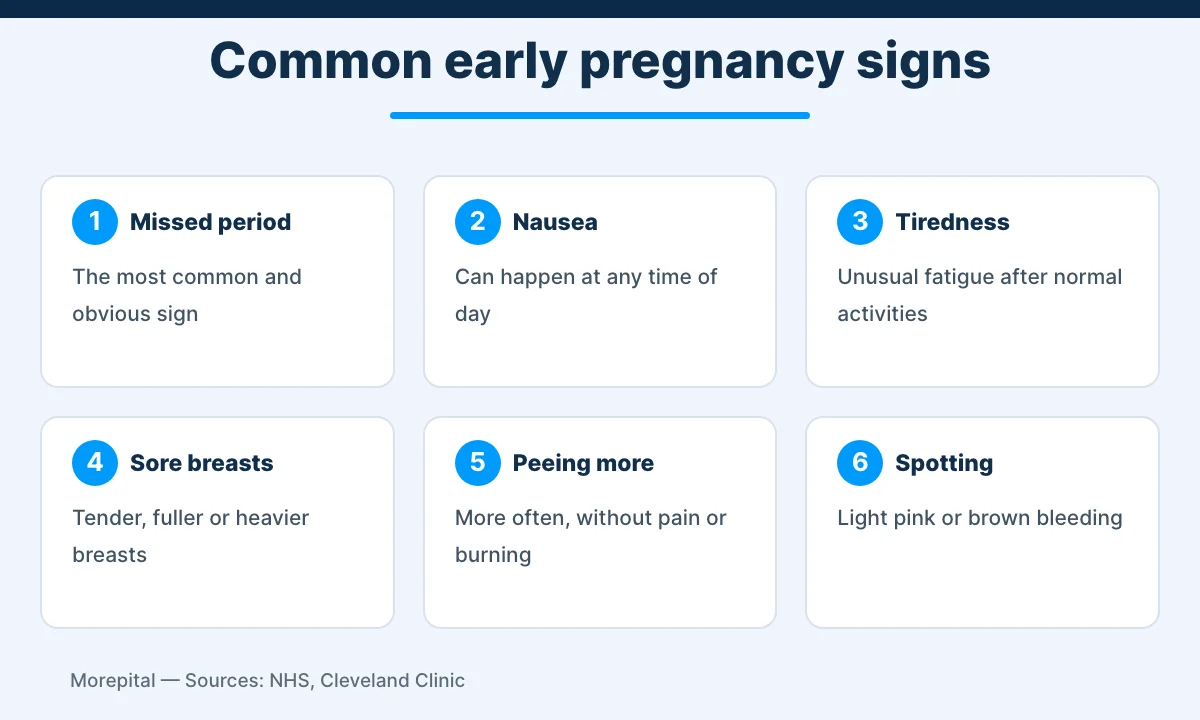
The list below combines the early pregnancy symptoms described by the NHS and Cleveland Clinic. You may notice one, several or none of these early pregnancy symptoms in the first weeks.
Source: NHS, Cleveland Clinic
- A missed period. This is the most common and obvious sign, although stress, heavy exercise and other causes can also delay a period.
- Light spotting. A small amount of bleeding around the time your period is due, known as implantation bleeding (see the next section).
- Nausea or vomiting. Often called morning sickness, but it can happen at any time of the day or night.
- Unusual tiredness. Feeling exhausted after normal daily activities; many women find the first trimester the most tiring.
- Breast changes. Breasts may feel tender, heavy, fuller or larger.
- Peeing more often. Needing to urinate more frequently, without pain or burning.
- Constipation. Pregnancy hormones slow digestion and relax the muscles of the bowel.
- More vaginal discharge. An increase in discharge without soreness, itching or irritation.
- A metallic taste in the mouth.
- A heightened sense of smell, which can make cooking smells or perfume hard to tolerate.
- Food cravings or aversions, including losing interest in foods or drinks you usually enjoy.
- Mood changes, such as feeling more emotional or irritable than usual.
- Bloating and a feeling of fullness.
- Mild cramping, similar to but lighter than period cramps.
- Headaches, dizziness or a blocked nose, which some people notice in the first weeks.
Source: NHS, Cleveland Clinic, Office on Women’s Health (HHS)
Several early pregnancy symptoms are also common in other conditions. Tiredness and dizziness can come from low iron, which is explained in our guide to anemia symptoms, and fatigue, mood changes and weight changes can also reflect an underactive or overactive thyroid, covered in thyroid symptoms. A pregnancy test is the quickest way to tell these possibilities apart.
Source: Cleveland Clinic, NHS
Implantation bleeding or a period?
Implantation bleeding is light bleeding that some people notice when the embryo attaches to the lining of the womb. According to Cleveland Clinic, about 1 in 4 pregnant women experience it, typically 10 to 14 days after ovulation, which is often before a missed period or a positive test. It looks like small drops of blood or a pink or brown discharge rather than bright or dark red blood.
Source: Cleveland Clinic, Cleveland Clinic
The main differences from a period are the amount and the duration. Implantation bleeding is light or spotty and should not soak through a pad; it lasts from a few hours to a couple of days and should stop on its own after about two days. Any cramping is very light or mild. A period is usually heavier, may contain clots and tends to build up over several days. If the bleeding is bright or dark red, heavy or contains clots, it is usually not implantation bleeding.
Source: Cleveland Clinic
Bleeding is one of the early pregnancy symptoms that can have other causes, including infection, miscarriage, ectopic pregnancy and molar pregnancy. If you have bleeding with pain, one-sided cramps or heavy flow, get medical advice rather than assuming it is implantation bleeding.
Source: NHS, Cleveland Clinic
Early pregnancy symptoms vs PMS
Premenstrual syndrome (PMS) and early pregnancy symptoms overlap a great deal, because both occur after ovulation in the days before a period is due. Breast swelling or tenderness, bloating, cramping, constipation, headache, fatigue, food cravings and mood swings appear on both lists. PMS symptoms usually show up in the five days before a period and ease within four days after bleeding starts.
Source: Office on Women’s Health (HHS), NHS
Some clues point more toward pregnancy than PMS: a period that does not arrive, nausea or vomiting, a metallic taste, a heightened sense of smell, and light spotting instead of a normal flow. Even so, no single one of these early pregnancy symptoms can confirm or rule out pregnancy, and the table below is only a rough guide.
Source: NHS, Office on Women’s Health (HHS), Cleveland Clinic
| Symptom | Early pregnancy | PMS |
|---|---|---|
| Period | Missed; sometimes light spotting only | Arrives as expected; symptoms ease within 4 days |
| Breast tenderness | Common; breasts may feel fuller and heavier | Common; swelling or tenderness |
| Nausea or vomiting | Common, at any time of day | Not a typical PMS symptom |
| Fatigue | Common; often marked in the first trimester | Common |
| Taste and smell | Metallic taste, stronger sense of smell | Not typical |
| Cramping | Mild; severe or one-sided pain needs a doctor | Common before and during the period |
| Mood and cravings | Mood changes, cravings or food aversions | Mood swings, irritability, cravings |
Source: NHS, Cleveland Clinic, Office on Women’s Health (HHS)
When to take a pregnancy test
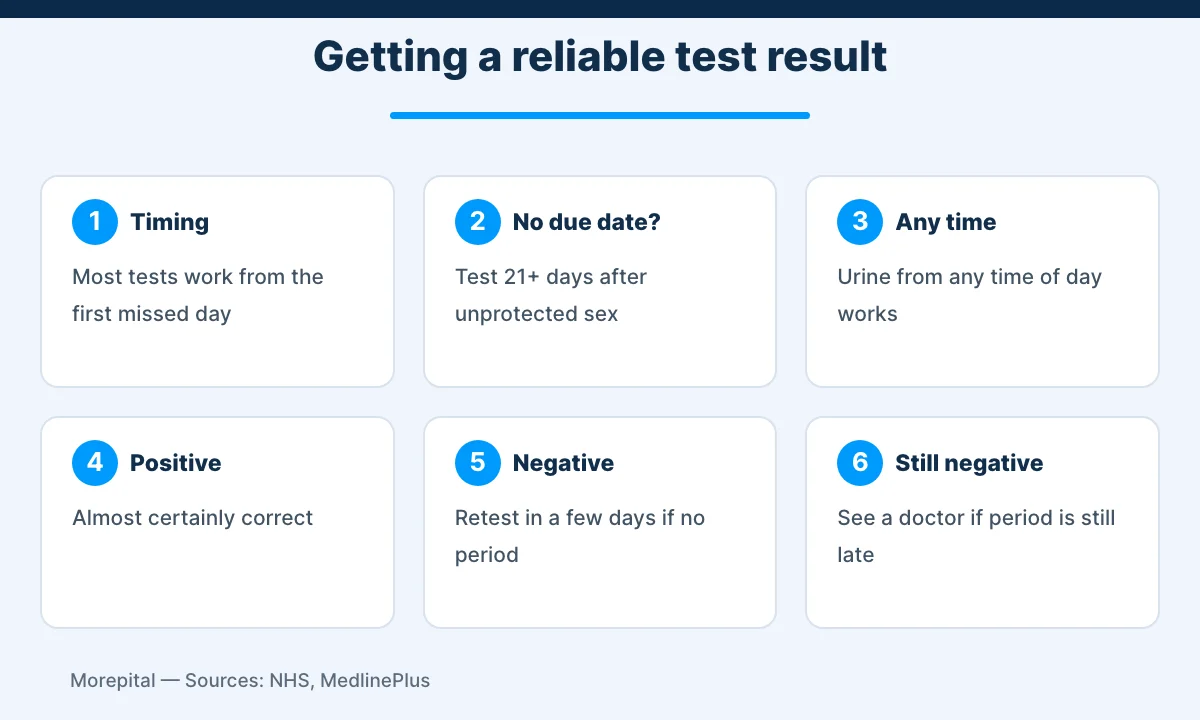
Home pregnancy tests detect hCG in urine. hCG can be found in blood and urine as early as 10 days after conception, but most over-the-counter tests do not show a positive result until the expected period is late, and testing earlier often gives an inaccurate result. The NHS advises that most tests work from the first day of a missed period; some very sensitive tests can be used a few days earlier.
Source: MedlinePlus (NIH), NHS, NHS
If you do not know when your next period is due, the NHS suggests testing at least 21 days after you last had unprotected sex. You can use urine collected at any time of day, although MedlinePlus notes that first-morning urine is more concentrated and is a good time to test.
Source: NHS, MedlinePlus (NIH)
How accurate are home tests?
A positive result is almost certainly correct. A negative result is less reliable: it may be wrong if you tested too early, did not follow the instructions, or take certain medicines. Taking the contraceptive pill does not stop a test from working. If your test is negative but your period still has not come, wait a few days and test again, and see a doctor if a second test is also negative and your period has not arrived.
Source: NHS, Cleveland Clinic
Blood tests
A doctor can also order a blood test for hCG. A quantitative test measures how much hCG is present, and repeated quantitative tests are sometimes used to check whether hCG is rising as expected, because a level that does not rise appropriately may signal a problem such as miscarriage or ectopic pregnancy.
Source: MedlinePlus (NIH)
Easing nausea, fatigue and other early pregnancy symptoms
Nausea and vomiting are the early pregnancy symptoms people ask about most. A 2022 review in Frontiers in Medicine reports that nausea and vomiting of pregnancy affect up to 70% of pregnant women, usually begin at 6 to 8 weeks, peak between 10 and 16 weeks, and generally resolve by 16 to 20 weeks. The NHS also says morning sickness usually clears up by weeks 16 to 20 and does not put the baby at increased risk.
Source: Frontiers in Medicine (2022 review), NHS
Practical tips for nausea
- Rest when you can; tiredness can make nausea worse.
- Avoid foods and smells that trigger it.
- Eat something like dry toast or a plain biscuit before getting up.
- Have small, frequent, plain meals that are high in carbohydrate and low in fat; cold foods may be easier if hot meals smell too strong.
- Sip fluids little and often rather than drinking a lot at once.
- Try foods or drinks containing ginger, but check with a pharmacist before taking ginger supplements.
- Try wrist acupressure.
Source: NHS
If nausea is severe or does not settle, a doctor can prescribe a short course of anti-sickness medicine for a short time, often an antihistamine taken as tablets. A small minority develop hyperemesis gravidarum, a severe form of pregnancy sickness that can lead to dehydration and malnutrition and may need hospital treatment. The Frontiers review cites estimates from 0.3% to 10.8% of pregnancies, with a meta-analysis figure of about 1.1%.
Source: NHS, Frontiers in Medicine (2022 review)
Fatigue, breasts, bladder and bowels
Other early pregnancy symptoms respond to simple measures. For tiredness, going to bed a little earlier and napping when possible can help. A well-fitting, supportive bra eases tender breasts; tell your doctor about any lumps, nipple changes or unusual discharge. For constipation, drink plenty of water, eat more fiber, cut back on caffeine and keep gently active. Frequent urination is expected, but burning when you pee may mean an infection, which is explained in our article on urinary tract infection. For heartburn, eat small meals, avoid greasy or spicy food and do not lie down right after eating; our guide to acid reflux covers more triggers.
Source: Office on Women’s Health (HHS)
Early pregnancy symptoms that need urgent care
Most early pregnancy symptoms are uncomfortable but harmless. A few can signal an ectopic pregnancy (a pregnancy growing outside the womb, most often in a fallopian tube), a miscarriage or another problem that needs prompt treatment. Ectopic pregnancy symptoms usually develop between the 4th and 12th weeks of pregnancy, and some people have no symptoms at first.
Get medical advice the same day if you have
- Vaginal bleeding, including bleeding that comes and goes or looks watery and dark brown.
- Tummy pain, especially low down on one side.
- Shoulder tip pain, where the shoulder meets the arm; this can be a sign of internal bleeding.
- Discomfort when going to the toilet, such as pain when peeing or pooing, or diarrhea, together with other symptoms.
The NHS advises getting advice if you have a combination of these early pregnancy symptoms and think you might be pregnant, even before a positive test.
Source: NHS
Call emergency services if you have
- Sudden, intense or severe tummy pain that stops you doing everyday tasks.
- Feeling dizzy, faint or sick, or losing consciousness.
- Heavy bleeding, such as soaking a pad soon after putting it on.
When vomiting becomes a concern
Contact your doctor or midwife if you are vomiting and have very dark urine or have not peed in more than 8 hours, cannot keep food or fluids down for 24 hours, feel very weak, dizzy or faint when standing up, have tummy pain or a high temperature, vomit blood, or are losing weight. These can be signs of dehydration or hyperemesis gravidarum. Mood changes are normal early pregnancy symptoms, but seek help right away if you feel anxious or depressed, or have any thoughts of harming yourself.
Source: NHS, Cleveland Clinic
What to do after a positive test
Once a home test is positive, contact a doctor or midwife to start pregnancy (prenatal) care. Cleveland Clinic notes that the first prenatal visit usually happens between the sixth and eighth week of pregnancy. In the UK you can refer yourself to NHS maternity care. If the pregnancy was unplanned or you are unsure about continuing, you can speak confidentially with a healthcare professional about your options.
Source: Cleveland Clinic, NHS
Folic acid
The CDC recommends that everyone who could become pregnant take 400 micrograms (mcg) of folic acid every day, ideally starting at least one month before conception and continuing during pregnancy, because neural tube defects of the brain and spine can develop in the first few weeks, often before a person knows they are pregnant. If a previous pregnancy was affected by a neural tube defect, talk to a doctor: the recommended dose is 4,000 mcg a day, starting one month before conception and through the first three months.
Source: CDC
Alcohol and other substances
There is no known safe amount of alcohol during pregnancy and no safe time to drink. If you drank before you knew you were pregnant, stop as soon as you find out, because it is never too late to stop, and mention it to your healthcare provider at your first appointment.
Preparing for your first visit
Bring a list of your early pregnancy symptoms, the date of your last period and any medical conditions to your first appointment, since pregnancy is dated from the first day of your last period. Tiredness and low mood can also come from other causes; our guide to vitamin D deficiency explains one common one.
Source: NHS, Cleveland Clinic
Early pregnancy symptoms: frequently asked questions
How soon do early pregnancy symptoms start?
Most people who notice early pregnancy symptoms do so around 4 to 6 weeks of pregnancy, counted from the first day of the last period, which is around the time a period is due or soon after. Some notice nothing for several more weeks.
Source: NHS, Cleveland Clinic
Can you have early pregnancy symptoms before a missed period?
Yes. Implantation bleeding often happens before a missed period, and some people notice breast tenderness, tiredness or mild cramps, but these overlap with PMS.
Source: Cleveland Clinic, Office on Women’s Health (HHS)
Is it normal to have no early pregnancy symptoms?
Yes. Many people have no early pregnancy symptoms at 4 weeks, and not everyone gets every symptom.
How long do early pregnancy symptoms like nausea last?
Nausea and vomiting usually start at 6 to 8 weeks, peak between 10 and 16 weeks and clear up by 16 to 20 weeks for most people. See a doctor if you cannot keep fluids down for 24 hours.
Source: Frontiers in Medicine (2022 review), NHS
Is spotting one of the early pregnancy symptoms?
It can be. Implantation bleeding is usually light spotting or a pink or brown discharge that does not soak a pad and stops within about two days. Heavy, bright red bleeding with clots is unlikely to be implantation bleeding.
Source: Cleveland Clinic
Which early pregnancy symptoms are an emergency?
Sudden severe tummy pain, shoulder tip pain, heavy bleeding, or feeling faint or dizzy can signal a ruptured ectopic pregnancy or another emergency. Call emergency services or go to the nearest emergency department.
Disclaimer: this article is for general health education and does not replace advice from a qualified doctor who can assess your individual case. Last updated: October 2026.