
Orthodontic braces
Fixed orthodontic appliances (dental braces)
Orthodontic braces are dental appliances, usually brackets bonded to the teeth and linked by a wire, that apply gentle, constant pressure to straighten teeth and correct a bad bite (malocclusion). Treatment typically lasts about 18 months to 2 years, with adjustment visits every 6–8 weeks, and a retainer must be worn afterward to keep the teeth from moving back.
Source: Cleveland Clinic, NHS, East Sussex Healthcare NHS Trust
- What are orthodontic braces?
- Types of braces
- Who needs braces and who is a candidate?
- Preparing for treatment
- How braces are fitted, step by step
- Recovery timeline and living with braces
- Results, retainers and durability
- Risks and complications
- Alternatives to braces
- Choosing an orthodontist and treatment abroad
- When to call your orthodontist
- FAQ
- Sources
What are orthodontic braces?
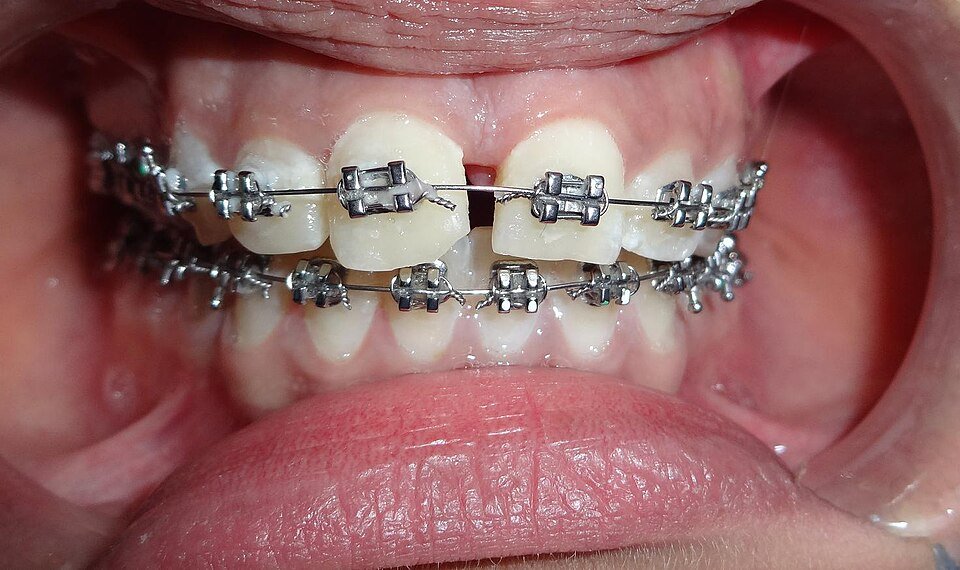
Orthodontic braces are dental appliances that straighten teeth and correct the way the upper and lower teeth meet. They work by applying mild, steady pressure that moves teeth into better positions over months. Braces are used for crooked, crowded, rotated or widely spaced teeth and for malocclusion, the medical term for a bad bite, such as an overbite or underbite. Besides a straighter smile, the aim is a bite that makes chewing, speaking and cleaning the teeth easier.
Source: Cleveland Clinic, NHS, American Dental Association (MouthHealthy)
A conventional fixed brace has three main parts. Small brackets are glued to the front of each tooth, and metal bands are often cemented around the back molars. A thin, flexible archwire runs through all the brackets and does the work of moving the teeth. Tiny elastic rings called ligatures or modules hold the wire in each bracket; patients can usually choose clear, tooth-colored or bright colors. Because the patient cannot take the appliance out, it is called a fixed appliance.
Source: Cleveland Clinic, NHS, East Sussex Healthcare NHS Trust
Who provides orthodontic braces?
Orthodontic braces are usually fitted by an orthodontist, a dentist who has completed an accredited two- to three-year orthodontic residency after four years of dental school. According to the American Association of Orthodontists, only about 6% of dental graduates become orthodontists. Some general dentists also offer braces, so it is reasonable to ask about the clinician’s training.
Source: American Association of Orthodontists, Cleveland Clinic
Types of braces
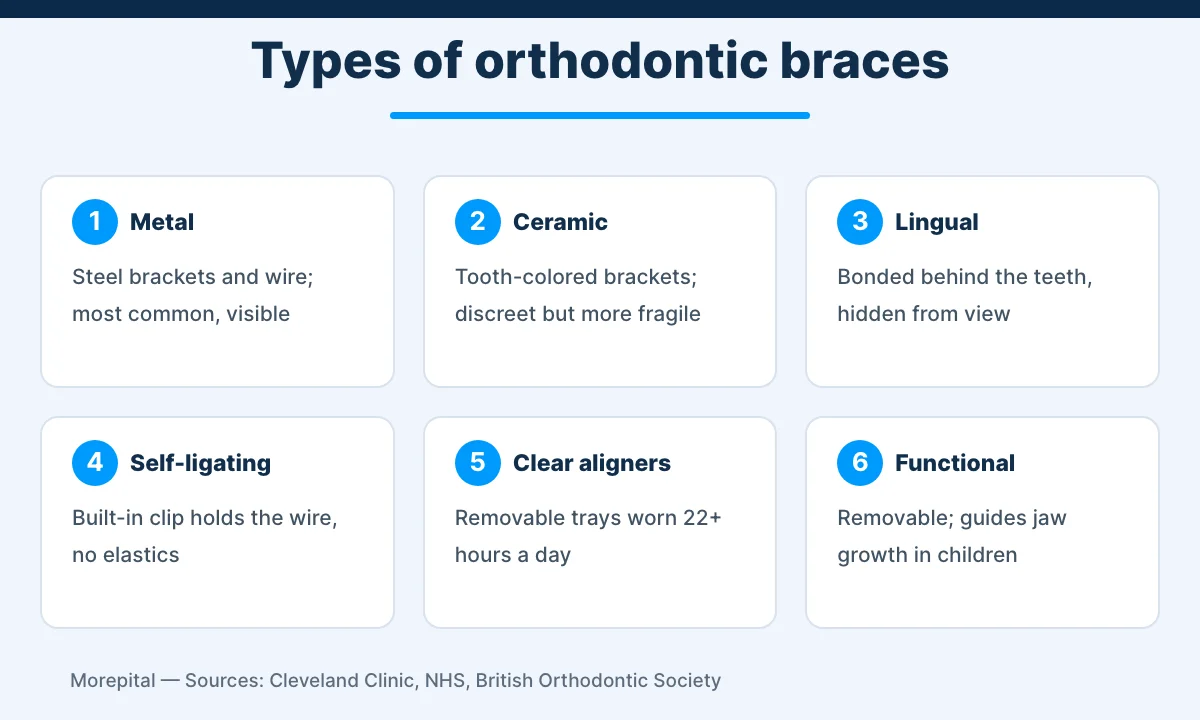
Several kinds of orthodontic braces are available. Fixed appliances are the most widely used type, and the right choice depends on the bite problem, the patient’s age and personal priorities such as appearance. Your orthodontist decides which options can achieve the planned tooth movement.
Source: British Orthodontic Society, Cleveland Clinic
- Metal braces: stainless steel brackets, bands and wires. They are the most common type in public health services such as the NHS and are visible when you smile.
- Ceramic (clear) braces: work the same way but use tooth-colored brackets, so they are less noticeable. Cleveland Clinic notes they are more fragile and more likely to break.
- Lingual braces: bonded to the back surfaces of the teeth, so they are hidden from view.
- Self-ligating braces: look similar to metal braces but hold the archwire with a built-in clip instead of elastic ligatures.
- Clear aligners: a series of custom removable plastic trays, each worn for about two weeks. They must be worn at least 22 hours a day and removed only to eat, drink or brush.
- Functional and removable appliances: removable braces, such as the Twin Block, that work on both jaws at once to change the bite in growing children.
Source: Cleveland Clinic, NHS, British Orthodontic Society
Orthodontists may also use extra components with fixed braces, including small elastics hooked between the upper and lower teeth, headgear in some cases, and temporary mini-implants (temporary anchorage devices) that act as fixed anchor points.
Source: Oral Health Foundation, British Orthodontic Society
Who needs braces and who is a candidate?
Orthodontic braces may be recommended when teeth are crowded or stick out, when there are large gaps, when the upper and lower jaws do not meet properly, or when tooth position makes chewing or cleaning difficult. A poor bite can sometimes strain the jaw and cause headaches. Many minor irregularities do not need treatment at all; MedlinePlus points out that very few people have perfectly aligned teeth.
Source: NHS, Oral Health Foundation, MedlinePlus
Children and teenagers
The American Association of Orthodontists recommends a first orthodontic check-up by age 7. Not every child seen at that age needs treatment, but early assessment can spot narrow jaws, crossbites or teeth that should be removed to guide adult teeth. Full orthodontic braces are often fitted once all the adult teeth have come through, and Cleveland Clinic describes ages 9 to 14 as the ideal window because the jaws are still developing.
Source: American Association of Orthodontists, Cleveland Clinic, NHS
Adults
You are not too old for orthodontic braces. Roughly one in five U.S. orthodontic patients is an adult, and adult treatment is often successful, although it may take longer than in teenagers. Adults are often offered less visible options, and some choose limited treatment that straightens only the front six teeth in one or both arches.
Source: Cleveland Clinic, MedlinePlus, British Orthodontic Society
When braces alone are not enough
Orthodontic braces move teeth, not jaws. When the jaw bones themselves are badly out of position, orthodontic treatment is combined with jaw surgery (orthognathic surgery), usually after the jaws have stopped growing. Healthy teeth and gums are also needed: a brace may be removed early if teeth and gums are not looked after.
Source: Cleveland Clinic, North Cumbria Integrated Care NHS
Preparing for treatment
Treatment begins with an assessment. The orthodontist examines the teeth and jaws and usually takes X-rays, photographs and molds or digital scans. These records are used to plan exactly how the teeth should move and to decide which type of appliance is suitable. You can also decide not to have treatment at all.
Source: NHS, Oral Health Foundation, East Sussex Healthcare NHS Trust
If there is not enough room for all the permanent teeth, the orthodontist may advise removing some teeth first; this is usually done by your regular dentist before the brace goes on. Tell the orthodontist if a front tooth has ever been knocked or damaged, because it may need extra treatment, and see your dentist so any cavities are treated before brackets are bonded.
Source: Oral Health Foundation, East Sussex Healthcare NHS Trust, British Orthodontic Society, NHS
How braces are fitted, step by step
Fitting fixed orthodontic braces does not require surgery, and having brackets placed is not painful. Some clinics fit the brace over two appointments about a week apart:
- Separators: small rubber spacers may be placed between the back teeth to make room for metal bands. They can make the back teeth ache for a few days.
- Preparing the teeth: a cheek retractor holds the lips away, and the teeth are cleaned and kept dry with suction.
- Bonding the brackets: a bracket is glued to each tooth with dental adhesive. Keeping still and dry matters, because placement is precise.
- Fitting the bands: the separators are removed, and metal bands are sized and cemented around the first molars.
- Placing the archwire: the wire is threaded through the brackets and held with elastic modules.
- Care instructions: a dental nurse or orthodontist explains how to clean and protect the brace.
Source: East Sussex Healthcare NHS Trust, NHS
After fitting, the teeth move gradually. You return for adjustments, usually every 6 to 8 weeks, when the wire may be changed or tightened. Missed appointments and repeated breakages make treatment last longer.
Source: NHS, Oral Health Foundation, North Cumbria Integrated Care NHS
Recovery timeline and living with braces
Most people adapt to orthodontic braces quickly. The table below summarizes what to expect, based on NHS and Cleveland Clinic guidance.
| Stage | What to expect |
|---|---|
| First 3–5 days | Teeth feel sore or tender; the brace may rub the lips and cheeks. Eat soft foods. |
| First 2 weeks | Mouth ulcers are common and usually heal within a couple of weeks. Orthodontic wax covers rubbing parts. |
| Every 6–8 weeks | Adjustment visit; teeth may ache again for a few days afterward. |
| About 18–24 months | Typical end of active treatment, with a range of under 12 months to about 3 years. |
| After removal | Retainers are fitted to hold the teeth; new retainers feel tight for a day or two. |
Source: British Orthodontic Society, North Cumbria Integrated Care NHS, NHS, Cleveland Clinic, East Sussex Healthcare NHS Trust, NHS Lothian
Pain relief
Discomfort can usually be managed with ordinary painkillers, and NHS leaflets suggest paracetamol (acetaminophen) or whatever you normally take for a headache. Cleveland Clinic specifically recommends acetaminophen and advises against ibuprofen and other NSAIDs, which it says may interfere with tooth movement. Ask your orthodontist which option suits you.
Source: University Hospitals Plymouth NHS, Cleveland Clinic, NHS
Cleaning and food
Orthodontic braces trap food and plaque, so cleaning takes more effort. Brush at least twice a day and after meals with fluoride toothpaste, clean around brackets and under the wire with an interdental brush, and use a fluoride mouthwash at a different time from brushing. Avoid hard, crunchy and sticky foods, cut foods such as apples and carrots into small pieces, limit sugary and fizzy drinks between meals, and avoid sugary chewing gum. Keep seeing your regular dentist for check-ups.
Source: NHS, North Cumbria Integrated Care NHS, University Hospitals Plymouth NHS, Cleveland Clinic
Sports and music
Wear a mouthguard for contact sports. Brass and wind instruments can feel awkward at first, but most players adapt with practice.
Source: North Cumbria Integrated Care NHS
Results, retainers and durability
At the end of active treatment the brace is removed and the teeth are polished. The results of orthodontic braces then depend heavily on retention. Retainers hold the newly straightened teeth while the tissues around the roots settle, and Cleveland Clinic states that everyone who has braces needs one. The risk of teeth moving back, called relapse, is highest in the first months after removal.
Source: East Sussex Healthcare NHS Trust, Cleveland Clinic
Types of retainers
- Removable clear (Essix) retainers: thin plastic trays taken out to eat and drink.
- Hawley retainers: a plastic plate with wires and clips.
- Bonded (fixed) retainers: a wire glued behind the front teeth. They make cleaning harder and need closer monitoring.
Source: NHS Lothian, North Cumbria Integrated Care NHS
How long to wear them
Advice varies between clinics, so follow your own orthodontist’s plan. One NHS service asks patients to wear removable retainers day and night for the first week, then every night, and after 12 months to continue 2 to 3 nights a week for life. Another advises nightly wear for as long as you want the teeth to stay straight. Even with retainers, small tooth movements continue throughout life as part of normal aging, so no result can be guaranteed permanent, although it is unusual for teeth to shift enough to need retreatment.
Source: North Cumbria Integrated Care NHS, NHS Lothian, East Sussex Healthcare NHS Trust, British Orthodontic Society
Risks and complications
Orthodontic braces are a routine, low-risk treatment, and most problems are preventable with good cleaning and diet. The main risks are:
- Tooth decay and white marks: plaque around brackets can cause permanent white or brown marks (decalcification) and cavities. A white mark is the first sign of decay.
- Gum inflammation: mild redness and swelling are common and usually settle after the brace comes off, but poor brushing can cause lasting damage.
- Root shortening (resorption): all brace treatment causes minor changes to the roots, usually only the tip. A review reports that severe shortening of more than a quarter of the root affects about 3% of patients. Root resorption cannot be reversed.
- Relapse: teeth can drift if retainers are not worn.
- Previously injured teeth: a tooth that was knocked in the past may darken and need treatment.
- Soft-tissue irritation and discomfort: ulcers, rubbing and aching teeth, mostly in the first days.
- Breakages: loose brackets or broken wires, which are more likely with ceramic brackets.
Source: British Orthodontic Society, North Cumbria Integrated Care NHS, Journal of Orthodontic Science (Meeran, 2013), Dentistry.co.uk (British Orthodontic Society statement), Cleveland Clinic
Less common issues
A 2013 review in the Journal of Orthodontic Science notes that small dark triangles can appear between the gums and teeth in about a third of adult patients, that nickel allergy is common in the general population but reactions inside the mouth are rare (nickel-free materials exist), and that teeth with ceramic brackets carry a higher risk of enamel damage when the brackets are removed. The same review found that orthodontic treatment in adolescence generally does not raise or lower the later risk of jaw-joint (TMJ) disorders.
Source: Journal of Orthodontic Science (Meeran, 2013)
Alternatives to braces
Alternatives depend on the problem. For mild to moderate crowding or spacing, clear aligners may be an option. A 2019 meta-analysis in BMC Oral Health found both aligners and fixed braces effective; aligners shortened treatment in simple non-extraction cases, while fixed appliances controlled the bite and root position more precisely. The authors called the evidence limited. Cleveland Clinic notes that severe cases may still need traditional orthodontic braces.
Source: BMC Oral Health (Ke et al., 2019), Cleveland Clinic
- No treatment: minor irregularities often need nothing at all.
- Tooth reshaping or bonding: rough or irregular teeth may be trimmed, reshaped, bonded or capped; cosmetic options such as veneers can change how teeth look but do not move them.
- Extractions: removing teeth can relieve overcrowding, often alongside braces.
- Jaw surgery: for skeletal problems, combined with braces before and after, in a process that takes about two to three years in total.
Source: MedlinePlus, East Sussex Healthcare NHS Trust, Cleveland Clinic
Choosing an orthodontist and treatment abroad
Look for a clinician with recognized specialist training. In the U.S., the title orthodontist is reserved for dentists who completed an accredited residency, and you can ask any dentist offering braces about their training or seek a second opinion. Before starting orthodontic braces, ask how long treatment is expected to take, which appliance is planned and why, how often you will be seen, and what retention plan and costs follow after the brace comes off.
Source: American Association of Orthodontists, Oral Health Foundation
The British Orthodontic Society warns against “do-it-yourself” or remote aligner treatment without an in-person examination and regular monitoring, because effects such as root resorption are permanent. It advises seeing a dentist or orthodontist first and confirming who is responsible for your care.
Source: Dentistry.co.uk (British Orthodontic Society statement)
Orthodontic braces need regular adjustments for a year or more, which makes treatment abroad harder to organize than a one-off procedure. UK travel-health guidance advises discussing plans with your own dentist, verifying the clinician’s qualifications yourself rather than through an agent, getting a written plan that states who pays for aftercare and complications, keeping copies of records and X-rays, and arranging follow-up at home in advance.
Source: TravelHealthPro (UKHSA), NHS
When to call your orthodontist
Soreness for a few days after fitting or adjustment is normal. Contact your orthodontist or dentist if any of the following happen:
- Pain lasting more than a few days or not improving with painkillers
- A broken or loose bracket, band or wire, or a wire digging into the cheek; call rather than waiting for your next visit
- Red, swollen, painful or bleeding gums, or signs of infection
- A new toothache or a front tooth becoming darker
- A lost or broken retainer
Source: NHS, Cleveland Clinic, MedlinePlus, North Cumbria Integrated Care NHS, North Cumbria Integrated Care NHS, British Orthodontic Society
- You have a significant injury to the mouth, teeth or face
- You notice bleeding or signs of infection in the gums
- Pain is severe and not relieved by painkillers
Source: Cleveland Clinic
Related treatments
Related conditions
Further reading
Orthodontic braces: frequently asked questions
How long do you have to wear orthodontic braces?
Most people wear fixed braces for about 18 months to 2 years. Simple cases can finish in under 12 months, while complex ones may take up to 3 years. A retainer is needed afterward.
Source: Cleveland Clinic, NHS, East Sussex Healthcare NHS Trust
Do braces hurt?
Fitting the brackets is not painful. Teeth usually feel sore for about 3–5 days after fitting and after each adjustment, which ordinary painkillers and soft food help with.
Source: East Sussex Healthcare NHS Trust, British Orthodontic Society, University Hospitals Plymouth NHS
What is the best age to get braces?
Experts recommend a first orthodontic check by age 7, and braces are often fitted between about 9 and 14, once adult teeth have come through. Adults can also be treated successfully.
Source: American Association of Orthodontists, Cleveland Clinic, NHS
Are clear aligners as good as braces?
For mild to moderate problems, aligners can work well. Fixed braces control complex movements and the bite more precisely, so severe cases often still need braces.
What foods can't you eat with braces?
Avoid hard, crunchy and sticky foods such as nuts and caramels, and sugary chewing gum. Cut firm foods like apples and carrots into small pieces and limit sugary drinks.
Source: NHS, Cleveland Clinic, North Cumbria Integrated Care NHS
How often do braces need to be adjusted?
Adjustment visits are usually every 6 to 8 weeks. Missed visits and breakages can make treatment longer.
Source: NHS, Oral Health Foundation
Do I need to wear a retainer forever?
Many orthodontists now advise long-term night-time retainer wear, because teeth can move throughout life. Follow your own orthodontist's schedule.
Source: NHS Lothian, North Cumbria Integrated Care NHS, East Sussex Healthcare NHS Trust
Can orthodontic braces damage your teeth?
Braces themselves rarely harm teeth, but poor cleaning and sugary food can cause permanent white marks and decay. Minor root shortening is common, and severe shortening is uncommon.
Source: East Sussex Healthcare NHS Trust, British Orthodontic Society, Journal of Orthodontic Science (Meeran, 2013)
Are braces free on the NHS?
In England, braces are usually free for under-18s with a significant problem, after assessment. Adults usually pay privately.
Source: NHS
Get a free orthodontic treatment plan
Sources
- Cleveland Clinic — Teeth Braces
- NHS — Braces
- American Association of Orthodontists — When should my child see an orthodontist?
- American Association of Orthodontists — General questions (FAQ)
- British Orthodontic Society — Treatment & brace types
- British Orthodontic Society — Orthodontics for adults
- British Orthodontic Society — Orthodontic treatment: what are the risks? (patient leaflet)
- Oral Health Foundation — Orthodontic treatment
- MedlinePlus — Malocclusion of teeth
- American Dental Association (MouthHealthy) — Orthodontics
- Journal of Orthodontic Science (Meeran, 2013) — Iatrogenic possibilities of orthodontic treatment and modalities of prevention
- BMC Oral Health (Ke et al., 2019) — A comparison of treatment effectiveness between clear aligner and fixed appliance therapies
- East Sussex Healthcare NHS Trust — Fixed appliances (patient leaflet)
- North Cumbria Integrated Care NHS — Orthodontics: fixed brace instructions
- North Cumbria Integrated Care NHS — Orthodontics: looking after removable retainers
- NHS Lothian — All about retainers (patient leaflet)
- University Hospitals Plymouth NHS — Your fixed brace (patient leaflet)
- Cleveland Clinic — Jaw surgery (orthognathic surgery)
- TravelHealthPro (UKHSA) — Travelling for treatment (medical tourism)
- Dentistry.co.uk (British Orthodontic Society statement) — DIY orthodontics is potentially dangerous, BOS reiterates
This page is part of the Morepital medical reference. It is for general health education and does not replace a consultation with a qualified doctor. Last reviewed: October 2026.