
Ovarian cancer symptoms most often include a swollen or bloated tummy, pain or pressure in the pelvis or abdomen, feeling full quickly or losing your appetite, and needing to urinate more often or more urgently. These signs are common and usually caused by something harmless, but they matter when they are new, persistent and happen frequently, roughly 12 or more times a month. Early ovarian cancer often causes no symptoms at all, so any lasting change like this should be checked by a doctor.
Source: NHS, American Cancer Society, CDC
Source: World Cancer Research Fund, CDC, NCI SEER
Contents
- What ovarian cancer symptoms are and why they are easy to miss
- The 4 main ovarian cancer symptoms
- Other and later ovarian cancer symptoms
- How ovarian cancer symptoms differ from everyday bloating
- Other conditions that mimic ovarian cancer symptoms
- Who is at higher risk of ovarian cancer
- How doctors investigate ovarian cancer symptoms
- Why there is no routine screening test
- Stages, survival and treatment
- Ways to lower your risk
- Ovarian cancer symptoms: frequently asked questions
What ovarian cancer symptoms are and why they are easy to miss

The National Cancer Institute groups three closely related cancers under “ovarian cancer” because they form in similar tissue and are treated the same way: cancer of the ovary itself, of the fallopian tube, and of the peritoneum (the lining of the abdomen). Their ovarian cancer symptoms overlap almost completely.
Source: National Cancer Institute, NHS, NCI SEER Training
The ovaries sit deep in the pelvis, and a growing tumor usually has plenty of room before it presses on anything. Early-stage disease therefore often causes no symptoms. Cleveland Clinic explains that symptoms commonly appear once the cancer spreads through the abdomen, where fluid can build up (ascites) and cause pain and swelling. When ovarian cancer symptoms do appear they are vague, and easy to put down to diet, stress, periods or age.
Source: Cleveland Clinic, National Cancer Institute, NCI SEER Training
The NHS describes these symptoms as “not always obvious”, and the American Cancer Society notes that the same complaints are commonly caused by benign conditions. The clue is not the symptom itself but its pattern: when ovarian cancer is the cause, symptoms tend to be persistent, new for you, and more frequent or more severe than your usual. Ovarian cancer mostly affects women over 50, and about half of women diagnosed in the US are 63 or older, so new, lasting symptoms in midlife deserve particular attention.
Source: NHS, American Cancer Society, American Cancer Society
The 4 main ovarian cancer symptoms
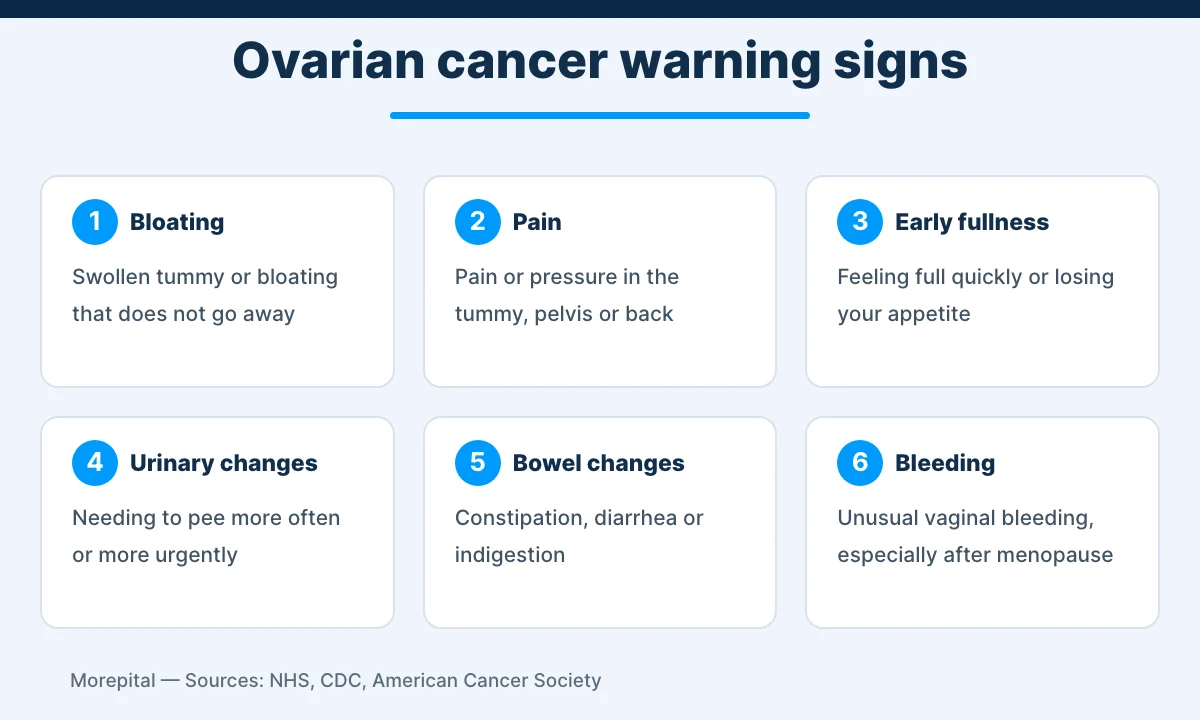
The NHS, the American Cancer Society and Cancer Research UK name the same four core ovarian cancer symptoms. Each is common on its own; frequent and together, they form the pattern doctors look for.
Source: NHS, American Cancer Society, Cancer Research UK
1. Bloating or a swollen tummy
Persistent bloating is one of the ovarian cancer symptoms people notice most. Cancer Research UK describes it as bloating or a growing waistline that does not go away, rather than bloating that comes and settles after a meal. A training resource from the NCI’s SEER program adds that clothes may feel tighter, with or without weight gain. Fluid collecting in the abdomen (ascites) is one reason the belly can swell.
Source: Cancer Research UK, NCI SEER Training, Cleveland Clinic
2. Pain or discomfort in the tummy or pelvis
Pain, pressure or tenderness can be felt in the lower abdomen, in the pelvis between the hip bones, or occasionally in the back. The CDC lists “pain or pressure in the pelvic area” and abdominal or back pain among its warning signs.
Source: Cancer Research UK, CDC, NHS
3. Feeling full quickly or losing your appetite
Getting full after only a few mouthfuls (early satiety), difficulty eating, or simply not wanting to eat are recognized ovarian cancer symptoms. They can lead to weight loss you were not trying for, which Cancer Research UK notes may come with feeling sick.
Source: NHS, CDC, Cancer Research UK
4. Needing to urinate more often or more urgently
A tumor or fluid in the pelvis can press on the bladder, causing a sudden urge to pass urine or more frequent trips to the toilet. The CDC describes this as a change in bathroom habits, which can also include constipation.
Source: CDC, American Cancer Society, NHS
Other and later ovarian cancer symptoms
Health bodies also list less specific ovarian cancer symptoms, which often appear alongside the core four:
- Indigestion or an upset stomach
- Constipation or diarrhea, or other changes in bowel habit
- Back pain
- Constant tiredness or extreme fatigue for no obvious reason
- Losing weight without trying
- Pain during sex
- Unusual vaginal bleeding or discharge, including bleeding between periods, heavier or irregular periods, or bleeding after menopause
Source: NHS, American Cancer Society, Cleveland Clinic
Vaginal bleeding deserves a special mention. The CDC advises that if you have unusual vaginal bleeding, particularly after menopause, you should see a doctor right away rather than waiting to see whether it settles. Bleeding is also a key sign of other gynecological cancers, which we cover in our guide to cervical cancer symptoms.
Source: CDC, Cancer Research UK
When the disease is more advanced, the picture can change. The SEER training material lists nausea, swelling (edema), a mass that can be felt in the abdomen, and ascites, the buildup of fluid in the belly that causes marked swelling and discomfort. The NCI lists a lump in the pelvis among possible signs. In stage IV disease, cancer cells can collect in the fluid around the lungs, and the cancer can reach organs such as the liver and lungs. Later ovarian cancer symptoms like these need prompt medical assessment.
Source: NCI SEER Training, National Cancer Institute, Cleveland Clinic
How ovarian cancer symptoms differ from everyday bloating
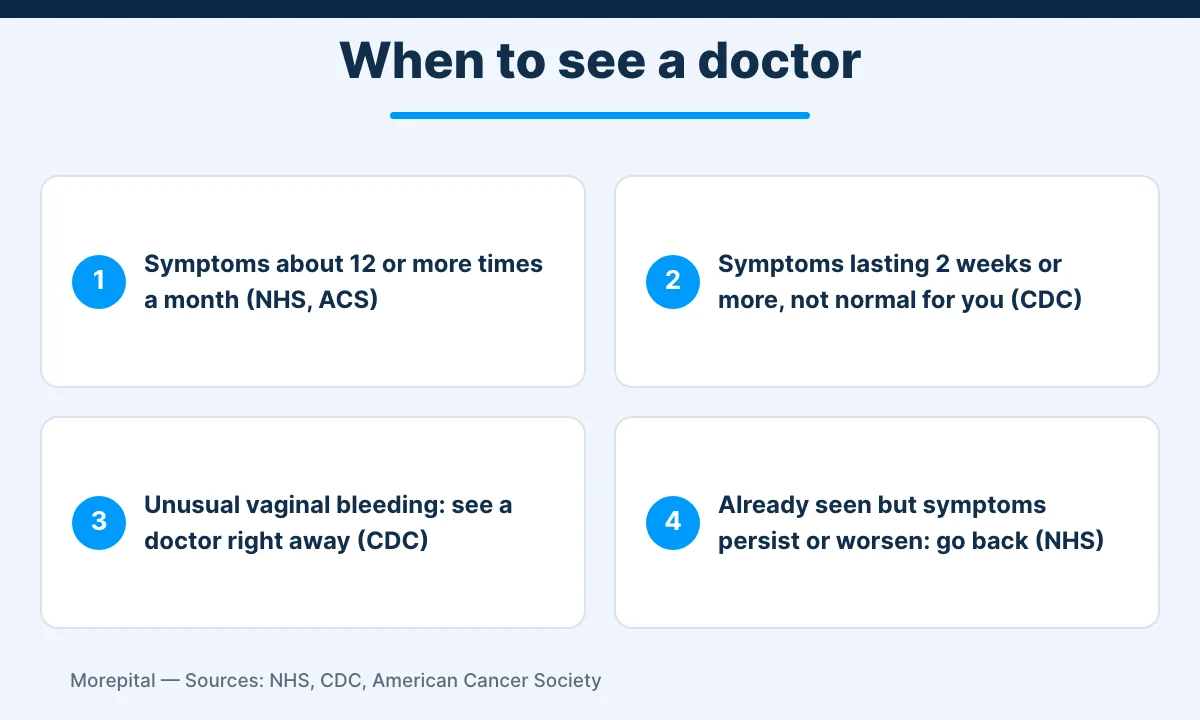
Almost everyone feels bloated sometimes, so frequency and persistence are the best guides to ovarian cancer symptoms. Organizations phrase the threshold slightly differently:
- NHS (UK): the main symptoms are significant when they happen frequently, roughly 12 or more times a month.
- American Cancer Society: see a doctor if you have these symptoms more than 12 times a month, and report symptoms that occur consistently for more than a few weeks.
- CDC (US): if pelvic pain, bloating, early fullness or bathroom changes last 2 weeks or longer and are not normal for you, see a doctor; unusual vaginal bleeding should be checked right away.
Source: NHS, American Cancer Society, American Cancer Society, CDC
The common thread is change: a symptom that is new for you, that keeps coming back most days, or that is getting worse. The CDC’s advice is simple: pay attention to your body and know what is normal for you. Because the NHS and the American Cancer Society both use a frequency of about 12 times a month, noting down on which days symptoms occur can make it easier to describe the pattern to your doctor.
Source: CDC, NHS, American Cancer Society
Go back to your doctor if you have already been seen but your symptoms have not gone away, have become worse, or are happening more often. In the UK, a GP who thinks symptoms could be cancer may make an urgent referral, usually to be seen within 2 weeks; a referral does not mean you have cancer.
Other conditions that mimic ovarian cancer symptoms
Most people who have bloating, pelvic pain or urinary changes do not have ovarian cancer. The American Cancer Society stresses that these complaints are commonly caused by benign diseases, and Cancer Research UK notes that indigestion in particular is common and usually not a sign of cancer. Conditions that can mimic ovarian cancer symptoms include:
- Irritable bowel syndrome and other gut problems, which cause bloating, pain and changes in bowel habit. Our guide to irritable bowel syndrome covers its typical pattern.
- Bowel cancer, which can also cause tummy pain, bloating and bowel changes; see colon cancer symptoms.
- Urinary tract infection, which causes urgency and frequency; a GP may check a urine sample.
- Ovarian cysts, which Cancer Research UK says should be checked if they persist, are large, cause symptoms or appear after menopause.
- Endometriosis, fibroids and pelvic inflammatory disease, which can cause pelvic pain and can also raise the CA125 blood marker.
Source: American Cancer Society, Cancer Research UK, Cancer Research UK
As the CDC notes, the only way to know is to see a doctor. A likely harmless explanation is no reason to ignore ovarian cancer symptoms that persist.
Source: CDC
Who is at higher risk of ovarian cancer
Anyone with ovaries can develop ovarian cancer, but some factors raise the risk. The CDC notes that most women who get it are not at high risk, so having no risk factors should never stop you from reporting ovarian cancer symptoms.
- Age: risk rises with age; most cases occur after 50, and the median age at diagnosis in the US is 63.
- Family history and inherited genes: close relatives on either side of the family with ovarian cancer, or an inherited change in BRCA1 or BRCA2 or a Lynch syndrome gene. The NCI states that BRCA changes are a major cause of hereditary ovarian cancer. BRCA changes also raise breast cancer risk; see our guide to breast cancer symptoms.
- Personal history: previous breast, uterine or colorectal (bowel) cancer, or radiotherapy for an earlier cancer.
- Ancestry: Eastern European or Ashkenazi Jewish background.
- Gynecological and medical conditions: endometriosis and diabetes.
- Reproductive history: never having given birth or having had trouble getting pregnant, starting periods young, or a late menopause.
- Hormones: taking hormone replacement therapy; some studies suggest a possible link with taking estrogen alone for 10 years or more.
- Lifestyle: being overweight and smoking.
Source: CDC, NHS, National Cancer Institute, NCI SEER
Excess weight can be changed; our reference page on obesity explains how it is defined and treated. If ovarian or breast cancer runs in your family, the CDC and the NHS advise talking to a doctor, who may refer you for genetic counseling and testing.
Source: NHS, CDC, US Preventive Services Task Force
How doctors investigate ovarian cancer symptoms
If you report ovarian cancer symptoms, the first checks are simple. According to Cancer Research UK and the NHS, a GP or family doctor will typically:
- Examine your abdomen and pelvis, including a pelvic (internal) examination.
- Arrange a CA125 blood test.
- Arrange an ultrasound scan, either transvaginal (a probe placed in the vagina) or over the tummy.
- Depending on your symptoms, check a urine sample for infection and a stool sample for blood.
Source: Cancer Research UK, NHS, National Cancer Institute
What the CA125 result means
CA125 is a protein that can be raised in some ovarian cancers, but it is not fully reliable. Some women with ovarian cancer have normal levels, and non-cancerous conditions such as endometriosis, fibroids, pelvic inflammatory disease and pregnancy can raise it. A high result leads to an ultrasound rather than a diagnosis on its own.
Source: Cancer Research UK, American Cancer Society
Specialist tests
If the blood test and scan suggest ovarian cancer, you are referred to a gynecological cancer team. Specialists may calculate a risk of malignancy index (RMI) from the ultrasound findings, CA125 level and menopausal status, and arrange a CT scan of the chest, abdomen and pelvis. A biopsy, taken by needle, laparoscopy (keyhole surgery) or open surgery, is the only definitive way to make the diagnosis.
Source: Cancer Research UK, NHS, National Cancer Institute
If a scan is normal, the NHS advises looking for other causes and returning if symptoms continue or become more frequent; ovaries can be too small to see on a scan, especially after menopause.
Source: NHS
Why there is no routine screening test
Unlike cervical cancer, ovarian cancer has no proven screening test for women without symptoms. The CDC states that there is no reliable way to screen women who have no symptoms, and that the Pap test does not screen for ovarian cancer. The US Preventive Services Task Force recommends against ovarian cancer screening in women without symptoms who are not known to have a high-risk inherited syndrome (a grade D recommendation, 2018).
Source: CDC, US Preventive Services Task Force
The reason is the balance of benefit and harm. The American Cancer Society explains that using transvaginal ultrasound and CA125 in average-risk women leads to more testing and surgery without lowering deaths from ovarian cancer. In trials reviewed by the USPSTF, up to 15% of women who had surgery after a positive result had major complications.
Source: American Cancer Society, US Preventive Services Task Force
The recommendation does not apply to women with ovarian cancer symptoms, who should be investigated, or to those with a known high-risk syndrome such as a BRCA mutation. Some organizations offer ultrasound and CA125 to high-risk women, though the American Cancer Society notes this has not been proven to lower deaths. For most people, recognizing ovarian cancer symptoms is the main safeguard.
Source: US Preventive Services Task Force, American Cancer Society
Stages, survival and treatment
Ovarian cancer is staged from I to IV. In stage I the cancer is in one or both ovaries or fallopian tubes; in stage II it has spread to other pelvic organs; in stage III it has spread within the abdomen beyond the pelvis and/or to nearby lymph nodes; and in stage IV it has spread beyond the abdomen. Stages II to IV are considered advanced. US registry data from the SEER program show why earlier diagnosis matters:
Source: National Cancer Institute, NCI SEER
| Stage at diagnosis (SEER) | What it means | Share of US cases | 5-year relative survival |
|---|---|---|---|
| Localized | Confined to the primary site; often no ovarian cancer symptoms | 22% | 91.9% |
| Regional | Spread to nearby lymph nodes or tissues | 18% | 70.1% |
| Distant | Spread to distant parts of the body | 54% | 31.5% |
| All stages | Overall figure (6% of cases unstaged) | 100% | 52.0% |
Source: NCI SEER
These are averages for people diagnosed in 2016 to 2022 and cannot predict an individual outcome. The American Cancer Society estimates about 21,010 new cases and 12,450 deaths in the US in 2026, with a lifetime risk of diagnosis of about 1 in 91.
Source: NCI SEER, National Cancer Institute, American Cancer Society
Main treatments
Surgery is the main treatment. It may remove the uterus, ovaries, fallopian tubes, omentum (a fatty layer in the abdomen) and lymph nodes; some younger women with early disease who want children keep one ovary. Chemotherapy is often given after surgery, especially for advanced disease, and the NCI describes targeted drugs such as bevacizumab and PARP inhibitors (olaparib, rucaparib, niraparib), which may be used as maintenance treatment.
Source: National Cancer Institute, Cancer Research UK
Ways to lower your risk
You cannot always prevent ovarian cancer, but several factors are linked to lower risk. The American Cancer Society lists using birth control medication, having children, breastfeeding and using a progestin-containing IUD. It also describes removing the fallopian tubes (salpingectomy), for example during a hysterectomy or instead of tubal ligation, as a way to reduce risk. This fits with the NCI’s grouping of fallopian tube cancer with ovarian cancer as one closely related disease.
Source: American Cancer Society, National Cancer Institute
For women with a BRCA mutation, surgery to remove the ovaries and fallopian tubes once childbearing is complete reduces ovarian cancer risk by 85% to 95%, according to the American Cancer Society. The NHS adds two general steps: stop smoking and keep a healthy weight. The NHS also lists diabetes among ovarian cancer risk factors; our reference page on type 2 diabetes explains how that condition is diagnosed and managed.
Source: American Cancer Society, NHS
No step removes the risk entirely, so knowing the ovarian cancer symptoms and acting on persistent changes remains essential.
Ovarian cancer symptoms: frequently asked questions
What are usually the first ovarian cancer symptoms?
The most common early complaints are persistent bloating, pelvic or tummy pain, feeling full quickly and needing to urinate more often. Many early cancers cause no symptoms, so new and frequent changes should be checked.
Source: NHS, American Cancer Society
Do ovarian cancer symptoms come and go?
They can vary from day to day, but when cancer is the cause they tend to keep coming back and become more frequent or severe. The NHS uses roughly 12 or more times a month as a guide.
Source: American Cancer Society, NHS
How long should ovarian cancer symptoms last before I see a doctor?
The CDC advises seeing a doctor if symptoms last 2 weeks or longer and are not normal for you, and right away for unusual vaginal bleeding.
Source: CDC
Can you get ovarian cancer after a hysterectomy?
Yes, it is still possible, even after the ovaries are removed, because related cancers can start in the fallopian tubes or the lining of the abdomen (peritoneum).
Source: NHS, National Cancer Institute
Are ovarian cancer symptoms different in younger women?
Ovarian cancer symptoms are the same at any age. Ovarian cancer is less common in younger women, as most cases occur after 50, but persistent symptoms should be checked at any age.
Source: NHS, American Cancer Society
Disclaimer: this article is for general health education and does not replace advice from a qualified doctor who can assess your individual case. Last updated: October 2026.