
Leukemia symptoms usually come from a shortage of healthy blood cells: tiredness and weakness, pale skin, fevers and infections that keep coming back, and bruising or bleeding that is easy or unexplained. Many people also notice night sweats, unplanned weight loss, bone or joint pain, swollen lymph nodes, or a full feeling under the ribs. These signs have many common causes, but if they persist or worsen, ask a doctor for a blood test.
Source: NHS, Cancer Research UK, MedlinePlus
Source: MedlinePlus, NHS, National Cancer Institute, NHS
Contents
- What leukemia is and why leukemia symptoms happen
- The 10 most common leukemia symptoms
- How low blood counts explain each symptom
- Leukemia symptoms by type: acute vs chronic
- Leukemia symptoms in children
- Emergency warning signs that need care today
- Other conditions that cause similar leukemia symptoms
- Risk factors and who gets leukemia
- How doctors diagnose leukemia: key tests
- Treatment and outlook
- Leukemia symptoms: frequently asked questions
What leukemia is and why leukemia symptoms happen
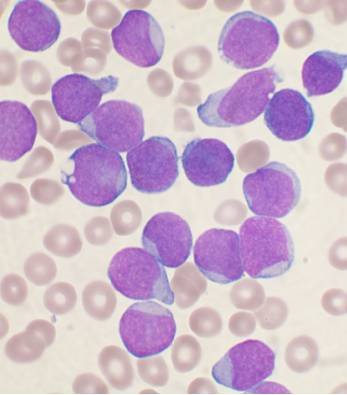
Leukemia is a group of cancers that begin in blood-forming tissue, mainly the bone marrow, the soft tissue inside large bones. In leukemia, the marrow produces large numbers of abnormal white blood cells. These cells do not work properly, and as they multiply they crowd out the healthy red blood cells, white blood cells and platelets the body depends on. Doctors classify leukemia in two ways: by the type of cell involved (lymphocytic or myeloid) and by how fast it progresses (acute, which moves quickly, or chronic, which moves slowly).
Source: MedlinePlus, Cleveland Clinic
That crowding-out effect explains why leukemia symptoms look so general. Too few red cells cause tiredness and breathlessness, too few working white cells leave you open to infection, and too few platelets lead to bruising and bleeding. Leukemia cells can also build up in the lymph nodes, liver, spleen and bones, which causes swelling, abdominal fullness and pain. Because none of these complaints is unique to leukemia, a blood test, not the symptoms alone, is what points toward the diagnosis.
Source: American Cancer Society, American Cancer Society, Cancer Research UK
The four main types
Combining the two classifications gives four main types: acute lymphoblastic leukemia (ALL), acute myeloid leukemia (AML), chronic lymphocytic leukemia (CLL) and chronic myeloid leukemia (CML). Less common forms include hairy cell leukemia, chronic myelomonocytic leukemia (CMML) and large granular lymphocytic leukemia. ALL is mainly a disease of young children, though adults can get it; AML is the most common acute leukemia in adults; CLL typically affects people aged 65 and older; and CML is more common after 55.
Source: Cleveland Clinic, Cancer Research UK
The 10 most common leukemia symptoms
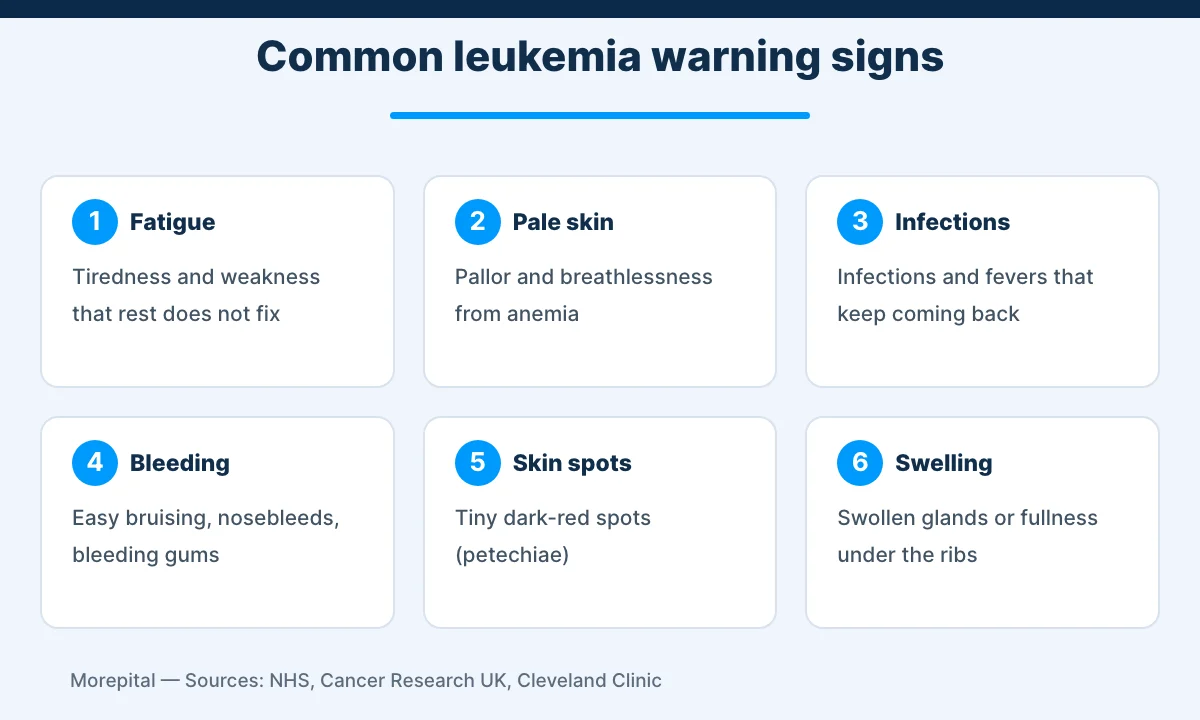
Major cancer organizations list largely the same core leukemia symptoms. Not everyone has all of them, and in acute leukemia they usually develop over a few weeks. Watch for:
- Tiredness and weakness that does not improve with rest or a good night’s sleep.
- Pale skin. On darker skin, paleness may be easier to see on the palms or the inside of the lower eyelids.
- Shortness of breath, especially during everyday activity.
- Frequent or lingering infections, such as chest or urinary infections that keep returning or are slow to clear.
- Fever or a high temperature, sometimes without any obvious infection.
- Easy bruising or bleeding, including nosebleeds, bleeding gums, very heavy periods, or blood in the urine or stool.
- Petechiae: tiny flat, dark-red spots under the skin caused by bleeding.
- Drenching night sweats.
- Unexplained weight loss or loss of appetite.
- Swollen lymph nodes, bone pain or a swollen tummy: painless lumps in the neck, armpits or groin, aching bones or joints, or fullness under the ribs from an enlarged liver or spleen.
Source: NHS, Cancer Research UK, Cleveland Clinic, National Cancer Institute
Cleveland Clinic advises speaking with a healthcare provider if symptoms like these last more than two weeks. The NHS goes further for acute types: if you have symptoms that could be acute myeloid leukemia, it recommends asking for an urgent GP appointment or contacting NHS 111, because finding cancer early makes treatment more likely to succeed.
Source: Cleveland Clinic, NHS
Some people with leukemia have no symptoms at all. Cancer Research UK notes that some patients are diagnosed after a routine blood test done for another reason, and this is especially common with chronic lymphocytic leukemia.
Source: Cancer Research UK, National Cancer Institute
How low blood counts explain each symptom
Most leukemia symptoms can be traced to one of three blood-cell shortages. Understanding this link helps you describe your leukemia symptoms clearly to a doctor.
Source: American Cancer Society, American Cancer Society
Low red blood cells (anemia)
Red cells carry oxygen. When leukemia crowds them out, the result is anemia, which causes tiredness, weakness, feeling cold, dizziness, headaches, pale skin and shortness of breath. Anemia has many causes besides cancer; our guide to anemia symptoms explains the more common ones, such as iron deficiency.
Source: American Cancer Society
Low working white blood cells (neutropenia)
Leukemia raises the number of white cells in many cases, but the cells are abnormal and cannot fight germs properly, while normal infection-fighting neutrophils fall. Among leukemia symptoms, this shows up as infections that do not clear, or one infection following another, often with fever. Some people also run fevers with no infection behind them.
Source: American Cancer Society, American Cancer Society
Low platelets (thrombocytopenia)
Platelets help blood clot. When they are low, you may bruise easily, notice small red or purple spots, have frequent nosebleeds, bleeding gums or heavy menstrual periods, or find that small cuts bleed longer than usual. The NHS describes a rash of small bruise-like spots that does not fade when a glass is rolled over it as one of the symptoms to report.
Source: American Cancer Society, NHS
Leukemia cells building up in organs
Other leukemia symptoms come from leukemia cells collecting in other tissues. Buildup in the bone marrow can cause bone or joint pain. An enlarged spleen causes pain or fullness under the left ribs, and an enlarged liver causes fullness in the upper right abdomen. In some types of AML, the gums become swollen, painful and bleed, and collections of leukemia cells can form lumps or spots on the skin that look like an ordinary rash.
Source: Cleveland Clinic, American Cancer Society
Leukemia symptoms by type: acute vs chronic
The speed of onset is often the clearest difference between types. Acute leukemia symptoms tend to appear and worsen over weeks; the National Cancer Institute notes that AML symptoms often develop about 4 to 6 weeks before diagnosis. Acute leukemias can be life-threatening without prompt treatment. Chronic leukemias develop over years, and early on they may cause no leukemia symptoms at all.
Source: National Cancer Institute, Cleveland Clinic, NHS
Acute myeloid and acute lymphoblastic leukemia
Both acute types cause the classic leukemia symptoms linked to blood counts: fatigue, pallor, breathlessness, infections, fever and bleeding. Swollen glands are a common sign of ALL but rare in AML. ALL can also, less commonly, cause headache, vomiting, blurred vision, seizures, cough, or swelling of the face, neck and arms. AML can affect the gums and skin, and one subtype, acute promyelocytic leukemia (APL), can cause bleeding that will not stop or blood clots in the legs or lungs.
Source: NHS, American Cancer Society
Chronic lymphocytic leukemia
In the beginning, CLL often causes no signs or symptoms and may be found during a routine blood test. Later, leukemia symptoms can include painless swelling of lymph nodes in the neck, underarm, abdomen or groin, tiredness, pain or fullness below the ribs, fever and infections, easy bruising, weight loss and drenching night sweats. CLL is rare in people under 40.
Source: National Cancer Institute, NHS
Chronic myeloid leukemia
CML sometimes causes no symptoms at all. When it does, typical leukemia symptoms are fatigue, unexplained weight loss, drenching night sweats, fever, and pain or fullness below the ribs on the left side from an enlarged spleen. Most people with CML have the Philadelphia chromosome, a swap of genetic material between chromosomes 9 and 22 that is acquired, not inherited.
Source: National Cancer Institute
| Type | Who it mainly affects | Speed | Typical symptoms |
|---|---|---|---|
| ALL | Young children (peak ages 1 to 4); also adults | Weeks | Fatigue, fever, bruising, bone pain, swollen glands |
| AML | Mostly older adults | Weeks | Fatigue, pallor, infections, bleeding, gum swelling |
| CLL | Usually 65 and older; rare under 40 | Years | Often none; painless lymph nodes, night sweats |
| CML | Adults, more common after 55 | Years | Often none; fatigue, weight loss, left-sided fullness |
Source: Cleveland Clinic, National Cancer Institute, NHS, National Cancer Institute
Leukemia symptoms in children
Leukemia is the most common cancer in children, and ALL accounts for about a quarter of childhood cancers in the United States, occurring most often between ages 1 and 4. Leukemia symptoms in children mirror those in adults (fatigue, pale skin, bruising, petechiae, nosebleeds, infections and fevers), but some signs are easier to spot in a child’s behavior.
Source: Cleveland Clinic, National Cancer Institute, American Cancer Society
- Limping or refusing to walk because of bone or joint pain.
- A swollen or full-feeling belly from an enlarged liver or spleen, sometimes with early fullness, poor appetite and weight loss.
- Lumps in the neck, armpits, groin or above the collarbone. Nodes in several areas, above the collarbone, or ones that keep growing or do not shrink within days to weeks need checking.
- Cough or trouble breathing if an enlarged thymus or chest nodes press on the windpipe.
- Headaches, vomiting, balance problems, blurred vision or seizures in the small number of children whose leukemia has reached the brain or spinal cord.
Source: American Cancer Society
The American Cancer Society stresses that most of these childhood leukemia symptoms are more likely to be caused by something other than leukemia. Still, it advises having a doctor check any that are persistent or unusual. In the UK, the NHS says to ask for an urgent GP appointment or call 111 if a child is bleeding or bruising easily for no clear reason.
Source: American Cancer Society, NHS
Emergency warning signs that need care today
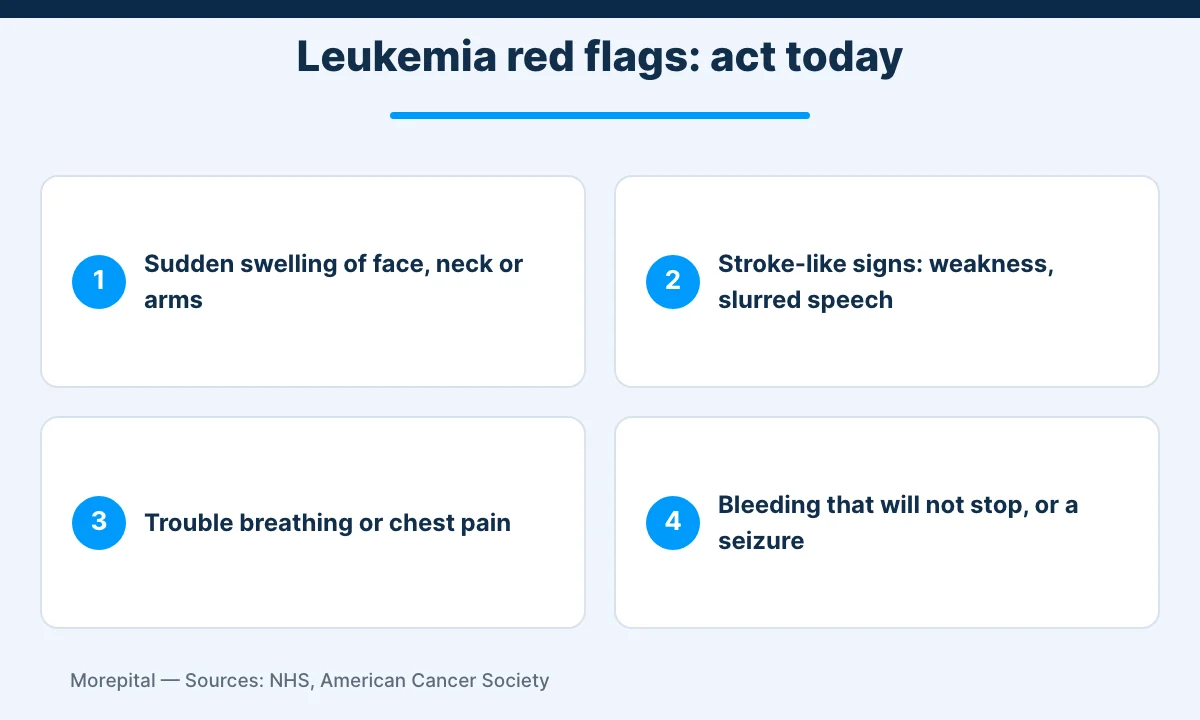
Most leukemia symptoms call for a prompt GP or primary care visit, not the emergency room. A few, however, suggest a serious complication and need same-day or emergency care:
- Sudden swelling of the face, neck, arms or hands, or swollen veins in the neck or chest. This can mean a mass in the chest is pressing on the large vein that drains the upper body (superior vena cava syndrome). The NHS advises calling 999 or going to A&E immediately.
- Stroke-like signs, such as one-sided weakness, slurred speech, confusion, severe headache or sudden vision loss. Very high leukemia cell counts can block small blood vessels, a rare emergency called leukostasis.
- Trouble breathing or chest pain, which can come from leukostasis, a chest mass or a blood clot.
- Bleeding that will not stop, such as a nosebleed or an oozing cut, which can occur with acute promyelocytic leukemia.
- A seizure.
Source: NHS, American Cancer Society, American Cancer Society
Other conditions that cause similar leukemia symptoms
Every major source makes the same point: leukemia symptoms are common and have many possible causes, and most people who have them do not have leukemia. Tiredness, fever and swollen glands are usually caused by something other than cancer. Pallor and breathlessness often come from anemia due to iron or vitamin deficiency; see our article on vitamin B12 deficiency for one example.
Source: NHS, Cancer Research UK, American Cancer Society
Some leukemia symptoms, such as weight loss, night sweats and fatigue, also overlap with other cancers. Persistent cough with breathlessness, for instance, is covered in our guide to lung cancer symptoms, and a neck lump could also come from the thyroid, as explained in thyroid cancer symptoms. This is why a doctor examines you and orders tests rather than judging leukemia symptoms one by one.
Source: Cancer Research UK, NHS
Risk factors and who gets leukemia
In the United States, an estimated 67,790 people will be diagnosed with leukemia in 2026, about 3.2% of all new cancer cases, and the median age at diagnosis is 68. Risk rises with age and is highest after 60. The exact cause of the DNA changes behind leukemia is unknown, but known risk factors include:
Source: NCI SEER, MedlinePlus
- Previous chemotherapy or radiation therapy for another cancer.
- Smoking or exposure to second-hand smoke.
- High-dose radiation or high levels of chemicals such as benzene.
- A personal history of a blood disorder, such as myelodysplastic syndrome (for AML).
- Being male (for AML and ALL in adults).
- Certain genetic conditions, such as Down syndrome, neurofibromatosis type 1, Fanconi anemia and Li-Fraumeni syndrome.
Source: Cleveland Clinic, National Cancer Institute, National Cancer Institute, National Cancer Institute
Having a risk factor does not mean you will get leukemia, and many people diagnosed have no known risk factor. People who have had chemotherapy or radiation, including survivors of other cancers such as those described in our breast cancer symptoms guide, should still report new leukemia symptoms promptly at follow-up visits.
Source: National Cancer Institute, National Cancer Institute
How doctors diagnose leukemia: key tests
When you see a doctor about possible leukemia symptoms, they will ask about your history, examine you for pallor, bruising, swollen lymph nodes and an enlarged liver or spleen, and usually order a blood test. For suspected leukemia symptoms in the UK, the GP will often arrange an urgent blood test and may refer you to a hematologist (a blood specialist). Sometimes people are asked to go to hospital straight away, which does not necessarily mean they have cancer.
Source: NHS, Cancer Research UK
Tests used to confirm leukemia
- Complete blood count (CBC): measures red cells, white cells, platelets and hemoglobin. Abnormal counts are often the first clue.
- Peripheral blood smear: a sample is looked at under a microscope for immature cells called blasts.
- Flow cytometry and immunophenotyping: identify the type of cell by markers on its surface.
- Bone marrow aspiration and biopsy: a sample of marrow, usually from the hipbone, confirms the diagnosis and the type.
- Cytogenetic and molecular tests: look for chromosome and gene changes, such as the Philadelphia chromosome, that guide treatment.
- Lumbar puncture and imaging: a spinal fluid test, chest X-ray, CT or MRI may check whether leukemia has spread.
Source: National Cancer Institute, Cleveland Clinic, MedlinePlus
Treatment and outlook
Treatment depends on the type of leukemia, how advanced it is, and the person’s age and overall health. Options include chemotherapy, targeted therapy (which may be the first treatment for ALL, CLL and CML), immunotherapy such as CAR T-cell therapy, radiation therapy, and stem cell transplant from a donor, mainly for acute leukemia. For CLL that causes no symptoms, doctors often recommend watchful waiting: close monitoring without treatment until signs or symptoms appear or change.
Source: Cleveland Clinic, MedlinePlus, National Cancer Institute
Outlook has improved considerably. In the United States, the five-year relative survival for all leukemias combined is 68.6% (2016 to 2022 data), meaning roughly 7 in 10 people are alive five years after diagnosis compared with people without the disease. Survival varies widely by type and age, and statistics cannot predict what will happen to one person. Treatment can put many leukemias into remission, sometimes for years, though the disease can return. CML, for example, can often be controlled for many years with treatment.
Source: NCI SEER, Cleveland Clinic, Cancer Research UK
The practical message is simple: you cannot diagnose or rule out leukemia from symptoms alone, but a blood test can quickly show whether your blood counts are normal. If leukemia symptoms persist for more than two weeks, or you notice unexplained bruising or tiny red spots, see a doctor.
Source: Cleveland Clinic, Cancer Research UK
Leukemia symptoms: frequently asked questions
What are usually the first leukemia symptoms?
Often the earliest signs are tiredness, weakness and pale skin from anemia, along with infections that are hard to shake off and easy bruising. Because these are vague, many people put them down to stress or a virus at first.
Source: Cancer Research UK, NHS
Can a blood test detect leukemia?
A complete blood count is usually the first test and often shows abnormal results. Doctors then confirm the diagnosis and the type with a blood smear, flow cytometry and a bone marrow test.
Source: National Cancer Institute, MedlinePlus
Can you have leukemia without symptoms?
Yes, especially chronic types. CLL often causes no signs in the beginning and may be found on a routine blood test, and CML sometimes causes no symptoms at all.
Source: National Cancer Institute, National Cancer Institute
What do leukemia spots on the skin look like?
Petechiae are tiny, flat, pinpoint dark-red or purple spots caused by bleeding under the skin. A rash of these spots that does not fade when a glass is rolled over it should be checked by a doctor.
Source: National Cancer Institute, NHS
How fast do leukemia symptoms develop?
In acute leukemia, symptoms usually develop over a few weeks; for AML they often start about 4 to 6 weeks before diagnosis. Chronic leukemias develop over years.
Source: NHS, National Cancer Institute, Cleveland Clinic
Are leukemia symptoms different in children?
The core signs are the same, but children may limp or refuse to walk because of bone pain, have a swollen belly, or seem unusually tired and pale. Most of these signs have other causes, but persistent ones need a doctor’s review.
Source: American Cancer Society
When are leukemia symptoms an emergency?
Seek emergency care for sudden swelling of the face, neck or arms, swollen chest veins, stroke-like signs, trouble breathing, chest pain, a seizure, or bleeding that will not stop.
Source: NHS, American Cancer Society
Disclaimer: this article is for general health education and does not replace advice from a qualified doctor who can assess your individual case. Last updated: October 2026.