
DHI hair transplant (direct hair implantation) is a form of follicular unit excision (FUE) in which each harvested graft is loaded into a pen-like device, the Choi implanter, that creates the opening in the scalp and places the graft in a single step. Grafts are taken from the donor area exactly as in standard FUE; only the implantation step differs. Published reviews describe implanters as one valid placement option, not a proven upgrade, and results depend mostly on the skill of the surgeon and team.
Source: Facial Plast Surg, Clin Cosmet Investig Dermatol, NHS
Source: Clin Cosmet Investig Dermatol, NHS, ISHRS
Contents
- What is a DHI hair transplant?
- How the Choi implanter pen works
- DHI hair transplant vs FUE: what actually differs
- What the research says about implanters
- Who is a good candidate for a DHI hair transplant?
- What happens on the day of surgery
- DHI hair transplant recovery timeline
- Risks and side effects of a DHI hair transplant
- Choosing a clinic for a DHI hair transplant
- DHI hair transplant: frequently asked questions
What is a DHI hair transplant?
Every modern hair transplant moves follicular units, the natural groups of one to four hairs, from the back and sides of the scalp to a thinning area. The donor hair is taken either as a strip of skin (follicular unit transplantation, FUT) or one unit at a time with a tiny round punch (follicular unit excision, FUE). A DHI hair transplant belongs to the FUE family: the harvesting is identical, and the “direct implantation” label refers to how the grafts are put back.
Source: JAAD, NHS, Int J Dermatol
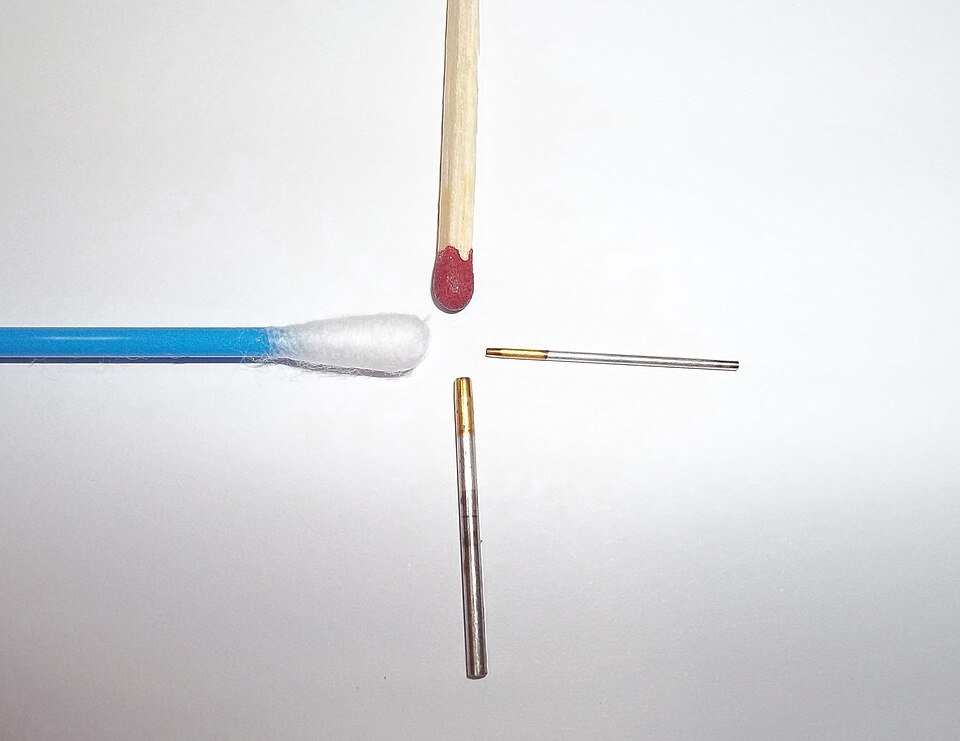
In conventional FUE, the surgeon first makes hundreds or thousands of tiny recipient incisions, and grafts are later placed into them, most often with fine forceps. With an implanter, the graft sits inside a hollow, beveled needle; the needle punctures the skin, and the graft stays in the channel as the needle is withdrawn. A 2023 technical guide calls this the “stick-and-place” method because incision and insertion happen at the same moment.
Source: JAAD, Clin Cosmet Investig Dermatol
“DHI” is therefore a marketing name for a placement technique, not a separate type of surgery recognized in medical classifications. Reviews in dermatology and plastic surgery journals describe the two donor methods, FUT and FUE, and list implanters among several placement tools. If you want to understand the broader procedure first, our hair transplant treatment guide covers both harvesting techniques.
Source: Int J Dermatol, JAAD
How the Choi implanter pen works
The device behind every DHI hair transplant dates back more than three decades. In 1992, Korean surgeons Choi and Kim described single-hair transplantation using the “Choi hair transplanter,” highlighting its use for refining the hairline and for reconstructing eyebrows, eyelashes and beards. A 2024 review notes that the implanter first became popular in East Asia, partly because Asian hair tends to be straight and thick.
Arabic-speaking readers: a detailed, source-referenced Arabic overview of this topic is available in the Alphateb medical encyclopedia — زراعة الشعر.
Source: J Dermatol Surg Oncol, Facial Plast Surg
The same review explains why implanters spread to Western practice: FUE was described in 2002 and became widely used about a decade later. FUE grafts are uniform in size but more fragile than grafts cut from a strip, and that fragility drove growing acceptance of implanters and inserters.
Source: Facial Plast Surg
Needle sizes and the team behind the pen
Implanter tips come in different diameters to match the graft. One practical guide suggests about 0.6 mm for eyebrows and eyelashes, 0.6–0.8 mm for one-hair units, 0.9–1.0 mm for two-hair units and 1.0–1.2 mm for three- and four-hair units, with tips replaced as soon as they feel blunt. The surgery is a team effort: in the author’s setup, two or three assistants load grafts into several implanters while a passer hands loaded pens to the surgeon. The author notes that a surgeon’s skill cannot compensate for a sub-standard assistant team. He also discloses patents and an ownership interest in an implanter company.
Source: Clin Cosmet Investig Dermatol
Depth and angle control
The incision should be just as long as the follicle, and the same guide calls proper depth control the key factor for graft survival. Because the needle sets the exit angle of each hair, the authors rate angle and direction control as better than with forceps. Because the method is prone to bleeding, a DHI hair transplant team injects adrenaline-containing anesthetic only over the area it can implant within 30 to 40 minutes.
Source: Clin Cosmet Investig Dermatol
DHI hair transplant vs FUE: what actually differs
Because the donor harvest is the same, the DHI hair transplant vs FUE comparison is really a comparison of placement methods: forceps into premade sites, blunt implanters into premade sites, or sharp implanters that make their own sites. A 2023 comparison table rated the sharp implanter as the fastest of the three and the best for controlling angle and direction, but also the most expensive and the most labor-intensive for the doctor. Forceps and blunt implanters in premade sites were rated cheaper, and placement with them could be delegated to trained assistants; with the sharp implanter, delegation was rated “not possible” because each insertion is also an incision.
Source: Clin Cosmet Investig Dermatol
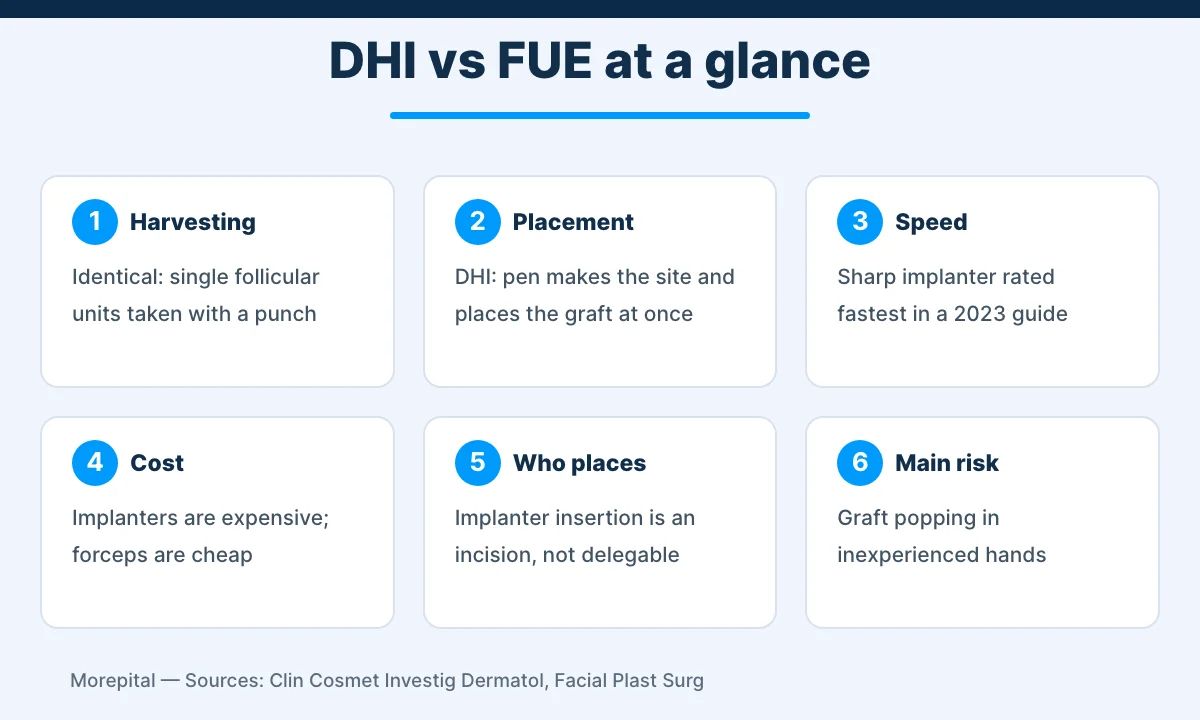
That point matters for patients. UK and Turkish surgical associations advise that you should be told at the first consultation whether a doctor or a technician will make the skin incisions or implant the hair. With a DHI hair transplant, the person holding the implanter is making incisions, so it is fair to ask who that will be.
Source: BAAPS/BAHRS
| Feature | FUE with forceps (premade sites) | DHI hair transplant (sharp implanter) |
|---|---|---|
| Donor harvesting | Individual units with a punch | Same: individual units with a punch |
| Recipient sites | Made first, grafts placed later | Made and filled in one step |
| Speed (2023 guide) | Slow | Fastest |
| Instrument cost | Cheap | Expensive |
| Placement delegable | Yes | No (each insertion is an incision) |
| Main technical risk | Graft trauma from handling | Graft popping, bleeding |
| Recovery and growth | Hair appears around 4 months; final result 10–18 months | Same timeline |
Source: Clin Cosmet Investig Dermatol, NHS
Some clinics advertise a DHI hair transplant as “unshaven.” A 2026 Dermatologic Surgery analysis found that “unshaven” terminology is used inconsistently in publications and advertising, which confuses patients and undermines informed consent. Ask exactly what will be trimmed or shaved, and where.
Source: Dermatol Surg (2026)
What the research says about implanters
Most of the published evidence on the DHI hair transplant technique consists of technical descriptions and small case series rather than large randomized trials. The 2024 Facial Plastic Surgery review concludes that the choice of implantation technique depends on each surgeon’s adaptation and the pros and cons of each instrument, and that forceps allow safe placement in the hands of well-trained teams.
Source: Facial Plast Surg
Graft survival studies
Early Korean studies used the KNU implanter. In 11 men with male pattern baldness, about half of the transplanted hairs fell out within the first month, but survival counted by total hairs was 92.0% at six months and 90.4% at 12 months. A follow-up study of just four patients found better survival at 20 or 30 one-hair grafts per square centimeter than at 40 or 50.
Source: Dermatol Surg (2001), Dermatol Surg (2006)
Dense packing and graft popping
The 2023 practical guide states that more than 50 to 60 grafts per square centimeter can be inserted with a sharp implanter without popping or loss of survival when its principles are followed, but warns that repeated graft popping in inexperienced hands may lower survival. A 2026 theoretical model by the same lead author suggests the push-out force on neighboring grafts rises as the insertion angle becomes more acute, as at the hairline. It offers hypotheses, not clinical proof.
Source: Clin Cosmet Investig Dermatol, Clin Cosmet Investig Dermatol (2026)
Hybrid approaches
Implanters can also be used in premade slits. A 2019 Indian series of 104 FUE patients used this hybrid method; visible growth began at two to five months, and scores improved from severe to mild in 74 patients (71%). The authors note they had no objective measure of regrowth and did not compare their results with other techniques.
Source: J Cutan Aesthet Surg
Who is a good candidate for a DHI hair transplant?
Candidacy for a DHI hair transplant follows the same rules as for any hair transplant. The NHS says transplants suit permanent baldness that runs in families and are usually not suitable for other hair loss, such as alopecia areata. The American Academy of Dermatology (AAD) lists two requirements: enough healthy donor hair, and a scalp that can still grow hair in the thinning area. A full head of hair may not be realistic, but a fuller head can be the goal.
Cleveland Clinic notes that surgery is generally performed once hair loss has been stabilized with medical treatment, and that most women with female pattern baldness are not candidates because they lack usable donor hair. The AAD adds that men in their 20s may be asked to wait and try medicine first. Learn more about the condition itself in our guide to male pattern baldness.
Source: Cleveland Clinic, AAD
According to Cleveland Clinic, coarse, gray or light-colored hair gives better coverage than fine, dark hair. A dermatologist’s assessment may include a scalp exam, blood tests and occasionally a biopsy to confirm the cause of hair loss before any DHI hair transplant is planned.
Source: Cleveland Clinic, AAD
Medicine before and after surgery
A transplant does not stop native hair from thinning. The AAD says your dermatologist may recommend hair loss medicine to help keep results, and a 2026 International Journal of Dermatology review covers optimizing medical therapy before transplantation. See our evidence summaries on finasteride for hair loss and minoxidil for hair loss for how these medicines work and their side effects.
Source: AAD, Int J Dermatol
What happens on the day of surgery
A DHI hair transplant is done as an outpatient procedure, usually under local anesthetic with or without sedation, so you are awake but should not feel pain. The AAD says surgery typically takes four to eight hours, large sessions may need a return visit the next day, and two to three team members may help place the hairs. The NHS adds that large areas may need two or more sessions on different days.
Source: NHS, AAD, Cleveland Clinic
The steps of a DHI hair transplant are: marking the hairline and planned area; numbing the donor and recipient areas; extracting follicular units one by one with a small punch; sorting the grafts by the number of hairs; and finally loading each graft into an implanter and inserting it at the planned angle and depth. Because harvesting and implantation can run in parallel, the 2019 series described assistants placing grafts while the surgeon continued scoring, to shorten the time grafts spend outside the body.
Source: JAAD, Clin Cosmet Investig Dermatol, J Cutan Aesthet Surg
How many grafts can be taken safely is a medical decision. A 2026 review of FUE complications reports that many authors recommend limiting extraction to 10–20% of the baseline follicular unit density per session, and lists megasessions of more than 3,500–4,000 grafts and very dense packing among risk factors for necrosis. Be wary of any clinic that promises unlimited grafts; the ISHRS points out that donor hair is finite.
DHI hair transplant recovery timeline
Recovery after a DHI hair transplant is the same as after other FUE surgery. The scalp is usually tight, achy and swollen for a few days, with temporary scabbing where grafts were placed. Bandages typically come off after two to five days, gentle hand washing is usually possible from about day six, and you may need one to two weeks off work. The NHS advises protecting the grafts for the first two weeks and cutting down on exercise for the first month.
Source: NHS
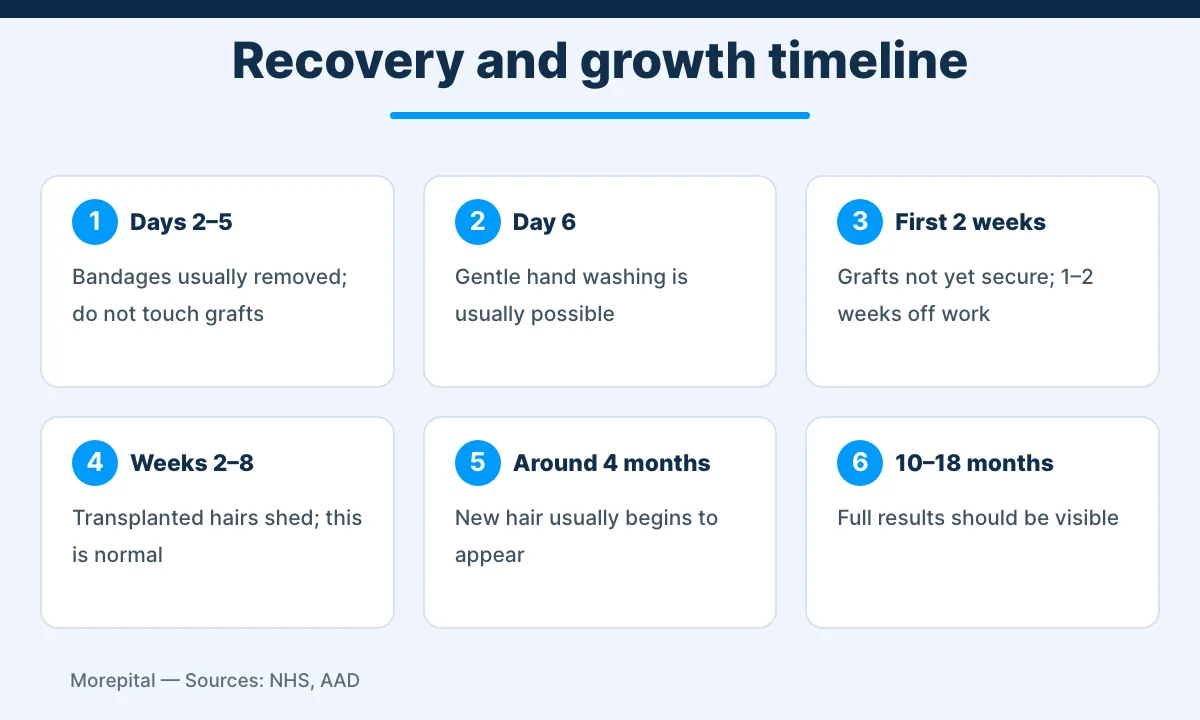
Cleveland Clinic notes that most people feel well within a day or two, although swelling of the forehead and eyelids can occur. Frontal swelling is common: the 2026 complications review reports it in nearly half of patients, with swelling around the eyes in about 3–5%.
Source: Cleveland Clinic, Front Med
When does new hair grow?
Transplanted hairs usually shed between two and eight weeks after surgery, and by the third month hair may look thinner than before; the AAD says both are normal. New growth usually begins around four months, most patients see results at six to nine months, and the NHS says full results should be visible at 10 to 18 months.
Source: AAD, NHS, Cleveland Clinic
Risks and side effects of a DHI hair transplant
A DHI hair transplant is surgery, and the NHS lists bleeding, infection, allergic reaction to the anesthetic, grafts that fail to take, noticeable scarring and continued thinning of natural hair around the transplant. Cleveland Clinic adds temporary numbness or tightness, pain and an unnatural appearance.
Source: NHS, Cleveland Clinic
The 2026 review of FUE complications cites overall complication rates of 1.2% to 4.7% in large series, with major adverse events uncommon. Reported rates include folliculitis in about 12% in one study, infection below 1% in most studies, long-term numbness in about 2% in one large series, and shock loss of native hair ranging widely from 0.15% to 15%.
Source: Front Med
Some risks are specific to how grafts are handled. The same review warns that excessive pressure from forceps or implanters can crush vital parts of the follicle, and that long out-of-body time and dehydration damage grafts. Patient factors matter too: the authors recommend stopping smoking at least one month before surgery. Contact your clinic promptly about severe pain, spreading redness, pus or fever.
Choosing a clinic for a DHI hair transplant
The ISHRS warns that terms such as “Sapphire FUE” or “Nano FUE” do not replace a physician’s judgment, and that outcomes depend more on who provides your care than on the name of a device. The same logic applies to a DHI hair transplant. The society also describes a “bait and switch” model abroad, in which a doctor’s credentials are advertised but unlicensed technicians perform the surgery.
In the UK, the NHS advises checking that the surgeon is registered with the General Medical Council, that the clinic is registered with the Care Quality Commission in England, and whether the surgeon belongs to the British Association of Hair Restoration Surgery. If you are traveling, UK and Turkish associations recommend meeting the operating surgeon, taking two weeks before paying, and confirming how complications will be managed. Our guide to a hair transplant in Turkey covers travel planning in detail.
Source: NHS, BAAPS/BAHRS
Hair Cultivate, a specialised hair-transplant centre in Istanbul, publishes its own overview of DHI hair transplant in Turkey and a patient guide describing its process. Whichever clinic you consider, use the same questions below.
Source: ISHRS
Questions to ask before you book
- Who diagnoses my hair loss and designs my hairline?
- Who will extract the grafts, and who will hold the implanter during my DHI hair transplant?
- Why do you recommend implanters, forceps or a combination for my case?
- How many grafts do you plan, and how will my donor area be protected for the future?
- What exactly will be shaved or trimmed?
- Who assesses my progress and handles complications after I go home?
Source: ISHRS, BAAPS/BAHRS, Dermatol Surg (2026)
An ethical surgeon may advise against a DHI hair transplant for now and suggest medicine, observation or a staged plan that preserves donor hair.
Source: ISHRS
Considering a DHI hair transplant? Contact us for a free consultation and a treatment plan tailored to you.
DHI hair transplant: frequently asked questions
Is a DHI hair transplant better than FUE?
Not proven. DHI is FUE with implanter placement, and reviews say forceps are safe in well-trained hands; the team’s skill matters most.
Source: Facial Plast Surg, ISHRS
Does a DHI hair transplant leave scars?
Yes, but small. FUE-type harvesting leaves many tiny dot scars in the donor area that are usually not very noticeable.
Source: NHS
How long does a DHI hair transplant take?
Usually four to eight hours in one day; large cases may need a second visit or extra sessions.
When will I see results from a DHI hair transplant?
New hair usually appears around four months, and the full result takes 10 to 18 months.
Source: NHS
Can women have a DHI hair transplant?
Some can, but most women with female pattern hair loss lack suitable donor hair. The cause of hair loss should be diagnosed first.
Source: Cleveland Clinic, AAD
Is a DHI hair transplant permanent?
Donor hair from the back and sides of the scalp tends to resist balding, but native hair around it may keep thinning, so medicine is often advised.
Source: Cleveland Clinic, AAD
When can I go back to work after a DHI hair transplant?
Many people need one to two weeks off; avoid heavy exercise for about a month.
Source: NHS
Disclaimer: this article is for general health education and does not replace advice from a qualified doctor who can assess your individual case. Last updated: October 2026.