
Malocclusion
Bad bite / misaligned teeth (dental malocclusion)
Malocclusion is a misaligned bite in which the upper and lower teeth do not fit together properly when the mouth closes, caused by crowded or crooked teeth, mismatched jaws, or both. It is very common and mostly inherited; mild cases often need no treatment, while more significant ones are corrected with braces, clear aligners, other orthodontic appliances or, rarely, jaw surgery.
Source: Cleveland Clinic, MedlinePlus
- What is malocclusion?
- Symptoms and signs of malocclusion
- Causes and risk factors
- Types and classes of malocclusion
- How malocclusion is diagnosed
- Treatment options for malocclusion
- How long treatment takes and the outlook
- Complications of untreated malocclusion
- Prevention and living with malocclusion
- When to see a dentist or orthodontist
- FAQ
- Sources
What is malocclusion?
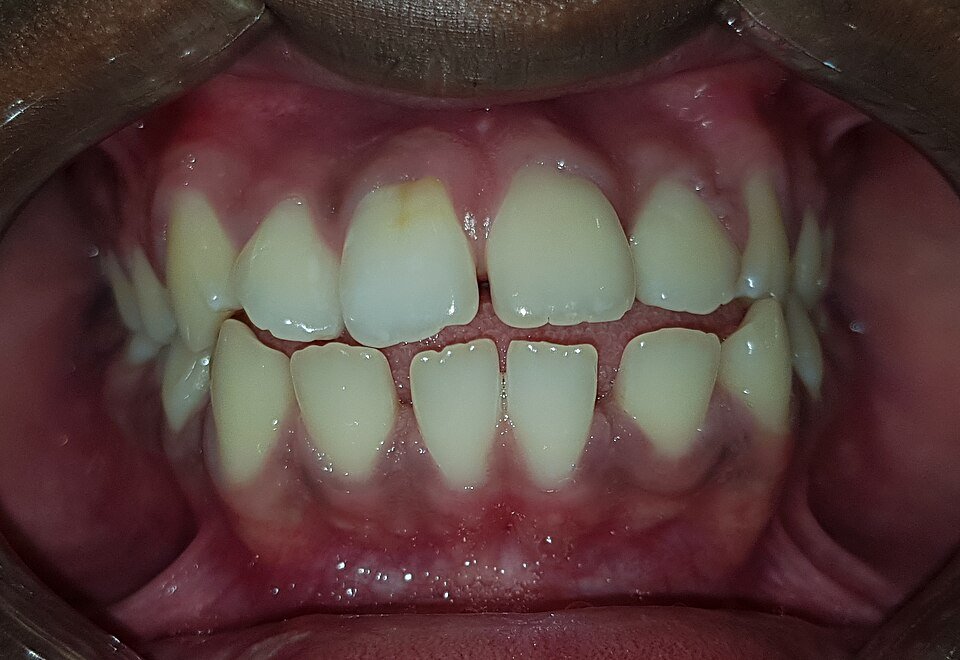
Malocclusion is the medical term for a bite in which the upper and lower teeth do not line up or meet the way they should when the mouth closes. Dentists use the word occlusion to describe how the teeth of the two jaws fit together; when that fit is off, the result is malocclusion, often called a “bad bite.” The problem can come from the teeth themselves, for example crowded or crooked teeth, from jaws that are mismatched in size or position, or from a combination of both.
Source: Cleveland Clinic, MedlinePlus
Malocclusion is extremely common. Cleveland Clinic estimates that about 56% of people worldwide have some form of it, and that up to 93% of children and adolescents show at least some degree of misalignment. That does not mean all of them need treatment: MedlinePlus notes that many cases are minor and can safely be left alone. Treatment becomes worthwhile when the bite affects chewing, cleaning, speech, the health of the teeth and gums, comfort of the jaw, or a person’s confidence in their smile.
Source: Cleveland Clinic, MedlinePlus
A large systematic review of 53 population studies (Alhammadi and colleagues, 2018) found that, in people with permanent teeth, roughly 75% had an Angle Class I molar relationship, about 20% Class II and about 6% Class III. The same review reported increased overjet in about 20%, a deep overbite in about 22%, a posterior crossbite in about 9% and an open bite in about 5%, with wide differences between regions and ethnic groups. Because the studies used different methods, these pooled figures should be read as approximate.
Source: Alhammadi et al., Dental Press J Orthod (PMC)
Symptoms and signs of malocclusion
Many people with mild malocclusion have no symptoms at all and only learn about it at a dental check-up. When symptoms do appear, they usually relate to how the teeth look, how they meet, and how well the mouth works for biting, chewing and speaking. Reported signs include:
Source: Cleveland Clinic, MedlinePlus
- Teeth that look crooked, crowded, widely spaced or out of line
- A change in the appearance of the face or profile, such as a protruding or receding lower jaw
- Difficulty or discomfort when biting or chewing food
- Front teeth that do not meet, making it hard to bite into foods (open bite)
- Frequently biting the inside of the cheeks
- Speech problems such as a lisp (MedlinePlus describes this as rare)
- Breathing through the mouth rather than the nose
Source: Cleveland Clinic, MedlinePlus
Because malocclusion develops slowly, people often adapt to it without noticing. Signs worth mentioning to a dentist include food constantly getting trapped between teeth, uneven wear on the biting surfaces, jaw aches, or teeth that seem to be shifting position over time.
Source: Cleveland Clinic, MedlinePlus
Causes and risk factors
Most malocclusion is inherited. MedlinePlus explains that the usual underlying problem is a size mismatch: the upper and lower jaws are different sizes, or the teeth are too large for the jaws, so there is not enough room for them to sit in a neat arch, and malocclusion results. Cleveland Clinic also lists genetics as the most common cause, which is why bite problems often run in families.
Source: MedlinePlus, Cleveland Clinic
Other causes
- Childhood habits: prolonged thumb sucking, tongue thrusting, long-term pacifier use and extended bottle feeding
- Tooth problems: extra teeth, missing or lost teeth, impacted teeth that cannot erupt, or abnormally shaped teeth
- Dental work that fits poorly: fillings, crowns, bridges, retainers or other appliances that do not fit correctly
- Injury: a severe jaw fracture that heals out of alignment, or other dental trauma
- Birth conditions: cleft lip and palate and other differences in jaw shape
- Other conditions: tooth grinding (bruxism), temporomandibular joint (TMJ) disorders, and, rarely, tumors of the mouth or jaw
Source: MedlinePlus, Cleveland Clinic
On the timing of pacifier habits, the sources differ slightly: MedlinePlus lists pacifier use beyond age 3 as a cause, while Cleveland Clinic suggests discouraging thumb sucking and pacifier use after about age 4. Either way, the message is that a long-lasting sucking habit can push developing teeth and jaws out of position.
Source: MedlinePlus, Cleveland Clinic
Types and classes of malocclusion
Angle classification
Dentists most often describe malocclusion using three classes based on how the upper and lower teeth, especially the first molars, relate to each other:
Source: MedlinePlus
- Class I: the most common type. The jaws are in a normal relationship and the upper teeth slightly overlap the lower ones, but individual teeth may be crowded, spaced, rotated or out of line.
- Class II (retrognathism, often called overbite): the upper jaw and teeth sit well ahead of and overlap the lower ones, usually because the lower jaw is small or set back.
- Class III (prognathism, often called underbite): the lower jaw protrudes so the lower front teeth sit in front of the upper front teeth. Cleveland Clinic notes this is often the hardest type to correct.
Source: MedlinePlus, Cleveland Clinic
Cleveland Clinic also describes an extended system that adds further classes for teeth sitting markedly forward or behind their opposing teeth, but the three Angle classes remain the standard shorthand used by most dentists and in research.
Source: Cleveland Clinic, Alhammadi et al., Dental Press J Orthod (PMC)
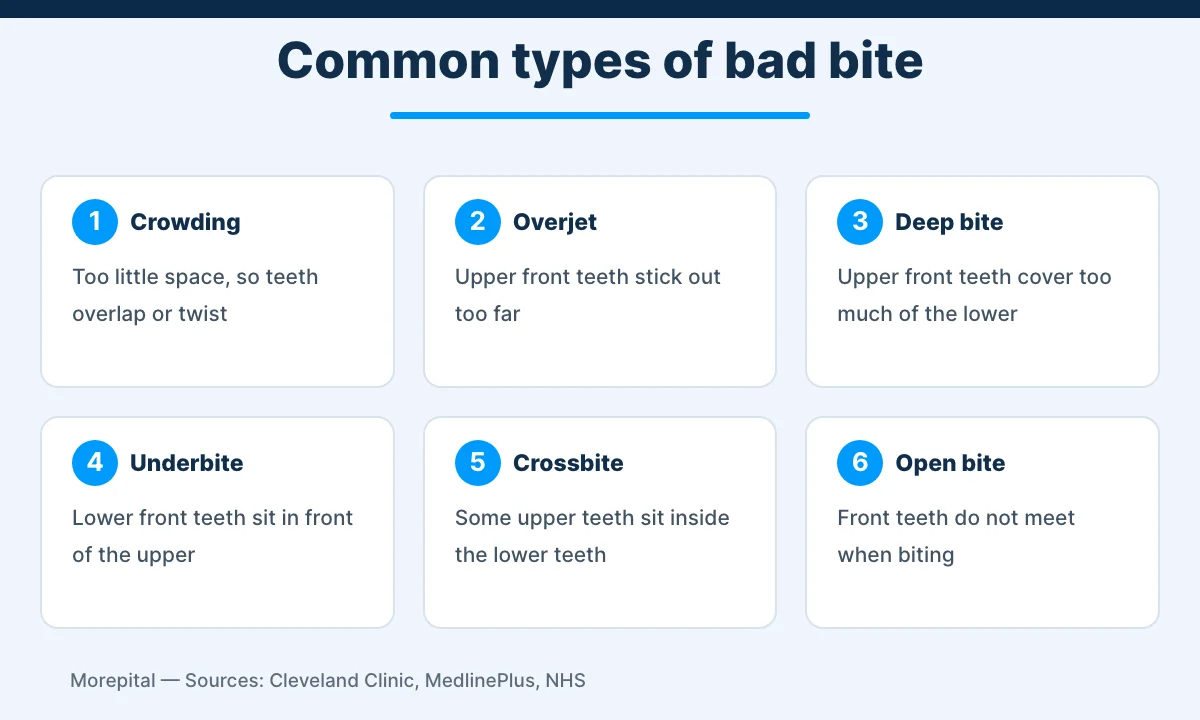
Common bite problems
- Crowding: not enough space in the arch, so teeth overlap or twist
- Spacing: large gaps between teeth
- Overjet: upper front teeth that stick out too far horizontally, sometimes called “buck teeth”
- Deep bite (overbite): upper front teeth that cover too much of the lower front teeth vertically
- Underbite: lower front teeth that sit in front of the upper front teeth
- Crossbite: some upper teeth sit inside the lower teeth when the mouth closes, at the front or at the sides
- Open bite: the upper and lower front teeth do not touch when the back teeth are together
Source: Cleveland Clinic, NHS
How malocclusion is diagnosed
A general dentist usually spots malocclusion during a routine examination, partly by watching how the back teeth come together when you bite. If the problem needs closer assessment or treatment, the dentist may refer you to an orthodontist, a dentist with specialist training in correcting the position of teeth and jaws. Cleveland Clinic notes that some general dentists offer braces, but more severe cases are best handled by a specialist.
Source: MedlinePlus, Cleveland Clinic
To plan treatment, the orthodontist gathers records of the teeth and jaws. These may include:
Source: MedlinePlus, Cleveland Clinic, NHS
- A clinical examination of the teeth, bite, jaw joints and facial profile
- Dental X-rays, and sometimes head (skull) or facial X-rays to see how the jaws relate
- Photographs of the face and teeth
- Impressions or digital scans to make study models of the teeth
Source: MedlinePlus, Cleveland Clinic, NHS
Measuring treatment need
In the UK, orthodontists use the Index of Orthodontic Treatment Need (IOTN) to decide whether a child under 18 qualifies for NHS braces. Its dental health component runs from grade 1 (almost perfect teeth) to grade 5 (severe problems, such as teeth that cannot erupt because of crowding, upper front teeth protruding more than 9 mm, or cleft lip and palate). Grades 4 and 5 are treated as needing treatment for health reasons; grade 3 can qualify if the appearance score is high enough. Other countries use their own criteria.
Source: British Orthodontic Society, NHS
Treatment options for malocclusion
The aim of treating malocclusion is to move the teeth, and when necessary the jaws, into a healthier position. MedlinePlus explains that a better bite can make the teeth easier to clean, reduce strain on the teeth, jaws and muscles, and improve facial appearance. The right approach depends on the type and severity of the malocclusion, the person’s age, and whether the jaws are still growing.
Source: MedlinePlus, Cleveland Clinic
Orthodontic braces
Orthodontic braces are the most widely used treatment for malocclusion. With fixed braces, small brackets are glued to each tooth and joined by a wire that applies gentle, steady pressure; small elastic modules hold the wire in place. The orthodontist adjusts the braces at appointments usually every 6 to 8 weeks. The NHS says fixed braces are usually worn for 1 to 2 years. Teeth often feel sore for a few days after fitting or adjustment.
Source: NHS, MedlinePlus
Clear aligners
Clear aligners are a series of removable, transparent trays that gradually shift teeth into position. Both Cleveland Clinic and MedlinePlus list them as an option for some people, typically when the problem is suitable for this approach; the orthodontist decides whether aligners or fixed braces are more appropriate.
Source: Cleveland Clinic, MedlinePlus
Early treatment in children
In growing children with malocclusion, an orthodontist can use the natural growth of the jaws. The American Association of Orthodontists (AAO) describes options such as palatal expanders that widen a narrow upper jaw to relieve crowding, short courses of early braces (for example to correct a front crossbite), and removing baby teeth or impacted teeth so the permanent teeth can come in better. Headgear may be used to guide jaw growth.
Source: American Association of Orthodontists, Cleveland Clinic
Tooth removal and dental repairs
When malocclusion involves severely crowded teeth, removing one or more teeth can create the space needed to straighten the rest. Rough or irregular teeth may be adjusted, reshaped, bonded or capped, and faulty fillings, crowns or appliances can be repaired. Missing teeth may be replaced with restorations such as implants or bridges to stop neighboring teeth drifting.
Source: MedlinePlus, Cleveland Clinic
Jaw (orthognathic) surgery
Braces move teeth but cannot change the size or position of the jawbones. When the jaws themselves are significantly mismatched, for example in severe Class II or Class III problems, orthognathic surgery can reposition the upper jaw, the lower jaw or both. Cleveland Clinic describes the full process as taking two to three years: orthodontic treatment to prepare the teeth, surgery under general anesthesia (often four to six hours), and further orthodontics to finish. Surgeons may advise waiting until jaw growth has stopped. MedlinePlus notes that surgery for malocclusion is needed only rarely.
Source: Cleveland Clinic – Jaw surgery, MedlinePlus
Retainers after treatment
Once braces or aligners come off, teeth tend to drift back toward their old positions. A retainer, either removable or fixed behind the teeth, is needed to hold the result. The orthodontist decides how long it must be worn.
Source: NHS, MedlinePlus
How long treatment takes and the outlook
Malocclusion treatment time varies widely. MedlinePlus gives a range of about 6 months to 2 years or more depending on how much correction is needed, and Cleveland Clinic says the average is around two years. The length depends on how much space there is in the mouth, the health of the teeth, gums and jawbone, and how severe the malocclusion is. Combined orthodontic and surgical treatment usually takes longer.
Source: MedlinePlus, Cleveland Clinic, Cleveland Clinic – Jaw surgery
The outlook for malocclusion is generally good. Correction tends to be easier, faster and less costly when it starts early, while the bones are still developing, which is why children and teenagers often respond best. Adults can also be treated successfully, though they may need to wear braces or other appliances for longer. Many adults choose orthodontic treatment, and the NHS notes that adults can have braces, usually paid for privately.
Source: MedlinePlus, NHS
Complications of untreated malocclusion
A mild malocclusion may never cause harm. A more significant one can, over time, lead to problems because teeth that do not line up are harder to clean and take uneven forces when you chew. Possible complications include:
Source: Cleveland Clinic
- Tooth decay, erosion and gum disease, because crowded or overlapping teeth trap plaque
- Gum recession and injury to the gums
- Jaw pain and strain on the jaw muscles and joints
- Difficulty chewing, which in severe cases can affect nutrition
- Speech difficulties
- Sleep apnea or other sleep disorders, mainly linked to jaw position
- Effects on self-confidence and social life
Source: Cleveland Clinic
Treating malocclusion also has temporary downsides. MedlinePlus lists discomfort, gum irritation (gingivitis) around appliances, tooth decay if cleaning is poor, and difficulty chewing or speaking while the appliance is new. Jaw surgery carries surgical risks such as bleeding, infection, reactions to anesthesia, limited mouth opening and lingering numbness around the mouth.
Source: MedlinePlus, Cleveland Clinic – Jaw surgery
Prevention and living with malocclusion
Because most malocclusion is inherited, it often cannot be prevented. However, several steps can lower the risk or stop a problem from getting worse:
Source: MedlinePlus, Cleveland Clinic
- Help children stop thumb sucking, tongue thrusting and pacifier use at an early age
- Keep up good oral hygiene and regular dental cleanings and exams
- Replace missing teeth with implants or bridges so neighboring teeth do not drift
- Have children checked early: the AAO recommends a first orthodontic evaluation by age 7
Source: MedlinePlus, Cleveland Clinic, American Association of Orthodontists
Caring for teeth during treatment
Braces used to treat malocclusion make cleaning harder, so careful care protects the teeth while they move. The NHS advises brushing with fluoride toothpaste in the morning, at night and after meals, cleaning between the teeth and under the wire with an interdental brush every day, cutting down on sugary foods and drinks, avoiding hard, crunchy or sticky foods, and not chewing gum. Regular dental check-ups should continue during orthodontic treatment.
Source: NHS
At an early orthodontic visit, the AAO explains that one of three things usually happens: no treatment is needed, the orthodontist monitors growth and plans treatment later, or a problem that benefits from early treatment is found. Not every check-up leads to braces.
Source: American Association of Orthodontists
When to see a dentist or orthodontist
See a dentist about possible malocclusion if you are worried about how your teeth look or fit together, and especially if you have trouble biting or chewing, frequent cheek biting, jaw pain or speech problems. Parents should arrange an orthodontic check for children by about age 7, or sooner if they notice crowding, a crossbite, teeth that are not coming through, or a strong sucking habit.
Source: Cleveland Clinic, American Association of Orthodontists
If you already wear braces or another appliance, contact your orthodontist or dentist if:
Source: NHS, MedlinePlus, Cleveland Clinic
- Pain lasts more than a few days
- Your gums are red, swollen or painful
- A bracket, wire or other part of the appliance breaks or comes loose
- You develop toothache, mouth pain or other new symptoms
Source: NHS, MedlinePlus, Cleveland Clinic
- After jaw surgery you have a fever above 100.4°F (38.3°C), pus or discharge, or worsening pain
- You have shortness of breath, or persistent vomiting or diarrhea after jaw surgery
- A jaw injury leaves your teeth suddenly not meeting properly
Source: Cleveland Clinic – Jaw surgery, MedlinePlus
Related treatments
Related conditions
Malocclusion: frequently asked questions
What is malocclusion in simple terms?
Malocclusion means your upper and lower teeth do not line up or meet properly when you close your mouth. It can involve crooked or crowded teeth, mismatched jaws, or both.
Source: Cleveland Clinic, MedlinePlus
How common is malocclusion?
Very common. Cleveland Clinic estimates about 56% of people worldwide have it, and up to 93% of children and teens have some degree of misalignment, though many cases are minor and need no treatment.
Source: Cleveland Clinic, MedlinePlus
Can malocclusion be fixed without braces?
Some cases can be treated with clear aligners, early appliances such as palatal expanders in children, tooth reshaping or restorations. Severe jaw mismatches may need jaw surgery combined with braces. Many mild cases need no treatment at all.
Source: Cleveland Clinic, MedlinePlus, American Association of Orthodontists
Can adults correct malocclusion?
Yes. Adult treatment for malocclusion is often successful, but it may take longer than in children because the jawbones have stopped growing.
Source: MedlinePlus, NHS
How long does malocclusion treatment take?
Usually between about 6 months and 2 years or more, with an average of around two years. Treatment combining braces and jaw surgery typically takes two to three years.
Source: MedlinePlus, Cleveland Clinic, Cleveland Clinic – Jaw surgery
What are the three classes of malocclusion?
Class I: normal jaw relationship but misaligned teeth (most common). Class II: the upper jaw and teeth sit too far forward over the lower ones (overbite). Class III: the lower jaw protrudes (underbite).
Source: MedlinePlus
Can a bad bite cause health problems?
Yes. A significant malocclusion can lead to tooth decay, gum disease, gum recession, jaw pain, chewing and speech difficulties, and sleep problems such as sleep apnea.
Source: Cleveland Clinic
When should a child first see an orthodontist?
The American Association of Orthodontists recommends a first orthodontic check by age 7, when problems with jaw growth and emerging teeth can often be spotted early.
Will my teeth move back after braces?
They can. That is why you need to wear a retainer after braces or aligners are removed; your orthodontist will tell you how long to wear it.
Source: NHS, MedlinePlus
Unhappy with your bite or crooked teeth? Contact us to discuss orthodontic and dental treatment options with our team.
Sources
- Cleveland Clinic — Malocclusion (Misaligned Bite)
- MedlinePlus (NIH) — Malocclusion of teeth
- NHS — Braces and orthodontics
- American Association of Orthodontists — When should my child see an orthodontist?
- Cleveland Clinic — Jaw Surgery (Orthognathic Surgery)
- British Orthodontic Society — What is the IOTN?
- Dental Press Journal of Orthodontics (PMC) — Global distribution of malocclusion traits: A systematic review (Alhammadi et al., 2018)
This page is part of the Morepital medical reference. It is for general health education and does not replace a consultation with a qualified doctor. Last reviewed: October 2026.