
Teeth whitening
Tooth bleaching
Teeth whitening is a cosmetic dental treatment that lightens the natural color of teeth with a hydrogen peroxide or carbamide peroxide gel, applied in a dental office or at home in custom trays. It works best on yellow stains from aging, coffee, tea, wine or smoking, does not change crowns or fillings, and its results usually last from about six months to three years.
Source: NHS, ADA, Cleveland Clinic
- What is teeth whitening?
- Who is a candidate and who is not
- Preparing for teeth whitening
- How teeth whitening is done
- Recovery timeline
- Results and how long they last
- Risks and complications
- Does light or laser whitening work better?
- Alternatives to teeth whitening
- Choosing a dentist and treatment abroad
- When to call your dentist
- FAQ
- Sources
What is teeth whitening?
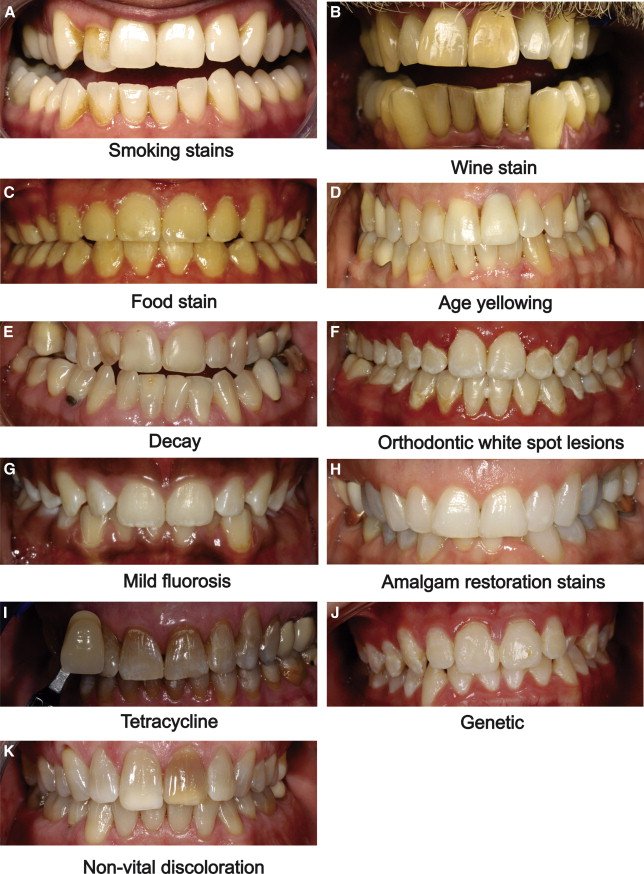
Teeth whitening, also called tooth bleaching, is a cosmetic dental treatment that lightens the natural color of your teeth. A whitening gel is applied to the tooth surface, either in a dental office or at home in trays made by your dentist, and sometimes a light is used to speed things up. It is most often chosen for teeth that have yellowed with age or been stained by coffee, tea, red wine or smoking. The result is not permanent, but it can last for years with good care.
Source: NHS, Oral Health Foundation
The active ingredient in true bleaching products is hydrogen peroxide or carbamide peroxide. Carbamide peroxide breaks down in the mouth, releasing roughly one-third of its strength as hydrogen peroxide. Hydrogen peroxide produces reactive oxygen that passes through the enamel into the dentin, where it breaks apart the colored molecules (chromogens) that make teeth look dark. The smaller, less concentrated fragments reflect light differently, so the tooth looks lighter. Peroxide can reach the inner pulp of the tooth within about 15 minutes, which helps explain why sensitivity is common.
Source: ADA, ADA MouthHealthy, Cleveland Clinic
Bleaching vs. stain removal
It helps to separate two ideas. Bleaching changes the color of the tooth itself. Stain removal, which is what most whitening toothpastes do, only polishes away surface stains with mild abrasives, and it does not change the tooth’s underlying shade. Professional cleaning and enamel microabrasion are other non-bleaching ways to remove surface (extrinsic) stains.
Source: ADA MouthHealthy, ADA
Main types of teeth whitening
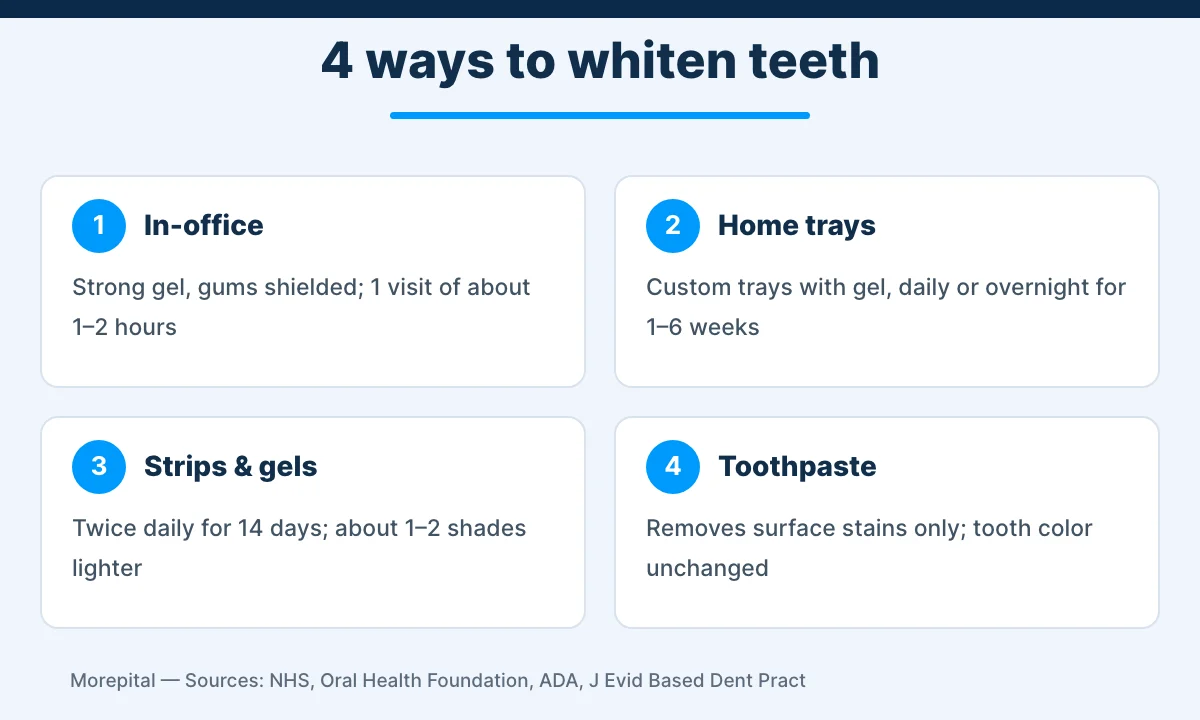
- In-office (chairside or power) bleaching: a dentist protects your gums and applies a strong peroxide gel, sometimes with a light. Usually one visit.
- Dentist-supervised home whitening: custom-made trays filled with a lower-strength gel, worn daily or overnight for one to several weeks.
- Over-the-counter (OTC) products: strips, paint-on gels, rinses, pens and toothpastes with low peroxide levels or abrasives.
- Internal (intracoronal) bleaching: used for a single dark tooth that has had root canal treatment; the bleach is placed inside the tooth.
Source: ADA, ADA MouthHealthy, Oral Health Foundation
Who is a candidate and who is not
Teeth whitening works best for adults with healthy teeth and gums whose discoloration is yellowish and caused by aging or by food, drink and tobacco. Yellow teeth usually bleach well, brown teeth respond less well and gray teeth may not lighten at all. Gray or brown discoloration can also be a sign of a problem, such as a tooth whose nerve has died after an injury, which bleaching alone will not fix.
Source: ADA MouthHealthy, Cleveland Clinic, Cleveland Clinic
Teeth whitening is usually not suitable if you:
- are 17 or younger (in the UK and EU, products releasing more than 0.1% hydrogen peroxide may not be used on anyone under 18 for cosmetic reasons)
- are pregnant or breastfeeding, when the NHS does not recommend it
- have untreated tooth decay, gum disease or exposed, worn roots; these should be treated first
- want to change the color of crowns, veneers, fillings, dentures or implants, which do not respond to bleach
- have discoloration from certain medicines or a tooth injury, which whitening often will not correct
Source: NHS, Dental Protection, Cleveland Clinic, ADA MouthHealthy
If you have tooth-colored fillings or crowns on your front teeth, whitening the natural teeth around them can leave the restorations looking darker than their neighbors. In that case your dentist may suggest whitening first and replacing the visible restorations afterward to match the new shade. The American Academy of Pediatric Dentistry discourages full-mouth cosmetic bleaching for children whose baby teeth have not all been replaced.
Source: ADA
Preparing for teeth whitening
Every major dental body advises seeing a dentist before you whiten, including before you use a kit from a shop. A clinical examination, sometimes with X-rays, helps find the real cause of the discoloration and any decay, cracks or gum disease that need treatment first. The dentist can also tell you whether your type of staining is likely to respond, and how much lightening is realistic.
Source: ADA, ADA MouthHealthy, NHS, Oral Health Foundation
- Get a check-up and cleaning. Treating cavities and gum disease first reduces pain and irritation during bleaching, and a cleaning removes surface stain so you can judge the true shade.
- Record your starting shade. Dentists usually compare your teeth against a shade guide before and after treatment.
- Ask about sensitivity. If your teeth are already sensitive, your dentist may suggest a lower-strength gel or a desensitizing product such as potassium nitrate and fluoride before or during treatment.
- Plan around dental work. Bleaching may weaken the bond between enamel and new composite or ceramic restorations, so tell your dentist if bonding, veneers or crowns are planned.
- Set realistic goals. Regular whitening lightens teeth by a few shades; going from very dark to very bright is not realistic.
Source: ADA, Cleveland Clinic, J Evid Based Dent Pract (PMC)
How teeth whitening is done
In-office whitening
- The dentist checks your teeth and records the starting shade.
- A rubber shield or protective gel is placed over the gums, and you may be given tinted glasses to protect your eyes.
- A concentrated hydrogen peroxide gel is painted on the front of the teeth. The ADA describes power bleaching applications of up to 30 minutes.
- A special light or laser may be shone on the gel; some clinics use no light at all.
- The gel is rinsed off, and the steps may be repeated within the visit or at a second visit.
Source: NHS, ADA, ADA MouthHealthy
An in-office appointment usually takes about an hour, and the NHS describes laser whitening as one visit of about one to two hours. Some dentists recommend avoiding local anesthetic so that you can tell them right away if the gel starts to burn your gums.
Source: Oral Health Foundation, NHS, ADA
Dentist-supervised home whitening
The dental team takes impressions or a scan of your teeth and makes thin, close-fitting trays, similar to a mouthguard. You place a small amount of carbamide peroxide gel in the trays and wear them for a set time each day or overnight. Treatment usually lasts one to two weeks according to the Oral Health Foundation, and up to two to six weeks according to the NHS, depending on the product and how stained the teeth are. Gel trays can show results within a few days, and you can keep the trays for later top-ups.
Source: Oral Health Foundation, NHS, Cleveland Clinic
Over-the-counter products
Strips are typically worn twice a day for 30 minutes over 14 days, and paint-on gels are used twice a day for about two weeks; both usually lighten teeth by about one to two shades. Rinses work much more slowly. Shop products contain less peroxide than professional gels, and one study found an OTC method needed 16 days to match a 7-day home-tray system or a single in-office session. If you choose one, look for the ADA Seal of Acceptance and check with your dentist first.
Source: J Evid Based Dent Pract (PMC), ADA, ADA MouthHealthy
Internal bleaching of a dead tooth
A single tooth that has darkened after an injury or root canal treatment can be bleached from the inside. The dentist opens the back of the tooth, seals the root filling, places a bleaching agent such as sodium perborate or hydrogen peroxide in the pulp chamber and closes it with a temporary filling. This is often called the walking bleach technique, and the bleach is replaced at follow-up visits, often several times, until the shade matches.
Source: ADA, Medicina (PMC)
Recovery timeline
Teeth whitening has no real recovery period, and you can usually go about your day straight away. The main thing to expect is short-lived sensitivity and gum irritation.
Source: NHS, Cleveland Clinic
| Time | What to expect |
|---|---|
| During and right after treatment | Possible sensitivity to cold, mild gum soreness or small white patches on the gums where gel touched them |
| Days 2–3 of a home or strip course | Sensitivity, if it occurs, often starts around this time |
| Around day 4 | Sensitivity from strips or trays usually settles |
| About 1 week | In studies, sensitivity after in-office bleaching had returned to normal levels within a week |
| Weeks to months | Teeth may slowly pick up new stains from coffee, red wine or smoking; top-ups can restore the shade |
Source: ADA, NHS, Heliyon (PMC), J Evid Based Dent Pract (PMC)
If sensitivity bothers you, pause treatment, switch to a milder product or use a sensitivity toothpaste, and talk to your dentist. Very aggressive bleaching can also dry out the teeth so they look whiter for a short time, before settling to their true new shade.
Source: Cleveland Clinic, ADA MouthHealthy, J Evid Based Dent Pract (PMC)
Results and how long they last
Teeth whitening is not permanent. Cleveland Clinic gives a typical range of about six months to three years, and the NHS says results may last around three years if you follow your dentist’s advice. The Oral Health Foundation notes that results can last several years but vary, and that smoking and staining drinks bring color back sooner. A clinical review found that re-staining from coffee, red wine or smoking can begin within a month, while teeth not exposed to these could stay whiter for up to a year or more.
Source: Cleveland Clinic, NHS, Oral Health Foundation, J Evid Based Dent Pract (PMC)
Research comparing methods gives a mixed picture. An umbrella review of 28 systematic reviews found no significant difference in color change between in-office and home bleaching, and noted that higher-strength gels did not clearly beat lower-strength gels used for longer. A 2024 systematic review suggested that home carbamide peroxide trays may give longer-lasting results with less relapse than in-office treatment, though only a few studies compared them directly. One trial found that an in-office session followed by monthly home top-ups held the shade better over six months than in-office whitening alone.
Source: Heliyon (PMC), Bioengineering (PMC), J Evid Based Dent Pract (PMC)
To keep teeth whitening results longer, brush twice a day with fluoride toothpaste, floss daily, limit tea, coffee, cola and red wine and rinse with water after drinking them, stop smoking, and keep up regular dental cleanings.
Source: Cleveland Clinic, Oral Health Foundation, Cleveland Clinic
Risks and complications
Professional teeth whitening is considered safe overall when it is done or supervised by a dental professional, and products have been used for decades. The two most common side effects are temporary tooth sensitivity and gum irritation.
Source: Cleveland Clinic, ADA
- Tooth sensitivity: mild to moderate sensitivity can affect up to two-thirds of users early in treatment. It is more likely with stronger gels, longer or more intense light use and existing bonded fillings, and it is usually temporary.
- Gum irritation: soreness, burning or white patches, usually from poorly fitting trays or gel leaking past the protective barrier; it typically settles quickly.
- Sore throat: listed by the NHS as a possible effect of the strong chemicals.
- Uneven color: crowns, fillings and implants do not change color, so they can stand out against newly whitened teeth.
- Enamel and restoration effects: lab studies show strong peroxide can soften or roughen enamel and soften composite fillings, sealants and ceramic crowns, and bleaching may reduce how well new restorations bond. These findings come mainly from laboratory rather than clinical studies.
- Root resorption after internal bleaching: a rare problem linked to bleaching root-filled teeth from the inside.
Source: ADA, NHS, Cleveland Clinic, J Evid Based Dent Pract (PMC)
Overusing products or using them without supervision can damage enamel and gums. Do not use household hydrogen peroxide on your teeth, and avoid DIY methods such as acidic fruit, vinegar, activated charcoal or oil pulling, which lack evidence and in some cases have worn away enamel. In the UK, the NHS warns that whitening in beauty salons or with kits bought online may not work as well and may harm your teeth and gums.
Source: ADA MouthHealthy, Cleveland Clinic, ADA, NHS
Does light or laser whitening work better?
Many clinics advertise LED, blue-light or laser whitening. The NHS describes laser whitening as quicker and more effective than gel alone. Research reviews are less clear: a review in the Journal of Evidence-Based Dental Practice concluded that light activation offers no clear benefit for the amount or persistence of whitening, and a systematic review it cited found that light raised the risk of sensitivity without improving results with 25–35% hydrogen peroxide. A 2024 umbrella review found light systems did not clearly improve color change and did not raise sensitivity. The ADA links longer and more intense light exposure with more sensitivity.
Source: NHS, J Evid Based Dent Pract (PMC), Heliyon (PMC), ADA
Because the evidence disagrees, ask your dentist what the light adds in their protocol, rather than choosing a clinic because of the device it uses.
Source: J Evid Based Dent Pract (PMC), Heliyon (PMC)
Alternatives to teeth whitening
When bleaching is not enough, or the stain is deep or affects only some teeth, other cosmetic options can help:
- Professional cleaning or microabrasion: removes surface stains on enamel without bleaching.
- Dental bonding: tooth-colored composite resin covers deep discoloration that whitening does not fix; it usually needs touch-ups every 5 to 7 years.
- Porcelain veneers: thin shells bonded to the front of the teeth for widespread discoloration. They require removing some enamel, are irreversible and may need replacing every 5 to 15 years.
- Crowns: recommended when discoloration comes with weakened or decayed teeth.
Source: ADA, Cleveland Clinic, Cleveland Clinic
Stains bound to metals and some intrinsic stains in the dentin are very hard to bleach, and reviewers suggest veneers, bonding or crowns for these cases. A full smile makeover that combines several of these options is often marketed as a Hollywood smile.
Source: J Evid Based Dent Pract (PMC), ADA
Choosing a dentist and treatment abroad
Who may whiten teeth depends on where you live. In the UK and EU, tooth whitening products that contain or release more than 0.1% and up to 6% hydrogen peroxide may be used only by a dentist or under a dentist’s direct supervision, and not on anyone under 18. Carbamide peroxide up to about 16% falls within the 6% limit. The Oral Health Foundation says whitening in the UK must be done by a registered dental professional, and that whitening in beauty salons is not allowed. In the US, the ADA considers the application of whitening chemicals by non-dentists to be the unlicensed practice of dentistry, apart from self-application.
Source: Dental Protection, Oral Health Foundation, ADA
Some people combine whitening with other cosmetic dental work abroad. UK health bodies advise you to:
- talk to your own dentist first and be assessed by a qualified dentist before accepting a treatment plan and cost estimate
- check that the dentist is qualified and registered with the regulator in that country
- ask about guarantees, aftercare, complaints procedures and who pays for corrective work or extra travel
- be wary of high-pressure sales, rushed decisions and no clear explanation of risks or aftercare
- arrange suitable travel insurance
Source: General Dental Council, NHS
For country-specific information on smile treatments, see our guide to veneers in Turkey.
When to call your dentist
Most side effects of teeth whitening are mild and fade on their own. Contact your dentist if:
- tooth sensitivity is severe or lasts more than a few days after you stop
- your gums burn, blister or stay sore or white after treatment
- a single tooth turns gray or darker, which can mean the nerve has died
- you notice a crack, pain on biting or a loose or rough filling after bleaching
- you have swelling, a bad taste or pain around a tooth that was bleached from the inside
Source: NHS, Cleveland Clinic, ADA
Related treatments
Related conditions
Further reading
Teeth whitening: frequently asked questions
Is teeth whitening safe?
Yes, when done or supervised by a dental professional or with products bearing the ADA Seal. The common side effects, sensitivity and gum irritation, are usually temporary. Overuse and DIY methods can damage enamel and gums.
Source: Cleveland Clinic, ADA, ADA MouthHealthy
How long does teeth whitening last?
Usually about six months to three years. The NHS says around three years with good care. Smoking, coffee, tea and red wine bring stains back sooner.
Source: Cleveland Clinic, NHS, Oral Health Foundation
Does teeth whitening damage enamel?
Clinical experience has not shown more cavities or fractures after whitening. Lab studies show strong peroxide can soften or roughen enamel, so follow instructions and avoid overuse.
Can crowns, veneers or fillings be whitened?
No. Whitening only lightens natural teeth. Crowns, veneers, fillings, dentures and implants keep their color and may need replacing to match the new shade.
Source: NHS, Oral Health Foundation, ADA
Why are my teeth sensitive after whitening?
Peroxide passes through the enamel to the dentin and irritates the nerve. Sensitivity often starts in the first 2–3 days and usually settles within days. Taking a break or a sensitivity toothpaste helps.
Source: ADA MouthHealthy, ADA
Is in-office or at-home whitening better?
Large reviews found similar color change and similar sensitivity. In-office is faster; home trays may hold their shade longer, though the evidence is limited.
Source: Heliyon (PMC), Bioengineering (PMC)
Do whitening toothpastes work?
They remove surface stains with mild abrasives, typically improving shade by about one to two shades, but they do not change the tooth's natural color like bleaching does.
Can I whiten my teeth if I am pregnant?
The NHS does not recommend teeth whitening during pregnancy or breastfeeding. It is also not recommended for people aged 17 or younger.
Source: NHS
Do home remedies like charcoal or lemon whiten teeth?
There is no good evidence they work, and acidic or abrasive remedies have damaged enamel in some cases. Dental bodies advise against them.
Source: ADA, Cleveland Clinic, Cleveland Clinic
Thinking about teeth whitening? Contact us for a free consultation and an honest check of whether whitening, bonding or veneers suit your teeth.
Sources
- NHS — Teeth whitening
- ADA — Whitening (Oral Health Topics)
- ADA MouthHealthy — Teeth Whitening
- Cleveland Clinic — Is Teeth Whitening Safe (and Does It Work)?
- Cleveland Clinic — Tooth Discoloration
- Cleveland Clinic — Cosmetic Dentistry
- Oral Health Foundation — Tooth whitening
- J Evid Based Dent Pract (PMC) — Tooth Whitening: What We Now Know
- Heliyon (PMC) — Comparison of in-office and at-home bleaching techniques: an umbrella review of efficacy and post-operative sensitivity
- Bioengineering (PMC) — Evaluation of the Effectiveness of Different Types of Professional Tooth Whitening: A Systematic Review
- Medicina (PMC) — Clinical Testing of Walking Bleach, In-Office, and Combined Bleaching of Endodontically Treated Teeth
- Dental Protection — Whitening within the law
- General Dental Council — Going abroad for dental treatment
- NHS — Treatment abroad checklist
This page is part of the Morepital medical reference. It is for general health education and does not replace a consultation with a qualified doctor. Last reviewed: October 2026.