
Sapphire FUE hair transplant is a standard follicular unit excision (FUE) procedure in which the tiny recipient incisions, or channels, are opened with a blade made of sapphire instead of steel. The harvesting of grafts and their placement are the same as in any FUE surgery; only the incision tool changes. Published evidence that sapphire blades give better results than steel is limited and partly conflicting, so the skill of the surgeon and team matters far more than the blade.
Source: J Am Acad Dermatol (2021), J Cosmet Dermatol (2021), ISHRS
Source: J Cosmet Dermatol (2021), J Maxillofac Oral Surg (2025), J Craniofac Surg (2023), NHS
Contents
- What is a Sapphire FUE hair transplant?
- Sapphire vs steel blades: what the material changes
- Sapphire FUE hair transplant: what the research shows
- Sapphire FUE vs DHI and classic FUE
- Who is a good candidate for sapphire FUE?
- How a Sapphire FUE hair transplant is performed
- Recovery, shedding and results
- Risks of a Sapphire FUE hair transplant
- Choosing a clinic for a Sapphire FUE hair transplant
- Sapphire FUE hair transplant: frequently asked questions
What is a Sapphire FUE hair transplant?
Every hair transplant has three basic stages: removing follicular units (natural groups of one to four hairs) from the back and sides of the scalp, creating recipient sites in the thinning area, and placing the grafts into those sites. A 2021 review in the Journal of the American Academy of Dermatology describes the two donor harvesting techniques, strip harvesting (FUT) and follicular unit excision (FUE), and the two main implantation approaches: premade sites and stick-and-place.
Source: J Am Acad Dermatol (2021)
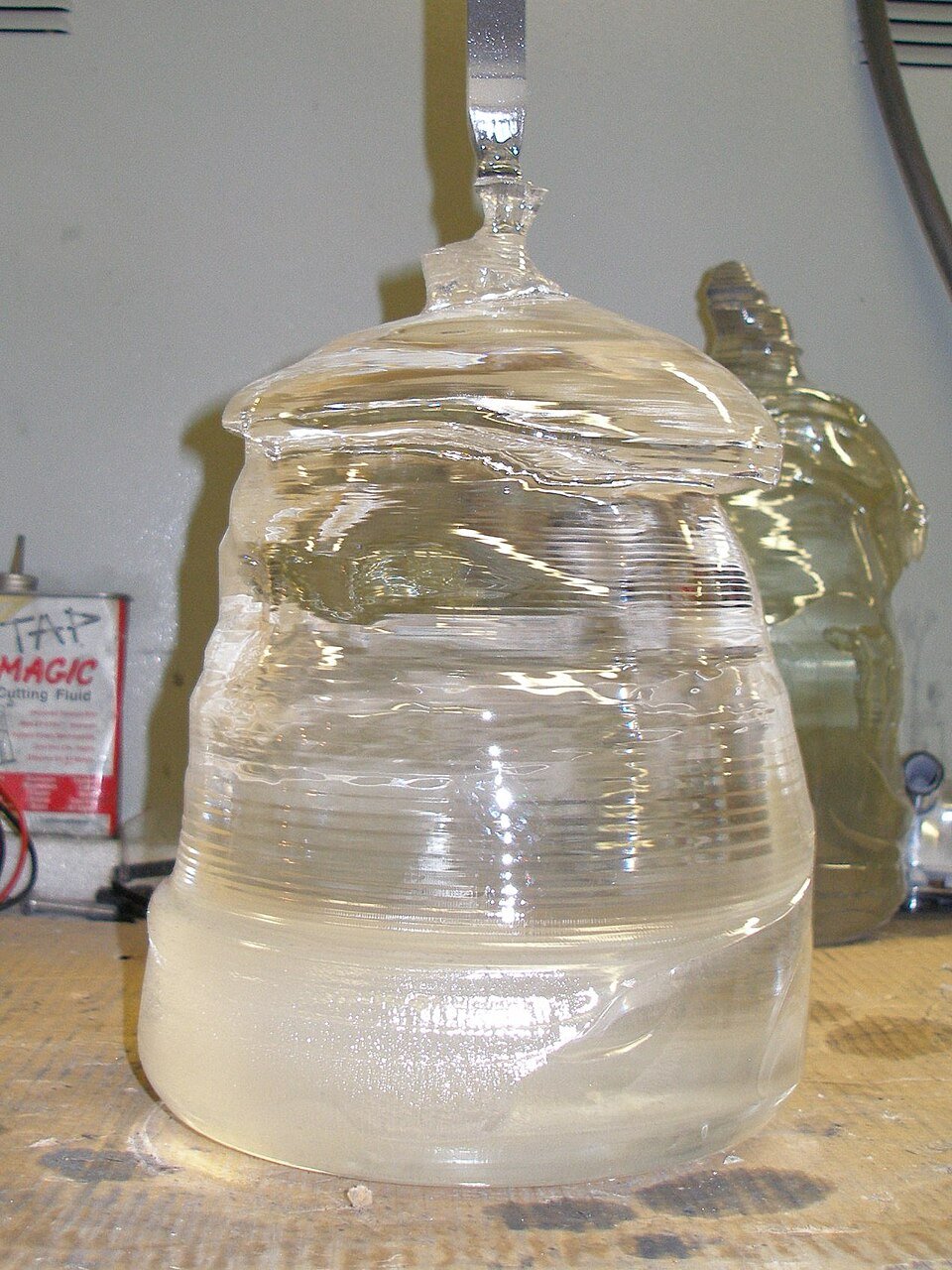
A Sapphire FUE hair transplant is the premade-site version of FUE. The surgeon first opens hundreds or thousands of small slits with a sapphire blade, and the grafts are then inserted into them, usually with fine forceps or a blunt implanter. The donor area is harvested with the same small punches used in any FUE procedure, so the donor scars are the same tiny dots that the NHS calls less noticeable than a strip scar.
Source: Indian J Plast Surg (2021), NHS
That means “Sapphire FUE” is a description of one instrument, not a separate operation recognized in medical classifications. The International Society of Hair Restoration Surgery (ISHRS) warns that terms like “Sapphire FUE” or “Nano FUE” do not replace a physician’s judgment and experience. For an overview of how transplants work in general, see our hair transplant treatment guide.
Source: ISHRS
Sapphire vs steel blades: what the material changes
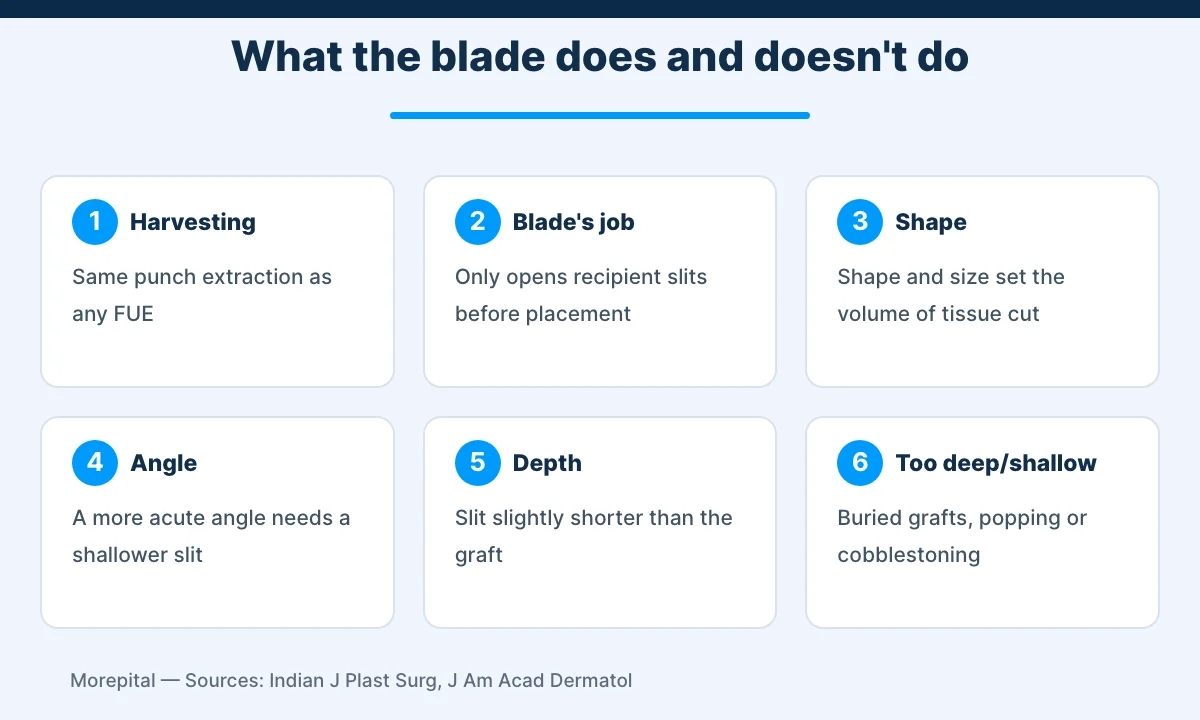
Recipient sites can be made with hollow needles, steel blades of different shapes, or blades cut to size. A 2021 paper in the Indian Journal of Plastic Surgery notes that there is no consensus on which instrument gives the best coverage with the least vascular damage, and argues that the shape of the instrument matters because it determines the volume of tissue cut, not just the length of the incision.
Source: Indian J Plast Surg (2021)
The same authors compared shapes rather than materials. They concluded that semiconical blades, which cut with a narrow tip and then dilate rather than cut, should cause less damage to the dermis and the deep vascular plexus than rectangular blades or needles, and that a more acute angle of entry reduces how deep the blade has to go. In short, shape, size, angle and depth are what change the wound; the material is one more variable.
Source: Indian J Plast Surg (2021)
Why angle and depth matter for graft survival
The scalp’s deep plexus contains large vessels that supply wide areas of skin, so damaging it can cause ischemia and necrosis. The 2021 paper advises that the slit be slightly shorter than the graft: too deep and grafts can be buried, causing folliculitis; too shallow and they can pop out or heal with a bumpy “cobblestone” look. These principles apply to every Sapphire FUE hair transplant just as they apply to steel.
Source: Indian J Plast Surg (2021)
| Question | Steel-blade or needle FUE | Sapphire FUE hair transplant |
|---|---|---|
| Donor harvesting | Individual units with a small punch | Identical |
| Recipient sites | Premade with needles or steel blades | Premade with a sapphire blade |
| Tissue injury (2021 math model) | Rectangular blade: largest | 30° sapphire blade: smallest |
| Vascular damage (2023, 12 patients) | Handmade razor slits: significantly less | Sapphire blade: more |
| Graft survival (2025, observational) | 88.9% (steel) | 94.7% |
| Randomized trials | None comparing blades | None comparing blades |
| Growth timeline | New hair around 4 months; full result 10–18 months | Same |
Source: J Cosmet Dermatol (2021), J Craniofac Surg (2023), J Maxillofac Oral Surg (2025), NHS
Sapphire FUE hair transplant: what the research shows
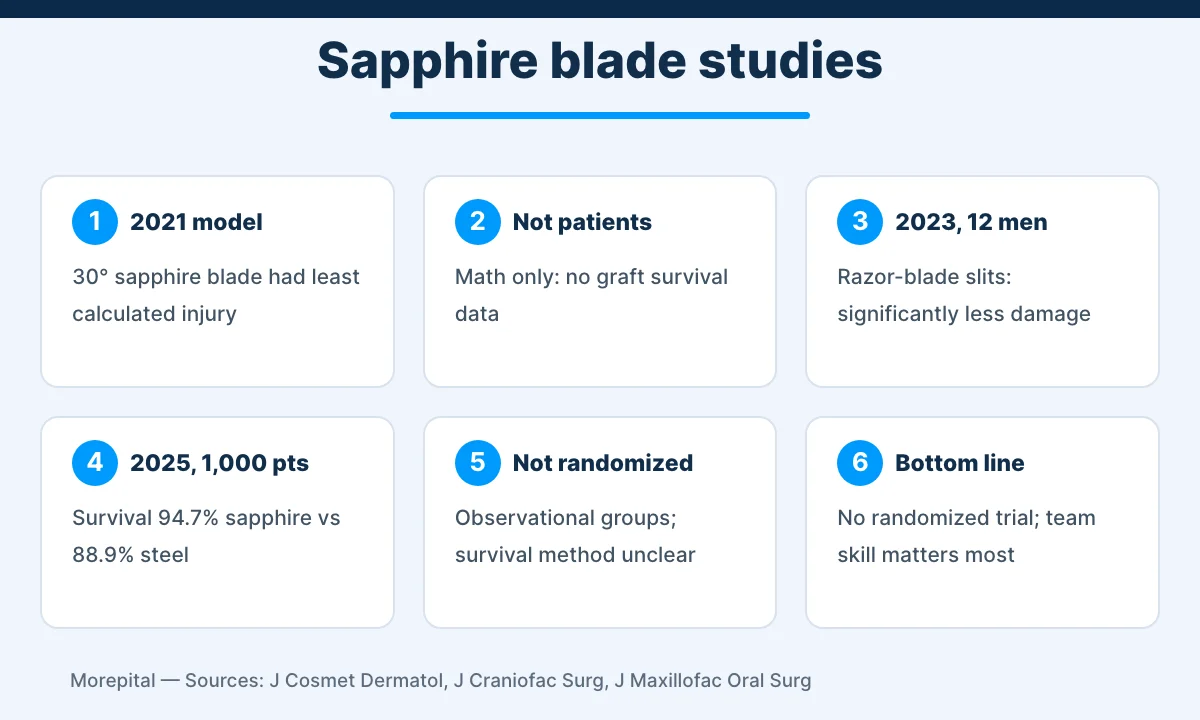
A search of PubMed for sapphire blades in hair transplantation returns only a handful of papers, and none is a randomized controlled trial. The four most relevant studies point in different directions, which is why claims that a Sapphire FUE hair transplant is “proven” to heal faster or grow more hair go beyond the evidence.
Source: J Cosmet Dermatol (2021), J Craniofac Surg (2023), J Maxillofac Oral Surg (2025), J Craniofac Surg (2026)
2021: a mathematical model favoring sapphire
Ahmad and Ismail used trigonometry to calculate the surface area cut by rectangular blades, 30- and 60-degree angled blades, and 30- and 60-degree sapphire blades at insertion angles from 90 to 15 degrees. The 30-degree sapphire blade had the smallest calculated injury and the rectangular blade the largest. Injury also fell as the insertion angle became more acute. This was a calculation, not a study of patients, so it says nothing directly about graft survival or appearance.
Source: J Cosmet Dermatol (2021)
2023: a split-scalp study favoring razor blades
In 12 men, Balik used a sapphire blade on the right side of the recipient area and handmade blades cut from razor blades on the left, then measured blood flow with laser Doppler flowmetry. The handmade razor blades caused significantly less tissue damage. The study is small and comes from a single Istanbul clinic, but it is the only same-patient comparison identified for this article, and it did not favor sapphire.
Source: J Craniofac Surg (2023)
2025: a large observational study favoring sapphire
A prospective observational study of 1,000 patients treated between January 2024 and March 2025 reported graft survival of 94.7% in the sapphire group and 88.9% in the steel group. Patients were grouped by blade, forceps technique, coverage area and session length rather than randomly assigned, and the published abstract does not explain how survival was measured, so other differences between groups could explain the gap.
Source: J Maxillofac Oral Surg (2025)
Disagreement on slit direction
Theory papers do not agree on details either. The 2021 mathematical model found that sagittal slits caused less injury than coronal slits, while the Indian Journal of Plastic Surgery analysis concluded that coronal slits cause less vascular damage. Both are reasoned arguments rather than clinical trials, so a surgeon’s chosen method for a Sapphire FUE hair transplant should be judged by results, not by theory.
Source: J Cosmet Dermatol (2021), Indian J Plast Surg (2021)
Sapphire FUE vs DHI and classic FUE
Clinics often present Sapphire FUE, DHI and “classic” FUE as three competing techniques. In practice they share the same harvesting step and differ only in how recipient sites are made and filled. In a Sapphire FUE hair transplant, sites are premade with a sapphire blade and filled afterward. In DHI, a sharp implanter pen makes each opening and deposits the graft in one movement, the stick-and-place method. Classic FUE usually means premade sites made with steel blades or needles.
Source: J Am Acad Dermatol (2021), Clin Cosmet Investig Dermatol (2023)
A 2023 practical guide notes that with premade slits a significant part of the surgery, the implantation, can be delegated to assistants, which is efficient for high-volume centers. With a sharp implanter, the incision and insertion happen together. The guide also says no single method is absolute, and one patient may need more than one approach depending on the scalp. Our article on the DHI hair transplant explains the implanter method and its evidence in detail.
Source: Clin Cosmet Investig Dermatol (2023), Indian J Plast Surg (2021)
A 2024 Facial Plastic Surgery review concludes that the choice of implantation technique depends on each surgeon’s adaptation and the pros and cons of each instrument, and that forceps placement is safe in the hands of well-trained teams. No source reviewed for this article ranks one branded method as best for every patient.
Source: Facial Plast Surg (2024)
Who is a good candidate for sapphire FUE?
Candidacy for a Sapphire FUE hair transplant does not depend on the blade. The NHS says transplants are suitable for permanent baldness that runs in families and usually not for other types of hair loss, such as alopecia areata. The American Academy of Dermatology (AAD) lists two requirements: enough healthy donor hair to move, and a scalp that can still grow hair in the thinning area. Men in their 20s may be asked to wait and try hair loss medicine first.
Source: NHS, American Academy of Dermatology
Cleveland Clinic says only a very small percentage of women are good candidates, for example those with traction alopecia or a male-like pattern with a usable donor area. It also notes that coarse, gray or light-colored hair gives better coverage than fine, dark hair. If you are not sure what is causing your hair loss, start with a diagnosis; our guide to male pattern baldness explains the most common cause.
Source: Cleveland Clinic
Medicine still matters after surgery
A Sapphire FUE hair transplant does not stop the native hair around the grafts from thinning. The AAD says a dermatologist may recommend hair loss medicine to help keep results, and a 2026 International Journal of Dermatology review covers optimizing medical therapy before transplantation. Read our summary of finasteride for hair loss to understand one of the main options.
Source: American Academy of Dermatology, Int J Dermatol (2026)
How a Sapphire FUE hair transplant is performed
The NHS says FUE is usually done under local anesthetic with sedation, so you are awake but should not feel pain, and is usually completed in one day without an overnight stay. The AAD says surgery typically takes four to eight hours, and large cases may need a return visit the next day. For FUE, the back of the head is usually shaved.
Source: NHS, American Academy of Dermatology
A typical Sapphire FUE hair transplant follows these steps:
- Diagnosis, hairline design and a plan for the number of grafts.
- Local anesthetic to the donor and recipient areas.
- Extraction of follicular units one by one with a small punch.
- Opening recipient sites with the sapphire blade at the planned angle, direction and depth.
- Placement of grafts into the premade slits, usually with forceps or blunt implanters.
- Bandaging and written aftercare instructions.
Source: J Am Acad Dermatol (2021), NHS, American Academy of Dermatology
How many grafts are taken in one Sapphire FUE hair transplant is a medical decision, not a marketing figure. A 2026 review of FUE complications lists dense packing above 50 grafts per square centimeter, megasessions of more than 3,500–4,000 grafts, and deep or overlapping slits among technical risk factors for recipient-site necrosis. The ISHRS adds that clinics advertising “unlimited” grafts ignore that every patient has a finite donor supply.
Source: Front Med (2026), ISHRS
Recovery, shedding and results
No randomized trial has shown that a Sapphire FUE hair transplant heals faster than other FUE, and official guidance gives the same advice whatever blade is used. The NHS says bandages usually come off after two to five days, gentle hand washing is possible from day six, and many people need one to two weeks off work. Grafts are not secure for the first two weeks, and you may be asked to cut down on exercise for the first month.
Source: NHS
Cleveland Clinic says most people feel well within a day or two, although forehead and eyelid swelling can occur. Transplanted hairs usually shed between two and eight weeks after surgery, and by the third month hair may look thinner than before; the AAD calls both normal. New growth usually starts around four months, most people see results at six to nine months, and the NHS says full results of a Sapphire FUE hair transplant, as with any FUE, should be visible at 10 to 18 months. Our hair transplant recovery guide covers washing, sleeping and exercise day by day.
Source: Cleveland Clinic, American Academy of Dermatology, NHS
Risks of a Sapphire FUE hair transplant
Like any hair transplant, a Sapphire FUE hair transplant can cause bleeding, infection, an allergic reaction to the anesthetic, grafts that fail to take, noticeable scarring and continued thinning of hair around the transplant, according to the NHS. Cleveland Clinic adds temporary numbness or tightness, pain, swelling and an unnatural appearance.
Source: NHS, Cleveland Clinic
Recipient-site necrosis
Necrosis, death of a patch of scalp skin from poor blood supply, is rare but serious. A 2026 case report described a 47-year-old man who developed scalp necrosis after FUE with sapphire-blade recipient sites performed abroad; pain worsened by day five, a dark eschar formed, and he needed surgical debridement before healing well. A single case does not show that sapphire blades cause necrosis, but it does show that the blade does not prevent it.
Source: J Craniofac Surg (2026)
The 2026 complications review lists smoking, diabetes, high blood pressure and vascular disease among patient risk factors, and recommends stopping smoking at least one month before surgery. Early warning signs include dark discoloration, oozing and thick black crusts. Contact your surgeon promptly if you notice these, or severe pain, spreading redness, pus or fever.
Source: Front Med (2026)
Choosing a clinic for a Sapphire FUE hair transplant
The ISHRS says the success of a hair transplant depends far more on who provides your care than on the name of a device or technique. Its red flags include a clinic that markets a brand without naming the responsible physician, a consultation that feels like a sales pitch, promises of unlimited grafts, and a doctor whose role is limited to drawing the hairline. Because recipient sites are incisions, ask exactly who will open them during your Sapphire FUE hair transplant.
Source: ISHRS
For UK patients traveling to Türkiye, a joint statement by UK and Turkish surgical associations advises meeting the operating doctor, taking two weeks to consider the plan and consent form before paying, being told whether a technician will make any skin incisions, and confirming how complications such as necrosis or infection will be handled. In the UK, the NHS advises checking General Medical Council registration and whether the surgeon belongs to the British Association of Hair Restoration Surgery. Our guide to a hair transplant in Turkey covers travel planning.
Source: BAAPS/BAHRS, NHS
Hair Cultivate, a specialised hair-transplant centre in Istanbul, publishes its own overview of Sapphire FUE hair transplant in Turkey and a patient guide describing its process. Whichever clinic you consider, ask the same questions.
Source: BAAPS/BAHRS
Questions to ask before you book
- Who diagnoses my hair loss and designs my hairline?
- Who extracts the grafts, and who opens the recipient sites?
- Why do you recommend a Sapphire FUE hair transplant rather than steel blades or needles for my scalp?
- How many grafts do you plan, and at what density?
- How will my donor area be protected for possible future sessions?
- Who reviews my progress and manages complications after I fly home?
Source: ISHRS, BAAPS/BAHRS
Considering a Sapphire FUE hair transplant? Contact us for a free consultation and a treatment plan tailored to you.
Sapphire FUE hair transplant: frequently asked questions
Is a Sapphire FUE hair transplant better than regular FUE?
Not proven. One large observational study favored sapphire, but a small split-scalp study favored razor blades, and there is no randomized trial.
Source: J Maxillofac Oral Surg (2025), J Craniofac Surg (2023)
Does a Sapphire FUE hair transplant heal faster?
There is no reliable evidence that it does. Official recovery advice is the same for all FUE: bandages off in two to five days and one to two weeks off work.
Source: NHS
Is a Sapphire FUE hair transplant painful?
It is done under local anesthetic, often with sedation, so you should not feel pain during surgery; soreness and tightness afterward are common.
Source: NHS, Cleveland Clinic
Does a Sapphire FUE hair transplant leave scars?
Yes. FUE harvesting leaves many tiny dot scars in the donor area that are usually not very noticeable.
Source: NHS, Cleveland Clinic
When will I see results?
New hair usually appears around four months, most people see results at six to nine months, and the full result takes 10 to 18 months.
Source: NHS, American Academy of Dermatology
Is sapphire the same as DHI?
No. Sapphire FUE uses premade slits; DHI uses an implanter pen that makes the opening and places the graft in one step.
Source: J Am Acad Dermatol (2021), Clin Cosmet Investig Dermatol (2023)
Can a Sapphire FUE hair transplant go wrong?
Yes. Infection, poor growth and, rarely, scalp necrosis can occur. Experience of the team matters more than the blade.
Source: NHS, J Craniofac Surg (2026), ISHRS
Disclaimer: this article is for general health education and does not replace advice from a qualified doctor who can assess your individual case. Last updated: October 2026.